What You’ll Learn
Why fast follow up erodes trust is the loss of buyer confidence that happens when rapid outreach arrives before a lead has enough context, intent, readiness, or control to welcome the contact.
Fast follow-up can feel helpful when it matches clear need, but it can feel intrusive when automation reacts to every form fill, download, or vague inquiry as if it were urgent buying intent.
Trust erodes when speed replaces relevance, creates pressure, ignores deeper concerns, or produces generic messages that feel like spam.
Strong follow-up protects trust by matching timing, message quality, ownership, and intent recognition to the buyer’s readiness.
Key Takeaways
- Rapid follow-up can erode trust when speed overrides customer context and readiness.
- Automated outreach without intent recognition often increases perceived intrusiveness and disengagement.
- Lack of clear ownership in response logic leads to confusion, not confidence, among prospects.
- Trust is best sustained by timing and relevance, not by maximizing reply speed or automation frequency.
There’s an unspoken risk for every team celebrating faster follow-up: the quick reply that cools real intent.
We’ve seen clients crank up reply automation, proud of their “under-five-minutes” metrics, only to watch engagement crater.
The myth: people want instant attention.
The reality?
When contact arrives before context, your outreach reads as interruption – not consideration.
Like a store clerk hawking you before you cross the threshold, speed becomes a signal of pressure, not care.
That broader governance problem is outlined in Marketing Automation & CRM.

When fast follow‑up feels unsafe, not helpful
In practice, the highest drop-off rates tend to follow blanket rapid responses, especially in complex B2B settings where buyers need space to orient.
The analogy: imagine a waiter thrusting a menu in your face before you’ve even sat down.
The move overrides your readiness and rewrites the script from “welcome” to “watch out”.
Speed without relevance erodes perceived respect faster than silence ever could.
Why speed without fit feels intrusive
Most think urgency communicates helpfulness.
In reality, rapid outreach often triggers nervous questions: “How did they get my info?”, “What’s their agenda?”, “Am I in control of this process?” Rather than lowering barriers, urgent contact can mimic spam’s trajectory – shrinking trust in the name of efficiency.
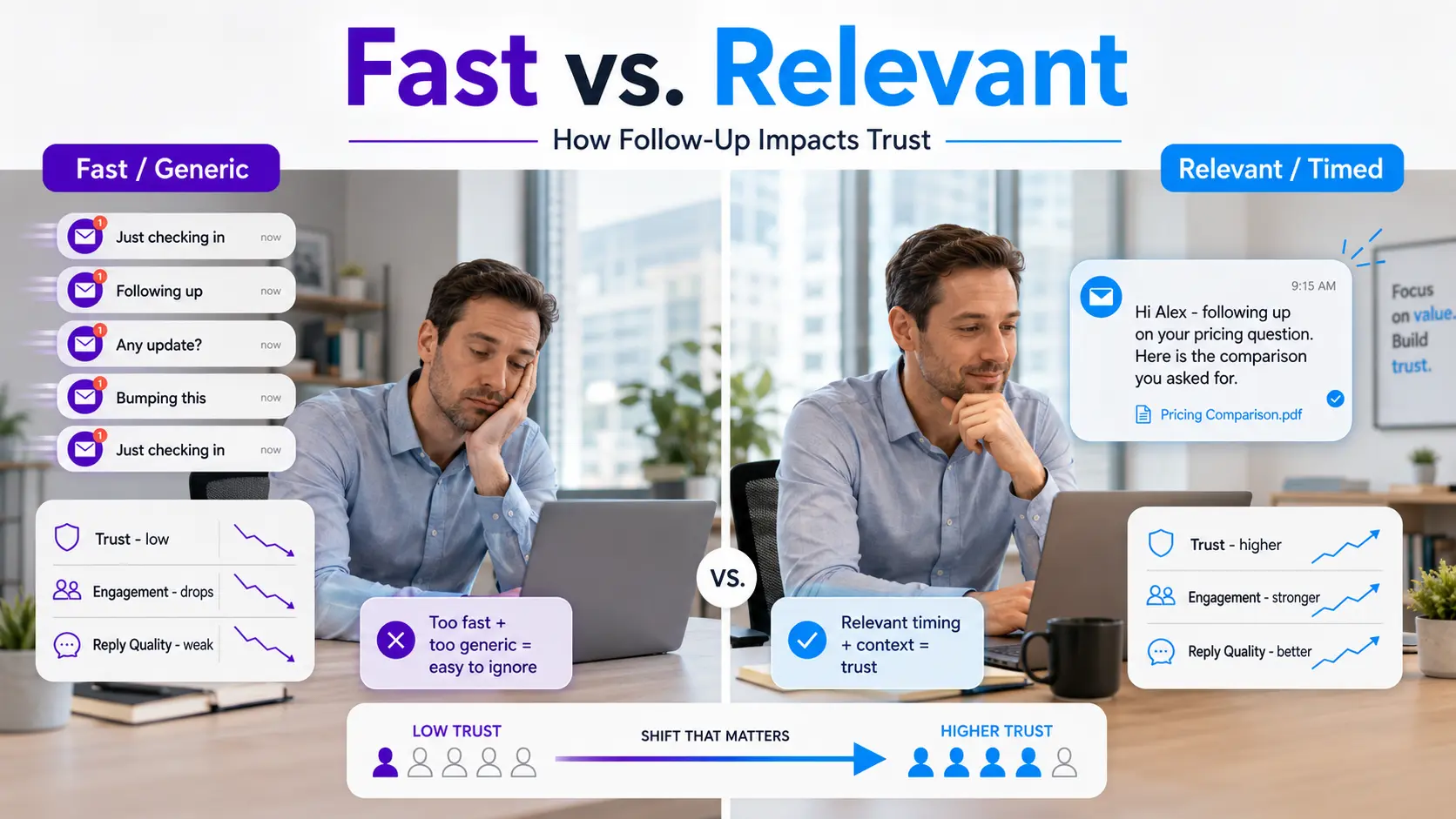
How pressure overrides perceived safety
We’ve watched teams lose hard-won leads because their first message pressed too hard, too fast.
The best intentions – showing responsiveness – backfire as prospects retreat behind defensive reflexes.
The sensory shift is palpable: tone turns stilted, replies slow, meetings evaporate.
Is your speed signaling a safe environment or prompting the equivalent of an internal “Do Not Disturb” sign?
Common Nervous Questions Triggered by Fast Outreach
- “How did they get my info?”
- “What’s their agenda?”
- “Am I in control of this process?”
- Is the outreach helpful or intrusive?
- Am I being pressured rather than supported?
Here’s what professional practice reveals: the faster you chase, the more you risk forcing prospects into their comfort zones.
The brain reads unnecessary speed as a pressure cue, not a safety signal.
Trust doesn’t just require action.
It requires timing that matches real intent.

How trust erodes when speed ignores deeper concerns
Even the swiftest reply can leave leaders more unsettled than assured if it lands before relevance takes root.
When speed leaps ahead of context, it breeds uncertainty instead of confidence.
We’ve seen deals stall not from delay – but from instant, generic messages that multiply questions and freeze engagement.
When quick replies amplify uncertainty, not resolve it
Imagine texting a medical expert about a personal concern and getting an instant, generic reply – how likely are you to trust the advice?
Clients have described this mismatch as “being seen but not understood”.
In one B2B engagement, vague but instant outreach doubled the clarification cycles, delaying close by weeks.
The real friction?
Velocity with no demonstration of listening.
Quick responses that sidestep core concerns amplify doubt, not confidence.
Like a locked door with a doorbell that never gets answered, urgency without clarity frustrates instead of resolves.
Why relevance – not velocity – sustains connection
Fast is forgettable.
Relevant is memorable – and persuasive.
In growth-driven teams, reps often chase quick contact as if it’s the trophy, but executives cite the most valuable conversations as those that nail the issue, not the stopwatch.
Even the most impressive speed counts for little if the message misses the mark.
We’ve seen trusted partner relationships form after a thoughtfully delayed, but tailored reply landed exactly on the buyer’s biggest worry.
One repeat insight: Quality touchpoints spark forward motion, while generic speed slows momentum.
Is your follow-up relieving tension – or adding to it?
Ask yourself which your last automated reply actually accomplished.
Clarity trumps clocks.
When connection is built on relevance, the tempo supports – rather than undermines – trust.

The system gap: speed shipped alone undermines governance
Most teams fixate on shaving seconds from their follow‑up, but nearly nobody asks: who owns the response logic, or the context?
Automation built for speed at scale often creates more distrust than silence.
Here’s the surprise: the more you automate responses – without recognizing intent – the more chaotic and unpredictable each customer touchpoint becomes.
It feels less like attentive service and more like spam with a respectable signature.
How automation without intent recognition creates noise
It’s easy to believe that faster, automated outreach equals progress.
In reality, automation without a filter for customer intent turns every vague inquiry into an instant sales blip.
One fintech client launched a fast-response bot across every funnel stage – intending reassurance.
Within days, reply rates plunged, and prospects flagged messages as unwanted.
The automation didn’t just miss context; it drowned real leads in noise.
Why?
Because a generic message received at lightning speed signals the system is listening for movement, not meaning.
Would you trust a conversation if every reply felt like a broadcast, not a response?
If speed isn’t paired with even basic intent recognition, every touch becomes just another interruption – indistinguishable from low-quality lead gen spam.
We often joke that poorly tuned automation is like blasting a foghorn through a stethoscope: it overwhelms rather than clarifies.
The punchline: what’s meant as efficiency ends up eroding trust at scale.
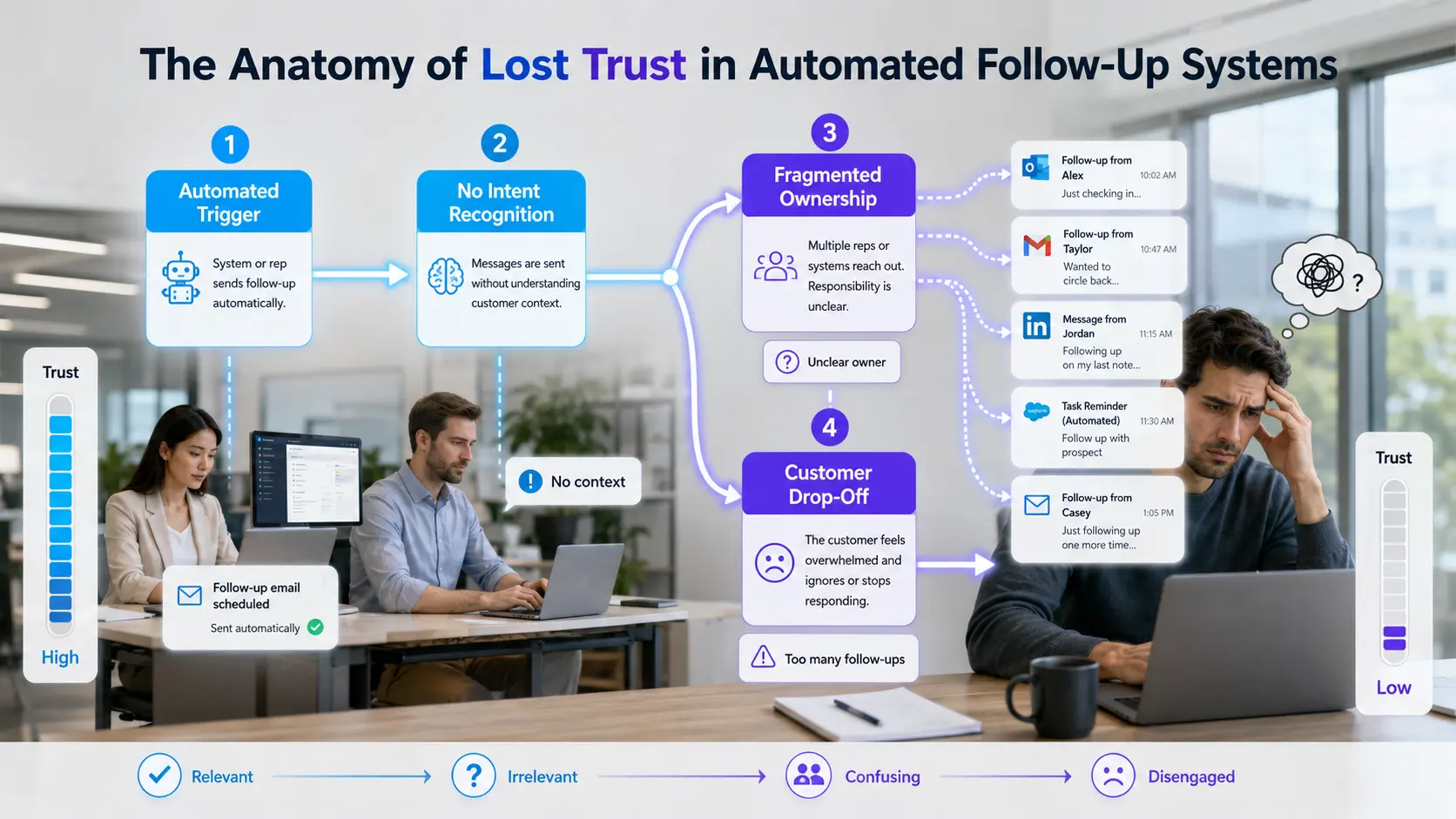
Why blurred handoff and responsibility derail trust at scale
Pressure ramps up exponentially when it’s unclear who’s actually accountable for following through.
When responsibility for speed is scattered – between marketing ops, SDRs, and automation platforms – nobody owns the nuance.
One recent SaaS engagement showed us a team where four different reps could respond to the same prospect within minutes, none aware of the others’ actions.
Instead of feeling supported, the prospect received mixed, sometimes contradictory, information.
The result: confusion, not confidence.
This system gap isn’t a technical glitch.
It’s a governance flaw: accountability for context collapses as speed takes priority.
When handoffs blur, trust erodes – because customers sense when they’re being processed, not understood.
Is your speed simply camouflaging a lack of ownership?
Automation without context recognition multiplies noise; fractured responsibility spreads pressure but kills trust.
True governance demands more than a stopwatch – it requires someone to own the story behind the speed.

How to spot if speed is costing you trust – not just conversions
Most teams think lost deals show up in CRM reports.
The real warning sign?
Prospects who respond once – then disappear.
When urgency flips from service to pressure, the lead rarely objects aloud; they just vanish, leaving your pipeline looking healthy but quietly bleeding trust.
Common signs that urgency is causing disengagement
There’s a shorthand most relationship builders miss: prospects who go silent aren’t always unqualified – they’re often overwhelmed.
One frequent client pattern: replies stop the moment a rapid-fire follow-up sequence starts.
The myth is that more touchpoints guarantee more progress.
In fact, we’ve seen B2B buyers who viewed initial speed as competence, but after the third “just checking in”, flagged the outreach as desperate and tuned out.
This isn’t fallout from timing – it’s the mismatch between the buyer’s comfort and your cadence.
Common Signs That Urgency Is Causing Disengagement
- Prospects go silent after a rapid sequence of follow-ups
- Contacts defer decisions without providing details
- Meetings are repeatedly postponed
- Prospects use non-committal phrases like “Let me get back to you”
- Engagement drops notably after scaling automated replies
Think of trust as a tank, not a switch.
Each pushy or poorly-timed “urgent” follow-up drains a little more, even if responses seem polite.
Notice these behavioral clues: contacts deferring decisions without detail, moving meetings repeatedly, or switching to non-committal phrases (“Let me get back to you”) after your outreach gets faster.
Do these patterns spike after you scale up automated replies?
That’s your signal: urgency has replaced safety.
Decision red flags: when fast outreach should pause, not scale
Scaling the tempo when you spot disengagement is like turning up the volume after someone starts plugging their ears.
Some markers demand an immediate pause.
If contact rates drop sharply as soon as your response time drops below a certain threshold, you’re no longer being “responsive” – you’re signaling you aren’t listening.
Another red flag: when prospects start looping in more stakeholders before replying, or shift communication to less traceable channels.
Decision Red Flags Indicating When to Pause Fast Outreach
| Red Flag | Description | Impact on Trust/Engagement |
| Sharp drop in contact rates | Contact rates fall sharply as response time decreases below a threshold | Signals poor listening; trust begins to fracture |
| Stakeholders looped in | Prospects bring in more stakeholders before replying | Indicates discomfort or lack of control in the process |
| Shift to less traceable channels | Communication moves to channels that are harder to monitor | Reveals prospect reluctance to engage in usual forums; trust is weakening |
| Muted engagement and rising no-shows | Prospects respond less, skip meetings, or delay next steps | Direct sign that pressure is crowding out safety and progress |
| Lengthening sales cycle despite healthy metrics | Sales cycle grows longer month over month even if follow-up metrics look good | Indicates loss of momentum due to urgency overshadowing relevance |
Best practice isn’t always “faster is better”.
Instead, use urgency as a diagnostic: if the pace outstrips relevance or context, trust fractures long before conversion rates tank.
One repeatable sign: when the follow-up metric looks healthy but, month over month, your average sales cycle quietly lengthens.
If you see muted engagement, rising no-shows, or delayed next steps right after a push for faster outreach, stop scaling.
Step back.
Examine whether your speed – meant to serve – is actually crowding out the safety that builds real progress.
Speed reveals cracks before results collapse.
The sharpest leaders use those cracks as early-warning systems – not a signal to push harder, but a cue to recalibrate for trust.
Speed also changes qualification quality.
That shift is explored in Qualification Trade‑Offs.

Scientific context and sources
The sources below provide foundational context for how decision-making, attention, and performance dynamics evolve under scaling and constraint conditions.
- Decision Overload in Management
Making Choices Impairs Subsequent Self-Control: A Limited-Resource Account of Decision Making, Self-Regulation, and Active Initiative – Kathleen D. Vohs, Roy F. Baumeister, Brandon J. Schmeichel, Jean M. Twenge, Noelle M. Nelson & Dianne M. Tice – Journal of Personality and Social Psychology
Relates the phenomenon of decision fatigue to team responsiveness and customer interactions, explaining why excess stimuli and repeated choice demands can degrade both trust and performance.
https://pubmed.ncbi.nlm.nih.gov/18444745/ - Expectations Under Uncertainty
Expectations Uncertainty and Household Economic Behavior – Itzhak Ben-David, Elyas Fermand, Camelia M. Kuhnen & Geng Li – National Bureau of Economic Research
Illuminates how increased velocity without matching intent can intensify uncertainty, which suppresses engagement in both B2C and B2B purchase contexts.
https://www.nber.org/papers/w25336 - The Role of Perceived Intrusiveness
Forced Exposure and Psychological Reactance: Antecedents and Consequences of the Perceived Intrusiveness of Pop-Up Ads – Steven M. Edwards, Hairong Li & Joo-Hyun Lee – Journal of Advertising
Frames why fast, context-missing outreach is likely to be perceived as intrusive and reduce trust, even with positive initial intent.
https://www.tandfonline.com/doi/abs/10.1080/00913367.2002.10673678 - Automation and Trust Fracture
Trusting Automation: Designing for Responsivity and Resilience – Erin K. Chiou & John D. Lee – Human Factors
Discusses how increasing automation without responsive human judgment can weaken appropriate reliance, cooperation, and resilience, which are critical for maintaining business trust.
https://journals.sagepub.com/doi/10.1177/00187208211009995 - Communication Timing and Relationship Outcomes
Online Pauses and Silence: Chronemic Expectancy Violations in Written Computer-Mediated Communication – Yoram M. Kalman & Sheizaf Rafaeli – Communication Research
Explores how timing mismatches in replies and follow-ups affect credibility, attractiveness, and interpersonal evaluation in mediated communication contexts.
https://journals.sagepub.com/doi/10.1177/0093650210378229
Questions You Might Ponder
Why does fast follow-up sometimes decrease customer trust instead of improving it?
Fast follow-up can signal pressure rather than consideration, especially when it arrives before the recipient is ready. Without context, rapid outreach feels intrusive and undermines trust, making prospects feel rushed rather than supported, leading them to disengage or go silent.
How can automated responses negatively impact lead engagement in B2B sales?
Automated responses, if not tuned for buyer intent, often deliver generic messages that lack relevance. This ‘one-speed-fits-all’ approach treats nuanced inquiries like simple tickets, causing prospects to perceive the outreach as spam and weakening overall engagement.
What behavioral signs suggest your follow-up cadence is overwhelming prospects?
Key signals include immediate silence after fast follow-ups, repeated meeting postponements, deferred decisions with no detail, or sudden drop-offs after scaled automation. These patterns indicate urgency is backfiring, overwhelming rather than reassuring your leads.
In what ways does a lack of ownership in fast responses undermine governance?
When multiple reps or automated systems respond without clear accountability, messages become fragmented or contradictory. This diffusion of responsibility erodes trust, as prospects sense disorganization and perceive your follow-up as more about speed than understanding.
How should companies recalibrate follow-up strategies if trust is eroding?
Leaders should halt scaling efforts at the first signs of disengagement, match the pace to buyer intent, and ensure each reply demonstrates attentive listening. Use rapid outreach as a diagnostic; prioritize relevance and clarity over speed to rebuild trust and guide true progress.