
What You’ll Learn
Brittle automation workflows are automated processes that work only when inputs, handoffs, user behavior, and exceptions follow the expected path, but break or create silent failures when real-world variation appears.
They often come from rigid assumptions, unclear ownership, undocumented manual fixes, weak exception handling, inconsistent data formats, or workflows designed for average cases instead of messy reality.
Brittle automation can make dashboards look healthy while support queues grow, customer issues rise, shadow processes appear, and ROI erodes.
A workflow becomes resilient only when exceptions are documented, owners are assigned, stop points are clear, and the process can adapt before small deviations multiply into system failure.
Key Takeaways
- Automation scales both efficiencies and hidden manual exceptions, causing “silent” workflow breakdowns if exceptions aren’t explicitly managed.
- Invisible manual fixes, when removed in automation, surface as latent chaos that can overwhelm support and erode system trust.
- Lack of clear ownership and flawed process assumptions drive shadow processes, making automation workflows brittle during scaling or change.
- Sustainable automation ROI relies on documented exceptions, assigned ownership, and flexible workflow design to handle real-world irregularities.
Most teams believe more automation means more consistency.
In reality, automation doesn’t erase variation – it scales it.
We’ve watched companies automate step-by-step processes that “almost always work”, expecting minor exceptions to just disappear.
Instead, those edge cases pile up faster.
Suddenly, a routine task spawns hundreds of silent exceptions, and dashboards report all systems go – while the underlying process frays at every seam.
That same pattern drives confusion across the broader Marketing Automation & CRM landscape.

Why automation multiplies fragile processes into fragile outcomes
Picture automation like a photocopier: if you copy a crisp page, fine.
But if there’s even a tiny wrinkle, every copy multiplies the flaw.
One client shifted invoice approvals from email to bots expecting fewer errors; within weeks, exceptions – variants in vendor formats, timing, or amounts – multiplied and overwhelmed support teams.
Instead of fixing the noise, they’d scaled it.
Why?
Because most automation is brittle to real-world irregularity – it doesn’t “learn” from outliers, it just amplifies them.
When exception is the rule, automation accelerates breakdown
The myth: automation smooths over business friction.
The reality: it’s an accelerant for hidden cracks.
Ask yourself – if every “one-off” becomes a dozen auto-handled misfires next month, what does this do to your cost, reputation, or data integrity?
Automation without real exception handling simply multiplies entropy.
Effects of Automation on Exceptions and Outcomes
| Issue | Description | Consequence | Example |
| Ownership Ambiguity | Multiple conflicting owners for exceptions | No accountability | Ten team members give ten answers on failed order |
| Shadow Processes | Manual workaround processes created unofficially | Untracked, unbudgeted effort | Slack or WhatsApp fixes outside official systems |
| Scalability | Manual patches prop up automation | Cannot scale; fragile system | Six automated systems supported by single lead’s manual edits |
| Visibility | Hidden processes not on dashboards | Operational chaos unseen | No trace of exception fixes in analytics |
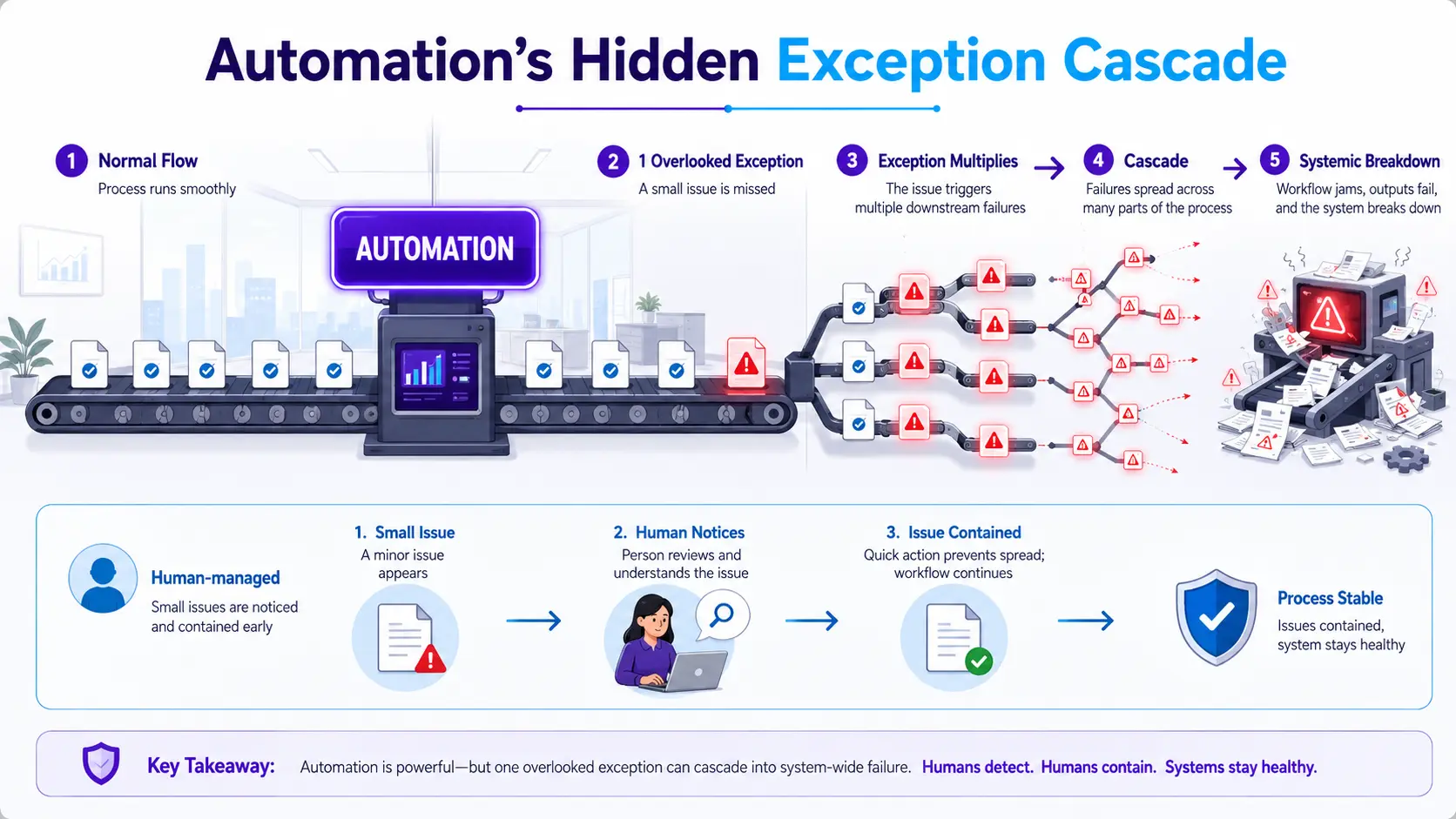
Invisible process fixes fed automation until chaos surfaced
Behind most “stable” workflows lurks a patchwork of quiet manual fixes.
Every time we map automation failures, we find something familiar: exceptions that humans handled through intuition or custom steps – never written down, never flagged.
When automation replaces the human, those fixes vanish.
The result?
Latent chaos finally bursts into view.
We saw this firsthand with a retailer automating product returns.
For years, their support agents had silently corrected mismatched SKUs or flagged refund mistakes, masking upstream data errors.
Once bots took over, refunds went to wrong accounts, exception queues exploded – yet dashboards stayed green.
The automation had hidden failure until volume collapsed trust in the process almost overnight.
Think of it like insulated wiring beginning to spark the moment the insulation (manual tweaks) is stripped out.
Automation looks smooth until every little imperfection, once quietly fixed, starts short-circuiting the system.
Executive dashboards tend to hide these small fires – right up until the flames spread too wide to ignore.
What does this mean for leaders?
Each invisible workaround is a delayed automation failure.
If you can’t see the patch, you can’t plan the fix.
Fragile automation doesn’t just replicate your existing flaws – it amplifies and exposes them.
As automation scales, so does the cost of every overlooked exception, driving instability beneath the surface until it erupts.

How unmanaged exceptions erode ROI and trust faster than it shows on dashboards
Automation rarely sinks projects through dramatic system crashes.
The slow drain comes from something less visible: exceptions recast as routine.
Most leaders expect automation to shrink manual work; instead, small unresolved exceptions teach teams to build shadow workflows that quietly sabotage ROI.
What appears as streamlined flow on your dashboard often hides the same process headaches – just ever-so-slightly disguised, multiplied, and running at machine speed.
Exception labor becomes constant cost, not temporary fix
Here’s the trap: companies treat exception handling as episodic, a blip in otherwise stable automation.
In practice, that “occasional” fix almost always ossifies into permanent overhead.
We’ve seen B2B ops teams hire full-time staff just to triage misrouted leads or clean up failed integrations – costs that should have vanished with automation now coded into the very operation.
The myth is that with enough automation, the exceptions fade.
Reality: exceptions simply move off the main highway and set up camp as recurring detours, each one demanding ongoing labor or mid-tier technical resources.
What percent of your automation ROI is actually eaten by invisible exception work?
For most clients, it’s larger (and stickier) than first estimated.
Think of it like building a self-driving car that forces you to drive in heavy rain; instead of being rare, those edge moments become a recurring tax on your resources.
Reasons Exception Labor Becomes Permanent Cost
- Treating exception handling as episodic repair rather than ongoing responsibility
- Recurring detours replacing main automation workflows
- Hiring full-time staff for exception triage and cleanups
- Invisible exception work reducing true automation ROI
- Erosion of governance and lost confidence in automation
This is where the costs compound – not only in additional staffing, but in lost confidence and missed opportunity as governance erodes.
When exception labor becomes pervasive, the economics and strategic risk of unchecked exceptions threaten the entire automation investment.
Silent failure strips trust before alarms ever sound
Automated dashboards worship green lights, but real outcomes bleed red in places you can’t see.
The silent killer isn’t dramatic alerts – it’s accumulated errors nobody questions until something external exposes them.
In one retail client, month after month, order fulfillment “looked perfect” by automation metrics, but customer complaints and returns told a very different story.
The sensation is like walking on a glass floor: everything looks stable – until the cracks multiply underneath.
The economics of exception-driven automation failure are insidious: each silent miss chips away at internal confidence, making process owners double-check results by hand or create parallel tracking.
By the time visible metrics shift, trust has quietly eroded, and governance becomes reactive, not preventive.
If you sense your team spending more time explaining automation performance than benefiting from it, the root cause is often hidden exception economics, not “user error”.
Exceptions aren’t mere irritants – they’re stealth expenses that quietly cannibalize automation’s promised gains.
The longer they go unmanaged, the faster both ROI and belief in automation crumble, usually long before the numbers on your dashboard catch up.

Why lacking ownership and structure makes workflows collapse under scale
Most automation breakdowns have nothing to do with code – they start with people avoiding responsibility.
Ask ten team members who owns a failed order, and you’ll get ten answers – none definitive.
The most expensive part: the chaos doesn’t appear in any dashboard.
Unclear ownership creates permanent shadow processes
When no one truly owns exception handling, workarounds multiply in the dark.
We’ve watched teams build spreadsheet “fire drills” on the side, quietly routing glitches through Slack or WhatsApp because the workflow owner is a ghost when things get messy.
Shadow processes are like weeds: invisible at first, soon choking every path.
One client ran six automated systems that were, in reality, propped up by after-hours manual edits from a single operations lead – unbudgeted, untracked, unscalable.
Impact of Unclear Ownership on Automation Workflows
| Aspect | Expectation | Reality | Impact |
| Automation Effect | More consistency | Scales variation and exceptions | Process fragility and breakdown |
| Exception Handling | Minor exceptions disappear | Exceptions multiply quickly | Support and exception queues overwhelmed |
| Example | Invoice approvals via email | Invoice approvals by bots multiply exceptions | Increased workload, hidden failures |
| Dashboard Status | Show all systems go | Hide exception spikes | False stability hides risks |
Ask yourself: how often do your critical workflows succeed only because someone unofficial catches what the automation missed?
What looks like efficiency is often a human patchwork, holding automation together by brute force.
Without formal owner accountability, every exception breeds a new shadow lane – and those never scale.
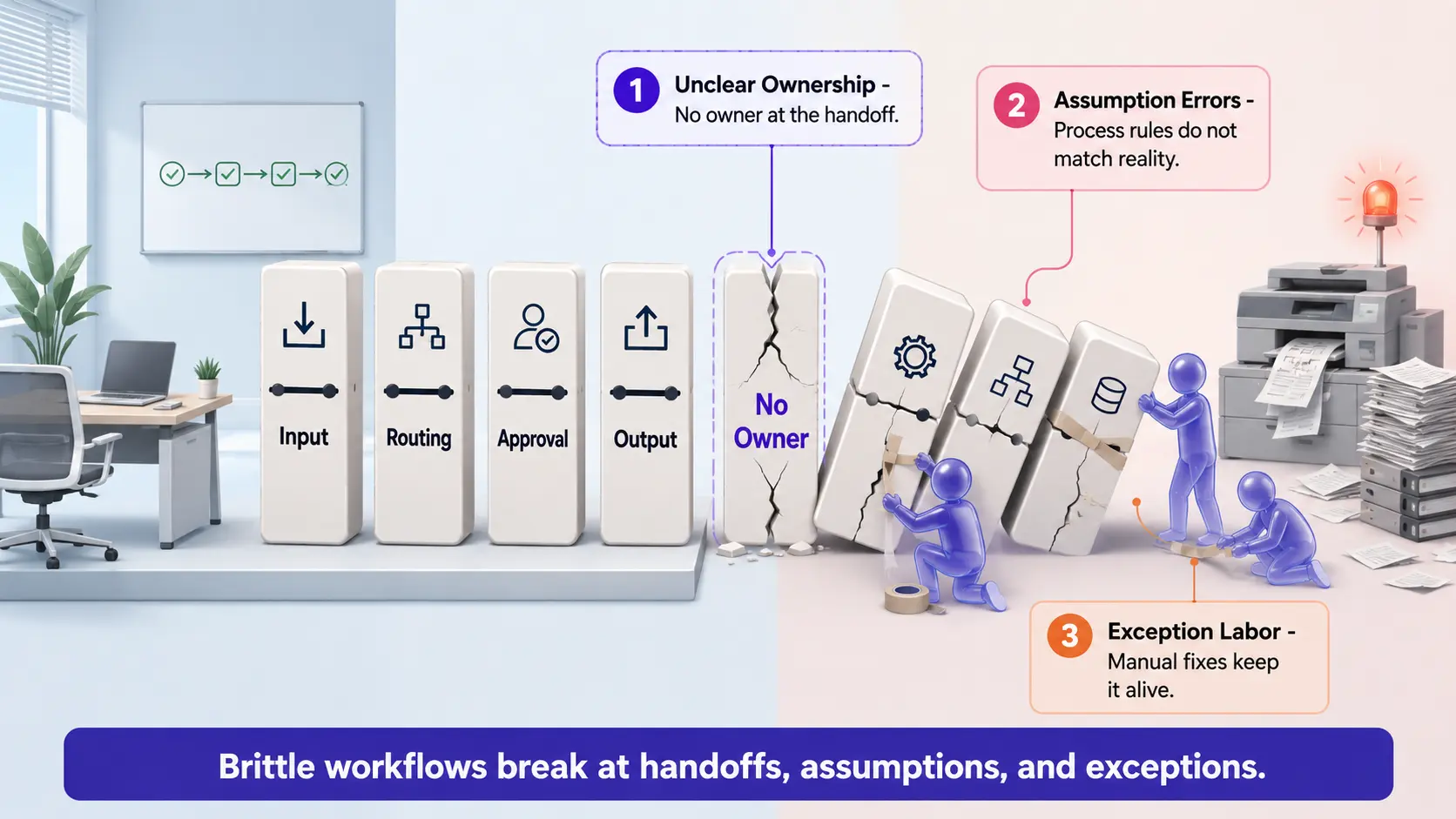
Process assumptions off by nuance create brittleness
It’s often a single missed detail that brings brittle automation to its knees.
Automation brittleness rarely comes from epic failure – it emerges when simple variations slip through unnoticed.
Consider one campaign management flow that assumed email domains always matched company names.
It worked in 99% of test cases, until one enterprise with an alternate domain triggered a silent process halt across hundreds of orders.
Common Causes of Automation Brittleness
- Assuming uniform data formats without allowance for variation
- Ignoring subtle user behavior differences
- Underestimating variable market requirements
- Designing workflows for ‘average’ cases only
- Lack of flexibility to handle exceptions quietly
What breaks brittle automation is rarely big – it’s the thousand quiet deviations: data format quirks, subtle user behavior, variable market requirements.
Think of a bridge designed for “average” traffic: if the materials don’t flex for stray trucks or storms, collapse isn’t a matter of if, but when.
Automation that “hides” failure behind smooth dashboards amplifies process flaws at speed.
If your automation crumbles under small, real-world change, the root cause isn’t the software – it’s the structure and ownership behind it.
Robust pipelines have clear accountability and flexible definitions; anything less is just waiting for scale to show the cracks.
Workflows without ownership or nuance-adjusted structure aren’t just prone to breakdown – they invite it with every exception.
To prevent scale from becoming your weakest link, make ownership explicit and build for messy reality.
When systems are brittle, people create workarounds – a pattern explored further in Exception Workarounds.

Scientific context and sources
The sources below provide foundational context for how decision-making, attention, and performance dynamics evolve under scaling and constraint conditions.
- Organizational Fragility with Process Scaling
Reconceptualizing Organizational Routines as a Source of Flexibility and Change – Martha S. Feldman, Brian T. Pentland – Administrative Science Quarterly
Examines how routines depend on specific human performances, local variation, and practical adaptation, supporting the article’s point that automation fails when hidden human fixes and exceptions are not codified.
https://journals.sagepub.com/doi/10.2307/3556620 - Exception Handling in Automated Systems
Exception Handling in Workflow Management Systems – Claus Hagen, Gustavo Alonso – IEEE Transactions on Software Engineering
Presents a structured framework for handling exceptions in workflow systems, supporting the article’s argument that unmanaged exceptions undermine automated workflows at scale.
https://doi.org/10.1109/32.879818 - Human-Automation Interaction Limits
Ten Challenges for Making Automation a “Team Player” in Joint Human-Agent Activity – Gary Klein, David D. Woods, Jeffrey M. Bradshaw, Robert R. Hoffman, Paul J. Feltovich – IEEE Intelligent Systems
Establishes why automation must reveal status, intentions, limits, and breakdown signals, supporting the article’s point that automation removes tacit human coordination unless systems are designed for joint work.
https://doi.org/10.1109/MIS.2004.74 - Reliability Engineering Under Exception Conditions
Engineering a Safer World: Systems Thinking Applied to Safety – Nancy G. Leveson – MIT Press
Demonstrates how poorly controlled systems fail through interactions, weak feedback, and unmanaged control structures, supporting the article’s point that small exceptions can cascade before dashboards show the real damage.
https://direct.mit.edu/books/oa-monograph/2908/Engineering-a-Safer-WorldSystems-Thinking-Applied
Questions You Might Ponder
How do exceptions in brittle automation workflows impact ROI?
Exceptions ignored during automation design often lead to costly manual interventions, eroding expected returns. By slowly consuming staff resources and creating hidden labor overhead, exceptions increase ongoing costs while reducing the value and predictability of automation investments.
Why does lack of clear workflow ownership cause automation breakdowns?
When exception handling lacks explicit ownership, shadow processes emerge, relying on informal manual fixes. Over time, these ad-hoc solutions are unsustainable at scale, causing increased fragility, operational risk, and ultimately, full or partial process collapse.
In what ways do dashboards hide automation process failures?
Dashboards typically only surface pre-defined error states. If automation silently mishandles exceptions, outward metrics remain green while process quality quietly deteriorates. This lag conceals real losses until failure becomes too severe or customers are directly affected.
What makes a workflow ‘brittle’ in real-world automation?
Brittle automation workflows are those that perform well under standard cases but quickly break down with unanticipated input formats, user behavior, or market requirements. Brittleness arises from lack of exception pathways and inflexible design, limiting scalability and resilience.
How can organizations proactively reduce brittle automation risks?
To minimize brittleness, organizations must document manual exceptions, assign clear ownership, and design for variation. Proactive exception logging, automated anomaly detection, and accountability structures help workflows adapt to real-world complexity and sustain ROI as automation scales.