
What You’ll Learn
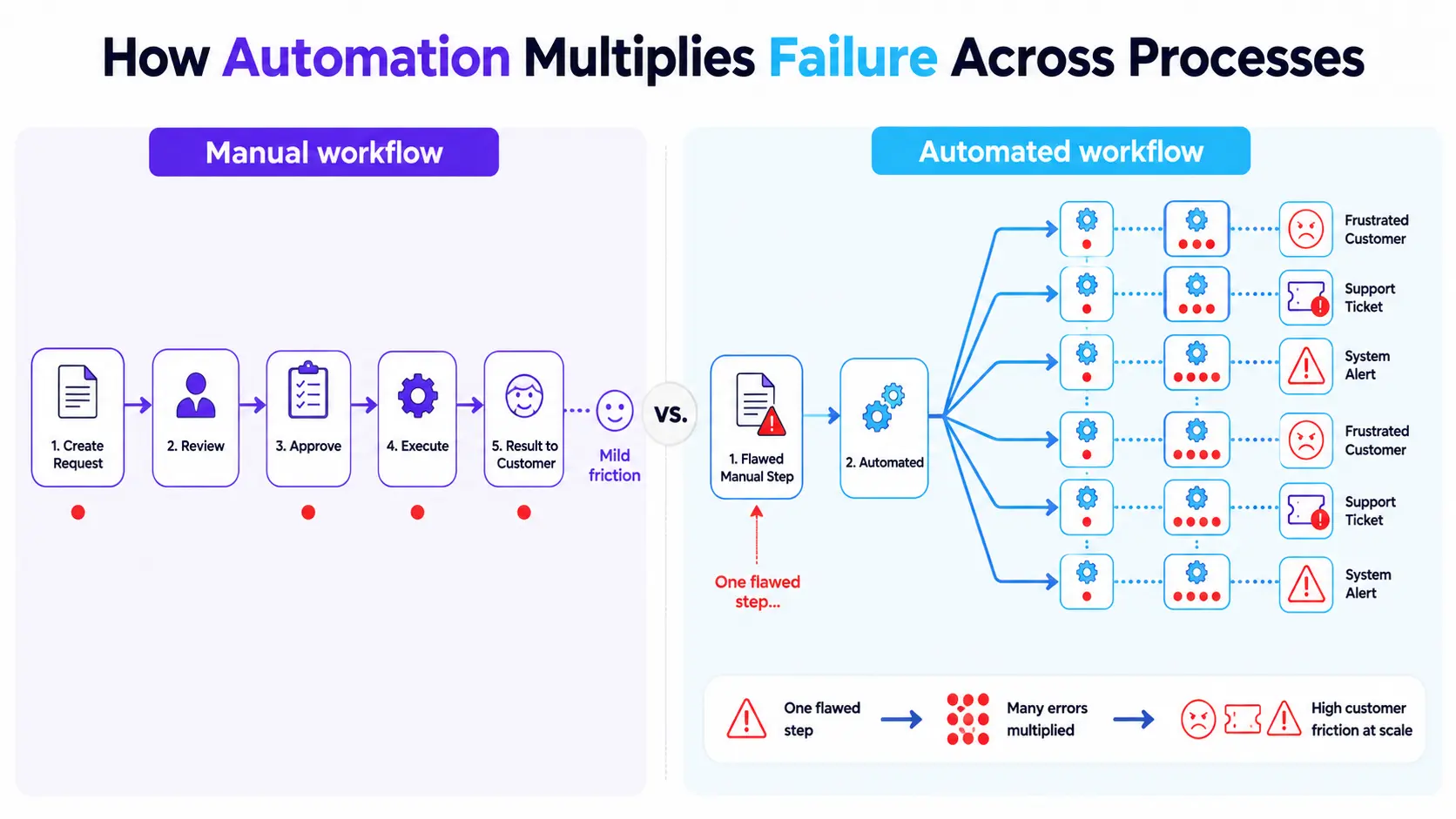
Automation multiplies failure means automation does not fix a broken process; it repeats and scales that process faster, wider, and with less human judgment.
When ownership is unclear, handoffs are brittle, data is inconsistent, exceptions are unhandled, or metrics track activity instead of outcomes, automation turns small flaws into system-wide problems.
It can misroute leads, copy bad data, accelerate poor customer experiences, hide weak logic behind green dashboards, and create a false sense of progress.
Automation becomes useful only when the underlying process is already clear, accountable, measurable by outcomes, and designed to stop or escalate when reality does not match the rule.
Key Takeaways
- Automation multiplies failure when underlying processes are broken, magnifying errors and dysfunction at speed and scale.
- Activity dashboards can mislead by focusing on volume rather than outcomes, masking ineffective or damaging automated actions.
- Structural weaknesses – such as unclear ownership and brittle handoffs – are exposed and amplified by automation, leading to loss of trust and adaptability.
- Executives must ensure process logic is sound and metrics track real value, not just activity, before scaling automation initiatives.
Most companies think you can automate your way out of bottlenecks.
In reality, automation multiplies failure when the underlying process is broken – making dysfunction go further, faster, and deeper than anyone expects.
Instead of a surgical fix, you often just accelerate chaos at scale.
That broader automation pattern is outlined in Marketing Automation & CRM.

Why automation becomes a failure multiplier – not a solution
One Fortune 100 executive told us: “The fastest we ever lost ground was right after our automation launch”.
When the underlying logic is shaky, every error is instantly magnified – not just repeated, but institutionalized at speed.
The myth: automation makes the business smarter by removing manual errors.
The reality: it makes the business faster at repeating exactly what’s wrong.
Speed isn’t a cure when the map is wrong; it just gets you lost sooner.
One client watched NPS scores collapse right after a new automation rollout – because all the hidden customer friction in their manual system was suddenly multiplied tenfold, not eliminated.
How automation accelerates flawed process logic
Automation accelerates dysfunction if the underlying process is misaligned, intensifying failure modes – often before leadership even notices the shift.
Reasons Automation Accelerates Flawed Process Logic
- Automation repeats errors instantly, not just manually.
- Speed magnifies hidden friction and customer dissatisfaction.
- Automation institutionalizes bad processes at scale.
- Faster operation is not the same as smarter operation.
- Leadership may not detect failure before it compounds.
Why activity dashboards mislead without outcome alignment
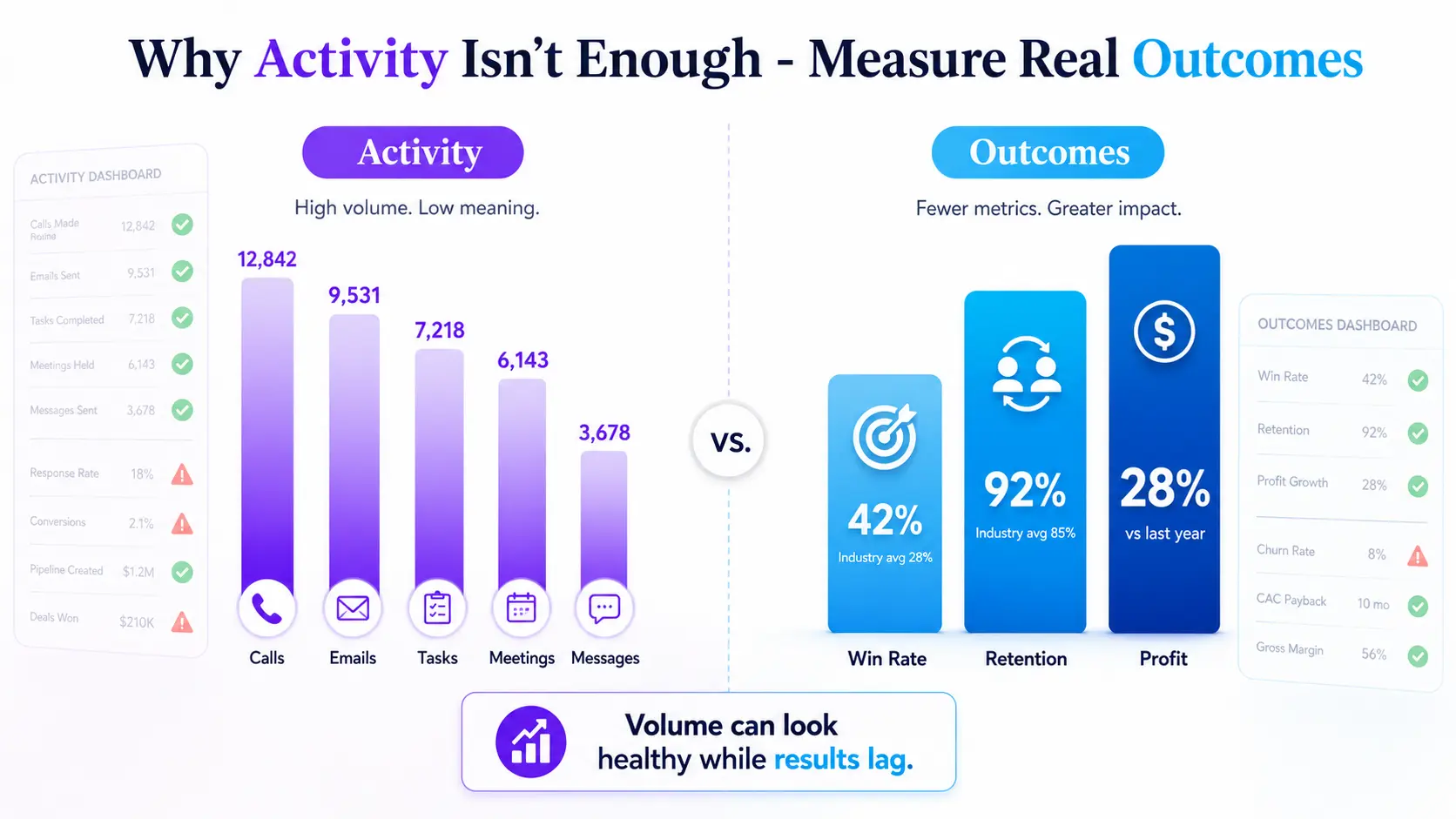
Activity dashboards glow green while value quietly leaks out the back.
Executives crave movement and clean metrics, but dashboards built on volume hide what matters unless outcomes are woven in.
We worked with a mid-market team celebrating thousands of automated “touches” per week – while win rates cratered and deals evaporated.
The data screamed activity, but whispered nothing about effectiveness.
Pitfalls of Activity Dashboards Without Outcome Alignment
- Dashboards measure volume, not effectiveness.
- High activity can mask declining win rates and retention.
- Metrics focus on motion, not real business gains.
- Leaders manage spin instead of actual improvement.
- Outcome metrics must be woven into dashboard design.
It’s like checking the odometer instead of the direction: you measure velocity, but never see you’re heading straight into a wall.
What happens when dashboards show high throughput, but all that movement drains resources?
Does anyone stop to ask if automation is accelerating the right things – or simply performing the wrong tasks more rapidly?
The emotional sting hits when teams realize progress was an illusion, masking bigger decline underneath.
Output and outcomes aren’t synonymous.
If automation hides failure by shifting focus onto activity, leaders are left managing spin, not real improvement.
Automation’s promise crumbles unless the logic and metrics behind it create genuine business gains – not just motion.
Before adding speed, step back: are you multiplying the right logic, or just hiding bigger problems?

What structural weaknesses automation exposes in CRM and handoffs
Most teams believe that automating CRM workflows will solve their data headaches and keep everyone on the same page.
In reality, the opposite often happens: automation exposes the cracks in responsibility, turning minor process ambiguity into a full-scale trust problem.
Structural Weaknesses Automation Exposes in CRM and Handoffs
| Question | Rationale | Potential Risk if Ignored |
| Can the team explain decisions if automation was disabled? | Ensures understanding of processes beyond the automation platform | Scaling guesswork, loss of manual control, invisible failures |
| Are outcome metrics aligned and visible beyond volume? | Ensures measurement of meaningful business value, not just activity | False sense of progress, hidden declines in customer retention or profit |
| What if we turned automation off? | Tests manual process robustness and clarity | Dependency on automation hiding flawed logic |
| Is automation multiplying the right logic or hiding problems? | Checks if automation accelerates correct operations or dysfunction | Accelerated chaos and institutionalized failure modes |
Why unclear ownership causes cascading CRM distrust
Picture a relay race where runners are convinced someone else is responsible for grabbing the baton.
Suddenly, the handoff zone turns chaotic.
Automated CRM handoffs do the same: when ownership isn’t clear at the human level, automated steps just accelerate confusion – each trigger and sync copying forward ambiguity instead of clarity.
Here’s what we see repeatedly with clients: automating a sales-to-service handoff without nailing down who owns the data, when, leaves every team blaming the system, not the process.
One executive said their CRM “lost accountability overnight” after rolling out automation.
The myth is that automation will enforce discipline; in fact, it amplifies finger-pointing because the system itself can’t assign intent.
Why does this matter?
When trust in the CRM erodes, reporting breaks down, and teams build workarounds – drawing further away from strategic alignment.
A CRM is supposed to be the system of record.
But unless ownership is locked in before automation, every data sync becomes a game of telephone at scale.
Who pushed the change?
Who is supposed to respond?
When lines blur, so does confidence in every dashboard and update the system delivers.
How brittle handoffs break when automation removes human judgment
Automated handoffs feel efficient – until something doesn’t fit the rules.
Most automation hides its real brittleness: when the process hits an edge case, there’s no human pause to catch it.
Think of a factory line moving at double speed but nobody watching for items out of spec.
Even one missed exception can domino into weeks of cleanup or lost opportunities.
Inside client CRMs, we’ve seen exceptions – like a multi-product deal or an unusual customer need – routed straight into oblivion because automation only follows logic, not judgment.
The myth is that the fewer humans involved, the fewer errors occur.
But some decisions can’t be captured in a rule set; context vanishes, and the system simply fails silent.
How many deals go sideways because the automation didn’t know to stop or ask?
Automation accelerates dysfunction not by acting unpredictably, but by being relentlessly consistent – even when that consistency is precisely what’s breaking things behind the dashboard.
Structural weaknesses in CRM and handoff automation don’t just slow momentum – they quietly compound risk.
Every misrouted lead and silent exception adds up, leaving leaders with a system that looks seamless but is quietly accelerating away from both trust and adaptability.

Which failure modes automation amplifies at scale
Most leadership teams expect automation to surface fewer issues as scale increases.
Instead, the opposite happens: every missed keystroke, unchecked assumption, or ambiguous rule gets multiplied across thousands of transactions in a heartbeat – often without detection.
The result isn’t just inefficiency.
It’s systemic breakdown that grows with each automated cycle, feeding failure back through the system faster than any manual process could.
Data inconsistency compounding through pipelines
In one global audit, a single overlooked field mis-mapping quietly changed revenue forecasting for six months – multiplying a trivial human miss into a company-wide blind spot with every automated sync.
The analogy: it’s like pouring polluted water into a city-wide pipeline – you don’t just contaminate one tap, you foul the whole grid in minutes.
For executives, the question isn’t whether errors exist, but how far the ripple reaches before anyone notices.
We’ve worked with organizations that realized only after six months they were reporting phantom pipeline value, all because one process step automated gaps instead of flagging them.
Exception blindness and reduced adaptability
Automation promises efficiency, but it quietly kills adaptability when built on rigid, assumption-heavy logic.
What used to be a quick human judgment call – spotting an outlier in a customer record, escalating a weird billing scenario – now disappears behind workflows with no off-ramp.
Most teams don’t realize how much nuance they sacrificed until something breaks at scale.
Here’s what that looks like: an edge case sneaks through – one acquisition from a region your logic wasn’t built to handle.
Suddenly, the automation isn’t just failing to process the exception; it’s flooding downstream systems with silent errors, all because the design expected reality to behave.
How often are you catching those outliers before they cascade?
A process that once flexed under pressure now snaps in silence – no alert, just an invisible backlog.
The longer the system runs, the more brittle it becomes.
If the logic is wrong, automation won’t only fail to catch it.
It will entrench it until performance drops off a cliff.
Scaling automation doesn’t create resilience; it exposes every flaw in the process logic – fast, wide, and brutally silent.
If you’re not actively countering error amplification and building for exceptions, automation is quietly multiplying failure beyond the reach of easy fixes.
Multiplication becomes brittleness when reality doesn’t match assumptions – covered in more depth in Brittleness and Unhandled Exceptions.

What should executives question before trusting fast automation
Most automation disasters start with an unasked question: what if we turned it all off?
If your team can’t instantly explain every step, excluding the software, you’re not scaling efficiency – you’re scaling guesswork at machine speed.
Key Questions Executives Should Ask Before Trusting Fast Automation
| Structural Weakness | Description | Effect of Automation |
| Unclear Ownership | Lack of clear responsibility for data and tasks among teams | Automated handoffs replicate and accelerate ambiguity |
| Brittle Handoffs | Automation removes human judgment in edge cases | No manual pause to catch exceptions; silent failures |
| Data Sync Ambiguities | Ambiguous data handoff timing and accountability | Each automated sync propagates unclear data responsibility |
| Rigid Processes | Rules-based automation unable to handle exceptions | Exceptions get lost or misrouted silently |
Can the team explain decisions if automation was disabled?
In boardrooms, I’ve watched leaders freeze when asked to describe their processes – without referencing the platform running them.
It’s the difference between a pilot understanding the flight plan versus just trusting autopilot.
One client’s onboarding workflow, when unplugged, left their team blank.
Decisions had become invisible rituals, executed solely by scripts.
Nobody could say why inquiries landed with certain reps, or why some setups triggered endless loops.
The myth: that detailed workflow charts equal clarity.
In reality, most documentation is just a proxy for what the system does – not why it happens.
If your top operators can’t walk through decisions manually, the process isn’t robust – it’s borrowed authority from automation.
Ask: could the team rebuild the logic in a spreadsheet, or even on paper?
If not, you’re scaling mystery, not mastery.
Are outcome metrics aligned and visible beyond volume?
One dashboard can show soaring ticket completions, but zero improvement in customer retention.
This is where automation hides failure in plain sight: activity explodes, but value remains flat or declines.
Most teams gravitate to what’s easiest to measure – calls placed, emails sent, deals moved – while overlooking whether any of those moves actually produce profit or retention.
One COO put it bluntly: ‘Our dashboards looked perfect, right up until retention cratered.’
The hard truth is that volume metrics lull leaders into a false sense of momentum.
We’ve seen teams celebrate record numbers, only to realize in Q4 nothing important moved.
The key diagnostic?
Track outcome metrics side-by-side with process stats.
If you can’t see value delivered (not just activity logged) before scaling automation, risk multiplies with every faster cycle.
Relentless speed means nothing if you’re measuring the wrong thing – or worse, can’t explain what happens when the noise stops.
For executives, the win isn’t adopting tools faster, but asking harder questions before you do.

Scientific context and sources
The sources below provide foundational context for how decision-making, attention, and performance dynamics evolve under scaling and constraint conditions.
- Decision Automation Pitfalls
Humans and Automation: Use, Misuse, Disuse, Abuse – Parasuraman, R., & Riley, V. – Human Factors
Discusses how automation can amplify system fragility and propagate errors if human oversight and intent are not structurally integrated.
https://journals.sagepub.com/doi/10.1518/001872097778543886 - Human-Automation Interaction
A Model for Types and Levels of Human Interaction with Automation – Raja Parasuraman, Thomas B. Sheridan, Christopher D. Wickens – IEEE Transactions on Systems, Man, and Cybernetics
Provides a research overview of how automation alters performance, highlights error amplification, and stresses actionable metrics for successful integration.
https://ieeexplore.ieee.org/document/844354 - Information Flow and Exception Handling
Workflow Management: Models, Methods, and Systems – Wil M.P. van der Aalst, Kees M. van Hee – The MIT Press
Explores exception handling in automated workflows and the risks of institutionalizing errors or ambiguity in business processes.
https://mitpress.mit.edu/9780262720465/workflow-management/ - Systemic Failure Measurement
Measuring and Managing Performance in Organizations – Robert D. Austin – Dorset House Publishing
Covers empirical findings on metric-driven behaviors, how activity dashboards can mislead, and why outcome alignment is crucial for automation.
https://www.dorsethouse.com/pdf/Dorset-House-mmpo.pdf - Organizational Trust and Automation
Trust in Automation: Designing for Appropriate Reliance – Lee J.D., See K.A. – Human Factors
Examines structural weaknesses in trust and accountability when automating team handoffs, highlighting the emergence of hidden risk.
https://journals.sagepub.com/doi/10.1518/hfes.46.1.50_30392
Questions You Might Ponder
Why does automation multiply failure when underlying processes are flawed?
Automation multiplies failure because it rapidly replicates existing errors and inefficiencies, institutionalizing poor decisions at scale. This leads to more widespread and harder-to-detect breakdowns, especially when core process logic is imperfect or ambiguous.
How can dashboards mislead business leaders about automation outcomes?
Dashboards often highlight activity metrics (like volume or velocity) without showing whether automated actions produce meaningful results. This can hide real declines in value, customer satisfaction, or profitability, causing leaders to mistake motion for progress.
What risks do unclear ownership and responsibility bring in automated CRM workflows?
Unclear ownership in CRM automation leads to data ambiguity, finger-pointing, and trust breakdown. When responsibility isn’t clearly assigned before automation, teams build shadow processes and lose faith in system accuracy, ultimately causing strategic misalignment.
How do automated systems fail to handle exceptions and edge cases?
Automated workflows lack human judgment, leading to silent failures with outliers or exceptions. These exceptions go unnoticed, compounding into larger issues across the organization, as automation consistently processes only what’s explicitly defined by rules.
What questions should executives ask before trusting fast automation?
Executives should ask if their teams can explain all decision logic without technology, if outcome metrics are tracked alongside activity metrics, and what risks are amplified if automation is suddenly stopped. This self-audit exposes process gaps and hidden dependencies.