
What You’ll Learn
Risk sensitive local visibility is the stricter form of local search visibility used in regulated or harm-sensitive industries where platforms suppress businesses more quickly when trust, safety, licensing, proximity, or entity signals appear uncertain.
It affects sectors such as healthcare, law, finance, addiction treatment, and other categories where showing the wrong provider could create user harm.
In these markets, proximity and SEO authority are not enough; businesses must pass higher confidence thresholds for names, addresses, phone numbers, categories, reviews, office types, and regulatory consistency.
Visibility can disappear silently when automated systems detect ambiguity, because platforms often prefer exclusion over the risk of recommending an unsafe or unverifiable business.
Key Takeaways
- In regulated industries, risk‑sensitive local visibility means stricter, often invisible thresholds dictate which businesses appear in search results.
- Platforms routinely suppress listings at the first sign of data inconsistency or elevated harm risk – appearing and disappearing is driven by user protection, not SEO errors.
- Proximity and trust interact differently for sensitive verticals; physical nearness can’t override high trust and authority requirements built to prevent harm.
- Automated, opaque enforcement systems drive sudden, volatile visibility shifts; recovery from exclusion is slow and more heavily scrutinized than original inclusion.
Most business owners assume that if they meet basic compliance, their location should appear in local search – especially when users are close by.
But the real boundary isn’t regulatory paperwork or standard SEO.
Behind the scenes, risk-sensitive local visibility is governed by invisible thresholds designed to protect users first and businesses second.
In regulated industries – think healthcare, law, financial services – safety trumps fairness every time.
That wider logic is outlined in Local Search Visibility.

Why local search hides regulated businesses more than others
There’s a myth that local search acts like a fair directory: if you’re in the right category, have a verified listing, and decent reviews, you’ll show where you should.
In sensitive verticals, that logic fails.
Instead, platforms silently dial up the minimum bar for showing a business at all – the local inclusion threshold – according to the perceived potential for user harm.
Think of the system like a security checkpoint: the greater the risk, the harder it is to get through, sometimes even with perfect documentation.
How harm potential raises inclusion thresholds in local systems
For instance, well-managed, compliant practices can quietly vanish from local results just as their competition ramps up.
No amount of proximity or rating muscle can override these hidden gates.
Local search systems, tuned for harm-sensitive industries, often suppress visibility even on small discrepancies – hours mismatches, inconsistent specialties, or vulnerable address types.
For a niche clinician, being “mostly compliant” isn’t enough; the system assumes that risk is hiding in any gray area.
Risk Potential Impact on Local Inclusion Thresholds
| Suppressor | Description | Example/Impact |
| Virtual or shared office addresses | Flagged as potential spam or regulatory loopholes | Business flagged for non-physical or shared locations |
| Inconsistent or non-government-issued business names | Business name discrepancies raise trust concerns | Name edits trigger stricter inclusion thresholds |
| Phone number mismatches across platforms | Conflicting contact info signals lack of authority | Multiple listings with different phone numbers flagged |
| Category misalignment (including subcategory) | Incorrect or ambiguous categories increase risk | Being listed under wrong specialty causes exclusion |
Ask yourself: If a user is searching for a lawyer or clinic, does the system prioritize showing options – or eliminating all doubt about safety?
In risk-calibrated search, omission is seldom an accident.
“User protection first – even if it means fewer search results” is the operating logic.
It’s like a seatbelt locking up in a crash: restriction feels sudden and harsh, but it’s designed to stop the worst outcome, not maximize comfort or access.
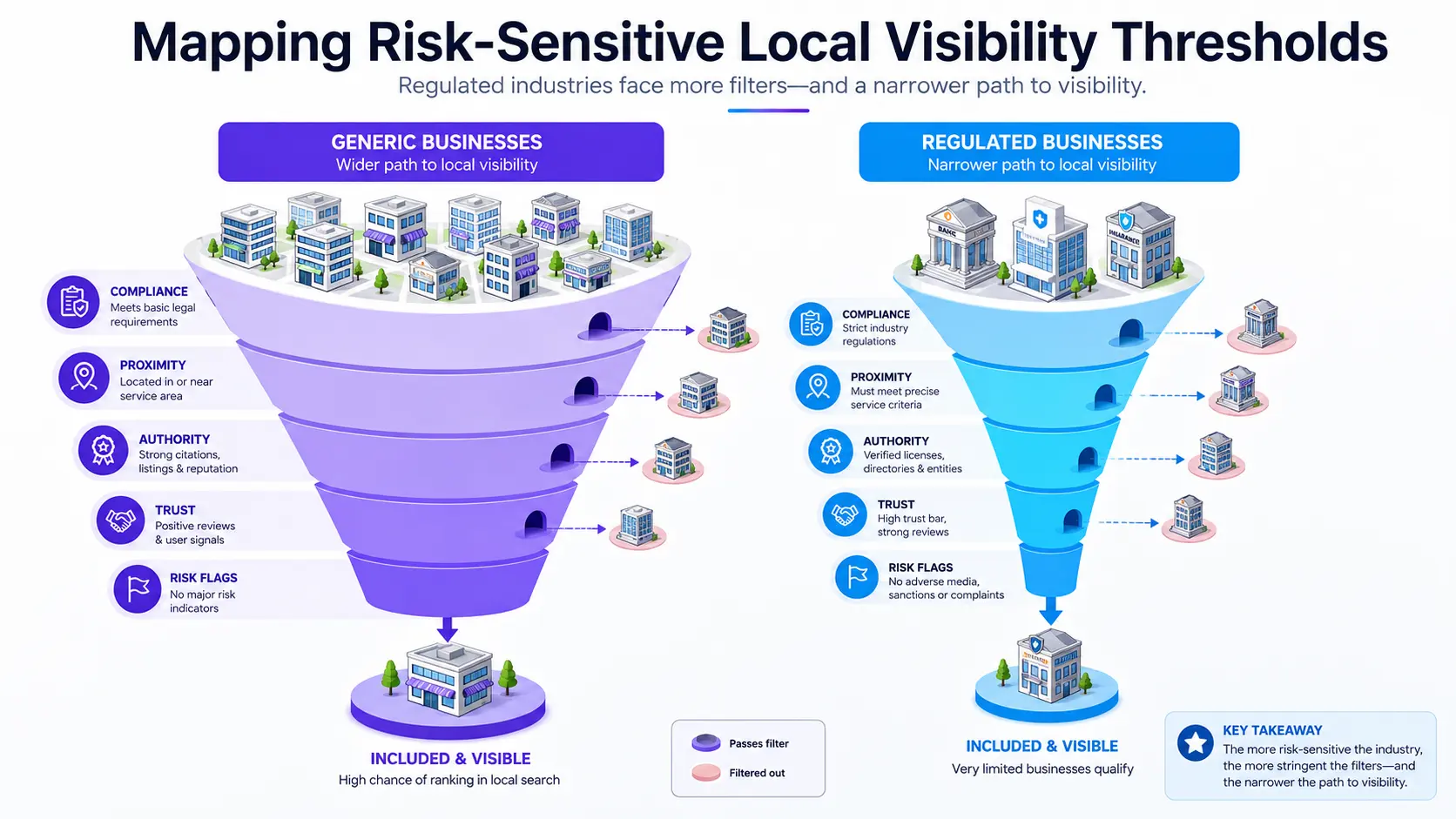
Why exclusion is safer than error when visibility fails
Most local search platforms would rather silently exclude than risk a single harmful match.
That means when the system senses increased uncertainty – or flags a mismatch – it doesn’t show a warning or downgrade ranking.
It makes businesses invisible.
This “silence as safety” protocol frustrates marketers and executives because it blocks any chance to plead your case or clarify intent.
But for the platform, the calculus is simple: one high-harm incident undermines trust with millions of users; one unjustly excluded business, in contrast, leaves a smaller footprint.
In risk-prone verticals, exclusion acts as a defensive moat: it’s better to let a good actor temporarily disappear than to let a bad actor slip through the cracks.
Multi-location healthcare clients sometimes experience sudden local suppression across entire metro areas – no penalties, no notifications, just blackout.
Only by mapping entity data consistency, office types, and trust thresholds were we able to pinpoint the invisible tripwire.
If trusted authority isn’t watertight, the system doesn’t just dock points.
It pulls the plug.
No warning, no way to appeal.
That’s the mechanics of harm-sensitive visibility constraints – better to vanish than to risk error when stakes run high.
Visibility in regulated contexts isn’t a right – it’s a risk privilege, earned and revoked with little notice.

Why proximity and authority interact differently under risk
Consider two identical clinics on the same block – only one appears in search.
In regulated sectors, being close no longer guarantees visibility.
Silent trust gates filter out even the neighbors, raising the bar for risk‑sensitive local visibility.
When closeness alone isn’t enough: elevated trust gates
Think of proximity like a security badge that only gets you into the lobby – not the server room.
In harm‑sensitive industries, local search algorithms ignore physical distance if a business can’t clear higher authority and trust thresholds.
It’s not just about hours, reviews, or licenses; it’s about the system’s confidence that exposure won’t create downstream risk.
An addiction clinic or med spa with a flawless record may vanish from Google Maps for weeks, while its neighbor remains.
What caused the blackout?
Small inconsistencies in regulatory filings or an ambiguous business category tipped the algorithm’s caution beyond acceptable risk.
Here, a single data mismatch can be the difference between trusted inclusion and enforced silence.
Notice the myth: proximity-driven results are not immune to harm rules.
Even flawless locations can be omitted if trust feels brittle.
If you operate in a sensitive category, assume the system weighs risk above fairness – every time.
Proximity squeeze: sudden visibility cliffs in regulated sectors
The most expensive mistake?
Believing you’re visible just because you’re near the searcher.
In these sectors, visibility cliffs happen fast.
One day you’re in the top map pack; tweak one listing detail or hit a new regulatory warning, and your presence evaporates past a hyper-tight radius.
For example, a background check service we worked with maintained solid visibility within a five-block radius – but fell off completely for users just a few streets farther, regardless of demand or business legitimacy.
It’s like walking across a bridge that ends without warning; one more step and the ground vanishes.
The algorithm’s sensitivity to harm means small adjustments – or even external rule updates – compress the radius where you’re trusted to appear.
No gradual fade-out, just abrupt exclusion, especially where proximity risk amplification is at play.
In regulated local search, visibility is fragile: nearness opens the door, but only unquestionable authority keeps you inside.
As trust thresholds harden and proximity constraints tighten, leaders must rethink what creates – and destroys – local presence.

How automated enforcement heightens volatility for sensitive verticals
You can be fully compliant, verified, and trusted by clients – yet vanish overnight from local results.
The hidden reason?
Algorithms now police risk‑sensitive local visibility at machine speed, operating on patterns too nuanced for humans or checklists.
Most executives expect audits, but not the silent filter: automated defenses act with zero warning, shutting the door before you even sense a problem.
Automation + opaque rules: unpredictable suppressions
Regulated local search behavior isn’t monitored by a single transparent playbook.
Instead, enforcement shifts continually, guided by harm‑sensitive visibility constraints programmed into black‑box systems.
One moment, your listing passes all the trust thresholds local search demands; the next, a minor category or data tweak triggers exclusion vs inclusion in maps – no alert, no path to argue your case.
With clients in high‑risk health and financial sectors, we’ve witnessed entire listings disappear after algorithmic reviews found faint patterns only bots could spot: a shared office address, a new negative review with just the wrong phrase, even an entity data hiccup that matched a risk profile.
A trusted operation can lose years of standing in a single crawl.
Here’s the myth: that local inclusion thresholds are well‑defined, and once crossed, remain stable.
In reality, inclusion is provisional – constantly recalculated, and one suppression can lead to wider risk amplification across your digital footprint.
It’s like a smoke detector primed for false positives: silence as safety in local SEO.
Is your business still visible, or are you only one algorithm update away from vanishing?
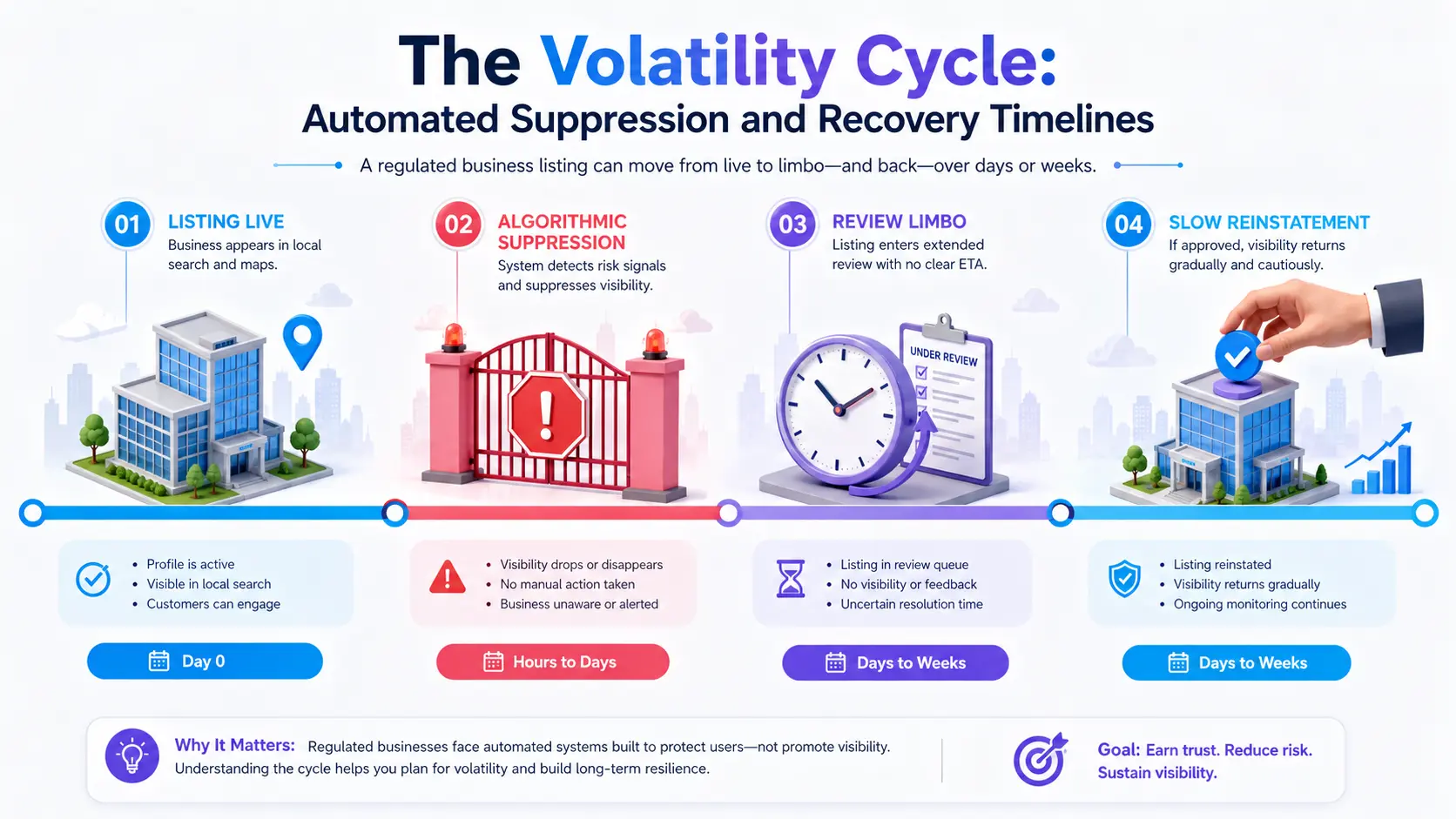
Why recovery takes longer where error risk matters most
Most think reinstatement is a procedural box-check.
Not when the system’s risk calculation controls the gates.
In regulated categories, recovery isn’t just about fixing a flagged issue; it’s slow and deliberately cautious, weighted by the proximity risk amplification algorithms fear most.
Platforms hesitate to reverse exclusions because the cost of a mistaken re‑listing is reputational, regulatory, even legal.
We’ve seen profiles stuck in review limbo for weeks – despite full documentation and escalation.
Each reinclusion request is scrutinized far more heavily than the original listing.
The workflow echoes a locked building after a security breach: every keycard disabled, every re‑entry triple‑checked.
In harm‑sensitive sectors, recovery from automated suppressions is always slower and more fragile than removal.
The process is designed for certainty, not speed.
Expect volatility.
For regulated industries, today’s visibility doesn’t guarantee tomorrow’s access.
Credibility must be rebuilt at each checkpoint – and the system rarely offers a map.

Signs your local visibility issue stems from risk sensitivity, not poor SEO
Most executives blame vanishing local visibility on missed optimizations somewhere in the process.
But what if you’re dealing with a different beast – one that suppresses you not for mistakes, but for being in the wrong category at the wrong time?
The invisible hand behind risk‑sensitive local visibility has little patience for perfect metadata if there’s even a whiff of perceived harm.
If your site has gone dark without warning, and no obvious errors or penalties appear, you may be facing the industry’s silent exclusion logic.
Patterns of silent disappearance despite compliance
Here’s where the myth collapses: doing everything “right” by the book is no guarantee you’ll stay visible.
In regulated categories – think healthcare, legal, finance, or anything with licensing stakes – disappearance often happens while your local profile remains untouched.
There’s no email, warning, or citation.
You wake up to fewer calls, map results drop, but your listings pass every self‑audit.
One client, a multi-location medical group, lost all map impressions overnight – despite flawless compliance and zero profile edits.
Their top competitors also vanished.
No reporting, no visible changes, just silence.
This isn’t algorithmic punishment for SEO missteps.
It’s the system defaulting to safety, removing exposure when risk signals are ambiguous or elevated.
Risk‑sensitive industries operate more like airport security than a public park: if anything at the gate feels off, you’re kept out, not corrected.
Is your disappearance abrupt, total, and unaccompanied by violations?
That’s the fingerprint of harm‑sensitive visibility constraints – not neglect.
Common suppressors in harm‑sensitive industries
So what actually triggers these silent exclusions?
In practice, it’s not small SEO errors – it’s systemic risk flags.
The most common culprits: – Virtual or shared office addresses (flagged as potential spam or regulatory loopholes) – Inconsistent or non-government-issued business names – Phone number mismatches across platforms – Category misalignment, even at the subcategory level – Sudden changes that raise trust thresholds, such as multiple owners or staff updates
Common Suppressors Triggering Silent Exclusions in Harm-Sensitive Industries
| Risk Potential | Threshold Level | Effect on Visibility |
| Low risk (e.g., retail) | Standard threshold | Fair directory-like inclusion |
| Moderate risk (e.g., financial services) | Elevated threshold | Requires higher data consistency |
| High risk (e.g., healthcare, law) | Strict threshold | Silent exclusion with minor discrepancies |
| Unknown or ambiguous risk | Maximum threshold | Automatic exclusion to avoid harm |
We’ve seen compliant firms disappear because their address matched that of a known trouble spot – or because a slight business name edit collided with stricter local inclusion thresholds.
Even a glitch in hours or description fields can trigger a review.
The system acts less like a directory and more like an immune system, removing what it can’t immediately verify as safe.
Think of risk‑sensitive local visibility like crossing a border: paperwork must be flawless, everything must match, and one misplaced detail means you’re sent back, silently, every time.
Most companies don’t realize the margin for error is microscopic.
If your local visibility fades without cause or comes and goes with no clear pattern, suspect risk triggers before blaming your execution.
In harm‑sensitive categories, staying seen is less about relentless optimization – and more about passing evolving, invisible safety tests.
That broader pattern is clearer in Addiction Treatment Local Search Visibility.

Scientific context and sources
The sources below provide foundational context for how decision-making, attention, and performance dynamics evolve under scaling and constraint conditions.
- Information quality, risk, and user trust
Trust and Credibility in Web-Based Health Information: A Review and Agenda for Future Research – Laura Sbaffi, Jennifer Rowley – Journal of Medical Internet Research
Explores how risk-prone sectors require higher information quality, credibility, and trust because poor information can directly affect real-world decisions and outcomes.
https://www.jmir.org/2017/6/e218/ - Local search, information systems, and regulatory barriers
Automated Compliance Checking in Healthcare Building Design – Joao Soliman-Junior, Patricia Tzortzopoulos, Juliana Parise Baldauf, Barbara Pedo, Mike Kagioglou, Carlos Torres Formoso, Julian Humphreys – Automation in Construction
Examines how complex regulatory frameworks in healthcare create technical and procedural constraints for automated compliance systems.
https://www.sciencedirect.com/science/article/pii/S0926580521002739 - Automation and opacity in algorithmic filtering
Algorithmic Regulation: A Critical Interrogation – Karen Yeung – Regulation & Governance
Details how automated systems regulate behavior through data-driven monitoring, classification, and intervention, creating opaque and difficult-to-contest filtering mechanisms.
https://onlinelibrary.wiley.com/doi/10.1111/rego.12158 - Risk management and user protection in digital interfaces
Risk, Information, and Incentives in Online Affiliate Marketing – Benjamin Edelman, Wesley Brandi – Journal of Marketing Research
Discusses how online platforms use monitoring and enforcement rules to manage risk, exclude harmful actors, and protect users in large-scale digital environments.
https://journals.sagepub.com/doi/10.1509/jmr.13.0472
Questions You Might Ponder
Why do regulated businesses disappear from local search, even with perfect compliance?
Even businesses with full compliance can vanish due to risk‑sensitive local visibility rules. In high-stakes verticals, systems prioritize user safety by using stricter, invisible thresholds that suppress any entity presenting even minor uncertainty, making omission the default over risky inclusion.
How does risk sensitivity change local SEO strategies for healthcare, legal, or finance firms?
Risk‑sensitive local visibility means standard SEO isn’t enough. In regulated categories, maintaining data consistency, flawless documentation, and proactive trust-building matter more than keywords or reviews. Small mismatches can immediately trigger suppression, so risk management must become a core strategy.
What are ‘silent exclusions’ and why don’t platforms provide warnings?
Silent exclusions refer to abrupt disappearance from local results without notification or appeal. Platforms adopt this safety-first approach to minimize user harm risk in sensitive sectors. Alerting affected businesses would slow down or undermine risk defenses, so the exclusion is swift and non-transparent.
Does proximity to searchers guarantee regulated businesses will appear in results?
No, proximity is secondary in risk-sensitive local search. Authority, trust signals, and data integrity outweigh location. Even two identical clinics on the same street can have different visibility if the algorithm detects risk signals – proximity creates opportunity, but only trust ensures presence.
How does automation affect visibility volatility in regulated industries?
Automated enforcement in platforms polices risk-sensitivity at scale, leading to unpredictable visibility changes for regulated entities. A single algorithm tweak or data signal can cause wide suppression, and recovery often requires extensive, multi-step verification, making local presence fragile and dynamic.