
What You’ll Learn
Local visibility radius is the geographic coverage area where a business is eligible to appear in local search results before ranking factors such as reviews, keywords, photos, or profile optimization are considered.
It is shaped mainly by proximity filters, market density, business category, competitor concentration, and searcher location.
A business may dominate inside its radius but disappear outside it because distance acts as a visibility gate, not a normal ranking boost.
Local visibility radius is often patchy and changes by neighborhood, city layout, and algorithm recalibration.
Expanding it usually requires structural changes such as additional locations, local entities, or partnerships, not minor profile tweaks.
Key Takeaways
- Local visibility radius is set by proximity filters, making many areas unreachable regardless of listing optimizations.
- Market density and business category both shape how far your local search reach extends, with denser areas shrinking coverage.
- Visibility fluctuations across neighborhoods or days usually indicate normal algorithmic recalibration, not errors.
- True expansion of local visibility radius requires structural changes, such as new locations – not just profile tweaks.
Most business owners assume that local visibility means owning the whole city – until they notice their profiles vanish beyond a few neighborhoods.
The core reality: your local visibility radius is not a dial you can simply turn up. It’s a hard barrier enforced by proximity, not a reward for optimization.

Why local visibility attenuates with distance – and what that means
Here’s the shock: proximity doesn’t make you more competitive; it decides if you show up at all.
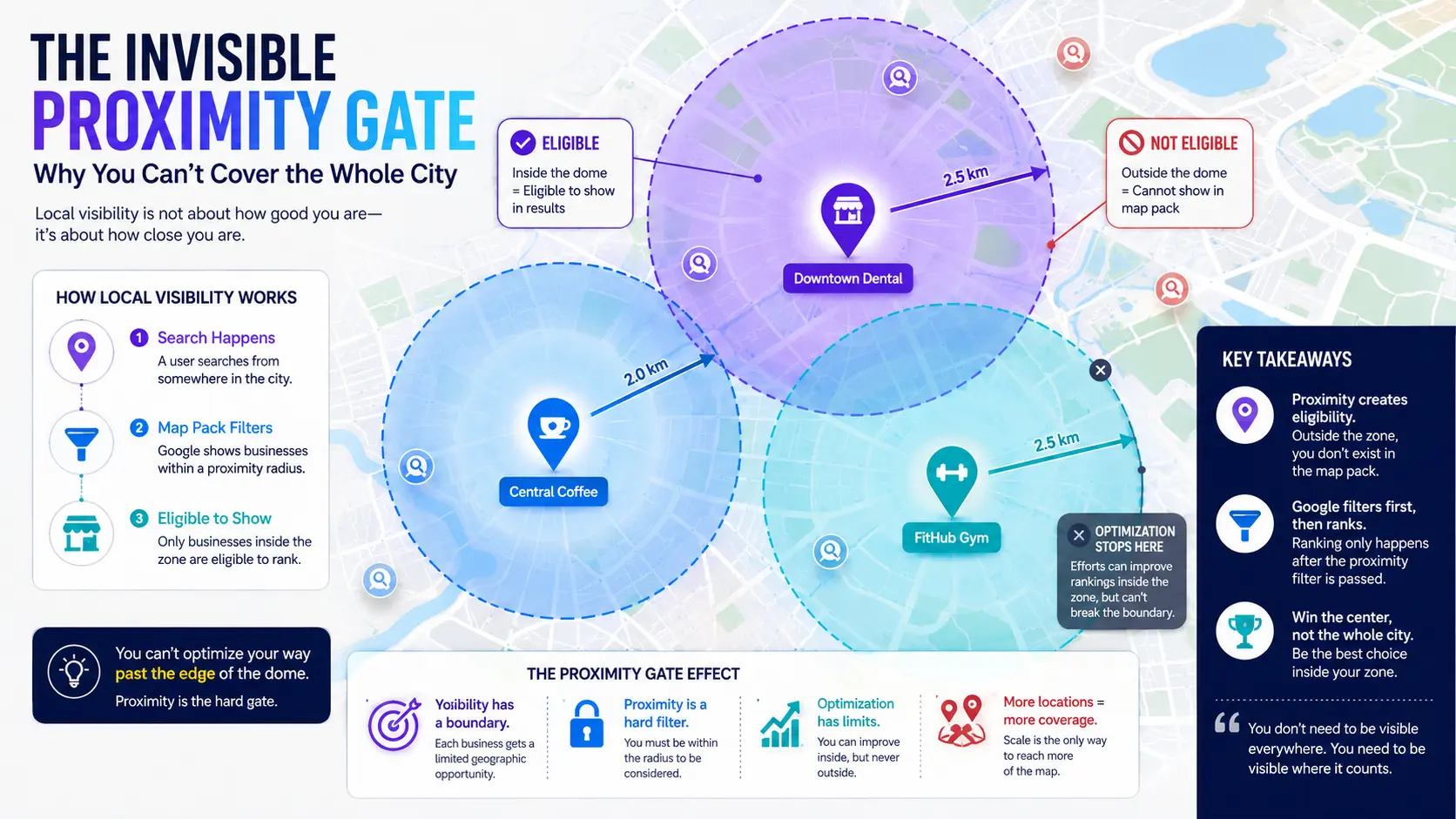
Think of your business as operating inside an invisible dome.
Outside that dome, it’s not about outranking competitors – it’s about not being eligible.
On every map pack, Google and other platforms first run a geo-constrained visibility filter.
If you’re outside the proximity constraint in local search, you are invisible, regardless of reviews or keywords.
How proximity acts as a gate – not a ranking boost
We’ve seen companies pour effort into “improving” rankings, only to find that their distance-limited local visibility makes such efforts irrelevant for most of the city.
The most common myth: more reviews or better photos will expand reach.
In fact, your local search proximity gate operates like a bouncer at a club; no matter how sharp you look, if your address isn’t close enough, you’re not on the guest list.
There’s a reason one business can show up downtown but disappear halfway to the suburbs – it’s rarely a technical flaw.
Eligibility always precedes ranking, not the other way around.
Why visibility radius varies by market and business type
Effect of Market Density and Business Type on Local Visibility Radius
| Approach | Description | Effect on Visibility Radius | Examples | Limitations |
| Incremental Tweaks | Optimizing profiles, reviews, keywords | No expansion of radius | More reviews, description edits | Limited by hard proximity constraints |
| Multi-location Footprint | Opening multiple physical locations | Significant expansion | New store openings | Requires capital and operational scale |
| Local Entities & Partnerships | Collaborations to share visibility | Moderate expansion | Strategic partnerships or co-branded listings | May need complex coordination |
| Profile Refinement Only | Focusing solely on profile content | No impact | Keyword stuffing, photo updates | Ineffective against geo constraints |
Ever wondered why a coffee shop downtown might show up citywide, but a chiropractor three blocks away barely appears past their own block?
The difference isn’t chance – it’s the density of competition and what Google considers “local intent” by category.
In dense urban cores, local search reach limits shrink because hundreds of businesses cluster in small areas.
That means your map pack radius limitations can be just a few blocks.
For specialized or low-density categories – like certain trades – your geo-constrained visibility stretches further, since there are fewer providers nearby.
One client in a sprawling suburb discovered their coverage vs domination local looked like a patchwork quilt, not a perfect circle.
Market density acts like competing radio towers: when everyone’s close, signals overlap and crowd out all but the closest results.
But in spread-out markets, visibility can extend for miles.
Here’s the analogy: Local visibility is less like flipping a light switch and more like shining a flashlight in fog – the further you try to reach, the fuzzier and dimmer your presence gets.
If your coverage changes from street to street, or day to day, it’s not a failure – it’s proximity and density doing exactly what the system is built to do.
Expecting to dominate across an entire metro with a single location means fighting the foundational rules of local search, not just competitors.
Local visibility decline with distance is baked into the system by design.
Until you shift your physical footprint, there’s no amount of tweaking that will let you color the whole city map.
This is uncomfortable clarity – but it’s also freedom from wasting effort where the game won’t let you play.

Modeling reach as coverage – not domination – sets realistic expectations
Most businesses chase “city-wide” visibility, measuring success by how often they appear across the map.
Yet, that’s the wrong lens.
Coverage is not domination – it’s eligibility, and every city is splintered into coverage zones defined by algorithms, not ambition.
If you’re showing up in one part of town but invisible five miles away, it’s rarely the sign of a malfunction.
It’s how the proximity constraint in local search is supposed to work.
Coverage zones differ from visibility gaps – understand the patterns
Picture a city like a collection of overlapping wireless signals.
Each location emits a unique “radius” of eligibility – a coverage zone – determined by the map pack’s built-in distance limits and the geo-constrained visibility profile of your listing.
The critical distinction: coverage zones are structured, predictable areas where you’re eligible to show, while visibility gaps are simply where you aren’t eligible, not technical errors.
Most owners mistake absence from search in a specific neighborhood as a failure, when it’s just a local search proximity gate in action.
From our advisory work, we see the pattern repeat: two nearly identical salons, one sees strong search presence in three zip codes, the other’s peters out after one.
The difference?
Street-level density and Google’s invisible fence.
If your coverage zone stops at a freeway or a cluster of competing businesses, it’s not broken.
It’s behaving like a neighborhood beacon: you reach the spaces nearby, but coverage fades with distance.
Do you really need to “cover” distant neighborhoods, or is the real opportunity saturating your current radius?
Most local search reach limits are questions of eligibility, not error.
Variability over time and location doesn’t always mean something is broken
Visibility is fluid. One week you’re visible in South Park, next week you aren’t – without changing a single thing about your listing.
This instability trips up even savvy teams, who assume every dip signals something wrong.
In reality, local visibility decline with distance is only occasionally a signal.
More often, variability is the system recalibrating coverage zones in real time, based on searcher location density, intent, and fleeting algorithmic shifts.
We’ve seen brick-and-mortar retailers panic over losing their map pack position for two days – then return to baseline the next week.
The myth: every fluctuation reveals a listing flaw.
The reality: minute shifts in proximity, query mix, or density are enough to toggle your appearance on and off, with no underlying damage.
Chasing domination invites disappointment.
Recognizing coverage as a moving target frees you to focus where you genuinely compete.
Coverage is fluid, not fixed.
The win is knowing where your business truly shows up – and accepting that patchiness is normal, not a signal of failure.
Strategic focus shifts from chasing ghosts to owning presence where it actually converts.

When distance limits visibility, structural change – not tweak – matters
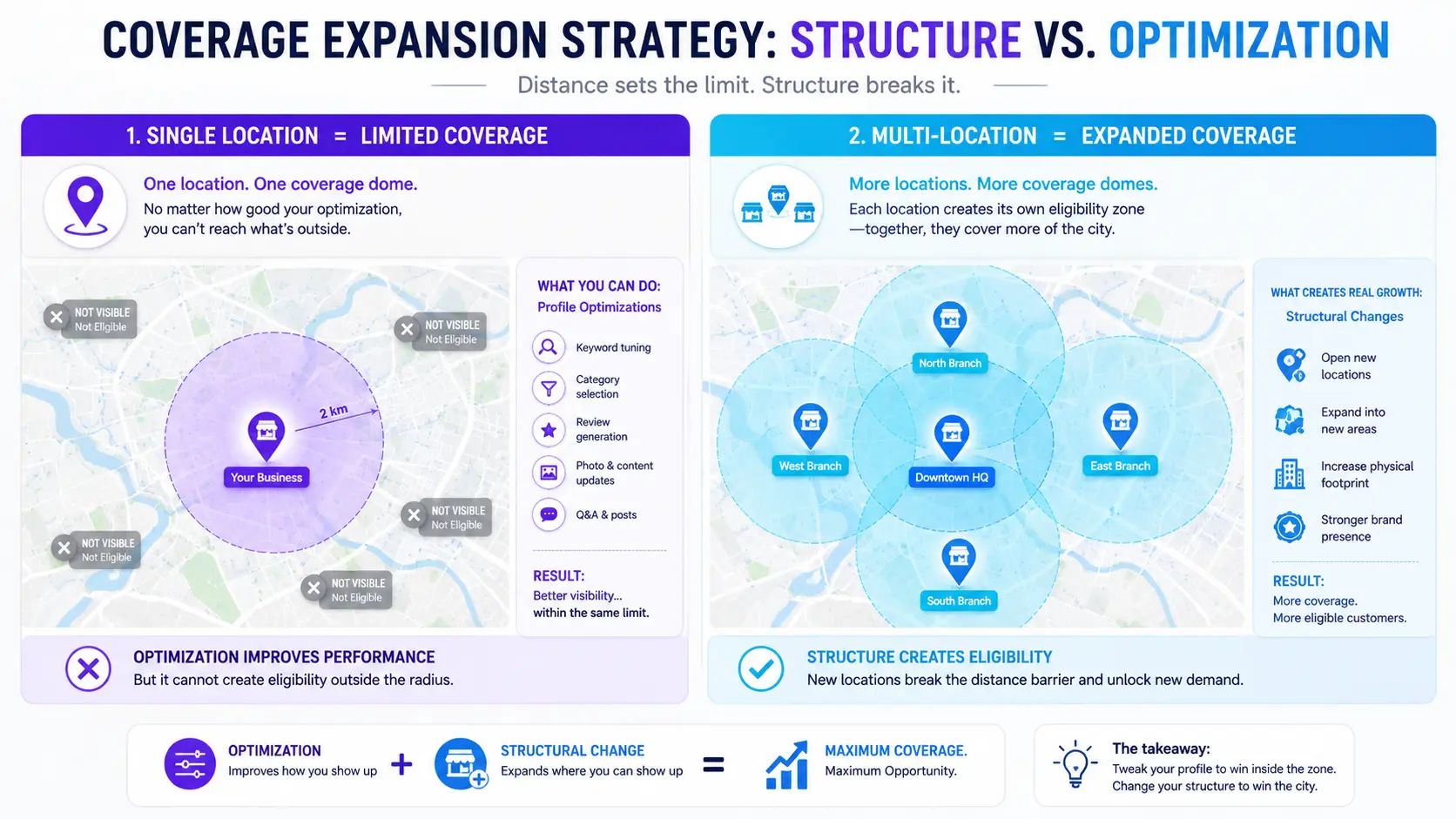
If your business shows up at the top in one corner of the city but evaporates from results a few miles away, piling on optimizations won’t bridge the gap.
Most assume that dialing in every field, category, or keyword can stretch their local visibility radius across an entire metro.
The reality: there’s a hard proximity constraint in local search – a boundary that no amount of tuning can fully erase.
Why a single location can’t cover an entire metro on its own
Think of local search like a spotlight attached to your front door: its intensity fades fast, even before you reach the edge of your neighborhood.
We’ve worked with businesses fixated on “fixing” visibility gaps, only to discover the map pack radius limitations are fundamentally geo-constrained – once you move past a certain distance, eligibility itself drops off.
It doesn’t matter if you’re the highest-rated provider in town; distance-limited local visibility gates your presence long before competitive factors weigh in.
A common myth is that centralizing your address – picking the “right” spot – can achieve city-wide domination. In practice, dense urban areas and sprawling suburbs respond differently, but the bottom line stays the same: local search reach limits mean a single pin cannot cover every relevant search across a metro.
One law firm we consulted saw 80% of their inbound calls come from zip codes within three miles, even though they ranked first for their category.
Physical presence shapes the entire visibility equation.
Want city-wide coverage?
The system demands more than minor changes – it wants more doors.
Conceptual approaches to extending visibility without tactics
Comparison of Approaches to Extending Local Visibility
| Market Type | Business Type | Density of Competitors | Visibility Radius Characteristic | Example |
| Dense Urban Core | Coffee Shop | High | Small radius, few blocks | Downtown coffee shop visible citywide but small radius |
| Dense Urban Core | Specialized Trade | Moderate-High | Small to moderate radius | Chiropractor with limited local visibility |
| Sprawling Suburb | General Retail | Low-Moderate | Extended radius, several miles | Suburban retailer with patchy but wide coverage |
| Sprawling Suburb | Low-density Trade | Low | Large radius | Specialized trades with far-reaching visibility |
Here’s where most strategies falter: they chase incremental tweaks (description edits, more reviews, content bursts) hoping to break through the geo wall.
But for true coverage expansion, the model itself must change – think multi-location footprint, local entities, or strategic partnerships, not just profile refinement.
Are you structuring the business itself to expand your local search proximity gate, or just rearranging deck chairs?
It’s like trying to broadcast on every household radio from a single rooftop; the signal fades, no matter how loudly you shout.
Only by moving transmitters – opening new presences – do you legitimately expand your geo-constrained visibility.
The difference between dominating a block and becoming metro-relevant isn’t better SEO tactics; it’s structural scale.
If your goal is to appear across the city, stop tuning and start designing for expansion.
The next move isn’t optimization. It’s architecture.

Scientific context and sources
The sources below provide foundational context for how decision-making, attention, and performance dynamics evolve under scaling and constraint conditions.
- Local Search and Proximity Effects
“Internet Advertising and the Generalized Second-Price Auction: Selling Billions of Dollars Worth of Keywords” – Benjamin Edelman, Michael Ostrovsky, Michael Schwarz – American Economic Review
Explores how search systems allocate visibility using ranking and auction mechanisms influenced by relevance and user context, foundational for understanding how geographic and proximity-based factors shape local search exposure.
https://papers.ssrn.com/sol3/papers.cfm?abstract_id=861164 - Scaling Business Operations and Market Density
“Micro-Foundations of Urban Agglomeration Economies” – Gilles Duranton, Diego Puga – Handbook of Regional and Urban Economics
Investigates how market density, geographic concentration, and agglomeration economies affect business performance and competitive visibility across urban environments.
https://www.nber.org/system/files/working_papers/w9931/w9931.pdf - Physical and Digital Visibility Limits
“Not All Transparency Is Equal: Source Presentation Effects on Attention, Interaction, and Persuasion in Conversational Search” – Jiangen He, Jiqun Liu – arXiv
Analyzes how source visibility, presentation format, and interface structure affect user attention and interaction behavior in search systems, demonstrating measurable visibility decay and engagement thresholds in digital environments.
https://arxiv.org/abs/2512.12207 - Location-Based Algorithmic Ranking
“Survey for Point-of-Interest Recommendation in Location-Based Social Networks” – Shenglin Zhao, Irwin King, Michael R. Lyu – arXiv
Details how spatial ranking models, geographic filtering, temporal signals, and contextual recommendation systems determine visibility and eligibility in location-based search environments.
https://arxiv.org/abs/1607.00647 - Firm Strategy and Multi-Location Expansion
“Diversity and Specialisation in Cities: Why, Where and When Does it Matter?” – Gilles Duranton, Diego Puga – Urban Studies
Examines how geographic expansion, density, and multi-location clustering influence business reach, specialization, and market visibility across urban systems.
https://journals.sagepub.com/doi/10.1080/0042098002104
Questions You Might Ponder
Why doesn’t my business appear in all neighborhoods during local searches?
Local visibility radius is determined by physical proximity and market density, not just optimization. Search engines show nearby listings first, applying strict geo-constraints. If your business is beyond a given area, you become ineligible, regardless of ranking signals or reviews.
Can I expand my local visibility radius with better reviews or more keywords
No. Reviews and keywords improve competitiveness within your eligible zone but cannot push your reach beyond built-in proximity limits. The local visibility radius is determined by algorithmic filters; profile enhancements alone do not expand where you can appear.
How does competitor density affect my business’s visibility across the city?
Higher competitor density shrinks your local visibility radius – especially in urban centers – since systems filter results more tightly. In sparse markets, like certain trades or suburbs, your reach extends further due to fewer nearby alternatives and a broader algorithmic coverage zone.
Why does my map pack ranking change from week to week or block to block?
Small shifts in searcher location, local intent, or competitive density trigger recalibration by algorithmic systems. This natural variability makes coverage zones fluid; fluctuations rarely signal malfunctions but reflect dynamic eligibility recalculated in real time.
What’s the most effective way to genuinely expand my local visibility radius?
Structural actions like opening new locations, forming local partnerships, or launching distinct local entities are essential. Algorithmic proximity gates resist incremental optimizations. Real expansion occurs by physically relocating or scaling your business footprint within the metro area.