
Table of Contents
Best PPC strategies for drug rehab centers are controlled paid search methods that help addiction treatment providers reach people actively searching for treatment while protecting budget, compliance, and lead quality.
They include intent-based keyword research, strict negative keyword lists, specific ad copy, location and device controls, treatment-focused landing pages, call tracking, CRM integration, conversion rate optimization, and regular budget reviews.
Strong rehab PPC does not aim for the cheapest clicks or the most leads.
It focuses on qualified inquiries, such as calls or forms from people who match the center’s services, location, payment model, and admissions criteria.
The goal is measurable, ethical growth from high-intent treatment searches.
Budgeting in drug rehab PPC is not just a finance task.
It is a growth control task.
Every dollar you put into search ads decides which treatment searches you compete for, which people reach your admissions team, and how quickly your campaign burns through spend before proving value.
That matters because addiction treatment advertising is expensive, regulated, and emotionally sensitive.
You are not buying casual traffic. You are trying to reach people at a moment when they may be scared, under pressure, or searching on behalf of someone they love.
So the budget has to do more than keep costs down.
It has to help you elevate your PPC campaigns while protecting margin, lead quality, compliance, and admissions capacity.

Introduction: Mastering Budgeting in Drug Rehab PPC Advertising
The mistake many centers make is simple:
They set a budget.
They launch campaigns.
They wait for leads.
But PPC does not reward passive spending.
It rewards controlled spending.
The centers that win are not always the ones with the biggest budgets. They are the ones that know where their money is going, which searches produce qualified calls, and where the campaign is quietly wasting spend.
Why Budgeting Matters in Rehab PPC Campaigns
PPC budget management is the backbone of a strong rehab marketing campaign.
Not because spreadsheets matter more than people.
Because poor budget control limits how many right-fit people you can reach.
When the budget is spent on broad, weak, or poor-fit searches, your ads may still get clicks. Your dashboard may still show leads. But your admissions team may spend time on inquiries that do not match your program, location, level of care, or payment model.
That is not efficient growth.
That is paid noise.
A better PPC budget asks sharper questions:
Which keywords produce qualified conversations?
Which campaigns attract poor-fit calls?
Which locations deserve more spend?
Which searches should be excluded?
Which ads generate clicks but not real opportunity?
Which landing pages convert traffic into serious next steps?
This is where budgeting becomes strategic.
It gives you control over reach, cost, and quality.
Without that control, campaign performance becomes fragile. You can spend more and still get weaker results.
The Landscape: Challenges in Drug Rehab Online Advertising
Drug rehab PPC is a difficult market.
Costs can be high. Competition is aggressive. Platform rules are strict. Messaging has to be careful. And every campaign has to respect the sensitivity of the person searching.
This creates pressure from several directions.
First, the market is crowded.
Treatment centers, directories, referral sites, local providers, national brands, and lead aggregators may compete for the same high-intent searches. That pushes costs up.
Second, compliance matters.
Drug rehab centers must follow advertising rules from platforms such as Google and Meta. They also need to avoid misleading claims, overpromising outcomes, or using messaging that creates privacy or trust concerns.
Third, intent varies widely.
A person searching “rehab” may want treatment, a job, a definition, a free resource, or a specific facility. If the campaign is not tightly managed, the budget can leak into searches that look relevant but do not convert into qualified admissions conversations.
That is why rehab PPC cannot be managed like a normal local lead generation campaign.
The stakes are different.
The rules are stricter.
The cost of poor targeting is higher.
The Benefits of Budget Management
Strong budget management does not only help you stay within a spending limit.
It helps you make better decisions.
When the budget is managed properly, you can see which parts of the campaign deserve more investment and which parts should be reduced, paused, or rebuilt.
That creates three clear benefits.
- Improved Visibility: A controlled budget helps your ads show for the searches that matter most, not just the searches that are easiest to buy.
- Better Resource Allocation: You can move spend toward campaigns, keywords, and locations that produce better-fit inquiries.
- Stronger ROI: ROI means return on investment. In plain terms, it tells you whether your ad spend is creating more value than it costs.
This is important because lead volume can mislead you.
A campaign can produce many leads and still be unprofitable if the inquiries do not fit the center.
A campaign can produce fewer leads but stronger outcomes if those inquiries are serious, qualified, and ready for an admissions conversation.
Budget management helps you see that difference.
Advertising Precision: The Secret Weapon of PPC Specialists
Good PPC specialists do not only look at spend.
They look at spend behavior.
That means they study the details:
Which keywords are spending too fast?
Which bids are too aggressive?
Which match types are too broad?
Which search terms should be blocked?
Which devices convert better?
Which hours produce serious calls?
Which landing pages waste traffic?
This level of precision matters in rehab PPC because small inefficiencies become expensive quickly.
A few weak keywords can drain budget.
A poor landing page can waste high-intent clicks.
A vague ad can attract the wrong searcher.
A bad conversion setup can teach Google Ads to optimize for the wrong lead.
That last point is critical.
If your campaign treats every form fill as a success, the platform may chase cheap conversions instead of qualified inquiries.
So budget control must connect to conversion quality.
The goal is not to get the most clicks.
The goal is to get the right clicks from people who may be a genuine fit for the care your center provides.
Strategic Budget Benefits: Efficiency, Allocation, and ROI
A well-managed PPC budget gives leadership a clearer growth system.
It shows where money is working and where it is only creating activity.
Here is what that unlocks.
- Improved Efficiency: You reduce wasted spend by cutting weak searches, poor-fit audiences, and underperforming placements.
- Enhanced Resource Allocation: You move money toward campaigns that produce qualified calls, better conversion rates, and stronger admissions opportunities.
- Boosted ROI: You improve return by spending on the demand that is more likely to become real pipeline.
This changes the role of the budget.
It stops being a fixed monthly number.
It becomes a decision tool.
If one campaign produces serious admissions conversations and another produces low-quality form fills, both should not be funded the same way.
If one keyword has a higher cost per click but better downstream quality, it may deserve more budget than a cheaper term with poor outcomes.
That is how PPC budget strategy becomes business strategy.
Balancing High Costs and Effective Outreach
Rehab PPC often involves a hard tradeoff.
The searches with the strongest intent can be expensive.
The cheaper searches often bring weaker intent.
So the answer is not always “lower the cost”.
Sometimes the better answer is “raise the quality of what the cost buys”.
That means managing budget around the full journey:
Search term.
Ad click.
Landing page.
Call or form.
Admissions conversation.
Qualified opportunity.
Admission outcome.
If you only measure the first half of that path, you may cut the wrong campaigns or scale the wrong ones.
Cost control is not about being cheap.
It is about making sure every dollar has a clear job.
Some dollars should protect brand visibility.
Some should capture urgent treatment searches.
Some should test new intent groups.
Some should support high-performing locations.
Some should be removed because they attract poor-fit traffic.
That is the work.
When your PPC budget is managed this way, it stops acting like a monthly expense.
It becomes a controlled growth lever.

Start today by refining your budget strategy.
Understanding Online Advertising for Drug Rehab Centers
Online advertising gives drug rehab centers something traditional marketing cannot offer with the same speed:
Visibility at the exact moment someone is searching for help.
That timing matters.
A person looking for treatment is often not browsing casually. They may be in crisis. A family member may be searching late at night. A spouse may be comparing options quietly. A parent may be trying to understand what to do next.
This is why PPC is so effective in addiction treatment marketing.
It does not wait for awareness to build slowly.
It meets demand when the search is already happening.
But PPC only works when the campaign is controlled. A rehab center can spend heavily and still attract the wrong inquiries if the keywords, ads, targeting, landing pages, and tracking are weak.
The goal is not just to appear online.
The goal is to appear for the right searches, with the right message, and turn that attention into qualified admissions conversations.
The Role of PPC in Drug Rehab Marketing
PPC gives rehab centers immediate visibility in search results.
That is the main advantage.
When someone searches for phrases like “alcohol detox near me”, “private drug rehab”, or “opioid treatment center”, PPC can place your center in front of that person at the moment they are already looking for options.
This is not passive exposure.
It is demand capture.
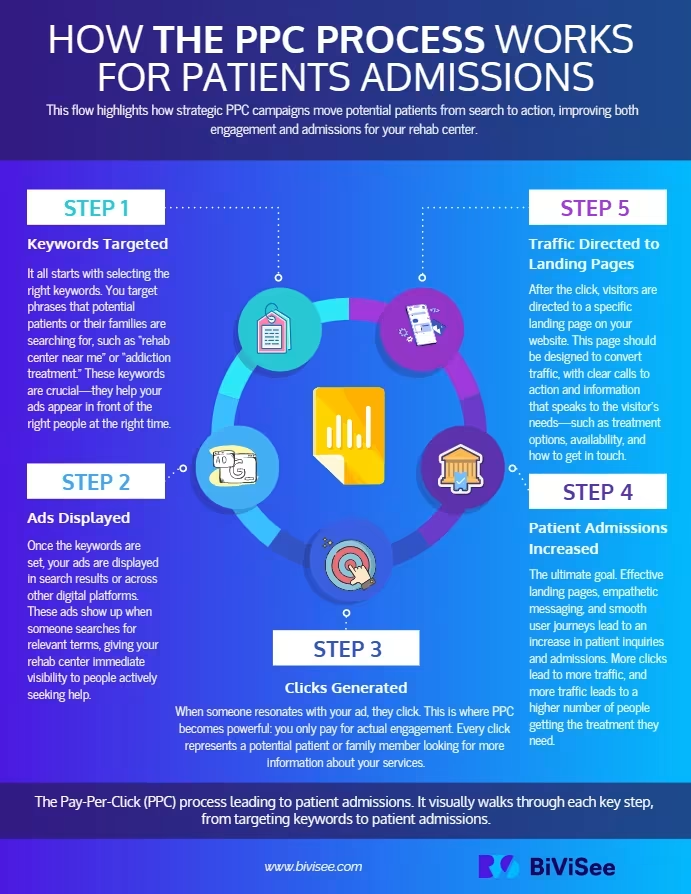
In simple terms, PPC works like paid placement in a high-intent moment. You choose the keywords you want to compete for. You write ads that match those searches. You send people to landing pages built for that specific need. You pay when someone clicks.
But the click is not the point.
The click is only the entry point.
For rehab centers, the real value comes from what happens after the click:
Does the person call?
Does the page answer their concern?
Does the inquiry match your treatment model?
Can admissions help them?
Does the campaign produce real opportunities, not just traffic?
That is why PPC should never be managed as a standalone ad channel.
It should connect search intent, ad copy, landing page, call tracking, and admissions feedback.
From a technical view, PPC platforms use algorithms to decide when and where ads appear. They look at factors like bid, keyword relevance, ad quality, expected click-through rate, landing page experience, and campaign settings.
But algorithms only work well when the strategy is clear.
If the campaign tells the platform that every form fill is valuable, the system may optimize toward easy leads. If the campaign tracks qualified calls and real admissions outcomes, it can become much more useful.
That is the difference between buying clicks and building a controlled growth system.
Benefits of Online Advertising for Drug Rehab Centers
Online advertising gives drug rehab centers three major advantages: speed, precision, and measurement.
Speed matters because treatment searches are often urgent.
SEO can be valuable, but it takes time. Social media can support awareness and trust, but it usually does not capture the same level of immediate intent. PPC can start generating visibility as soon as the campaign goes live.
Precision matters because not every searcher is a fit.
A center that offers private residential treatment should not waste budget on searches for free outpatient programs. A detox-focused center should not treat every rehab keyword the same way. A dual diagnosis program should speak clearly to people searching for addiction and mental health support together.
Online advertising makes that level of control possible.
You can target by:
- keyword intent
- location
- device
- time of day
- treatment category
- landing page
- campaign objective
- conversion type
Measurement matters because rehab PPC can get expensive quickly.
With the right tracking, you can see which searches produce clicks, which clicks become calls, and which calls become qualified admissions conversations.
That gives leadership a clearer view of what is working.
Without measurement, the campaign becomes guesswork.
You may know how many leads came in, but not whether those leads were useful. You may know how much was spent, but not which spend created real opportunity.
That is where many rehab PPC campaigns become weak.
They report activity instead of value.
Why PPC Advertising is Essential for Drug Rehab Centers
Drug rehab marketing has a timing problem.
People often search when the need becomes immediate.
That may happen after a relapse, a family conflict, a medical warning, a legal issue, or a private moment where someone realizes they cannot keep going the same way.
In that moment, the center that appears clearly and credibly has an advantage.
PPC helps with that.
It gives treatment centers a way to reach high-intent searchers without waiting months for organic rankings to improve.
The strongest benefits are clear:
- Increased visibility: PPC can place your center in front of people actively searching for treatment.
- Precise targeting: Campaigns can be shaped around location, treatment type, urgency, and search intent.
- Immediate results: Once campaigns are live, traffic and inquiries can begin quickly.
- Trackable performance: You can measure clicks, calls, forms, cost per inquiry, and downstream quality.
- Budget control: You can increase, reduce, or shift spend based on performance.
But PPC is not automatically profitable.
It can attract unqualified traffic if the strategy is too broad.
That is why PPC should be built around fit.
Fit means the person’s need matches your center’s services, location, payment model, level of care, and admissions process.
A campaign that produces fewer but better-fit inquiries may be more valuable than a campaign that produces high lead volume with weak quality.
That is the part executives should watch closely.
Lead volume is not the same as growth.
PPC vs Other Marketing Strategies for Rehab Centers
PPC is not the only marketing channel rehab centers need.
But it plays a specific role.
It captures existing demand.
SEO builds long-term visibility. It helps people find your center through educational content, local search results, service pages, and authority-building resources. But SEO takes time.
Social media can help with awareness, brand trust, education, and community visibility. But it is not always where urgent treatment decisions begin.
PPC is different.
It reaches people who are already searching.
That makes PPC especially useful for bottom-of-funnel demand, where the person may be closer to calling, comparing centers, or asking admissions questions.
The tradeoff is cost.
SEO does not charge for every click. PPC does.
That means poor strategy becomes expensive quickly.
If the campaign targets weak keywords, the budget disappears. If the landing page is vague, clicks do not convert. If tracking is poor, the platform learns from bad data. If admissions feedback is not connected, the campaign may optimize toward the wrong leads.
So PPC should not be judged only against SEO or social media.
It should be judged by its role in the full system.
SEO can educate.
Social can support trust.
PPC can capture urgent demand.
The website converts that demand.
Admissions turns the inquiry into a real conversation.
When these parts work together, marketing becomes more stable.
When they work separately, performance becomes harder to control.
Case Studies: Successful PPC Campaigns in the Rehab Industry
The best PPC results usually come from sharper strategy, not bigger spend.
For example, a treatment center focused on opioid addiction may perform better when it separates opioid-related searches from broad addiction keywords.
A search like “heroin detox near me” carries different intent than “what is opioid addiction”.
One suggests urgent treatment need.
The other suggests research.
Those searches need different campaigns, different ads, and different landing pages.
A center that builds around this difference can improve lead quality because the campaign speaks directly to the person’s situation.
Another common example is location control.
A rehab center may use geo-targeting to focus ads on cities, states, or regions that produce stronger admissions opportunities. This can reduce wasted spend from locations that rarely convert or do not match the center’s service model.
But location targeting needs care.
Some private or residential centers draw clients from outside the immediate area. Others are mostly local. A narrow radius may work for one center and limit another.
The strategy depends on how people actually choose the program.
The deeper lesson is this:
Successful PPC campaigns do not rely on one tactic.
They combine several controls:
- specific keywords
- strong negative keyword lists
- clear ad copy
- location strategy
- treatment-specific landing pages
- call tracking
- admissions feedback
- budget adjustments based on lead quality
That is how a campaign becomes sharper over time.
It learns which searches matter.
It cuts the searches that waste money.
It moves budget toward demand that can become real admissions opportunity.

Lead your team toward smarter advertising solutions that drive patient recovery and organizational growth.
Budget Management Strategies for PPC Campaigns
A rehab PPC budget can disappear quietly.
Not because the campaign is broken in an obvious way.
Because small leaks compound.
A broad keyword spends too much.
A weak ad attracts the wrong searcher.
A landing page converts, but into poor-fit inquiries.
A high-cost location keeps running because nobody checked lead quality.
A bidding strategy optimizes for form fills instead of qualified admissions conversations.
This is why budget management is not just about setting a limit inside Google Ads.
It is about controlling how money moves through the campaign.
In drug rehab marketing, that control matters more than in many other industries. The clicks are expensive. The decision is sensitive. The competition is intense. And not every lead has the same value.
A campaign that produces cheap leads may still be wasteful.
A campaign that produces fewer but stronger inquiries may be the one worth scaling.
So the real question is not:
“How much should we spend?”
The better question is:
“Which spend is creating qualified opportunities, and which spend is only creating activity?”
Setting a Realistic Budget for PPC Campaigns
A realistic PPC budget starts with the market.
You need to know what you are competing against before you decide what you can afford.
Rehab-related searches can be expensive because many providers are fighting for people with urgent intent. The cost can also shift by location, treatment type, keyword, competition, and how aggressive other advertisers are in the auction.
According to WordStream, average cost-per-click benchmarks vary by industry, and health-related categories can carry meaningful media costs. For rehab centers, the actual CPC can rise much higher when the keyword is high-intent, local, or tied to immediate treatment need.
That means your budget cannot be based on guesswork.
Start with four inputs:
- your monthly advertising budget
- expected cost per click
- expected landing page conversion rate
- expected qualified inquiry rate
Then connect those numbers to the business outcome that matters.
A form submission is not enough.
A phone call is not enough.
A lead is not enough.
You need to know how many qualified admissions conversations the campaign must produce to justify the spend.
For example, a campaign may generate 100 leads. But if only 10 match your care model, location, payment fit, and admission criteria, your real cost is not cost per lead. It is cost per qualified inquiry.
That is the number leadership should care about.
A practical budget should also leave room for learning.
If every dollar goes into the first version of the campaign, you have no space to test new keywords, ad copy, landing pages, or locations.
A better approach is to divide spend into two groups:
- proven campaigns that already produce qualified inquiries
- testing budget for new opportunities
This keeps the campaign stable while still allowing improvement.
Cost-Effective PPC Strategies
Cost-effective PPC does not mean chasing the cheapest click.
Cheap clicks often come from weak intent.
For rehab centers, the better goal is to lower wasted spend while protecting qualified demand.
Start with keyword discipline.
Separate high-intent searches from broad research searches. A person searching “private alcohol detox near me” is in a very different place from someone searching “what is alcohol addiction”. Both searches matter, but they should not carry the same budget priority.
Next, review search terms often.
This is where many campaigns leak money.
Google Ads may match your ads to searches that look relevant on the surface but do not fit your center. For example:
- rehab jobs
- free rehab
- state-funded rehab
- outpatient rehab, if you do not offer it
- Medicaid rehab, if you do not accept it
- addiction counselor salary
- rehab training
- research questions with no admissions intent
These searches can consume budget without creating real opportunity.
Negative keywords protect the account from this waste.
Then test ad copy.
The message affects who clicks.
A vague ad attracts vague traffic. A specific ad helps qualify the searcher before the click.
For example:
“Drug Rehab Center – Call Today”
This is broad.
“Private Residential Alcohol Treatment – Speak With Admissions”
This is clearer. It tells the searcher what type of care is offered and what the next step is.
Better ad copy can reduce waste because it helps the wrong-fit searcher self-select out before clicking.
Landing pages also affect cost.
If your ad promises “dual diagnosis treatment”, but the landing page speaks only about generic rehab, the visitor has to work too hard. That weak match can lower conversion quality and increase wasted spend.
A cost-effective campaign connects every layer:
Search intent.
Ad message.
Landing page.
Call or form.
Admissions feedback.
Budget decision.
That is how you pay for fewer bad clicks and more useful conversations.
Making Budget Decisions Based on Business Objectives
Budget decisions should match the center’s actual growth objective.
Not every campaign has the same job.
Some campaigns should generate immediate admissions inquiries.
Some should protect brand searches.
Some should test new geographic markets.
Some should support a new treatment line.
Some should help families understand next steps.
Some should be paused because they are not producing qualified demand.
This is where PPC becomes a leadership issue, not only a marketing task.
If the business objective is more private residential admissions, the budget should favor searches that suggest private residential fit.
If the objective is to fill detox capacity, the budget should favor detox-related searches with urgent intent.
If the objective is to grow a specific location, the budget should be controlled by geography and local search behavior.
If the objective is to improve profitability, the budget should shift away from low-quality lead volume and toward higher-fit inquiries.
This prevents one of the most common mistakes in rehab PPC:
Treating all leads as equal.
They are not equal.
A poor-fit inquiry may still look like a conversion in Google Ads. But it uses staff time and makes performance look better than it is.
Your budget should follow the strongest business signals, not the easiest platform signals.
How Different Stakeholders Should Read the Budget
A PPC budget means different things to different people inside a rehab organization.
Leadership looks at growth, margin, and predictability.
Admissions looks at call quality, urgency, and fit.
Marketing looks at keyword performance, conversion rates, and channel efficiency.
Finance looks at spend control and return.
The problem starts when each team uses a different definition of success.
Marketing may celebrate lower cost per lead.
Admissions may complain that the calls are weak.
Finance may question why spend is rising.
Leadership may only see that admissions are not increasing.
A better budget report connects all four views.
It should show:
- how much was spent
- which campaigns spent it
- how many leads were generated
- how many were qualified
- how many became admissions conversations
- which searches created poor-fit inquiries
- which campaigns deserve more budget
- which campaigns should be cut or rebuilt
This makes budget decisions easier.
You stop asking whether PPC “worked” in general.
You start asking which part worked, which part did not, and what should change next.
Cost Control Without Cutting Growth
Many teams react to high PPC costs by cutting budget.
Sometimes that is correct.
But often, the better move is to cut waste before cutting opportunity.
If a campaign is spending on weak searches, fix the keyword structure.
If forms are poor quality, improve the landing page and qualification path.
If calls are being missed, fix call handling before reducing media spend.
If one location performs badly, reduce spend there and shift it to stronger markets.
If one keyword is expensive but produces real admissions conversations, do not cut it only because the CPC looks high.
Cost control should be precise.
A lower budget can make performance worse if it removes spend from the only campaigns that were working.
The goal is not to spend less at any cost.
The goal is to make each dollar more accountable.
That means budget reviews should happen regularly, especially in active or high-spend campaigns.
Look for:
- keywords with spend but no qualified inquiries
- locations with high cost and poor fit
- ads with clicks but weak conversions
- landing pages with high bounce rates
- devices with poor conversion quality
- call times with missed opportunities
- campaigns optimizing toward low-value actions
Then make targeted changes.
Not emotional cuts.
Not broad reductions.
Targeted corrections.
When Budget Boundaries Help Performance
A budget limit can feel restrictive.
But in PPC, boundaries often improve discipline.
When the budget is unlimited or loosely managed, weak campaigns can survive too long. Poor keywords keep spending. Broad match expands too far. Testing becomes messy. Nobody is forced to decide what matters.
A controlled budget forces prioritization.
It makes the campaign answer hard questions:
Which searches are worth paying for?
Which inquiries are worth more?
Which campaigns deserve protection?
Which tests are worth funding?
Which conversions should count?
Which leads should not influence bidding?
This is where growth becomes cleaner.
You do not need to outspend every competitor.
You need to out-control them.
A rehab center with a disciplined budget, strong negative keywords, clear landing pages, and real admissions feedback can often compete more effectively than a center spending more with weaker control.
That is the real advantage.
Not more spend.
Better spend.

Consider how these insights can transform your approach to PPC management.
Best PPC Strategies for Drug Rehab Centers
Strong PPC performance rarely comes from one tactic.
It comes from a system.
Keyword research brings in the right searchers.
Ad copy earns the click.
Landing pages turn interest into action.
Tracking shows what happened after the click.
Admissions feedback tells you whether the lead was worth the spend.
When those pieces work together, PPC becomes much easier to manage.
When they do not, the campaign may still generate activity – but not the kind of activity that helps a rehab center grow.
This chapter covers the practical PPC strategies that matter most for drug rehab centers: keyword research, ad creation, landing page optimization, tracking, and ethical competitive execution.
Keyword Research and Selection
Keyword research is where the campaign starts making money or losing it.
The keywords you choose decide which searches you pay for. That means they also decide which people arrive on your landing page and which calls reach your admissions team.
In drug rehab marketing, broad keywords can be dangerous.
Terms like “rehab”, “addiction”, or “treatment center” may look attractive because they have volume. But they can carry unclear intent.
A person may be looking for:
- treatment for themselves
- help for a loved one
- free services
- outpatient care
- detox
- a job
- a definition
- a specific facility
- general research
The campaign pays for the click either way.
That is why keyword selection needs to focus on intent, not just search volume.
Use tools like Google Keyword Planner, SEMrush, and Ahrefs to understand search demand, keyword variations, competition, and estimated costs. These tools can help you identify which phrases have commercial intent and which ones are too broad to trust without tighter controls.
But tools should not make the final decision.
Your care model should.
A private residential treatment center should not chase the same terms as a public outpatient provider. A detox facility should not build the same keyword list as a long-term dual diagnosis program. A center serving families should also think differently from one focused mainly on self-referrals.
A stronger approach is to build keyword groups around clear intent:
- alcohol detox
- opioid treatment
- residential rehab
- dual diagnosis treatment
- private addiction treatment
- family help for addiction
- executive rehab
- local “near me” searches
- branded searches
- competitor and directory-related searches, where legally and ethically appropriate
Then refine each group with negative keywords.
This protects the budget from irrelevant searches like “jobs”, “training”, “free”, “salary”, “definition”, or payment models your center does not support.
A simple change can shift lead quality.
Instead of bidding broadly on “addiction treatment programs”, a center may perform better with more specific terms like “private alcohol rehab near me”, “residential opioid treatment center”, or “dual diagnosis treatment program”.
Specific keywords usually bring less volume.
But they often bring better intent.
And in rehab PPC, better intent usually matters more than more traffic.
Creating Effective PPC Ads
A PPC ad has very little space to do a difficult job.
It needs to earn attention, signal relevance, build trust, and make the next step clear.
For rehab centers, this has to be done with care.
The ad should not sound dramatic.
It should not shame the person searching.
It should not overpromise outcomes.
It should not create a false sense of certainty.
The best ad copy is clear, specific, and calm.
A weak ad says:
“Drug Rehab Center – Call Today.”
It may be understandable, but it does not explain why the searcher should trust the center or what kind of help is available.
A stronger ad says:
“Private Residential Alcohol Treatment”
“Speak With Admissions Today”
Or:
“Dual Diagnosis Addiction Treatment”
“Confidential Admissions Support Available”
These messages do more work.
They tell the searcher what the center offers. They help the wrong-fit person self-filter. They also make the next step feel practical.
Effective PPC ads usually include three core parts.
First, a clear headline.
This should match the searcher’s intent. If the person searched for alcohol detox, the ad should speak to alcohol detox. If the person searched for dual diagnosis treatment, the ad should not sound like a generic rehab ad.
Second, a useful call-to-action.
“Call Now”, “Speak With Admissions”, “Check Availability”, or “Talk Through Options” can work when they match the visitor’s stage.
Third, a relevant value point.
This may include privacy, residential care, medical detox support, dual diagnosis care, family guidance, or 24/7 admissions – only if those claims are true.
Small changes matter.
A different headline can change click quality. A more specific CTA can reduce weak leads. A clearer service description can prevent wasted clicks before they happen.
That is why ad copy should not be written once and ignored.
Test different angles:
- privacy
- urgency
- family support
- residential care
- detox support
- dual diagnosis
- admissions availability
- executive or professional needs
But judge the winner carefully.
The best ad is not always the one with the highest click-through rate.
It is the one that brings better-fit inquiries.
Optimizing Landing Pages
The landing page is where the campaign proves whether the click was worth paying for.
The ad creates expectation.
The landing page either confirms it or breaks it.
A person who clicks an ad for “private alcohol rehab” should not land on a generic page about all addiction services. A family member searching for help should not have to dig through navigation to find the phone number. A mobile visitor should not have to wait for a slow page to load while trying to make a difficult decision.
The landing page must make the next step easy.
A strong rehab PPC landing page includes:
- a headline that matches the search intent
- a clear explanation of the treatment option
- visible phone number and click-to-call button
- short, direct form if forms are used
- trust signals such as licenses, accreditations, or certifications
- privacy reassurance
- clear next-step language
- mobile-first design
- fast load speed
- limited distractions
The page should answer the visitor’s hidden questions fast:
Is this the right kind of care?
Can I talk to someone now?
Will this be private?
Can my family call?
What happens after I call?
Is this center credible?
Does this match my situation?
Design matters, but design is not decoration.
Good design reduces friction.
It helps the person understand the offer, trust the page, and take action without feeling lost.
A/B testing helps improve the page over time. Test headlines, CTA wording, form length, phone number placement, trust signal order, and page length.
But do not judge tests only by total conversions.
A page that creates more forms but worse leads is not better.
For rehab PPC, landing page optimization should measure both conversion rate and lead quality.
The goal is not just more actions.
The goal is more useful actions.
Tracking and Analytics
If tracking is weak, PPC decisions become guesses.
And in rehab PPC, guesses get expensive.
You need to know more than how many people clicked.
You need to know which keywords produced serious inquiries, which ads attracted poor-fit traffic, which landing pages converted well, and which calls moved toward admissions.
Basic tracking should include:
- impressions
- clicks
- click-through rate
- cost per click
- landing page conversion rate
- form submissions
- phone calls
- cost per lead
- qualified call rate
- booked assessments
- admissions outcomes, where available
Google Ads can show ad and keyword performance.
Google Analytics can show what users do after they land on the site.
Call tracking can connect phone calls back to campaigns, keywords, and landing pages.
CRM data can show what happened after the inquiry.
That last part is critical.
Without CRM or admissions feedback, the campaign may optimize toward whatever is easiest to measure.
That often means more form fills or more calls, even if those leads are not qualified.
A better reporting system connects marketing activity to business quality.
For example:
A campaign may have a low cost per lead but poor admissions fit.
Another campaign may have a higher cost per click but better qualified call quality.
The second campaign may deserve more budget.
You cannot know that unless tracking goes beyond the platform dashboard.
Ethical and Compliance-Aware PPC Execution
Drug rehab advertising needs restraint.
Competitive markets often push advertisers toward aggressive claims, emotional pressure, or vague promises. That is risky.
In addiction treatment, trust is part of the conversion path.
Ads should not imply guaranteed recovery.
They should not shame the searcher.
They should not exploit fear.
They should not use misleading claims.
They should not create privacy concerns.
They should not target in ways that violate platform rules or sensitive-category standards.
The best PPC strategy is not only effective.
It is defensible.
That means your ads and landing pages should use clear, accurate language. Claims should be supported. Treatment descriptions should match real services. Privacy and admissions information should be easy to understand.
You can still be persuasive.
But persuasion should come from relevance, clarity, and trust – not pressure.
This matters for compliance.
It also matters for performance.
People making treatment decisions need confidence. They are more likely to take action when the message feels credible, specific, and respectful.
That is how ethical PPC supports growth.
Not as a limitation.
As a filter for stronger, more sustainable demand.
Testing, Refinement, and Scaling
Scaling rehab PPC before the campaign is clean can make waste bigger.
So scale should come after proof.
Before increasing budget, check:
- Are the best keywords clear?
- Are poor-fit searches blocked?
- Are landing pages matched to intent?
- Are calls tracked correctly?
- Are form submissions qualified?
- Does admissions confirm lead quality?
- Are campaigns separated by service line or intent?
- Is the bidding strategy using the right conversion signals?
If the answer is no, scaling may only amplify the problem.
A better process is:
Test.
Measure.
Tighten.
Confirm quality.
Then scale.
This keeps the campaign from growing in the wrong direction.
For example, if a detox campaign produces strong calls, you may raise budget there before expanding broad rehab terms. If a dual diagnosis landing page converts well and produces qualified calls, you may build more keyword coverage around that intent. If one location performs poorly, you may reduce spend there and test another market.
Scaling should follow evidence.
Not hope.

Take the lead and revitalize your online presence today.
Monitoring and Adjusting PPC Campaigns
A PPC campaign should never be treated like a vending machine.
You do not put budget in and wait for admissions to come out.
The market moves too fast for that.
Competitors change bids.
Search behavior changes.
Keyword costs rise.
Ad fatigue appears.
Landing pages stop performing.
Calls come in from the wrong-fit audience.
A bidding strategy that looked efficient last month starts chasing weaker leads this month.
This is why monitoring matters.
Not as a reporting habit.
As a protection system.
For drug rehab centers, every paid click has to earn its place. If it does not, the campaign can keep spending while slowly drifting away from real business outcomes.
The goal is not to watch every number every hour.
The goal is to know which numbers actually matter, what they mean, and what should change when performance moves.
Tracking and Analyzing Performance Metrics
Most PPC dashboards show too much data and too little meaning.
You can see impressions, clicks, CTR, CPC, CPA, conversion rate, keyword cost, device performance, location performance, and more.
But not every metric deserves the same attention.
For rehab PPC, the most important metrics are the ones that show whether paid traffic is becoming qualified admissions opportunity.
Start with the basics:
- Click-through rate (CTR): Shows whether your ad is relevant enough to earn clicks.
- Conversion rate: Shows whether the landing page turns visitors into calls, forms, or other desired actions.
- Cost per acquisition (CPA): Shows how much you pay for a conversion.
- Return on investment (ROI): Shows whether spend creates more value than it costs.
These are useful.
But they are not enough.
A high CTR may simply mean the ad is broad or emotionally strong. It does not prove the searcher is a fit.
A low CPA may look efficient, but it may come from weak form fills that admissions cannot use.
A high conversion rate may look good, but if the calls are poor quality, the campaign is not working as well as the dashboard suggests.
This is the central problem in rehab PPC:
Platform metrics can make weak demand look successful.
That is why performance analysis needs two layers.
The first layer is platform performance.
This includes clicks, impressions, CTR, CPC, conversion rate, CPA, Quality Score, search terms, and landing page performance.
The second layer is business performance.
This includes qualified calls, booked assessments, admissions conversations, admission outcomes, poor-fit inquiries, missed calls, and payment-fit issues.
You need both.
Without platform metrics, you cannot fix the campaign mechanics.
Without business metrics, you cannot tell whether the campaign is producing real value.
Tools like Google Analytics help show what happens after someone clicks. You can see which pages visitors engage with, where they drop off, and which paths lead to conversions.
But even Google Analytics should not be the final source of truth.
It shows behavior.
Admissions data shows quality.
The strongest reporting connects both.
Building a Performance Review Routine
PPC optimization works best when it follows a rhythm.
Not random checks.
Not panic changes.
Not waiting until spend feels too high.
A rehab center should have a clear review routine.
A weekly review can focus on tactical control:
- search terms
- wasted spend
- negative keywords
- budget pacing
- poor-performing ads
- mobile performance
- landing page issues
- sudden CPC changes
- missed-call patterns
A monthly review can focus on business impact:
- cost per qualified inquiry
- call quality by campaign
- lead quality by location
- admissions feedback
- strongest treatment-intent groups
- campaigns that deserve more budget
- campaigns that should be reduced or rebuilt
- conversion trends by landing page
- ROI direction
This structure prevents overreacting to small changes while still catching major problems early.
For example, one bad day does not mean a campaign is failing.
But three weeks of weak qualified-call quality is a signal.
One expensive keyword may not be a problem if it produces admissions conversations.
But a keyword that spends heavily and produces poor-fit inquiries should be reduced, paused, or rebuilt.
The review routine should turn data into action.
That means each review should end with clear decisions:
What stays?
What changes?
What gets tested?
What gets paused?
What needs admissions feedback?
What needs landing page work?
If the meeting ends with “we will keep watching it”, nothing has really changed.
Budget Allocation Based on Performance
Budget allocation should follow evidence.
Not opinion.
Not habit.
Not the campaign structure from launch day.
If a campaign produces qualified inquiries, it deserves protection.
If a campaign produces clicks but weak conversations, it needs correction.
If a campaign spends budget without clear value, it should not keep running just because it has always been there.
Budget should be reviewed across several dimensions:
- campaign
- ad group
- keyword
- search term
- location
- device
- time of day
- landing page
- treatment category
- conversion quality
This helps you avoid one of the biggest PPC mistakes:
Cutting budget from what works and funding what only looks busy.
A campaign with a higher CPC may be worth more if the calls are serious.
A campaign with a lower CPA may be worth less if the leads do not match your treatment model.
This is why budget allocation should not be based on cost alone.
It should be based on cost plus quality.
Ask:
Which campaigns create qualified admissions conversations?
Which keywords attract the right treatment need?
Which locations produce better-fit calls?
Which devices convert into real inquiries?
Which landing pages move people toward the next step?
Which parts of the account create noise?
Then move budget accordingly.
This is how PPC becomes sharper over time.
You do not need every campaign to grow.
You need the right campaigns to grow.
Adjusting Bids Without Losing Control
Bid changes can improve performance.
They can also make waste bigger if they are based on the wrong signal.
For example, raising bids on a keyword because it has many conversions may look logical.
But if those conversions are mostly poor-fit inquiries, the campaign will spend more to create more of the wrong outcome.
Before adjusting bids, check the quality behind the metric.
A bid increase may make sense when:
- the keyword produces qualified calls
- the landing page converts well
- admissions feedback is positive
- the campaign has room to scale
- impression share is limited by budget or rank
- the cost still works against expected revenue
A bid decrease may make sense when:
- clicks are expensive but weak
- calls do not qualify
- the term attracts the wrong audience
- the search intent is too broad
- conversion quality has declined
- the landing page does not match the search
Automated bidding can help, but only when the conversion signal is clean.
If Google Ads is optimizing toward all form fills, it may chase form fills.
If it is optimizing toward qualified actions, it can work better.
That is why conversion setup matters before automation.
Bad data does not become good strategy because automation is involved.
Using Search Term Data to Cut Waste
Search term reports are one of the most important tools in rehab PPC.
They show what people actually typed before clicking your ads.
This is where you find the truth.
Your keyword may be “drug rehab center”, but the actual search terms may include:
- rehab jobs
- free drug rehab
- court ordered rehab
- state funded rehab
- outpatient rehab
- addiction counselor certification
- drug rehab meaning
- rehab near me for a friend
- private inpatient rehab near me
Some of these may be useful.
Some may be waste.
You cannot know unless you review them.
Search term reviews help you do three things.
First, add negative keywords to block poor-fit traffic.
Second, find new high-intent terms worth adding as exact-match or phrase-match keywords.
Third, discover new landing page opportunities when search intent is strong but not yet served well.
For example, if many qualified searches mention “dual diagnosis”, that may justify a dedicated campaign and landing page.
If many poor-fit searches mention “free”, “jobs”, or “Medicaid”, those terms may need to be excluded, depending on your center’s model.
This is not small maintenance.
It is budget defense.
Every irrelevant search you block helps the budget work harder.
Monitoring Landing Page Performance
A PPC campaign can be well-built and still fail on the landing page.
That is why landing page performance needs constant review.
Look at:
- conversion rate
- mobile conversion rate
- page speed
- bounce rate
- scroll depth
- form completion rate
- click-to-call rate
- CTA engagement
- call quality from that page
- differences by traffic source or campaign
A landing page should match the search that brought the visitor there.
If someone searches for alcohol detox, the page should clearly speak to alcohol detox.
If someone searches for private residential treatment, the page should not feel like a generic addiction information page.
If someone searches on behalf of a loved one, the page should make it clear that families can call for guidance.
The page should not force the visitor to interpret the offer.
It should reduce uncertainty.
If a landing page gets clicks but few actions, the issue may be clarity, speed, trust, CTA placement, or message mismatch.
If a page gets many actions but poor-quality leads, the issue may be overbroad copy, weak qualification, or unclear service fit.
Both problems matter.
The first wastes clicks.
The second wastes admissions time.
- add these negative keywords
- increase budget here
- reduce spend there
- test this landing page
- rewrite this ad group
- review these calls
- check these locations
- fix mobile page speed
- separate this intent into its own campaign
That is how monitoring turns into growth control.
When to Pause, Rebuild, or Scale
Not every weak campaign should be paused immediately.
Sometimes it needs cleaner tracking.
Sometimes it needs stronger negative keywords.
Sometimes it needs a better landing page.
Sometimes it needs more time and data.
But some campaigns should not keep spending.
Use this decision framework.
Pause when the campaign has clear spend, enough data, and no qualified outcomes.
Rebuild when the intent is valuable but the structure is wrong.
Scale when performance is strong, lead quality is confirmed, and the campaign still has room to capture more demand.
This prevents two mistakes.
The first mistake is killing campaigns too early.
The second mistake is letting weak campaigns survive too long.
A campaign should earn more budget through evidence.
Not through hope.
Turning Reporting Into Action
Reports are only useful if they change decisions.
A good PPC report should not just say:
“CTR increased by 8%.”
“CPA decreased by 12%.”
“Conversions are up.”
It should explain what those changes mean.
Did lead quality improve?
Did admissions confirm better fit?
Did conversion volume rise because of strong demand or because the campaign became too broad?
Did CPA fall because the campaign improved or because it started attracting easier, weaker leads?
Should budget move, stay, or be reduced?
That is the difference between reporting and management.
Drug rehab PPC needs management.
The market is too competitive and the decisions are too sensitive for passive reporting.
A useful report should lead to clear actions.

Harness the power of analytics for transformative growth.
Conversion Rate Optimization (CRO) for Rehab PPC Campaigns
PPC does not end when someone clicks the ad.
That is where the most expensive part begins.
You already paid for the visitor. Now the landing page has to help that person take the next step.
If the page is unclear, slow, generic, or hard to use, the click is wasted. If the page creates form fills but those forms are poor-fit, the budget still leaks. If the page gets calls but admissions cannot work those calls, the campaign may look good in the dashboard while performing badly in the business.
That is why Conversion Rate Optimization, or CRO, matters so much in rehab PPC.
CRO is not about tricks.
It is about making the path from ad click to qualified inquiry clearer, easier, and more trustworthy.
For drug rehab centers, this has to be handled with care. The visitor may be scared, overwhelmed, private, or searching for someone else. The page should not pressure them. It should help them understand what to do next.
Understanding Conversion Rate Optimization
Conversion Rate Optimization means improving the percentage of visitors who take the action you want them to take.
That action may be:
- calling admissions
- submitting an inquiry form
- starting a chat
- requesting availability
- booking a consultation
- taking the next step in the admissions process
In plain terms:
You are trying to get more value from traffic you already paid for.
That matters because PPC clicks in addiction treatment can be expensive. If your campaign drives 1,000 visitors and only a small number take action, the issue may not be traffic volume. The issue may be the page, the message, the offer, the trust signals, or the conversion path.
CRO is essential because it helps campaigns produce real outcomes, not just visits.
But for rehab centers, CRO needs a more serious definition.
It is not only about increasing the number of conversions.
It is about increasing the number of qualified conversions.
A page that creates more form submissions but sends more poor-fit inquiries to admissions is not better.
A page that creates fewer total leads but more serious conversations may be much stronger.
That is the difference.
CRO should improve both quantity and quality.
Why CRO Matters in Drug Rehab PPC
Every click has a cost.
Every poor-fit inquiry also has a cost.
It takes admissions time. It creates reporting noise. It can push Google Ads toward the wrong conversion signals. It can make leadership think PPC is working or failing for the wrong reasons.
This is why CRO matters beyond the landing page.
A strong CRO process helps answer these questions:
Is the page matching the search intent?
Is the headline clear?
Is the phone number easy to find?
Is the form too long or too vague?
Do visitors understand what happens after they call?
Does the page build trust quickly?
Does the page attract the right-fit person?
Does it filter out people the center cannot help?
Do conversions turn into qualified admissions conversations?
Most teams stop too early.
They ask, “Did the page convert?”
A better question is:
“What kind of person did the page convert?”
That question changes everything.
Implementing CRO Strategies
A good CRO strategy starts with the visitor’s state of mind.
Someone clicking a rehab ad is not casually shopping. They may be acting under pressure. They may have already visited several sites. They may be afraid to call. They may not know whether the center is right for their situation.
The page should reduce that uncertainty fast.
Start with the core message.
The headline should match the ad and the search.
If the ad says “private alcohol treatment”, the landing page should say that clearly. If the ad says “dual diagnosis rehab”, the page should not lead with generic addiction treatment language.
Then make the next step obvious.
The visitor should know:
- who to call
- what happens after calling
- whether family can call
- whether the conversation is private
- what treatment type is available
- whether the program matches their likely need
- what information admissions may ask for
The goal is not to overload the page.
The goal is to remove friction.
Techniques for Success
A/B Testing
A/B testing compares two versions of a page or page element to see which performs better.
For rehab PPC, you might test:
- headline A vs headline B
- “Call Admissions Now” vs “Speak With a Specialist”
- short form vs more qualified form
- phone-first layout vs form-first layout
- trust signals above the fold vs lower on the page
- family-focused copy vs self-directed copy
- detox-specific page vs general treatment page
A/B testing helps reduce guesswork.
But the test must be judged correctly.
Do not choose the winner only by total conversions.
Check lead quality.
If Version A generates 40 form fills and 4 qualified calls, while Version B generates 25 form fills and 10 qualified calls, Version B may be the better business asset.
That is how CRO should be measured in rehab PPC.
User Feedback
User feedback can show why people hesitate.
Surveys, feedback forms, call notes, chat transcripts, and admissions conversations can all reveal problems that analytics alone may miss.
For example, visitors may wonder:
- whether the call is confidential
- whether family members can contact the center
- whether treatment is available now
- whether detox is included
- whether the center treats dual diagnosis
- whether insurance or private pay is required
- what happens after the first call
These concerns should shape the page.
If people repeatedly ask the same question during calls, the landing page may not be answering it clearly enough.
Good CRO uses real language from real inquiries.
That makes the page more useful.
Practical Implementation
CRO should make the visitor’s path simpler.
The page should not feel like a maze.
A person who clicks an ad should not need to navigate through several pages to find the phone number, treatment type, or admissions step.
The page should have one primary goal.
For most rehab PPC campaigns, that goal is a call.
That means the phone number should be visible, clickable on mobile, and repeated in logical places. If a form is used, it should be short enough to complete but specific enough to improve lead quality.
Strong implementation usually includes:
- a search-intent-matched headline
- a clear subheadline
- one primary CTA
- visible click-to-call button
- short and clear form
- trust signals near the top
- privacy reassurance
- simple treatment explanation
- common questions answered
- fast mobile load speed
- minimal navigation distractions
The pathway from ad to inquiry should feel natural.
Ad promise.
Landing page confirmation.
Trust proof.
Next step.
Call or form.
That is the structure.
Using Analytics and Behavior Data
Advanced tracking is essential for CRO.
Without it, you may know that a page did or did not convert, but not why.
Use analytics tools to review:
- landing page conversion rate
- mobile vs desktop performance
- scroll depth
- click-to-call rate
- form abandonment
- bounce rate
- page speed
- CTA clicks
- time on page
- call quality by page
- conversion quality by campaign
Tools like Google Analytics can help show what visitors do on the page. Tools like Hotjar can help show user behavior through heatmaps and recordings.
But analytics should not be interpreted in isolation.
A page with a high conversion rate may still produce poor leads.
A page with a lower conversion rate may produce stronger calls.
That is why CRO data should connect with admissions feedback.
You need to know not only where people clicked, but whether those clicks became serious conversations.
To illustrate, a comparison table of conversion rates before and after implementing CRO strategies can provide a clear picture of success:
| Conversion Metric | Before CRO | After CRO |
|---|---|---|
| Website Conversion Rate | 3% | 5% |
| Lead Form Completion | 50 per month | 80 per month |
| Cost Per Acquisition (CPA) | $120 | $85 |
CRO and Landing Page Message Match
Message match is one of the simplest CRO principles.
It means the landing page should continue the same promise that brought the visitor there.
If the keyword is “alcohol detox near me”, the ad should mention alcohol detox, and the landing page should clearly explain alcohol detox support.
If the keyword is “private drug rehab”, the ad should speak to private care, and the page should make privacy and treatment structure clear.
If the keyword is “dual diagnosis treatment”, the page should explain addiction and mental health care together.
Weak message match creates doubt.
The visitor clicks one thing and lands on something broader. That forces them to interpret whether the center can help.
In a sensitive decision, friction kills action.
Strong message match helps the person feel:
“I am in the right place.”
That feeling matters.
CRO Should Qualify, Not Just Convert
Many landing pages are built to get the most leads possible.
That can be a problem.
In rehab PPC, the page should help the right person take action and help the wrong-fit person avoid wasting their time and yours.
This does not mean being cold or exclusionary.
It means being clear.
If your center offers residential treatment, say so.
If your center specializes in private care, say so.
If you provide dual diagnosis support, say so.
If family members can call, say so.
If you do not offer a service, avoid writing the page in a way that suggests you do.
Clear positioning improves trust.
It also improves lead quality.
A qualified conversion is more valuable than a vague conversion.
Common CRO Problems in Rehab PPC
Many rehab PPC landing pages struggle with the same issues.
The headline is too generic.
The phone number is hard to find.
The form asks too much too soon.
The page loads slowly on mobile.
The copy sounds like every other treatment center.
The CTA is vague.
The page lacks trust signals.
The treatment type is unclear.
The page does not explain what happens after the call.
The campaign sends every keyword to the same landing page.
Each issue creates friction.
Some friction stops people from calling.
Other friction attracts the wrong inquiries.
Both hurt performance.
CRO is the process of finding these weak points and fixing them one by one.
Building a CRO Feedback Loop
CRO should be continuous.
A landing page should not be designed once and ignored for a year.
Review it regularly with both marketing and admissions data.
Use this loop:
- Review PPC traffic and conversion data.
- Review call quality and form quality.
- Identify where the page creates friction.
- Build a clear test.
- Run the test long enough to get useful data.
- Compare conversion volume and lead quality.
- Keep what improves business outcomes.
- Repeat.
This turns CRO into a working system.
It also prevents random changes.
You are not redesigning based on taste.
You are improving based on evidence.
CRO as a Growth Lever
CRO can improve PPC economics without increasing ad spend.
That is why it is so valuable.
If the same budget produces more qualified conversations, your cost per qualified inquiry goes down.
If the page helps visitors understand the next step faster, admissions may receive better-prepared calls.
If the page filters poor-fit traffic more clearly, the team wastes less time.
If the page matches the search intent better, Google Ads may also see a stronger landing page experience.
This is why CRO is not just a website task.
It is part of PPC performance.
And for rehab centers, it can be one of the fastest ways to improve paid media results without simply spending more.

Conclusion
Drug rehab PPC is not won by spending more.
It is won by spending with control.
That is the thread running through every strategy in this guide.
A campaign can have strong visibility and still waste money. It can generate leads and still fail admissions. It can lower cost per click and still attract the wrong people.
That is why budgeting, targeting, tracking, and conversion quality have to work together.
The goal is not to make PPC look good in a dashboard.
The goal is to help the right people find the right treatment option at the right moment, while protecting your budget, your team, and your growth model.
For rehab centers, this means every part of the campaign needs a job.
Keywords decide which searches you pay for.
Ads decide who clicks.
Landing pages decide whether people take action.
Tracking decides what the platform learns.
Admissions feedback decides whether the campaign is actually valuable.
Budget reviews decide what gets scaled, fixed, or stopped.
When those parts are disconnected, PPC becomes expensive activity.
When they are aligned, PPC becomes a controlled growth channel.
What Leaders Should Take From This
If you are responsible for growth, the main question is not whether PPC can work.
It can.
The better question is whether your PPC system is disciplined enough to create qualified demand without wasting budget on the wrong searches.
That requires a different way of reading performance.
Do not stop at clicks.
Do not stop at leads.
Do not stop at cost per acquisition.
Look deeper.
Which campaigns produce qualified admissions conversations?
Which searches create poor-fit calls?
Which landing pages convert the right people?
Which locations deserve more spend?
Which bidding strategies are learning from clean data?
Which parts of the budget are buying activity instead of opportunity?
Those answers matter more than broad channel performance.
A rehab PPC campaign does not need more noise.
It needs cleaner signals.
The Real Role of Optimization
Optimization is not a one-time improvement.
It is the operating rhythm of PPC.
Search behavior changes. Competitors change. Costs change. Platform automation changes. Lead quality changes. A campaign that worked last quarter may need different controls today.
That means your team needs a repeatable process:
Review search terms.
Add negative keywords.
Check call quality.
Compare landing pages.
Inspect mobile performance.
Review budget allocation.
Test ads.
Feed admissions data back into campaign decisions.
This is not busywork.
It is how you keep the account from drifting.
Without this process, PPC performance often declines slowly. The dashboard may still show conversions, but the business may feel less benefit.
That gap is where money gets lost.
Final Thought
Drug rehab PPC sits at the intersection of demand, trust, urgency, and compliance.
That makes it more demanding than ordinary lead generation.
But it also makes strong execution more valuable.
A carefully managed PPC system can help a treatment center reach people who are actively searching for help. It can give families a clearer next step. It can help admissions teams speak with better-fit inquiries. It can show leadership where spend is creating value and where it needs to be cut or rebuilt.
The centers that win with PPC will not be the ones that simply outbid competitors.
They will be the ones that out-measure, out-refine, and out-control them.

Questions You Might Ponder
How do I ensure my PPC budget remains effective amid fluctuating costs and competition?
To keep your PPC budget effective, continuously monitor and adjust your campaigns based on performance data. Utilize tools such as Google Analytics for real-time insights. Implement A/B testing for ad copies and landing pages, and consider seasonal trends that may affect keyword costs. Regularly adjust bidding strategies to optimize cost per click (CPC) and ensure your ads stay competitive without overspending.
What specific compliance regulations should I be aware of when advertising for drug rehab services online?
Compliance regulations for drug rehab advertising can vary by region but generally include requirements to avoid misleading claims, ensure privacy standards, and follow advertising guidelines set by platforms like Google and Facebook. Familiarize yourself with the Health Insurance Portability and Accountability Act (HIPAA) for privacy concerns in the U.S. Additionally, review the platform-specific policies to avoid ad disapprovals and potential penalties.
How can I integrate new digital advertising trends into my existing PPC strategy for drug rehab marketing?
To integrate new digital advertising trends, stay updated with industry news and best practices. Embrace video ads, voice search optimization, and AI-driven personalization to enhance engagement. Incorporate social proof elements, like testimonials, in your PPC campaigns. Test new ad formats and track their performance. Use advanced targeting options such as lookalike audiences on platforms like Facebook to reach more potential clients more effectively.
What are some examples of successful case studies in drug rehab PPC advertising, and what can be learned from them?
Successful case studies often involve integrating robust keyword strategies, engaging ad copies, and optimized landing pages. For instance, a rehab center might double patient inquiries by targeting keywords like ‘holistic addiction treatment’ and ‘top-rated rehab near me’. Key takeaways include the importance of keyword specificity, compelling CTAs, and constant iteration based on data insights. These elements combined significantly improve click-through and conversion rates.
How do I balance ethical considerations with competitive marketing strategies in drug rehab PPC campaigns?
Balancing ethical considerations with competitive strategies involves transparent communication, respecting user privacy, and avoiding sensationalist or misleading claims. Prioritize empathic, informative ad copy and provide clear, accurate information about your services. Focus on user experience by creating supportive and helpful content that genuinely addresses their needs. An ethical approach not only builds trust but often leads to higher quality leads and sustainable business growth.
What steps can you take today to transform your advertising strategy into a powerhouse for growth? Seize the moment – unlock powerful pathways to cost control and performance optimization.