What You’ll Learn
Speed KPIs distort behavior when response-time targets become the goal instead of better lead quality, trust, conversion, or customer outcomes.
Teams may rush outreach, skip qualification, log activity just to stop the clock, misclassify leads, create incomplete CRM records, or use automation to hit timing metrics without improving real engagement.
Speed can help when a qualified buyer is ready, but speed-only KPIs often push teams toward shallow contact, poor-fit meetings, diluted ownership, CRM distrust, and lower close rates.
The distortion appears when response times improve while conversions, lead quality, engagement, forecast trust, or customer confidence decline.
Key Takeaways
- Overemphasizing speed KPIs distorts staff behavior, causing rushed, low-quality interactions that erode trust and decrease actual conversions.
- Automation amplifies underlying process flaws when paired with speed KPIs, resulting in misfit leads, poor CRM data, and operational chaos.
- Poor decision ownership and fragmented accountability exacerbate the downside of speed metrics, leading to activity without true outcome progress.
- Teams should deprioritize speed KPIs whenever they sacrifice fit, qualification, or ownership, redirecting focus to quality engagement and accountability.
Most teams assume the faster a lead is touched, the closer they get to success.
Here’s the hard truth: chasing response time often becomes a distraction, not a lever.
We’ve seen entire sales orgs hit their quoted “speed to lead” numbers – then wonder why conversion rates tanked.

Why speed KPIs feel appealing but mislead
It’s easy to confuse the instrument for the outcome.
Once a number (like two-minute follow-up or instant ticket assignment) becomes sacred, it starts driving behavior that serves itself, not revenue.
This is classic proxy metric distortion: you incentivize the chase – then wonder why deals feel forced, cycles shorten but pipelines thin, and the real customer conversations deteriorate.
When the metric becomes the goal, not the result
Inside BiViSee, we’ve watched operators reorient workflows just to “stop the clock”, sometimes creating workarounds that do nothing to serve the prospect.
One client celebrated a 20% improvement in their ticket response time.
It felt successful – until their net promoter score quietly dropped.
Key Pitfalls of Speed KPIs as Primary Metrics
- Metrics become targets that drive behavior serving the metric, not revenue
- Teams reorient workflows to stop the clock, not serve prospects
- Focusing on speed sacrifices quality, trust, and real customer conversations
- Faster response correlates with rushed, shallow engagement
- Speed KPIs mask deeper problems in qualification and sales process
The myth: “If we’re faster, we win more”.
Reality: speed KPIs often just mask sloppy prospecting or shallow engagement.
Like a chef so focused on ticket times, they rush plates out half-cooked – quality sacrificed for speed.
Speed KPIs: Myths vs Realities and Consequences
| Assumption | Observed Reality | Impact |
| Clear KPIs drive collective urgency and ownership | Accountability scatters as teams optimize only for speed metrics | Pipeline shrinks quietly despite improved response times |
| Faster response means better qualification and follow-up | Departments assume others own qualification and engagement depth | Prospects fall through gaps; responsibility diluted |
| Measuring time-to-respond aligns team goals | Focus shifts to logging timestamps more than genuine engagement | KPI-focused activity increases but business outcomes decline |
What if every measured second is actually counter-productive?
The most measurable metric is rarely the most meaningful.
Never let the timer overshadow the scoreboard.
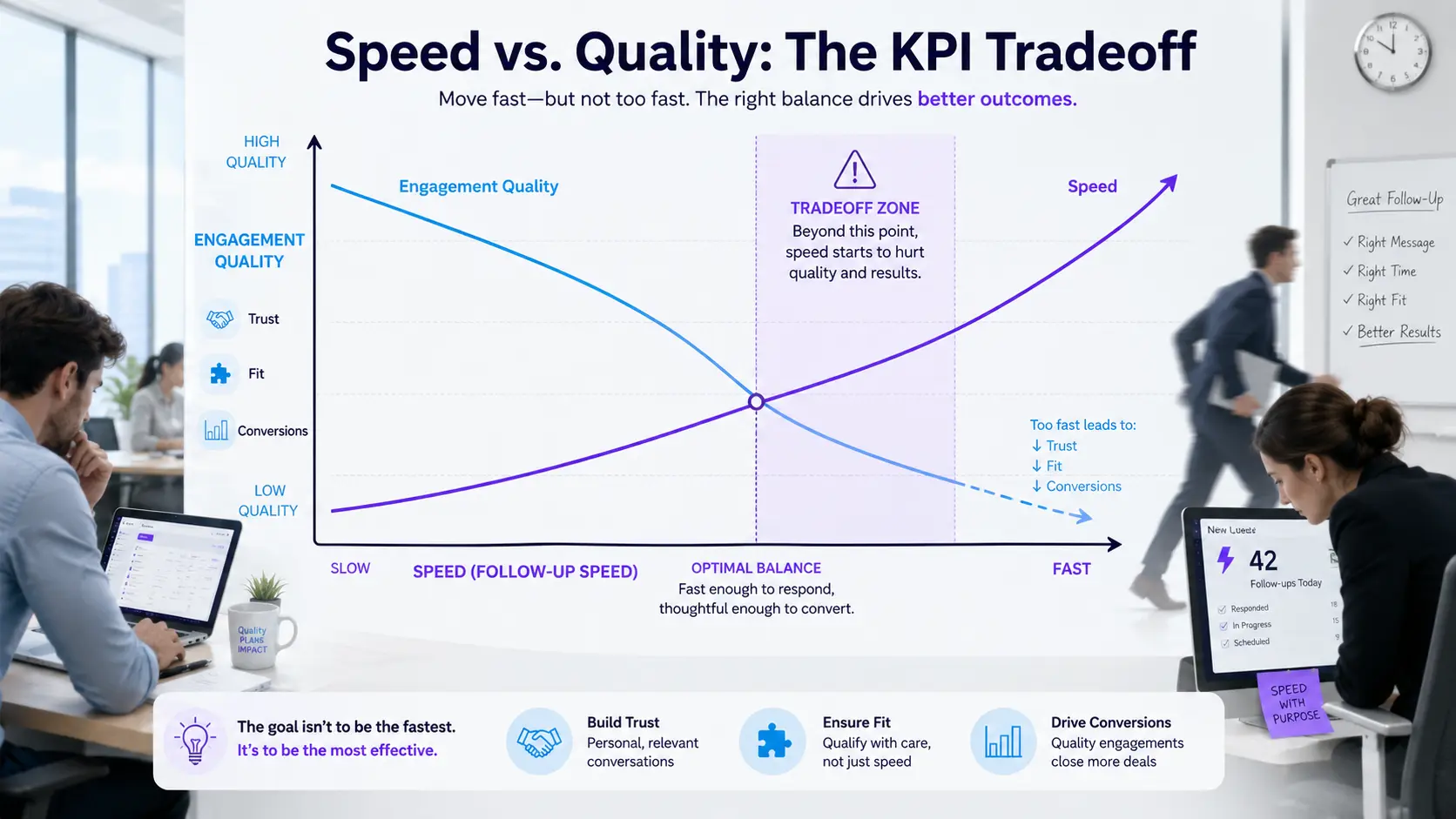
Faster doesn’t mean better – especially when fit and trust drop
Urgency sells internally but skepticism grows externally.
Push for hyper-speed and expect prospects to sense desperation instead of intent.
Rushed outreach is the digital equivalent of a salesperson cornering someone before they’ve even looked at the product.
In actual CRM data, we’ve spotted that faster handoffs often correlate with incomplete notes, missing context, or misaligned qualification.
Is the team winning trust or just checking boxes?
The risk: speed pressure creates a “spray and pray” effect – leads contacted early, but poorly, resulting in friction and missed fit.
Here’s the analogy we’ve shared with executives: winning a race doesn’t help if you’re on the wrong track.
You can high-five over instant response rates, but if the prospect isn’t ready or doesn’t feel heard, those extra-fast first touches just seed doubt.
Ask yourself: would your best-fit prospects prefer a lightning reply, or a thoughtful response that actually addresses their needs?
Speed only works when credibility and timing move in sync.
Stripping outcome quality in favor of hitting metric-driven targets leaves teams busy but less effective.
The appeal of speed fades fast when conversion and trust take the hit.
The model behind this distortion is clarified in Marketing Automation & CRM.

How automation amplifies poor process design through speed pressure
Most teams expect automation to fix their pipeline, but the wrong KPIs can turn automation into an amplifier for every underlying flaw – fast.
Think of automation as a magnifying glass: if the process underneath is broken, everything accelerates in the wrong direction.
Speed KPIs don’t discriminate.
They just hit the gas pedal.
Leads rushed before qualification become mismatches
What happens when a system triggers outreach based on timing, not intent?
The result looks like efficiency, but it’s really volume without discrimination.
We’ve watched client CRMs fill rapidly with prospects who never really fit – because automation was set to trigger contact the moment a form landed, before sales even knew what qualified meant.
One fintech client grew its lead count by 60% in a quarter, but post-demo conversion tanked: their SDRs were running a sprint nobody wanted to finish.
The myth is that speed delivers value first.
In practice, it just delivers the wrong contacts faster.
Imagine a factory switching from handcrafted inspection to conveyor belt – only someone removed the quality check before packing.
Bad product outpaces good.
How many of your leads actually pass the smell test after day one?
If speed is the only lever, every misfit ends up clogging the works.
Ask: is your automation scaling opportunity, or scaling waste?
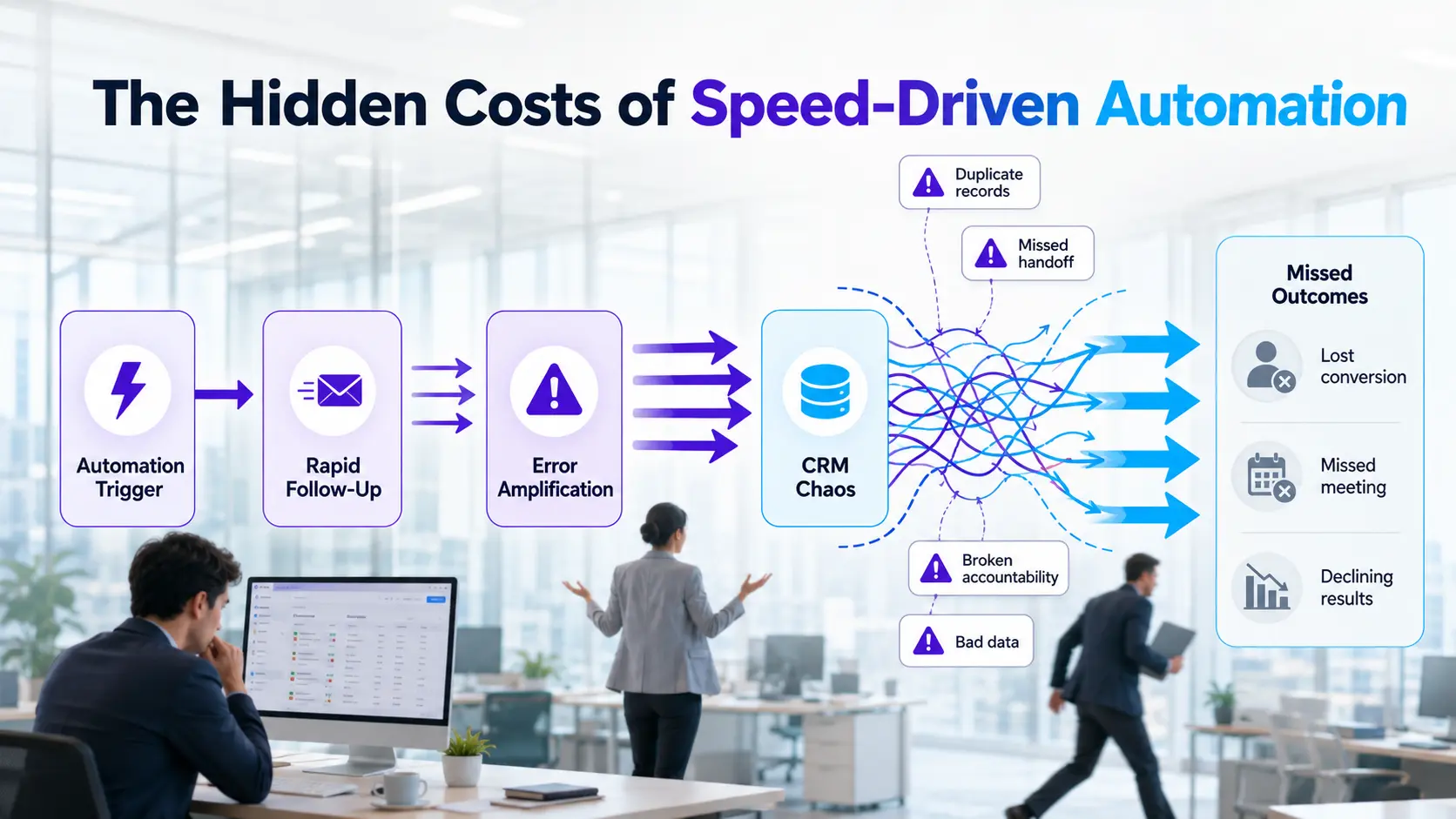
Rushed handoffs blur ownership and erode CRM trust
There’s a hidden cost to automation-driven speed: responsibility turns into a relay race.
When time-to-touch dictates every step, ownership passes without context.
We’ve seen teams where a new lead is assigned, contacted, and reassigned within 10 minutes – just to meet response KPIs.
Every handoff risks losing critical intel.
Gaps form in CRM records: missing notes, incomplete stages, deals that drift until someone reclaims them, or not at all.
Speed pressure breeds shortcuts.
People find ways to stop the auto-timer – often by rushing updates before real engagement happens.
Over time, CRM data turns into a patchwork, riddled with ghost prospects and measurable trust loss in the database itself.
One global SaaS client complained that after automating handoffs, nobody trusted the “status” field: what looked fast on dashboards was chaos in real conversations.
Speed KPIs plus automation don’t fix broken processes – they multiply the harm.
If acceleration exposes more gaps than gains, the problem isn’t the tech; it’s what you’re asking it to scale.
When automation and speed KPIs run unchecked, you don’t just get faster.
You get further from the result that matters.
Real growth demands precision, not just pace.

How unclear decision ownership makes speed KPIs toxic
Speed pressure doesn’t just rush actions – it dissolves accountability.
Most leaders assume clear KPIs will drive collective urgency, but here’s the reality: nobody owns the result when everyone’s racing the clock.
The pursuit of metric-driven quickness becomes a game of hot potato – blame and responsibility moving faster than the work itself.
When no one stops the clock or takes accountability
You’d expect tighter deadlines to sharpen roles, but we see the opposite: as timelines shrink, accountability scatters.
The myth is that measuring time to respond gets everyone on the same page.
In truth, it creates a limbo where sales, marketing, and ops each think, “At least I met my number”.
Impact of Speed KPIs on Accountability and Pipeline Health
| Myth | Reality | Consequences |
| “If we’re faster, we win more” | Speed KPIs often mask sloppy prospecting or shallow engagement | Deals feel forced, pipelines thin, conversations deteriorate |
| Faster response always improves customer satisfaction | Quality often sacrificed for speed, hurting customer experience | Net promoter scores can drop despite faster response times |
| Chasing speed improves conversion rates | Speed without fit and trust leads to lower conversion | Rushing prospects damages trust and elongates sales cycles |
One B2B SaaS client saw response times hit all-time lows – on paper, a win – while qualified pipeline quietly shrank.
Each department assumed the next would own actual qualification or follow-up depth.
The handoff became the only thing measured, so everyone optimized for sending, not owning.
We’ve witnessed teams spend more effort logging timestamps in the CRM than actually engaging prospects.
When a prospect falls through, who takes the call?
Silence.
A KPI without a human behind it leads to the business equivalent of a relay race where nobody finishes the lap.
If your team acts like the clock is the customer, the real customer disappears from view.
Who owns the outcome?
If the answer isn’t quick and clear, the risk of misfires and metric-driven behavior risk only grows.
Built-in latency: meetings, approvals, escalations in disguise
Ironically, the harder you push for speed, the more invisible drag creeps in.
Piling on pressure to “move faster” spawns new bottlenecks – meeting overload, last-minute approval chains, endless Slack messages to “clear blockers”.
We’ve seen pipeline reviews become theater: people scramble to clock activities on time, then regroup in recurring meetings to justify those same numbers.
Delays hide in plain sight – masked by a wall of metric compliance.
Every escalation (“Just get VP sign-off before sending”) looks like governance, but it’s often procrastination disguised as control.
Picture a Formula 1 pit stop – everyone ready, but the signal to release never comes because every detail must be double-checked, just in case.
Question: If your pipeline feels busy but deals don’t progress, is your team speedier – or just drowning in micro-approvals?
Real decision latency is rarely counted in KPI dashboards, but it eats results all the same.
Speed for the sake of speed turns ownership into a mirage.
When decision clarity disappears, trust and results follow.
The more a metric fragments responsibility, the further your team drifts from outcomes that matter.
The signal: activity everywhere, progress nowhere.

What signals show speed KPIs are transforming into traps
Even when your team beats the clock, you might be watching pipeline value quietly bleed away.
The unsettling truth: improved response times can mask deteriorating conversion rates and rising churn.
Why does hitting a speed metric so often coincide with missed revenue targets?
The disconnect reveals itself only when you stop to measure what matters – outcomes, not just activity velocity.
Conversions drop despite improved response times
Here’s the red flag most executives overlook: conversion rates stagnate or fall, even as average response windows shrink.
You can watch reps shave minutes off first contact yet still see deal volume slip.
In practice, pushing for speed often means leads are engaged before context or readiness is clear – a pitfall we’ve seen spiral into double-digit conversion losses for SaaS and B2B services clients.
Fast follow-up tells prospects you’re eager – but if every touch feels canned, rushed, or misaligned, trust evaporates.
Picture a doctor who diagnoses before listening: confidence plummets, no matter how available they seem.
The rush to “score fast” forces reps into robotic scripts, skipping qualification and personalization, eroding deal nurture and making it far easier to say no.
Ask yourself: are more prospects responding quickly, or are more simply bowing out sooner?
Our most reliable signal that speed KPIs have gone too far?
When the close rate drops as your team hits all the response goals.
That’s when speed isn’t a proxy for readiness; it’s become a mask for mismatched intent.
Process moves, but business stands still.
CRM data churn and disengagement accelerate
Another clear tell: your CRM starts filling with half-complete records, disengaged contacts, or activity logs that look busy but never advance the funnel.
Rapid-fire outreach (especially when automated) leads to touchpoints that feel transactional, not relational.
Engagement rates fall, and accounts flagged as “touched” become less responsive over time.
We’ve watched client teams push contact attempts to beat a response SLA, only to create a shadow pipeline – hundreds of records marked as followed up, yet never qualified, often ignored for follow-up or left to rot in queues.
This pattern compounds automation fatigue: recipients tune out, rep morale drops, and soon every metric except raw speed declines.
Over time, leaders start to distrust their data; reporting becomes suspect, forecasting loses its anchor, and sales teams stop believing in the tools they’re measured against.
If your CRM looks like a high-activity graveyard, speed metrics are acting as blinders, not accelerators.
The moment you spot conversions slipping and engagement decaying, it’s a signal: time to pause, reassess, and put outcome signals back above arbitrary speed marks – because the longer you chase speed alone, the less there is left to win.

When to deprioritize speed KPIs and redirect focus
Most teams double down on response speed when results slip, thinking urgency itself will force conversions up.
It rarely works – and the hidden cost is fit quality craters while finger-pointing spreads.
Here’s the logic gap: if “faster is better”, why does your pipeline start filling with the wrong prospects, frayed trust, and rising team friction?
If faster follow-up means lower fit, slow down for qualification
There’s a point where speed KPIs distort behavior so badly that quality barely matters – every lead gets the same race-to-contact.
On multiple client projects, we’ve reversed falling win rates not by working harder, but by hitting pause on instant response and leaning into deeper qualification.
The anxiety to beat the clock suffocates the signals that show real readiness.
Imagine speed KPIs acting as a strobe light: everything looks urgent, nothing looks clear.
If the most common follow-up objection you hear is “I’m not ready to buy”, your metric is flooding the funnel with mismatches, not accelerating growth.
Why chase more conversations if each one drops your average close score?
When to Slow Down and Focus on Qualification Instead of Speed
- If most leads respond “I’m not ready to buy”, speed is adding poor-fit contacts
- Trade speed for fit: slowing follow-up enhances lead qualification
- Rushed speed KPIs push teams away from diligence and thoughtful engagement
- A moderate slowdown gives space to confirm lead readiness and fit
- Prioritize accountability and outcome ownership over just fast response times
Trade speed for fit.
A six-minute slowdown won’t repel a true buyer, but it gives you space to check if the lead actually belongs.
Proxy metric distortion – treating time-to-touch as the win – turns diligence into an afterthought.
The tighter you squeeze the stopwatch, the further you push actual qualification from reality.
When CRM behavior falls off under time pressure, reevaluate accountability not tools
Does your team start bypassing notes, misclassifying leads, or gaming timestamps as speed targets tighten?
It’s not a workflow problem – it’s a trust and ownership warning.
Rushed resolution pressure triggers short-term hacks: skipped data, surface-level updates, and a sudden drop in team initiative.
We’ve seen otherwise sharp account execs cycle through three CRMs in eighteen months, blaming tech, when the real failure mode was metric-driven behavior risk: nobody felt safe slowing down to do it right.
The analogy: pushing CRM adoption under speed KPIs is like trying to row faster by removing oars – momentum looks good, progress vanishes.
Instead of asking “which tool will make us faster”, start with, “who actually owns the outcome when time runs out?” Accountability closes decision latency and rebuilds trust – no platform can do that automatically.
The core decision: deprioritize speed when it starts to corrode fit and fracture ownership.
Redirect the focus to qualification criteria and real accountability.
When you value substance over stopwatch, you’ll see both confidence and conversion rates recover.

Scientific context and sources
The sources below provide foundational context for how decision-making, attention, and performance dynamics evolve under scaling and constraint conditions.
- Goal Conflict and Human Performance
The Effects of Intra-individual Goal Conflict on Performance – Locke, E. A., Smith, K. G., Erez, M., Chah, D.-O., & Schaffer, A. – Journal of Management
This research explores how conflicting goals, such as speed versus quality, impact performance outcomes and create pressure-driven tradeoffs.
https://doi.org/10.1177/014920639402000104 - The Impact of Time Pressure on Quality of Decision Making
Time pressure and performance of scientists and engineers: A five-year panel study – Andrews, F. M., & Farris, G. F. – Organizational Behavior and Human Performance
Details how time pressure can affect work performance, including the point where excessive pressure weakens useful output and innovation.
https://doi.org/10.1016/0030-5073(72)90045-1 - Organizational Behavior and Proxy Metrics
Strategy Selection, Surrogation, and Strategic Performance Measurement Systems – Choi, J., Hecht, G. W., & Tayler, W. B. – Journal of Accounting Research
Explains how performance measures can become substitutes for the real strategic construct they were meant to represent, reinforcing the article’s point about speed KPIs becoming the goal.
https://doi.org/10.1111/j.1475-679X.2012.00465.x - CRM Efficiency, Data Quality, and Accountability
Designing a Data Quality Management Framework for CRM Platform Delivery and Consultancy – Albrecht, R., Overbeek, S., & van de Weerd, I. – SN Computer Science
Analyzes CRM data quality as a practical system problem, including how poor-quality CRM data can reduce trust, adoption, and operational reliability.
https://link.springer.com/article/10.1007/s42979-023-02196-z - Automation, Human Oversight, and Error Amplification
Automation Bias in Intelligent Time Critical Decision Support Systems – Cummings, M. L. – AIAA 1st Intelligent Systems Technical Conference
Demonstrates how automation in time-critical decision environments can increase risk when human oversight weakens or when teams over-rely on system outputs.
https://doi.org/10.2514/6.2004-6313
Questions You Might Ponder
How do speed KPIs distort behavior in sales and customer service teams?
Speed KPIs disproportionately focus staff on meeting time-based metrics rather than on prospect needs or conversion quality. This results in rushed, shallow engagements and incentivizes behavior that ‘stops the clock’ instead of building trust or securing meaningful deals, often lowering actual conversion rates.
Why do fast response times sometimes decrease conversion rates?
While immediate follow-up feels impressive, it often means leads are contacted before qualification and readiness are verified. This can leave prospects feeling pressured or misunderstood, reducing trust and engagement and, paradoxically, lowering the likelihood of successful conversions despite speedy initial contact.
What risks do automation and speed KPIs present to CRM data quality?
Automation triggered by speed KPIs can create rapid-fire handoffs without context, leading to incomplete notes, chaotic ownership, and a CRM full of poorly qualified or ‘ghost’ records. Over time, this degrades trust in data, damages reporting accuracy, and erodes sales team accountability.
When should organizations deprioritize speed KPIs in the sales pipeline?
Organizations should reduce emphasis on speed KPIs when rapid response results in high volumes of unqualified leads, misaligned handoffs, or falling conversion rates. Focusing instead on lead fit, thoughtful qualification, and accountable ownership can restore meaningful pipeline growth and increase overall performance.
How can proxy metrics like speed KPIs undermine team accountability?
Proxy metrics, when overemphasized, fragment responsibility by making the metric itself the goal. Teams perform just enough to meet the KPI, assuming the next participant owns the outcome, which can dissolve clear accountability and make it difficult to identify and resolve real performance bottlenecks.