
What You’ll Learn
Regulated automation consent boundaries are the permission limits that determine what marketing, CRM, or follow-up automation is allowed to do in regulated contexts.
They treat consent as an operational constraint, not a checkbox, meaning automated workflows must stop, pause, suppress, or reduce personalization when consent is missing, revoked, unclear, outdated, or restricted.
These boundaries matter in industries such as healthcare, finance, insurance, legal, and addiction treatment because one misfired message can create legal, reputational, and trust risk.
Strong regulated automation uses real-time suppression, clear ownership, audit trails, human override roles, and restraint so systems move only when consent and trust rules permit action.
Key Takeaways
- Regulated automation consent boundaries must operate as operational constraints – not mere compliance checkboxes – to avoid legal and reputational risk.
- Real-time monitoring and dynamic suppression are critical; failing to act on consent updates immediately leads to audit gaps and trust erosion.
- Automation errors in regulated contexts are usually social and organizational, not just technical, due to unclear handoffs and weak governance.
- High-integrity automation slows down when trust or consent is unclear, using precise stopping logic and defined human roles to protect credibility and compliance.
Most executives still treat consent as a box to tick instead of the wall automation can’t cross.
The uncomfortable reality: in regulated contexts, every automation trigger becomes a liability if consent isn’t treated as a primary operational constraint rather than just legal paperwork.
The real challenge isn’t speed – it’s knowing where “go” stops.
That broader logic is grounded further in Marketing Automation & CRM.

How consent becomes a structural boundary, not compliance checkbox
The difference between compliant automation and automation that survives an audit is the ability to let consent dictate its own tempo.
Once, we saw a highly-targeted nurture campaign stall overnight – not because the content missed, but because consent policies changed and suddenly half the segment wasn’t eligible for contact.
Triggers tied to page visits or CRM tags are outpaced by the real boundary: user permission that updates dynamically.
This means personalization can’t simply be “smarter” – it must defer to limits set by the data subject.
When consent rewrites follow-up logic, what’s no longer acceptable
Myth: More data always enables more tailored outreach.
In truth, regulated automation starts by suppressing, not expanding, communications when consent is ambiguous.
A high-frequency, hyper-personalized drip sequence might look like good automation on paper.
But if the underlying consent record only permits quarterly outreach, 90% of those triggers are violations, not optimizations.
Like traffic lights that only turn green when the road is clear, automation firing without consent is a crash waiting to happen.
Key Insights on Consent Constraints in Automation
- Consent becomes a primary operational constraint, not just a legal checkbox.
- Automation must defer to dynamic, updated user permission boundaries.
- High-frequency outreach can violate consent limits despite good data.
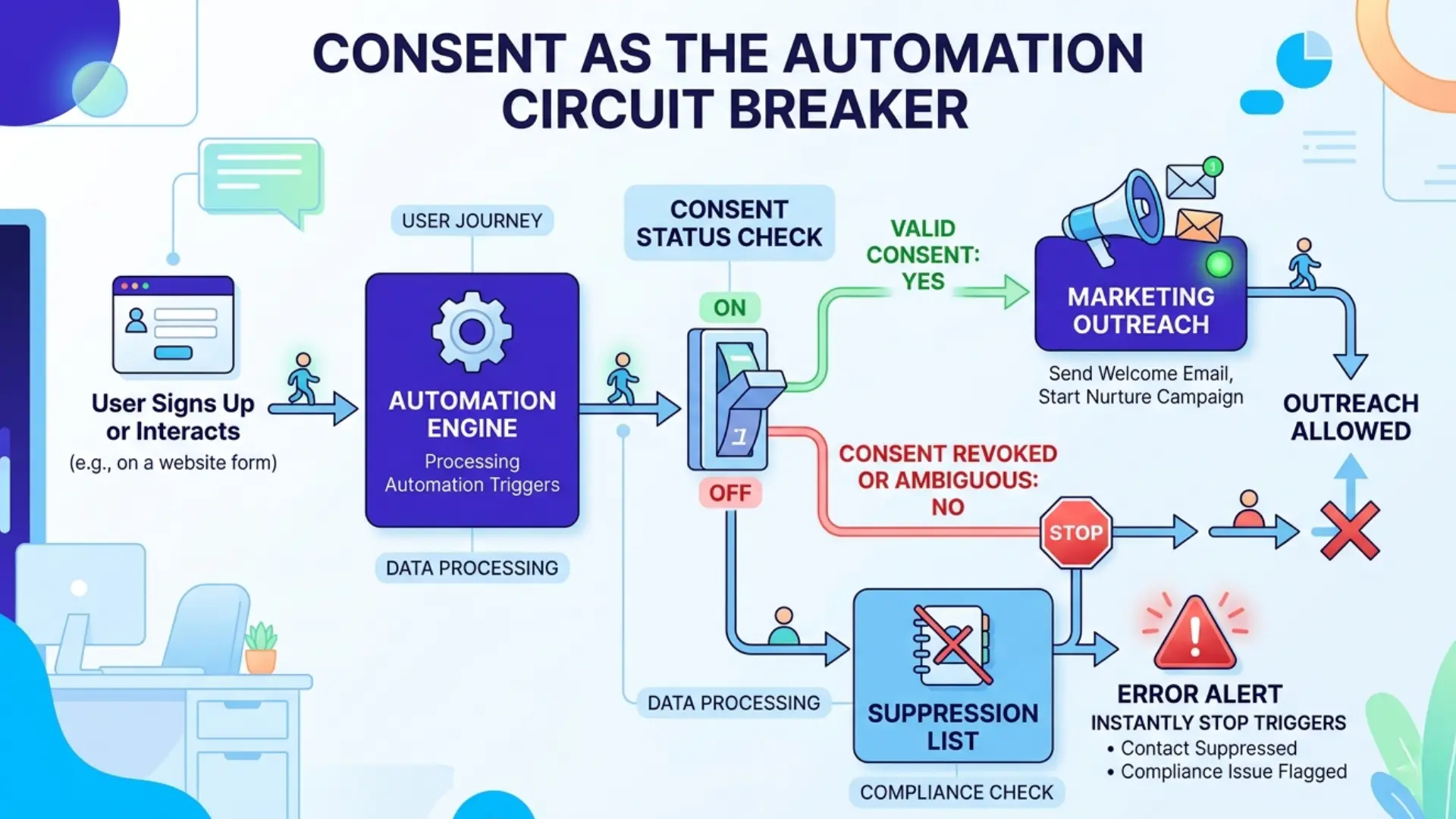
- Systems must immediately stop triggers if consent is revoked mid-sequence.
- Automation’s success depends on precise stopping as much as fast execution.
Ask yourself: What would your system do if a customer revoked consent mid-sequence?
If there’s any lag, or “grey area” where triggers persist, every message sent is now a risk event.
Automation in regulated environments isn’t about how fast you move, but how precisely you stop.
What trust erosion looks like when messages feel invasive
The instant a message feels out of bounds, trust drops and recoveries become expensive – or impossible.
Recipients rarely split hairs between regulatory and relational breaches.
For one client in insurance, a single poorly-timed outreach triggered dozens of opt-outs and escalations even though the content was “technically allowed”.
The fact that the sequence was automated only amplified the violation; customers sensed a loss of control.
Think of trust as a battery: intrusive automation drains it fast, and you can’t recharge by apologizing after the fact.
Ignored trust thresholds trigger behavioral fallout – blocks, negative reviews, public complaints – that persist long after the system is fixed.
Have you noticed how unsubscribes spike after an automation “oops”?
That’s not random.
It’s an alarm bell that your system failed to protect boundaries.
If regulated automation doesn’t actively monitor and respect consent, you’re accelerating your way toward brand risk, not loyalty.
Managing consent isn’t compliance theater – it’s operational self-defense.
Real customer trust is built by automations that know how, and when, to pause.

Why systems break when consent is captured but not governed
Most leaders assume recording consent means the job is done.
But a weak enforcement layer quietly unravels your entire automation strategy – like building a vault, then taping the door shut.
The illusion of coverage is often worse than overt risk.
Why?
Because every unchecked trigger or missed suppression isn’t a technical hiccup – it’s a breach of trust and compliance, live in your CRM.
Audit gaps, suppression misfires, and CRM distrust
Here’s the myth: consent frameworks are a pure compliance exercise.
In practice, undetected audit gaps and misfires in suppression logic can turn a well-meaning operation into a reputational hazard.
We’ve seen enterprise clients with permission records held in one module – while aged nurture logic and campaign list builders draw from another.
The result?
Opted-out contacts keep getting emails, sometimes for months, long after their intent is crystal clear.
Every one of these lapses chips away at the “trust capital” your CRM holds with prospects and regulators alike.
Causes and Consequences of Weak Consent Governance
- Audit gaps arise when consent records and automation rules are stored or checked in different systems.
- Suppression misfires cause opted-out contacts to keep receiving communications.
- Delayed or missed syncing of consent revocation leads to persistent trust erosion.
- Lost accountability for consent-related decisions creates decision vacuums.
- Internal data distrust emerges when systems don’t align on suppression status.
Gaps in the audit trail and weak opt-out synchronization further erode organizational trust when permission records aren’t governed by a MAP as a compliance layer.
Think of consent as the circuit breaker for your automation grid.
One faulty switch and you get sparks downstream – persistent, hard-to-trace incidents that erode belief in the system’s promise.
Ask yourself: how many times can a customer opt out before they lose faith that their data will ever really be respected?
The answer is always fewer than you think.
Suppression misfires often go undetected until an incident escalates – a regulator’s inquiry, a customer’s complaint, or a public post calling out mishandling.
What’s predictable to practitioners: the most destructive errors come not from “bad actors” but from good systems running on stale or partial data.
When a platform can’t guarantee real-time suppression, “automation as governance” becomes an empty phrase.
Even the best-intentioned teams begin to distrust internal data.
When call logs don’t match suppression outcomes, or marketing claims opt-out coverage that ops can’t verify, confidence in the CRM itself starts to degrade.
What was supposed to be the single source of truth becomes a source of second-guessing.
Broken handoffs and ambiguous ownership of consent-derived decisions
Consent doesn’t live in one system – it traverses marketing, sales, legal, and IT.
Where things break down is in the handoff: Who’s ultimately responsible for making sure a revoked consent instantly triggers suppression logic across all tools?
In too many organizations, no one owns end-to-end accountability.
The result is a patchwork approach to “consent as system constraint”.
It’s like passing a baton in a relay – if each runner isn’t clear when the handoff happens and who owns the next leg, the baton is dropped.
We’ve worked with teams where marketing believed legal was monitoring regulatory compliance, while legal assumed ops controlled technical enforcement.
Meanwhile, automation kept firing based on old consent rules.
Ambiguous consent ownership undermines trust both internally and externally.
It creates decision vacuums: who can veto a campaign when an edge-case consent scenario emerges?
Who documents the override – and on whose authority?
This ambiguity fuels social failure modes.
When no one has the authority (or willingness) to halt automation that violates trust thresholds, issues spiral.
Roles become fuzzy, leadership frustrations mount, and risk accrues in silence.
Reputational damage emerges less from malicious intent, more from quiet diffusion of responsibility.
The repeatable outcome: systems that record consent without governing it are quietly brittle, leaking trust and risk at every handoff.
Only by mapping clear accountability can digital automation begin to play by the rules trust requires.
Systems that capture but don’t govern consent leave the door open for errors and confusion – often without warning.
In regulated contexts, the real acceleration isn’t how fast you automate, but how seamlessly you can halt the machine when trust demands it.

How automation amplifies risk when trust rules aren’t baked in
Most automation errors aren’t technical – they’re social.
One overlooked trust rule can transform a tight campaign into a reputation crisis, especially when automation scales mistakes with the same energy it scales wins.
The belief: automation moves you faster.
The reality in regulated contexts?
It also gets you in trouble faster, especially when trust boundaries are invisible to your trigger logic.
When efficiency hurts reputation: examples of mis-targeted automation
It’s tempting to equate speed with progress.
But in highly regulated environments, automated outreach that ignores trust thresholds isn’t just noise – it’s ammunition for watchdogs and a signal to customers that their agency is optional.
We’ve seen healthcare CRMs auto-send reminders about sensitive conditions to shared family emails because consent logic wasn’t rigorously enforced.
One sequence cost a provider months of clean-up: regulatory complaints, panicked calls, and lasting distrust – the antithesis of automation as governance.
Every time automation acts before updating consent state, it gambles with your brand’s credibility.
A single misfired compliance email may seem trivial in SaaS, but in sectors like financial services, that same slip can mean formal complaints or revoked licenses.
The analogy: automation without trust boundaries is like driving a high-speed train with fogged-up windows – you’ll get there faster, but you can’t see the danger until it’s too late.
What makes this worse: reputation damage compounds.
Regulators remember.
Customers tell their peers.
If you’ve ever noticed opt-outs spike after one off-tone email, you’ve felt the aftershock firsthand.
How over-personalization backfires in sensitive contexts
Personalization, done wrong, quickly morphs into violation.
Feeding regulated attributes into automation without a hard consent filter (think: medical status, legal history, financial triggers) is more than risky – it invites both legal blowback and the quiet erosion of trust.
We’ve advised teams that thought knowing a customer’s pain points was an advantage; in regulated environments, that knowledge is a liability unless used with surgical care.
One financial client’s system auto-populated debt recovery milestones – meant for internal use – into “personalized” outbound emails.
The backlash wasn’t just regulatory.
Relationships frayed.
Suddenly, what was meant to reassure led to anxiety and complaints.
Why does this blow up so fast?
Because recipients in these spaces expect a walled garden, not a one-way mirror.
Getting too personal triggers doubt about your data hygiene and motives.
Is that extra data point a value-add, or a signal you’ve overstepped your bounds?
Efficient automation in regulated contexts must treat trust as a speed limit, not a throttle.
When automation is governed by trust and restraint – not just efficiency – it protects your license to operate, not just your bottom line.
The systems that last are the ones that slow down when consent or relational risk enters the frame.

What does high-integrity automation look like under consent constraints?
Most teams assume more automation equals better results – until one misstep triggers regulatory exposure or fractures customer trust.
The truth: boundaries matter more than levers in regulated spaces, and restraint – not speed – is the difference between scalable growth and systemic risk.
If you’re automating at full throttle, ask yourself: what’s your system’s true braking distance?
Choosing restraint: evaluating follow-up speed, personalization, and consent rules
The rarest discipline in regulated automation isn’t what you send – it’s what you don’t.
High-integrity automation starts by treating “wait” and “pause” as core system actions, not edge cases.
We’ve witnessed teams reduce follow-up frequency sharply, even if they risk lower short-term engagement, because once a customer withdraws consent, every queued message becomes a risk multiplier.
This isn’t theoretical: one healthcare client shredded their campaign velocity after a single ignored opt-out exposed them to legal review.
The lesson stuck.
Comparison of Automation Approaches under Consent Constraints
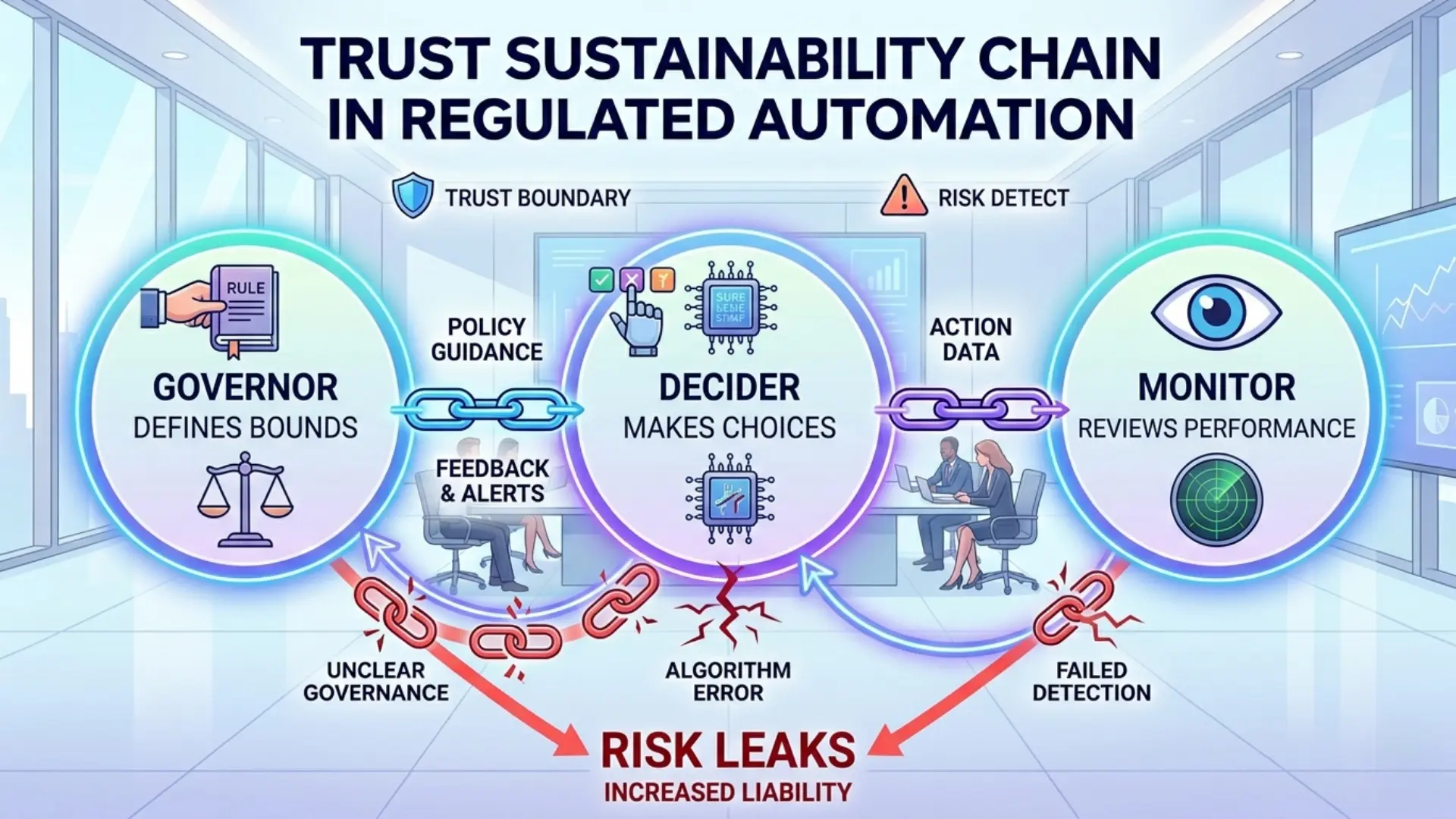
| Role | Primary Responsibility | Description |
| Deciders | Define automation permissibility | Business unit or compliance leads who set both green and red lines for automation |
| Monitors | Monitor automation and consent compliance | Operations or QA specialists conducting audits, tests, and simulations regularly |
| Governors | Govern overrides and enforce halt controls | Individuals with authority to instantly stop or rollback automation workflows |
Frequency and personalization must now yield to what we call the “consent system constraint”: a decision layer that vetoes actions if any ambiguity or revocation exists.
Without such a veto, automation veers into the red – no matter how well-intentioned your nurture flow looks on paper.
Imagine your CRM like a self-driving car: it shouldn’t accelerate if it can’t read the stop sign.
Are your automation triggers truly reading those signs, or guessing past them?
Here’s what separates trust-preserving automation:
- Follow-up pacing flexes to the strictest consent record, not the most aggressive marketing cadence.
- Personalization is permissioned, not assumed – no implied “if we know it, we use it”.
- Automated logic aborts at any sign of revoked or questionable consent, not after.
Restraint isn’t weakness; in regulated markets, it’s the real arbitrage.
Mapping trust-preserving roles: who decides, who monitors, who governs
Automation that survives regulatory and social scrutiny is never just a software problem – it’s an operating model.
The strongest systems split three roles: – Deciders: Usually the business unit or compliance leads who define when automation is permissible.
They don’t just green-light; they set the red lines. – Monitors: Often operations or QA specialists, these are the people combing logs, running suppression list tests, and simulating consent withdrawal.
In practice, we’ve seen organizations cut incident rates sharply simply by making monitoring a quarterly, not ad hoc, function. – Governors: This rarely gets formalized, but in resilient companies, governance means someone owns override authority – the ability to halt or roll back workflows instantly.
In highly regulated sectors, one missed escalation can trigger regulatory or brand fallout.
Key Roles in Trust-Preserving Automation
| Aspect | Trust-Preserving Automation | Typical Automation |
| Follow-up Speed | Flexes to the strictest consent record | Uses most aggressive marketing cadence |
| Personalization | Permissioned and cautious | Assumed if data is available |
| Response to Revoked Consent | Aborts actions immediately on revocation or ambiguity | May continue sending queued messages |
Think of it like a high-stakes control tower: pilots (automation) follow the rules handed down, but air traffic (monitors) and the control center (governing authority) keep disaster at bay.
Where roles blur or go missing, so does trust – internally and with regulators.
With boundaries and accountability in place, automation regains its real purpose: compounding trust and compliance at scale – not just generating touchpoints.
Restraint becomes your strongest lever, and the margin between speed and risk becomes a difference-maker, not a liability.
Industry-specific automation risks and adaptations are explored in Addiction Treatment Marketing Automation & CRM.

Scientific context and sources
The sources below provide foundational context for how decision-making, attention, and performance dynamics evolve under scaling and constraint conditions.
- Consent, Trust, and Behavioral Economics
Privacy and Human Behavior in the Age of Information – Alessandro Acquisti, Laura Brandimarte, George Loewenstein – Science
Examines how users’ perception of privacy, uncertainty, control, and trust impacts behavior around data use, consent, and policy in information environments.
https://www.science.org/doi/10.1126/science.aaa1465 - Systemic Trust and Automation Failures
Trust in Automation: Designing for Appropriate Reliance – John D. Lee, Katrina A. See – Human Factors
Analyzes the dynamics of trust, breakdowns, and over-reliance on automation within regulated systems.
https://journals.sagepub.com/doi/10.1518/hfes.46.1.50_30392 - Consent Management in Information Systems
ADvoCATE: A Consent Management Platform for Personal Data Processing in the IoT Using Blockchain Technology – Konstantinos Rantos, George Drosatos, Konstantinos Demertzis, Christos Ilioudis, Alexandros Papanikolaou, Antonios Kritsas – Lecture Notes in Computer Science / Springer
Investigates technical and governance layers for consent management and their implications for GDPR compliance, consent integrity, and auditability.
https://link.springer.com/chapter/10.1007/978-3-030-12942-2_23 - Organizational Accountability and Governance
From Transparency to Accountability of Intelligent Systems: Moving Beyond Aspirations – Rebecca Williams, Richard Cloete, Jennifer Cobbe, Caitlin Cottrill, Peter Edwards, Milan Markovic, Iman Naja, Frances Ryan, Jatinder Singh, Wei Pang – Data & Policy
Explores how ambiguity in accountability, transparency, and governance can leave intelligent systems without enforceable operational responsibility.
https://www.cambridge.org/core/journals/data-and-policy/article/from-transparency-to-accountability-of-intelligent-systems-moving-beyond-aspirations/E412FF94EC2A293985D414D80415F4AA - Automation Risk and Reputation
A Right to Reasonable Inferences: Re-Thinking Data Protection Law in the Age of Big Data and AI – Sandra Wachter, Brent Mittelstadt – Columbia Business Law Review
Studies how inferential and automated systems create privacy, autonomy, discrimination, accountability, and reputation risks when governance and contestability are weak.
https://journals.library.columbia.edu/index.php/CBLR/article/view/3424
Questions You Might Ponder
What are regulated automation consent boundaries in marketing automation?
Regulated automation consent boundaries refer to explicit limits set by regulations and users regarding how and when automated systems can contact or process their data. These constraints ensure compliance, operational safety, and protect organizational trust by enforcing user-driven permission thresholds in real time.
How do consent constraints impact automation in financial or healthcare sectors?
In sectors like finance and healthcare, consent constraints halt or suppress automated actions immediately if user permission is ambiguous or revoked. Automation must prioritize user-defined boundaries to avoid compliance violations and maintain trust, creating a greater emphasis on stopping power over campaign speed.
What happens when consent is recorded but not actively governed in automation systems?
When consent is only captured but not dynamically enforced, audit gaps and suppression errors occur. This can result in unauthorized communications, escalated compliance risks, and loss of customer trust – often without warning, leaving organizations vulnerable to reputational and regulatory fallout.
Why do trust and consent lapses escalate faster in highly regulated automation environments?
Automation in regulated settings scales both successes and failures. Any misalignment or delay in honoring consent rapidly affects many users, compounding risk. Because trust is fragile, a single ‘oops’ quickly leads to opt-outs, complaints, and scrutiny from regulators – and the consequences multiply.
What distinguishes high-integrity regulated automation from standard campaign logic?
High-integrity automation enforces dynamic consent checks, prioritizing accurate suppression and restraint over maximal outreach. It uses real-time veto logic to halt actions if consent is ambiguous, assigns clear accountability for oversight, and embeds trust as a system-wide constraint – not just a compliance checkbox.