What You’ll Learn
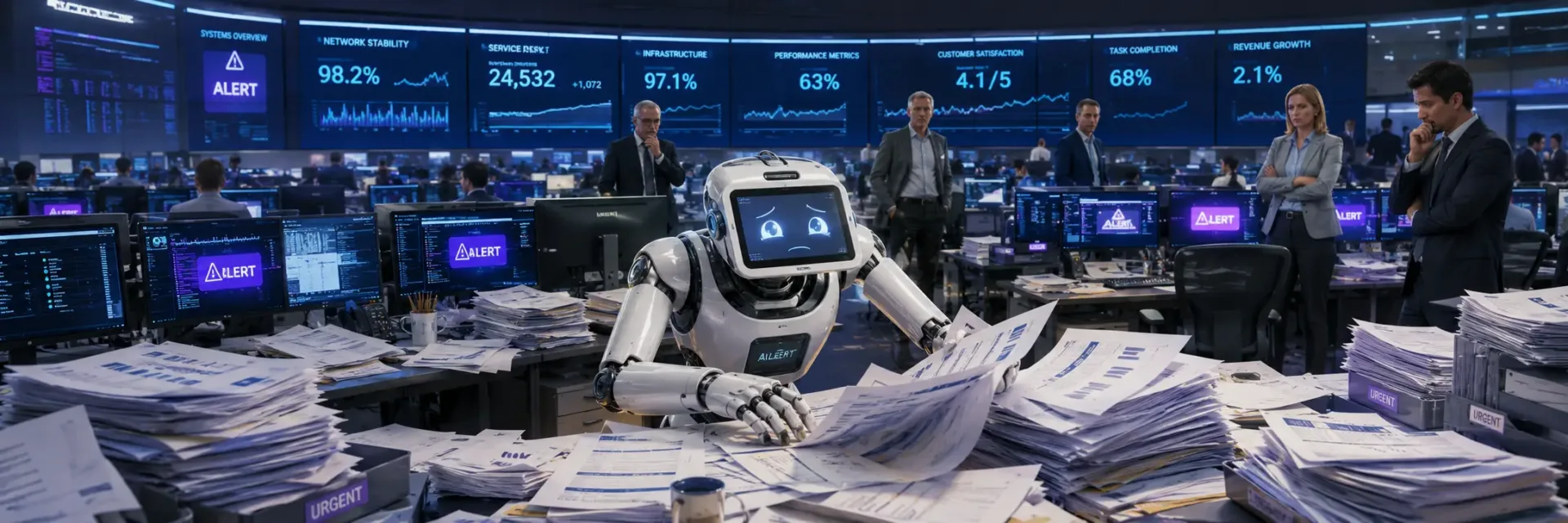
Automation noise is the overload of automated tasks, alerts, notifications, handoffs, updates, and dashboard activity that creates motion without improving business outcomes.
It happens when automation scales weak logic, unclear triggers, unowned actions, brittle exceptions, or low-value workflows, causing teams to chase signals that do not move leads, customers, revenue, or service quality forward.
Automation noise makes systems feel busy while hiding performance decline, alert fatigue, missed ownership, and stalled outcomes.
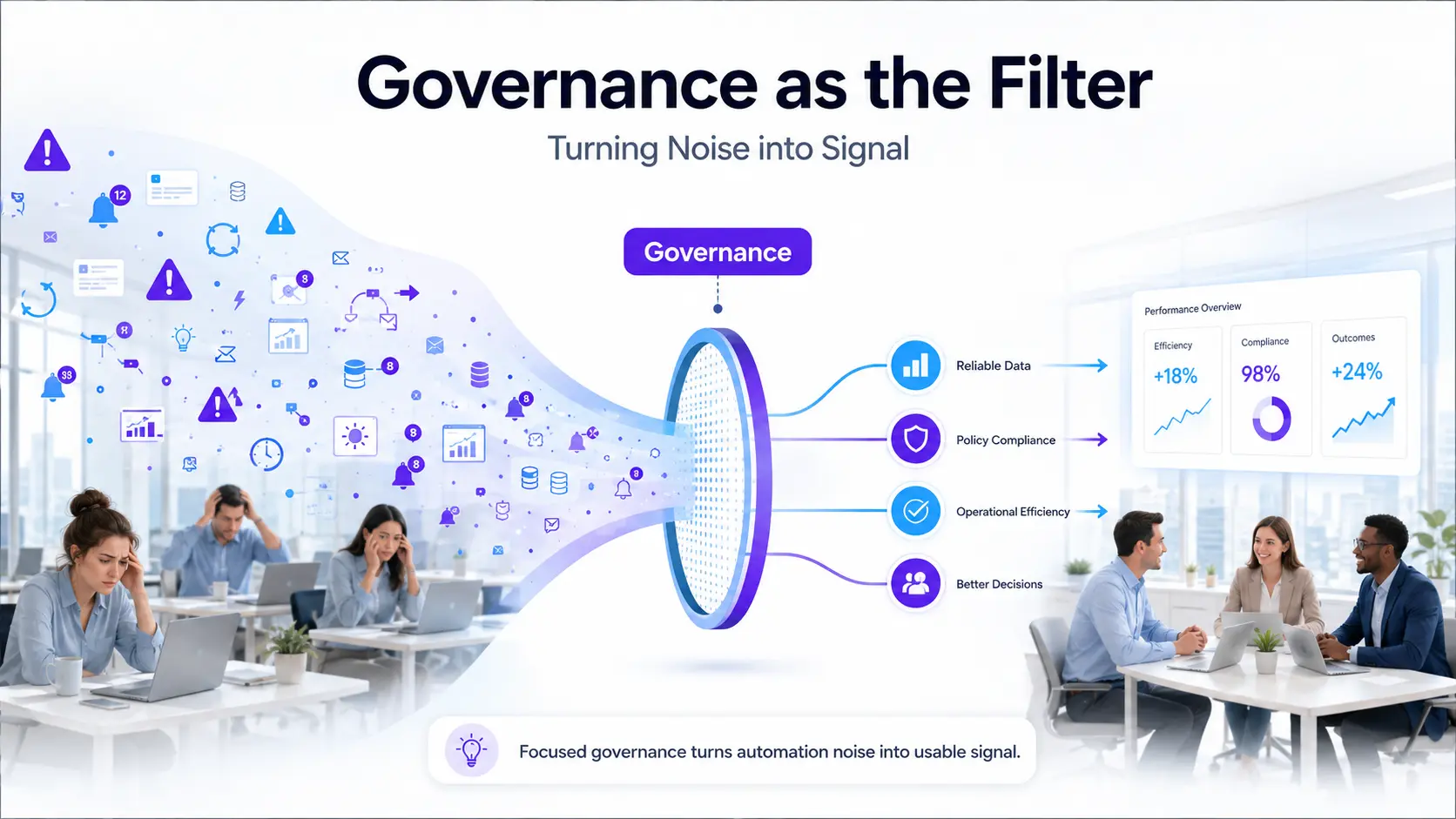
The fix is not more automation, but governance: clear boundaries, defined owners, outcome-based metrics, escalation rules, and pruning of workflows that create activity without measurable value.
Key Takeaways
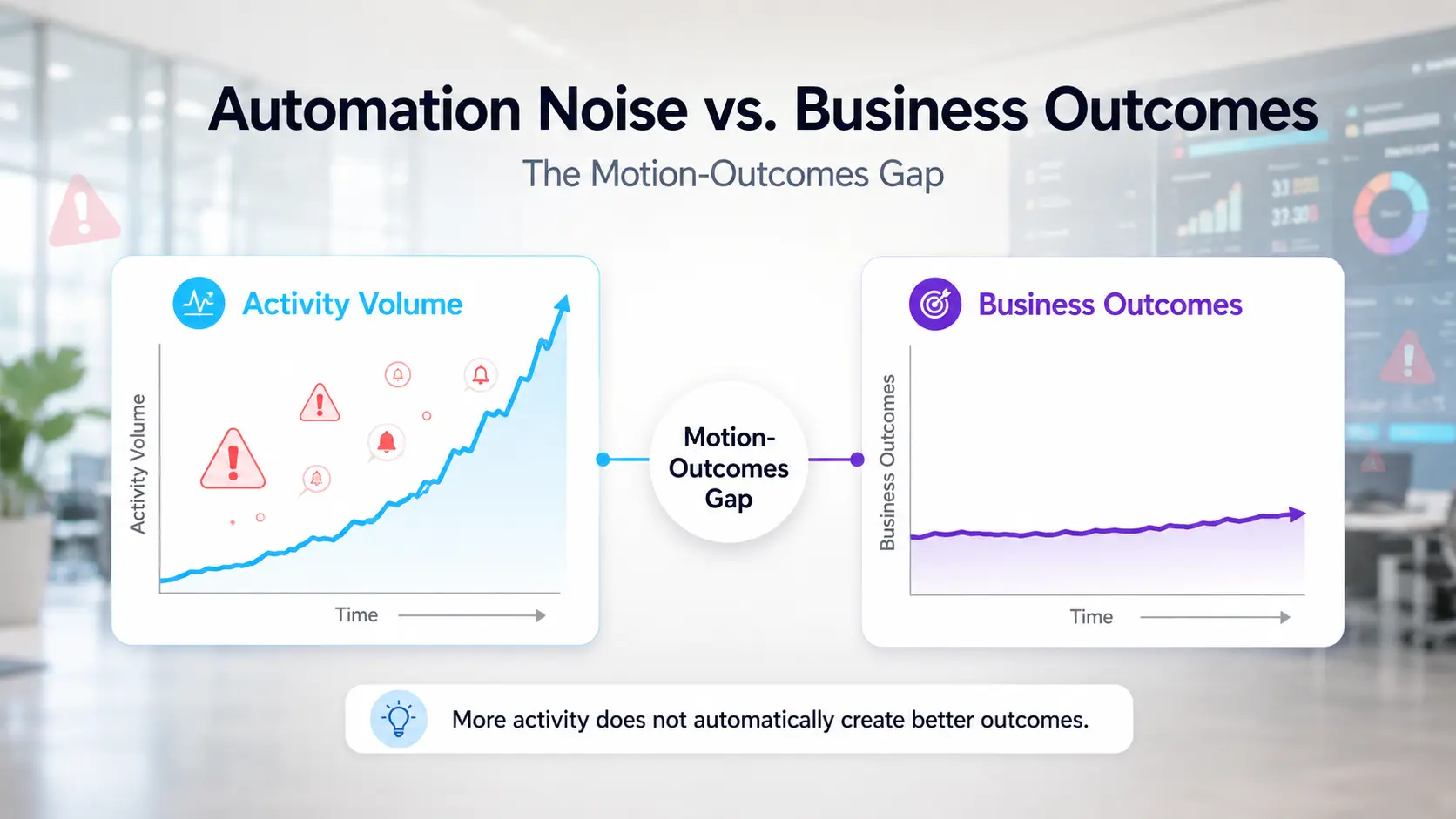
- Automation noise results when activity volume increases but outcomes remain unchanged, diluting impactful business signals.
- Lack of ownership and unchecked workflows turn helpful notifications into distracting clutter, eroding trust and clarity.
- Effective automation requires boundaries and accountability – governance, not just tools, is critical to sustainable results.
- The most successful systems automate decisions tied to measurable outcomes and minimize unclaimed, low-value activity.
Most executives don’t realize the dirty secret of automation: you can drown in activity while business results stall.
More bots, more alerts, more workflows – yet the metrics that matter barely move.
The real paradox?
Automation noise creates a blur of motion that feels productive but leaves outcomes untouched.
That expansion of motion at the expense of outcomes is explained further in Marketing Automation & CRM.

Why more automation activity doesn’t equal business outcomes
Automation is often seen as a lever for efficiency, but what happens when the logic it scales is shaky?
We’ve watched companies automate lead assignment with half-baked scoring rules – churning out more notifications, reassigned tasks, and dashboard updates.
The flood looks impressive in reports, but beneath it, sales teams chase junk leads and work evaporates into noise.
How automation amplifies flawed logic into useless volume
Here’s the myth: more automation inputs automatically produce better results.
What actually happens is signal dilution – unclear triggers and vague business rules get multiplied, not clarified.
It’s like putting a megaphone to a muddled message: the volume increases, but meaning fades.
Ask yourself: Is your dashboard full of “accomplishments”, or are you simply tracking more low-value activity?
Common Pitfalls of Scaling Flawed Automation Logic
- Automation of unclear or vague triggers multiplies noise, not signal.
- Activity volume increases but real business outcomes stagnate.
- Sales teams waste effort chasing low-value or junk leads.
- Increased notifications and task reassignments create distractions.
- High-speed automation with bad logic results in chaos, not progress.
A client once boasted of handling double the tickets after automating their support processes.
The reality: most tickets reopened or bounced between teams because underlying logic gaps went unresolved.
The lesson – bad logic plus high speed equals chaos, not progress.
The real win isn’t automating activity, but automating decisions that tie directly to measurable outcomes.
When exceptions become urgent distractions
Brittle automation systems promise less human intervention, but what they often create is a constant boomerang of exceptions dumped back onto people.
One enterprise marketing team automated campaign approvals only to discover that every corner case – missing field, ambiguous budget, “out-of-policy” – exploded into urgent escalations.
What’s sold as seamless ends up amplifying interruptions.
Impact of Brittle Automation on Team Productivity
| Governance Practice | Description | Outcome |
| Radical Pruning | Define which automations should exist and their triggers | Reduces flood of meaningless workflows |
| Defined Service Levels | Manage automation with clear escalation and stop limits | Maintains signal quality and data cleanliness |
| Curation of Inputs | Filter which processes generate alerts or tasks | Prevents infinite inputs without value |
| Purpose and Ownership | Establish authority for each automation process | Ensures meaningful, outcome-driven automation |
Think of brittle automation as a leaky bucket: every exception pokes a new hole, and pretty soon the flow demands constant patching.
Teams spend more energy triaging exceptions than achieving goals, with alert noise and notification pings crowding actual signal.
We’ve seen alert fatigue set in within weeks, leaving critical issues buried beneath a pile of “urgent” but meaningless alerts.
Executives who equate busy automation with effectiveness miss a key point: only meaningful, resilient flows move business forward.
If every unfamiliar input halts progress and triggers manual review, automation isn’t saving work – it’s multiplying cognitive load.
The fast path to system effectiveness is simplifying logic and containing exceptions.
Otherwise, motion without results is just expensive distraction.
Activity can multiply endlessly, but only intentional, outcome-driven automation creates impact.

Who owns the outcome when automation just moves leads
Most teams believe automating handoffs is a shortcut to clarity – until an urgent alert pings, and nobody steps up.
Suddenly, every notification starts to feel important, yet ownership dissolves into a ghost town of digital to-dos.
If automation can route leads, trigger reminders, and update statuses in seconds, why do pipeline blockages and missed follow-ups still spread like wildfire?
Why ownership ambiguity turns notifications into clutter
Activity without clear ownership is a recipe for wasted attention.
We’ve seen high-growth teams crank up automation thinking it will force accountability, only to find their Slack and inboxes bloated with “important” task alerts.
The real culprit: no one knows, in real time, who is truly responsible for each next action.
This isn’t just inefficient – it erodes trust in the entire system.
Consequences of Ownership Ambiguity in Automation
- Important notifications become background noise without accountability.
- Teams waste time determining responsibility for tasks.
- Alert noise erodes trust in the automation system.
- Unclaimed tasks pile up unresolved, reducing efficiency.
- Leads to decreased morale and silent loss of sales hours.
Think of your notifications like airport flight announcements: when every gate agent hears every message, no one feels responsible for any particular flight.
The system creates noise, not clarity.
In practice, teams drown in alert noise, rechecking lead statuses or asking, “Is this mine?” That pause – repeated hundreds of times daily – silently cannibalizes sales hours and morale.
Clarity isn’t delivered by automation, only by accountability.
Anything automated without a name beside it devolves into background static.
Open loops pile up, unclaimed and unresolved, while everyone assumes someone else will handle the fallout.
Why automation bypass is a symptom, not a solution
Most executives view employees ignoring or overriding automation as resistance.
But when reps start forwarding leads to themselves or messaging colleagues instead of trusting the pipeline, it’s a signal – automation has created unowned noise, not confidence.
Across dozens of workflows, we’ve watched top performers build side processes just to avoid misrouted tasks or signal dilution.
Their quiet rebellion isn’t laziness – it’s survival.
When an alert or task handoff feels like an orphan, teams will invent their own safety nets rather than risk dropped revenue.
Is automation to blame?
Not directly.
The real failure is relying on technology to enforce outcomes while absolving real humans of responsibility.
Motion without results – what we call the automation productivity paradox – emerges: the busier the system, the less obvious it is where drop-offs occur.
When responsibility is everybody’s business, it becomes nobody’s.
Unowned automation breeds bypasses, eroding both output and trust.
Ownership, not automation, turns alerts into action.
Unclaimed notifications signal a broken promise: volume and speed only have value when someone owns the outcome.
Own the action, or watch the noise multiply.

Why signal dissolves into noise in overloaded automation systems
Most leaders think more automation means sharper insight.
In reality, overloaded systems work more like a crowded emergency room – so many alarms, few actually save lives.
What started as signal turns into a blur of motion, flooding teams with alert noise and stealing focus from real outcomes.
When alerts lose meaning: fatigue as a behavioral failure
The difference between actionable alerts and background noise can disappear almost overnight.
At first, every notification feels critical.
But as activity ramps up, so does the volume of pings – until even the sharpest teams begin to tune out everything.
Here’s the paradox: We’ve seen teams start with legitimate alerting, only to slide into a cycle where the system barks at every minor fluctuation.
Suddenly, high performers miss genuine issues because their brains are bathed in constant digital interruptions.
Alert fatigue sets in; the risk isn’t missing one critical message, it’s becoming blind to them all.
This fatigue acts as a silent saboteur.
Teams assume more automation equals fewer errors, but endless false positives dilute vigilance to the point where individuals swipe away alerts without reading.
In our work, the pattern repeats: The more you try to automate attention, the less you actually get.
If you had to bet your quarter’s success on a single system notification being seen and acted on, would you trust your current setup?
When every beep promises urgency, none of them deliver.
How automation noise hides performance collapse
Noise doesn’t just distract – it camouflages real declines.
When you measure activity instead of outcomes, missed warnings go unnoticed until metrics erode and customers walk.
We’ve watched conversion rates drop by double digits, disguised by endless logs of “tasks completed” and “alerts handled”.
Teams are so busy closing tickets and responding to pings that they lose sight of quality.
Automation noise turns systemic underperformance into white noise, slowly dissolving accountability into mere motion.
It’s like trying to diagnose engine failure with the radio blaring: the real warning signs get drowned out by everything else.
Are drops in pipeline progression getting lost behind hundreds of minor automations?
Does anyone know when a process truly collapses, or does it just fade behind an infinite scroll of bot updates?
High-impact systems don’t just automate – they filter.
The most reliable insight: Only what gets surfaced through clarity, not clutter, moves the needle.
Signal becomes noise the moment automation is measured by volume, not validity.
The real cost isn’t more alerts – it’s the silent decay behind the noise.

What changes the outcome: governance, not more automation
Most companies think solving automation noise is just a matter of tightening rules or adding another tool – but the shock comes when doubling down only multiplies the mess.
The difference between a system in perpetual activity and one that delivers repeatable business outcomes is not more automation – it’s the boundaries that define purpose, authority, and ownership around every process.
If your team still finds itself drowning in alert noise or chasing “busywork automation”, chances are you’ve mistaken motion for progress.
Here’s where the true lever hides.
Enforcing boundaries so automation enforces outcomes
The automation productivity paradox is unbelievably common: you automate everything possible, yet outcomes don’t improve – and signals actually get weaker.
Why?
Because most automation scales activity, not clarity.
In dozens of client transformations, the breakthrough never came from writing more scripts.
It came from radical pruning – defining which automation should exist, for whom, what decisions it replaces, and exactly what triggers demand a human response.
Treat automation without governance like letting water spill everywhere and hoping it magically finds its way into bottles.
Uncontained, it floods everything and dilutes value.
Key Practices to Enforce Automation Governance
| Issue | Explanation | Effect on Team |
| Constant Boomerang of Exceptions | Unhandled corner cases create urgent escalations | Increased interruptions and manual patching |
| Alert Noise and Notification Pings | Excessive alerts crowd out real signals | Teams experience alert fatigue within weeks |
| Increased Cognitive Load | Manual triaging of exception alerts demands energy | Reduced focus on actual goals |
| Automation Perception | Promises reduced human intervention but fails | Multiplying work rather than saving it |
One myth persists that automation always brings efficiency.
In reality, boundaryless automation produces endless motion without results.
The moment you say yes to every workflow, process, or integration “because we can”, you stop protecting signal quality.
The only way automation does its job is if it’s managed like infrastructure – with service levels, escalation paths, and hard stop limits.
What gets protected – data cleanliness, channel priority, alert thresholds – matters more than what gets moved.
If every part of your tech stack can fire alerts or spin up new tasks, you’ve created infinite inputs but no curation.
Does a workflow really need to automate that notification?
Does every lead change truly require a new flag?
The real work isn’t just in building flows – it’s in enforcing what doesn’t flow unless it creates measurable value.
Stabilizing throughput by restoring decision accountability
Motion without accountability is how automation brittleness sneaks in: work moves, but nobody’s responsible for results.
Every system we’ve seen struggle with alert fatigue shares the same root failure – the system acts, but ownership is blurry.
True throughput – steady, reliable, high-quality output – requires each automated action to have a decision owner.
No exceptions.
The solution is not more activity, but sharper, almost ruthless accountability.
This means hardwiring decision points: who is responsible when automation ends?
Who reviews errors?
Who answers when conversion collapses?
In our own client audits, the transition from chaos to sustainable productivity always came from mapping each workflow’s ultimate owner – not just its automation designer.
Without clear custodians, signal dilution becomes inevitable and system effectiveness tanks, however sophisticated the tech.
Imagine your pipeline like a relay race – without batons, nothing finishes because no one knows who holds what.
Adding runners (automation steps) without confirming the next handoff only breeds motion and confusion.
But once every step is overtly assigned, and exceptions route back with clear owners, you see throughput stabilize.
Suddenly, automation isn’t the source of noise – it becomes the platform for real results.
Outcome stability will always come from governance first, automation second.
If signal matters, make ownership and boundaries your north star.

Scientific context and sources
The sources below provide foundational context for how decision-making, attention, and performance dynamics evolve under scaling and constraint conditions.
- Behavioral response to information overload
Cognitive Control in Media Multitaskers – Eyal Ophir, Clifford Nass, Anthony D. Wagner – Proceedings of the National Academy of Sciences
Demonstrates that increased digital task switching and alert noise undermines focus, efficiency, and effective information filtering – directly informing “automation noise” consequences.
https://pmc.ncbi.nlm.nih.gov/articles/PMC2747164/ - Organizational performance under automation
Automation and New Tasks: How Technology Displaces and Reinstates Labor – Daron Acemoglu, Pascual Restrepo – Journal of Economic Perspectives
Explores automation’s productivity paradox, showing that more automating does not guarantee outcome improvements and can create misaligned organizational effort.
https://www.aeaweb.org/articles?id=10.1257/jep.33.2.3 - Alert fatigue and system safety
Alarm Fatigue: Impacts on Patient Safety – Keith J. Ruskin, Dirk Hueske-Kraus – Current Opinion in Anaesthesiology
Analyzes how excessive, poorly differentiated alarms lead to reduced vigilance and missed critical events, applicable to business alert overload scenarios.
https://journals.lww.com/co-anesthesiology/fulltext/2015/12000/Alarm_fatigue__impacts_on_patient_safety.13.aspx - Complex systems, exception handling, and ownership
Human Error: Models and Management – James Reason – BMJ
Examines how errors arise from system conditions, latent failures, and weak defenses rather than individual failure alone, mirroring the article’s main governance theme.
https://pmc.ncbi.nlm.nih.gov/articles/PMC1117770/ - Information filtering and organizational attention
Towards an Attention-Based View of the Firm – William Ocasio – Strategic Management Journal
Explores how organizational attention is shaped by rules, resources, relationships, communication channels, and procedures, highlighting decision accountability and focused signal handling as drivers of performance.
https://doi.org/10.1002/(SICI)1097-0266(199707)18:1+%3C187::AID-SMJ936%3E3.0.CO;2-K
Questions You Might Ponder
What is automation noise and why does it reduce business impact?
Automation noise refers to excessive, low-value automated alerts, tasks, or notifications that increase activity without delivering meaningful outcomes. This noise distracts teams, dilutes critical information, and can actually decrease focus, undermining real productivity and performance in business environments.
How does alert fatigue develop in automated business systems?
Alert fatigue occurs when employees are bombarded with too many notifications or alerts from automated systems. Overexposure causes teams to tune out messages, miss critical events, and develop mistrust in notifications, resulting in lower responsiveness and potential drops in key metrics or customer satisfaction.
Why does automating workflows sometimes worsen clarity and accountability?
When automation routes tasks or notifications without clear ownership, action items pile up unclaimed. Instead of clarifying responsibilities, automation can foster ambiguity, leading to bottlenecks, delayed outcomes, and wasted attention as team members spend time determining who should act on each task.
How can governance prevent the negative effects of automation noise?
Strong automation governance sets strict boundaries for when, why, and how processes are automated. By assigning clear accountability, limiting unnecessary alerts, and focusing on outcome-driven automation, organizations cut through noise and ensure that only high-value signals drive business decisions and performance.
What is the ‘automation productivity paradox’ in modern enterprises?
The automation productivity paradox describes how increased automation activity creates more measurable ‘work’ but doesn’t necessarily improve business outcomes. This paradox arises when systems focus on motion – such as more workflows or alerts – rather than the actual results that impact revenue, efficiency, or customer satisfaction.