What You’ll Learn
intent containment
Key Takeaways
- Intent containment funnels decision energy into one focused path, preventing distraction and maximizing conversion rates on landing pages.
- Extra links, navigation, or helpful side options reintroduce choice, causing decision fatigue and intent leakage that reduce conversions.
- Diagnostic tools and user behavior analysis can pinpoint both common and subtle intent leaks, supporting more effective landing page design.
- Clarity and single-action focus outperform information overload, building trust by enforcing directional user momentum without cognitive detours.
Key Questions This Article Answers
- Why isn’t my landing page converting?
- Are extra links killing conversions?
- How is landing page intent containment different from website navigation?
- Where does decision momentum leak first?
- How can I route users clearly to next diagnostic steps?

Why landing pages must differ from websites
Here’s a question that unsettles most execs after a campaign launch: Why do 70% of high-intent visitors vanish from what looked like a perfectly designed landing page?
The most expensive mistake isn’t fuzzy copy – it’s treating a landing page like a website.
Websites are malls – vast, exploratory, lined with inviting stores.
Landing pages are airport jet bridges.
One purpose: funnel focused travelers directly to one flight, ticket in hand. You don’t offer them detours to the food court.
Landing pages as intent containers, not layouts
A landing page’s real job is intent containment.
This means capturing the exact decision energy a visitor brings – and holding it, undiluted.
In my work with SaaS firms scaling from Series A to Series D, it’s the “container” idea that moves the needle.
A client once asked if extra product tabs would help.
But every tab was an intellectual off-ramp.
One sudden turn and intent evaporates – leaked into curiosity, hesitation, or worse, comparison shopping.
Most conversion tools – like Unbounce or Instapage – pitch themselves as “drag-and-drop layout” builders.
But the sharpest teams use them to strip everything but the essential.
Their playbook?
One offer, one path, no escape (“one-call-to-action landing page” isn’t a cliché – it’s a filter against decision decay).
Notice how your best-performing pages rarely echo your homepage’s menu, blog, or social proof carousel.
That’s not an accident. It’s containment by design.
What if your landing page gave people only what their intent can metabolize right now?
Imagine a coffee filter: pour through just what you need, nothing more.
How multi-intent pages dissipate decision momentum
Think of your audience like marathon runners at mile twenty.
They’re tired but committed.
Now scatter five different finish lines across the city – brand details here, pricing there, testimonials at another corner.
Who makes it?
Very few.
Mixed pages fracture attention.
Each extra link or conflicting call-to-action invites reconsideration, hesitation, or tactical withdrawal.
Clients often fear missing out by not “showcasing everything”.
One ecommerce CEO told me, “Let’s add more inspiration sections – we want to be helpful!”
The result: click maps showed visitors drifting sideways, not forward.
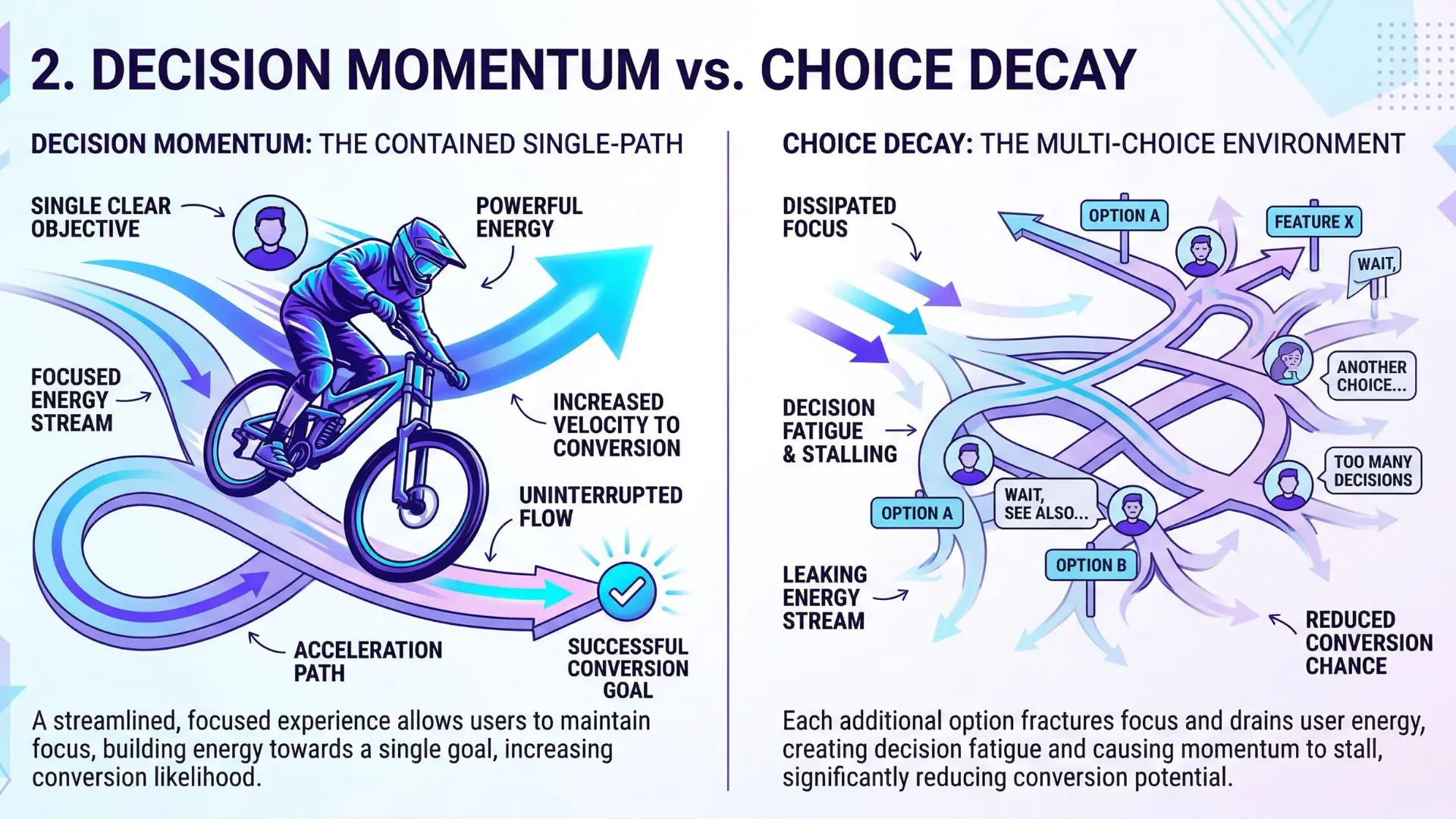
Decision momentum – the psychological force that keeps a user moving forward – decayed every time a user questioned, “Wait, should I detour for more info?”
A myth says more information builds trust. In practice, more choice leads to option fatigue.
You’ll see exit rates spike near rating widgets, FAQs, or “helpful” related offers.
Each is a subtle intent leak, not a trust booster.
The best analogy?
It’s like trying to run a marathon with multiple possible finish lines – energy scatters, and very few reach the goal.
Intent containment, by contrast, pours every drop into one glass – fast, clear, no waste.
If your landing page feels like a mini-website, are you actually scattering decision energy instead of clinching the conversion?
When landing pages hold intent tight and avoid multi-path distraction, decision energy compounds.
The next section breaks down how to diagnose – and fix – these silent leaks.

Intent containment in practice
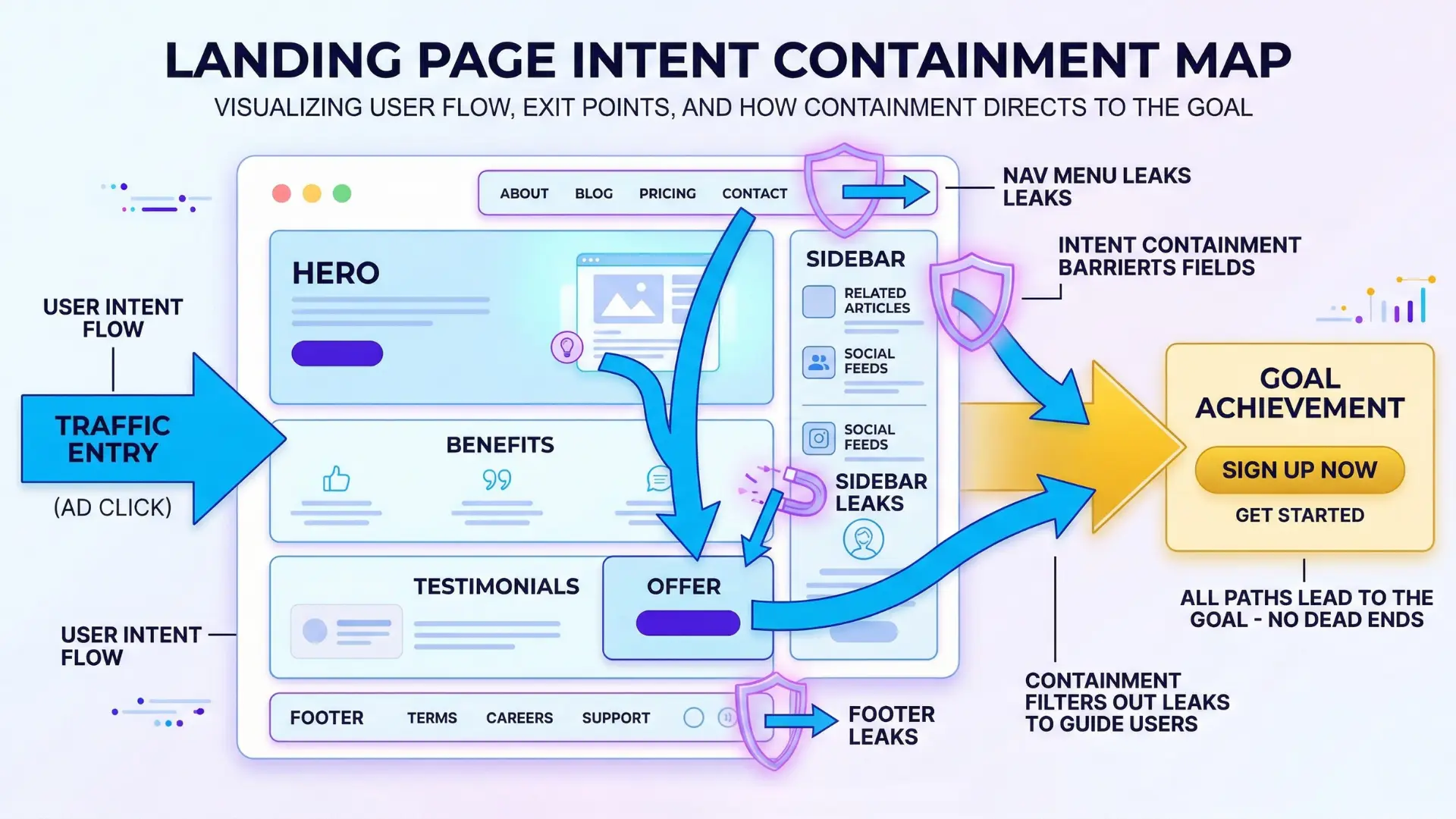
Diagnostic intent containment: The practice of diagnosing exactly how, when, and where landing pages lose decision focus – and applying precise, remedial containment to stop intent decay at the source.
Identifying choice reintroduction triggers
Landing Page Exit Mechanism Taxonomy
| Leakage Point Type | Examples | Effect on User Behavior | Observed Conversion Impact |
| Common Leakage Points | Navigation menus, footers, side links (e.g., About Us links) | Encourages exploration away from CTA | Exit rates increased by 12-20% in case studies |
| Subtle Escape Routes | Related offers, pricing sidebars, support chat bubbles | Shift focus to secondary actions, cause hesitancy | Bounce rates rose by 8-9%, form completions dropped |
Ever wonder why visitors vanish mid-scroll even when everything looks “on brand”?
Here’s a hard truth: most landing pages unintentionally invite exits the moment they reintroduce choices.
Exit Mechanism Taxonomy
Landing page exits usually fall into these categories:
- Visible navigation (top nav, footer, sidebars)
- Hidden links (logos, in-text links, FAQ buttons)
- Related or competing offers
- Support/help pop-ups
Each exit type has specific leakage patterns – diagnosing your actual taxonomy is the first diagnostic step.
We’ve seen it first-hand – a client with a killer offer and bold CTA watched 32% of their paid traffic leak to a bland “About” page.
Why?
A single top nav link, designed for ‘helpfulness,’ created a mental fork in the road.
Another project for a SaaS client tanked activation by giving users a “Learn More” sidebar; users took the hint, wandered, and rarely returned to act.
Choice reintroduction happens everywhere: a logo that links home, an unobtrusive footer menu, or even an in-line FAQ button.
Each link acts like an escape hatch, diluting the visitor’s intent to decide.
Would you pause a tense movie to browse the actor’s filmography?
Neither will your users.
One myth persists: “More information gives users confidence”.
Real-world data says otherwise – the more you scatter focus, the less likely visitors are to convert.
Think of a landing page as a bowling alley. If you open even one alley door, people will step out mid-game.
Containment wins over exploration for high-intent moments.
So, where are your hidden exits?
Decision momentum: keeping users on the path
A landing page’s true value isn’t in how much it persuades; it’s in how little it distracts.
Flow creates conversions by compressing doubt and keeping momentum high.
Every detour, hint of another action, or open door drains decision energy – a cognitive fuel that burns fast.
Seen in practice: landing pages stripped to one clear path (single CTA, zero nav, no side roads) routinely boost conversion rates by 18 – 27% compared to multi-route layouts.
Why?
The mind prefers frictionless progress.
Once a user commits, even a small disruption – like comparing plans or clicking a support link – can break the spell.
We call this “intent decay”.
It happens quietly, but once the thread snaps, it rarely returns intact.
Think of decision momentum like a downhill bike ride.
Smooth, single-track paths let you pick up speed. Introduce bumps or signs pointing in five directions, and progress stops cold.
High-converting landing pages respect this principle.
Use tools like Google Optimize or Hotjar to spot both obvious and hidden distraction points by mapping real exit patterns, then close as many open loops as possible.
Containment isn’t about being ruthless – it’s about focusing the user’s mental energy exactly where it matters most.
When you keep decision doors in one direction, momentum rarely leaks away.
The better you operationalize intent containment, the fewer decisions escape, and the more predictable your outcomes become.

Why choice and clarity collapse intent
Ever added more FAQs thinking it would boost conversions, and actually saw your numbers drop?
That’s not a fluke – it’s a direct hit to what’s called “decision momentum”.
When helpfulness becomes distraction
Here’s the odd part: information that feels supportive in a meeting room often deflates action when on the page.
One client thought six micro-case-studies below the fold would push buyers over the line – instead, clickthroughs fell by 22% in one week.
Why?
Every tidbit, download, or modal designed to be “helpful” cracks open new browser tabs.
Users veer off-track. Instead of moving forward, they retrace, compare, or get stuck in side quests (think: wandering a grocery store with a dozen free samples instead of reaching the checkout).
Even a well-intended ‘See more options’ button creates a mini detour that rarely loops users back to the singular call-to-action.
Consider: When was the last time you finished an online purchase after pausing to read three buyer’s guides and a pop-up FAQ?
That open loop – should I?
Shouldn’t I? – drains the energy that brought you here in the first place.
Trust dilution via too much optional detail
It’s tempting to believe that more detail means more trust.
Here’s the surprise: landing page leak intent isn’t always about users fleeing.
Sometimes, excess detail makes them question your clarity.
We’ve seen pages with a dozen trust badges, 14 testimonials, and ten guarantee icons – each meant to reassure, but the effect is like a restaurant menu with 200 dishes: you wonder if any single choice is truly good.
Practical story: a B2B SaaS vendor showed us exit recordings where visitors spent 90 seconds hovering over fine-print terms, then left without clicking the primary CTA.
FOMO detail backfired by sparking suspicion, not confidence. Clarity wins over quantity every time.
Clarity requires limitation: When information is limited to only what is essential for decision, trust is built through focus – not excess.
The paradox? High-intent visitors prefer selective transparency over an encyclopedia.
Think of clarity here as a spotlight, not a floodlight.
Brief, purposeful content helps the key call to action stand out – while information overload builds uncertainty, slowing or halting action altogether.
Choice and clarity are unstable allies.
The more paths or details you add, the more decision energy seeps away – often without you realizing until the data tells the hard story.
Next, let’s pinpoint where intent leaks first so you can reclaim control sooner.

First places intent escapes
Ever spotted a landing page where users abandon ship before taking action – and wondered why?
The culprit is often right in plain sight: navigation menus, footers, and tempting side links.
These elements whisper an invitation to explore, not decide.
A homepage can hold a dozen doors open.
But a landing page is meant to contain intent, focusing every ounce of user momentum on a singular next step.
Common vs. Subtle Intent Leakage Points
| Exit Mechanism Type | Description | Common Examples | Leakage Impact |
| Visible Navigation | Top-level menu items and visible site navigation | Top nav bars, footer menus, sidebars | Creates clear mental forks causing visitor exit |
| Hidden Links | Links embedded in logos, in-text anchor links, FAQ buttons | Clickable logos, inline text links, FAQ pop-ups | Subtle escape hatches that dilute decision focus |
Common leakage points (nav, footer, side links)
With clients, we’ve seen even a top bar link to ‘About Us’ siphon off 12% of high-potential prospects.
One client thought leaving a full navigation menu built trust – until analytics revealed exits spiked where secondary pages invited click drift.
The implicit message: “Other options exist, maybe this isn’t urgent”.
On a high-stakes lead gen page, adding four exploratory links cost another client 8% of conversions within just a week.
Their offer wasn’t less compelling – the path to it was crowded out.
Think of it like leaving doors open in a hallway on a windy day.
The draft takes energy wherever it finds an exit.
Why give users new decisions once they’re primed for action?
Short circuiting intent isn’t just about visible exits; it’s about the micro-signals your page sends.
Subtle escape routes (related offers, help links)
Here’s a twist: not all intent leaks start in the obvious places.
Related offers, chat pop-ups, and even help links – these well-meaning features slip under the radar.
To most, they look helpful. In reality, they splinter decision energy at the moment it’s most valuable.
A B2B SaaS client added a “See our pricing tiers” sidebar button on their demo request page.
Bounce rates jumped 9%. Inquiry forms dropped off.
Why?
That tiny option pulled users back into research mode, triggering hesitancy where decision momentum was highest.
One framework we use for detection: list every clickable element that doesn’t drive the primary action.
You’ll spot intent leaks you never expected.
Ever notice how airline websites hide baggage policy links during checkout?
They’re not just trying to save time – they’re preserving single-decision focus.
Even a support chat bubble, if offered too early, replaces a confident “Yes” with “Maybe I should ask one more thing”.
The brain latches to new exits.
The loss is subtle, but measurable.
Every leakage point, visible or subtle, dilutes landing page intent containment.
Before you patch the funnel, you have to see where it’s truly leaking.

Routing to diagnostic next steps
Ever notice how the best conversion paths almost feel like they’re pulling you forward, one decision at a time?
Here’s a surprise: on high-performing landing pages, cluster tiles aren’t just cosmetic – they’re the hidden junction boxes that channel intent, not distract it.
We’ve seen clients double their lead quality simply by restructuring these decision doors.
Instead of showing catch-all navigation, they use visual tiles that act as gateways, each representing a specific next logical step (not a list of random services).
Linking cluster tiles as decision doors
One B2B software client went from 9% to 16% demo bookings in a month by swapping generic menu links for sharp, visually distinct tiles tied to diagnostic quizzes or next-level spokes.
Why did it work?
Because every cluster tile looked and felt like a direct answer to the visitor’s core question – eliminating the desire to wander.
It’s like guiding someone through a museum with lighted arrows: they never wonder which exhibit to see next, and they don’t double back.
Here’s a myth: “Giving more options always increases engagement”.
We’ve proven the opposite in landing page intent containment.
Too much choice doesn’t generate excitement – it fractures decision energy.
Think of cluster tiles as doors in a well-marked corridor (not portals to a mall).
Every tile should signal progress, not distraction.
If a tile isn’t explicitly diagnostic or tied to a genuine next step, it’s just another exit to intent decay.
Framing choice: move users downward, not sideways
What’s the fastest way to lose decision momentum? Forced sideways choices.
If users face side-paths, their intent leaks into dead ends, side offers, or support links that weren’t the reason they landed here.
The smartest landing pages don’t ask, “Want to look around?” but, “Ready to take the next step?”
For example, instead of placing a support link next to a main CTA, one client repositioned it deep in the FAQ spoke.
Result: exit rate on the core offer dropped by 22% in three weeks.
Sound small?
When you’re spending thousands per week on paid traffic, those percentage points mean real revenue.
Here’s the kicker: when diagnostic spokes pull users downward into deeper decision states, they pattern the desired sequence for qualified action.
It’s like an expertly run airport – not a detour-heavy bus terminal.
If you want users to land, clear customs, and reach their gate efficiently, every sign moves them forward, never sideways.
Are you still giving users reasons to review old options – or making it easy for their initial decision to stick?
Intent containment isn’t about building fences – it’s about designing channels that feel inevitable, so every next diagnostic step feels less like a choice, more like gravity.
This closes out the containment logic and sets up every next decision as an easy, obvious yes.

Scientific context and sources
The sources below provide foundational context for how decision-making, attention, and performance dynamics evolve under scaling and constraint conditions.
- Cognitive load and decision quality
The Paradox of Choice: Why More Is Less – Barry Schwartz – Ecco/HarperCollins
Schwartz’s book synthesizes decades of research showing that increasing the number of choices leads to decision fatigue and reduced conversion rates, underpinning the article’s advocacy for intent containment.
https://works.swarthmore.edu/fac-psychology/198/ - Attention economics and goal progression
Attention and Effort – Daniel Kahneman – Prentice Hall
This seminal academic text discusses how limited attentional resources impact decision-making in environments with multiple competing demands, providing the theoretical underpinning for eliminating distractions on landing pages.
https://books.google.com.np/books/about/Attention_and_effort.html?id=7kvuAAAAMAAJ - Usability and conversion outcomes
Don’t Make Me Think, Revisited: A Common Sense Approach to Web Usability – Steve Krug – New Riders
Krug’s widely cited usability research demonstrates that web interfaces aligned with users’ immediate intent yield significantly higher conversion by reducing friction and cognitive overload.
https://www.peachpit.com/store/dont-make-me-think-revisited-a-common-sense-approach-9780321965516 - Loss aversion in digital experiences
Prospect Theory: An Analysis of Decision under Risk – Daniel Kahneman & Amos Tversky – Econometrica
This foundational research describes loss aversion and its practical application to digital interfaces, supporting the article’s discussion of “decision momentum” and the risks of reintroducing alternative options.
https://www.jstor.org/stable/1914185 - Multi-tasking, distraction, and performance costs
Cognitive Control in Media Multitaskers – Eyal Ophir, Clifford Nass, Anthony D. Wagner – Proceedings of the National Academy of Sciences (PNAS)
Research evidencing how exposure to multiple options and distractions erodes cognitive control, directly relevant to why “intent containment” improves digital performance.
https://www.pnas.org/doi/10.1073/pnas.0903620106
Questions You Might Ponder
What is intent containment and why does it matter for landing pages?
Intent containment is the practice of designing landing pages to focus user attention strictly on one desired action, minimizing distractions or alternative paths. Effective intent containment prevents decision fatigue and increases conversion rates by guiding visitors directly to the primary goal without cognitive detours.
How do extra navigation links impact landing page conversion rates?
Adding navigation links or side offers on a landing page often leads to ‘intent leakage’, pulling users away from the key action. Research shows that each extra link increases exit rates and decreases conversion by fracturing user momentum and introducing hesitation or new decisions.
How is a landing page different from a homepage in intent containment?
A homepage functions like a navigational mall, providing many routes for exploration, while a landing page should operate as a tightly focused ‘jet bridge’, funneling users toward a single action. This distinction is critical; landing pages must eliminate extraneous choices to maximize intent containment and outcomes.
Where are the first places decision momentum leaks in digital funnels?
Decision momentum commonly leaks at visible navigation bars, footers, or help links, as well as subtle elements like related offers and chat widgets. These features distract users from converting, increasing bounce rates and lowering the efficiency of paid acquisition campaigns or lead gen flows.
What diagnostic steps help identify weak intent containment on my page?
Review your landing page’s exit data and click maps for points with high drop-off that don’t directly support your main offer. Tools like Hotjar or Google Optimize can reveal choice ‘reintroduction’ triggers, such as extra CTAs, misleading links, or support buttons, allowing you to patch and strengthen intent containment.