
What You’ll Learn
When CRO cant help means the conversion problem sits before or beyond the page, so tests, layouts, copy tweaks, and button changes cannot create meaningful lift.
CRO can reduce friction, clarify expectations, improve trust cues, and make the next step easier for visitors who already have the right intent.
It cannot fix poor traffic quality, weak offer resonance, unclear positioning, wrong audience targeting, lack of demand, or broken sales handoffs.
If users bounce quickly, show low intent, or leads never engage despite a strong page, the issue is likely upstream.
The fix is acquisition, segmentation, offer, or positioning diagnosis – not another CRO test.
Key Takeaways
- Most conversion issues occur upstream – CRO cannot fix poor traffic quality, misaligned offers, or lack of demand clarity.
- CRO excels at reducing friction, clarifying messages, and managing expectations, but only for the right audience and fit.
- Endless page optimizations rarely pay off if visitor intent, acquisition targeting, or value proposition are broken.
- The biggest lifts happen when businesses match diagnostics to the true constraint, distinguishing between CRO and upstream fixes.
When CRO can’t help, it’s nearly always because the bottleneck lives before the page.
This guide makes the boundaries visible – so your next move matches the real constraint.

Why conversion still fails despite traffic – when CRO isn’t the answer
Most companies assume that high-quality pages and a steady stream of visitors will unlock growth.
The surprise?
Even with perfect landing pages, conversion can stall – because CRO’s power ends where upstream misalignment begins.
Picture this: traffic flows, analytics show visitors pouring in, but engagement flatlines.
The numbers look alive, yet revenue refuses to budge.
That’s not a CRO failure.
It’s a demand-and-intent mismatch – a silent killer that optimization tactics can’t address.
When visitors don’t act: signs that the issue starts before the page
Low scroll depth, high bounce rates, and quick exits from paid audiences are classic signs: this is when CRO can’t help – the problem starts at traffic quality, not with the page.
One persistent myth: all you need is more visits, and the rest will follow.
In reality, mismatched intent – from irrelevant SEO, misplaced ads, or channels pulling in browsers rather than buyers – means your best pages face the wrong crowd.
We’ve seen SaaS clients spend six figures sending paid traffic to “best practice” pages.
The result?
Engagement tanks, time-on-page drops, and conversions barely register.
The early warning signals are there: users arrive but don’t interact, or they click once and vanish.
Imagine hosting a Michelin-starred dinner for guests who aren’t hungry.
No dish, however perfect, can save the night.
Ask yourself: are visitors primed to make a decision – or were they never the audience in the first place?
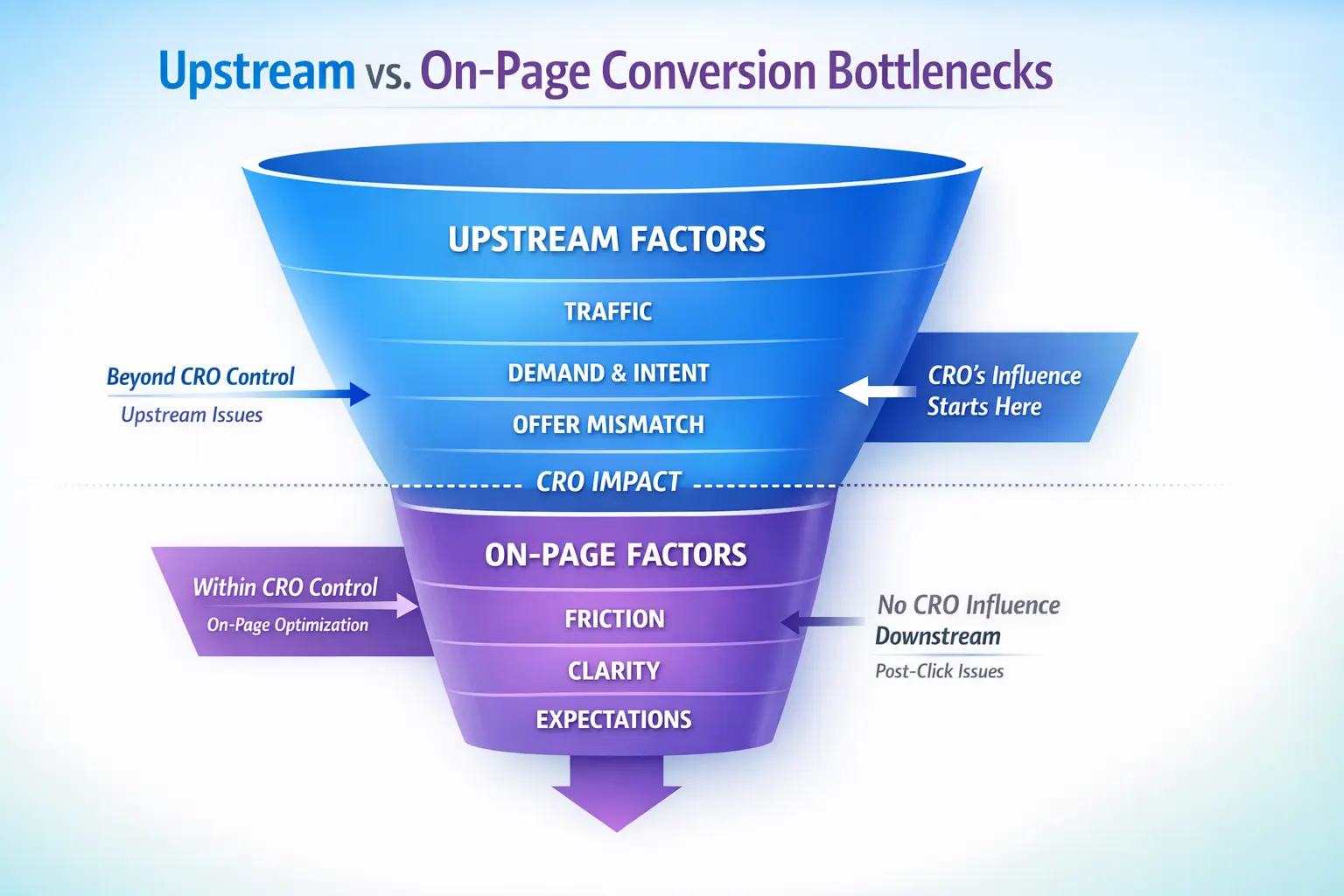
When good pages don’t fix it: why perfectly built experiences still stall without demand clarity
It’s easy to blame the page when numbers disappoint.
But we’ve watched world-class ecommerce flows – painstakingly tested, beautifully designed – produce no lift because the offer was off.
One executive asked, “How can acquisition be broken if the page is flawless?”
Here’s the reality: optimization is powerless if what you’re offering doesn’t resonate, if the context isn’t clear, or if buyers aren’t ready.
Modern B2B journeys make this even sharper: stakeholders hit the page needing a fit for purpose, not a lesson in UI clarity.
Traffic and design are only half the equation.
When revenue stalls despite pixel-perfect pages and solid traffic, look upstream – at messaging, market timing, or offer logic.
Most conversion problems start before a visitor ever sees your call to action.
If results stall even when CRO is firing on all cylinders, it’s rarely a page problem.
True gains happen when page and demand work in concert; without upstream clarity, no amount of optimization fills the gap.
The next move: start with the real root cause, not the nearest tweak.

What CRO really controls – and what lies beyond its scope
What CRO Can Control vs. What CRO Cannot Control
| Decision Area | Key Indicators | Recommended Action |
|---|---|---|
| Escalate to Acquisition or Positioning | Steady traffic but low intent; high bounce rates despite good UX; leads never engage; rising CAC with stagnant conversions; qualitative feedback shows confusion | Conduct demand mapping, segmentation, and sharpen offer articulation |
| Let CRO Focus on Reducing Decision Friction | Users scroll deep; re-engage on page; drop-off occurs right before form completions | Optimize message sequencing, reduce hesitation and friction, improve trust cues |
What CRO can control:
- Friction reduction
- Context and message clarity
- Managing immediate expectations
What CRO cannot control:
- Traffic quality
- Offer resonance/meaning
- Sales or operational handoff failures
Most teams misjudge what their best optimizers can actually shape.
CRO isn’t a universal fix – its greatest power exists within tight boundaries, often narrower than leadership expects.
Uncovering where optimization truly moves the needle means facing an inconvenient truth: even flawless UX leaves the real growth bottlenecks untouched if the problem lives upstream.
Areas where CRO drives lift: friction reduction, clarity, immediate expectations
Picture CRO as a skilled pit crew – not replacing your racecar, but shaving crucial seconds off pit stops.
The standout gains originate from clearing obstacles: reducing user hesitation, clarifying next steps, and shrinking the psychological cost of action.
When we’ve audited underperforming funnels, three levers outshine the rest: friction reduction, context clarity, and managing immediate visitor expectations.
Here’s where the needle moves fast:
- Sharpening calls to action to diminish uncertainty.
- Collapsing cognitive overhead by simplifying paths – one client streamlined a quote process, cutting steps by 40%, and saw same-session conversions jump by double digits.
- Making benefits obvious above the fold, reducing “wait, what do I get?” moments.
This is decision friction’s domain – those micro-barriers and moments of hesitation that even interested prospects feel.
Ask: is confusion, effort, or anxiety killing your best offers on the page?
If you remove those, CRO delivers.
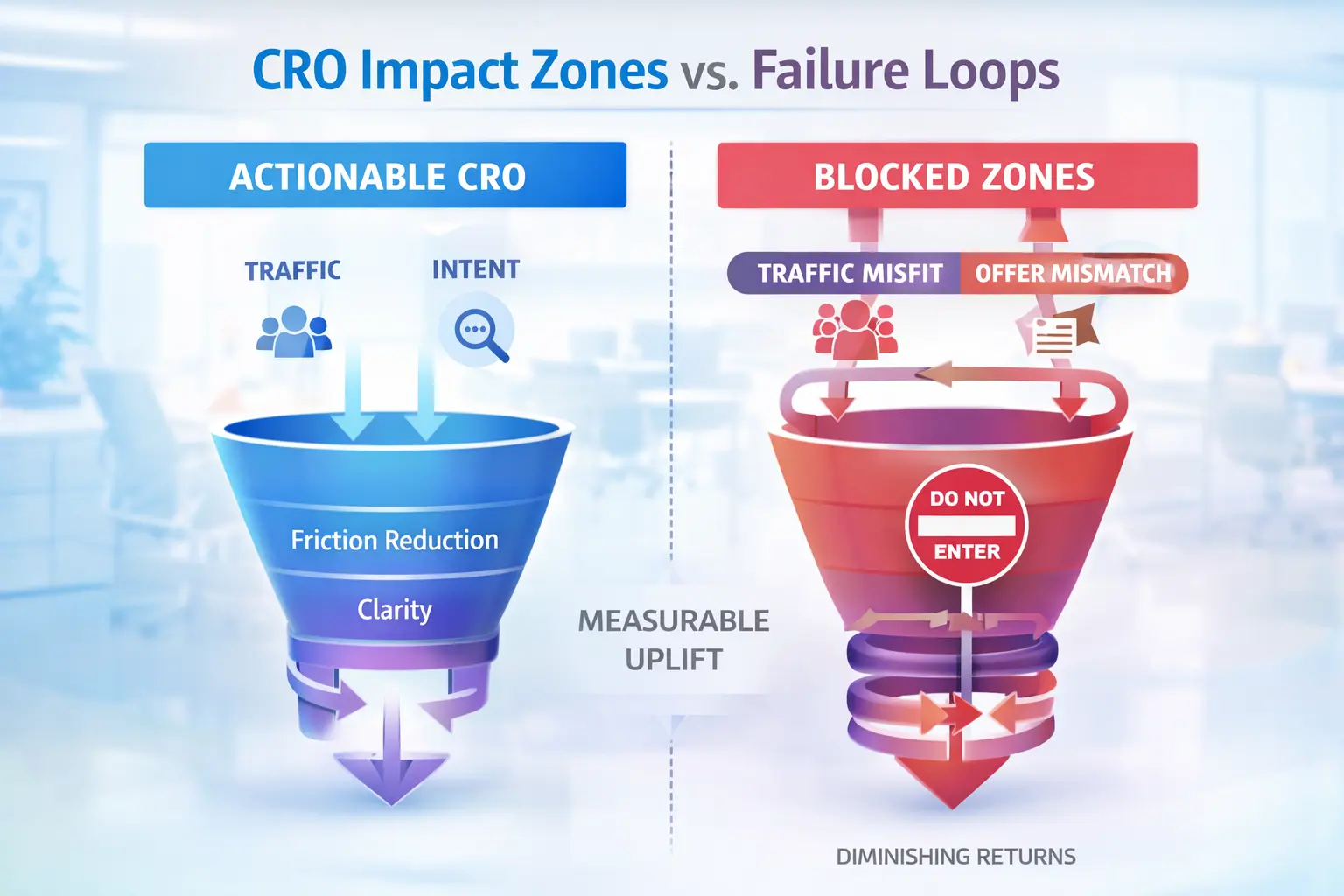
Failure zones: traffic quality, offer meaning, operational handoffs that CRO can’t fix
But here’s the myth: that fixing button color, copy, or layout can compensate when the incoming audience is wrong or the offer is misaligned.
We’ve inherited projects with gorgeous, conversion-optimized pages – yet results flatlined, because traffic sources were mis-targeted or underlying offers failed to resonate.
CRO’s influence stops at the edge of the page’s context.
If visitors arrive with mismatched intent, no design trick can create demand from thin air.
This also applies to broken handoffs – where sales ops, tech stack issues, or mis-set expectations sabotage the downstream flow.
These domains live outside CRO’s reach, yet executives still expect miracles from website tweaks.
If you’ve looped through endless redesigns with only fragile, short-term gains, you’re chasing symptoms, not solutions.
The core insight: CRO wins inside the frame of page interaction and fails when forced to paper over gaps that should have been solved at the traffic, offer, or strategic positioning level.
Define the battle lines.
CRO can shape the decision – but only if the right person, with the right question, lands on the right page.
The rest is noise.

Common failure loops when misassigning responsibility to CRO
Most marketing teams burn months chasing micro-optimizations – believing each new color test or headline tweak will finally push conversion north.
The shock comes when the numbers barely budge or, worse, gains fade as fast as they appear.
Here’s why those cycles keep repeating, even with talented CRO leads in the room.
Redesign chase: endless page tweaks without solving upstream gaps
You can relaunch the same page five times, each version sharper and technically flawless, and still watch conversions flatline.
The core misdiagnosis: treating symptoms on the page, when the real block sits miles upstream.
In our work, we’ve witnessed teams iterate wireframes weekly, stacking feedback, deploying variant after variant – only for the initial problem to persist.
One enterprise team hit a wall after 40+ A/B tests, only to realize their traffic was the wrong audience altogether.
CRO limits are hard boundaries: no amount of polish compensates for a poor fit between offer and visitor intent.
It’s like endlessly tuning a sports car’s suspension, while its engine is running on the wrong fuel.
What feels like progress is often motion without movement.
Ask yourself: if every CRO experiment needs an explanation for underperforming, are you hunting the right issue?
Fragile gains: why minor uplifts vanish without alignment and system coherence
Now and then, a page tweak shows a promising bump – maybe +10% in signups or demos.
The celebration is short-lived.
Within weeks, metrics drift back or drop lower than baseline.
These bumps are fragile gains: temporary upticks on shaky foundations.
We’ve seen SaaS clients drive up conversion for a single campaign, only for user churn and dissatisfaction to rise downstream, because the offer and promise never truly matched the market’s readiness or need.
Here’s the actual pattern: superficial results appear when teams apply CRO as patchwork.
The lack of upstream alignment – between traffic source, value proposition, and user motivation – means even strong conversion wins evaporate fast.
Shared accountability across strategy, acquisition, and conversion is the only defense against these costly cycles.
Misassigned CRO responsibility creates endless loops, not lasting improvement.
Leaders who recognize these patterns early can stop burning resources and focus decisions where they’ll actually move the business forward.

How to decide where to act next: diagnose or delegate
When to Escalate Acquisition vs. When to Focus CRO
| Category | Can Control | Cannot Control |
| Traffic Quality | ✔ | |
| Friction Reduction | ✔ |
Most conversion shortfalls aren’t actually page problems – they’re misdiagnosed business signals.
The real break often hides upstream, long before anyone lands on your optimized experience.
So how do you know whether to double down on CRO or pivot attention to acquisition and positioning?
The wrong move wastes quarters.
When to escalate to acquisition or positioning diagnostics
If you see persistent patterns – steady traffic but low intent, high bounce rates despite crisp UX, or leads that never engage – the root issue usually escaped the CRO process entirely.
We’ve seen B2B clients tweak every on-page element for months, yet conversions flatline because ads drew in researchers, not buyers.
Optimizations only polish irrelevance.
It’s like fixing a leaky faucet when the main water line is broken: you end up with dry pipes, no matter how well the fixtures work.
Ask yourself: are visitor motivations truly matched to your offer?
Is your message attracting the segment ready to act – or just the ones curious enough to click but not commit?
Here’s the mistake: believing funnel metrics reflect only page quality, when they’re just as often windows into strategy flaws above the page.
Diagnose upstream if any of these flags appear: channel CAC rises but conversion rates stagnate, qualitative feedback centers on confusion (“not what I expected”), or sales cycles drag despite strong initial traffic.
That’s the cue for deeper demand mapping, better segmentation, and sharper offer articulation – capabilities well beyond CRO’s brief.
When to let CRO focus on reducing decision friction
But don’t eject CRO from the process without evidence.
When analytics show clear intent – users scrolling deep, re-engaging, or dropping right before completing forms – page-side friction is likely the bottleneck.
In one SaaS rollout, we watched activation rates double after stripping away two steps; everything else (ad source, core offer) stayed the same.
The lesson: when the wrong people aren’t clogging the top of funnel, micro-barriers and hesitation often cripple the close.
Rhetorical question: What if your visitors want to buy, but your flow quietly erodes their confidence?
In those cases, every CRO dollar works harder than any upstream spend.
These scenarios demand laser attention on message sequencing, trust cues, and uncertainty reduction – the areas where optimization earns its keep.
The distinction is subtle but decisive: fix the path when fit is right; recalibrate targeting and positioning when everyone’s walking past the front door.
Clarity at this fork saves cycles and capital.
Smart teams set boundaries, then act with confidence – either by dialing up acquisition diagnostics or empowering CRO to do what it does best.

Scientific context and sources
The sources below provide foundational context for how decision-making, attention, and performance dynamics evolve under scaling and constraint conditions.
- Digital Marketing Funnel Efficiency
“Shaping the Digital Customer Journey” – Edelman & Singer – Harvard Business Review
This study expands on the original McKinsey framework, illustrating how digital technology has shifted the funnel from a linear path to a continuous circular journey. It emphasizes that efficiency is gained by automating and personalizing touchpoints to proactively lead customers through the experience.
https://hbr.org/2015/11/designing-marketing-ecosystems-to-accelerate-the-customer-experience - Behavioral Economics & Bottlenecks
“Thinking, Fast and Slow” – Daniel Kahneman – Farrar, Straus and Giroux / Macmillan
A foundational text in behavioral science explaining the dual-process model of “System 1” (intuitive) and “System 2” (analytical) thinking. It identifies how cognitive biases act as psychological bottlenecks, causing users to abandon tasks when “mental friction” exceeds their motivation.
https://us.macmillan.com/books/9780374533557/thinkingfastandslow/ - Demand, Fit, and Market Timing
- “The Lean Startup” – Eric Ries – Penguin Books
Introduces the “Build-Measure-Learn” framework for validating product-market fit. Ries argues that funnel optimization is often secondary to fundamental demand; if the “offer resonance” is missing, no amount of conversion tuning will lead to sustainable growth.
https://www.penguin.co.uk/books/185058/the-lean-startup-by-ries-eric/9780670921607 - Funnel Diagnostics & Marketing Attribution
“Marketing Models: Multivariate Statistics and Marketing Analytics” – Dawn Iacobucci – Earlie LiteA rigorous academic guide to diagnostic modeling. It provides statistical methods for determining whether conversion issues stem from traffic quality (source), messaging (offer), or the user experience (conversion), allowing for data-driven evidence of where the true funnel boundaries lie.
https://www.researchgate.net/publication/314286386_New_Marketing_Models_Multivariate_Statistics_and_Marketing_Analytics_4e
Questions You Might Ponder
What does it mean when CRO can’t help conversion rates?
When CRO (Conversion Rate Optimization) can’t help, it typically means the main conversion problem lies upstream – such as poor traffic quality, mismatched offer, or flawed targeting – rather than within the website or landing page experience itself. Fixing these upstream issues is essential for meaningful lift.
How do you identify if conversion issues are due to upstream problems?
Key signs include high bounce rates, low engagement, brief visits from paid traffic, or persistent flatlining despite landing page improvements. If visitors aren’t interacting meaningfully, it usually indicates a disconnect between traffic intent and what the page delivers.
What are examples of conversion bottlenecks outside CRO’s control?
Typical bottlenecks beyond CRO include irrelevant or unqualified traffic, value propositions that don’t resonate with visitors, and broken operational handoffs (e.g., sales follow-up failures). These require strategic or acquisition-level intervention to resolve.
When should you prioritize acquisition diagnostics over CRO testing?
You should pivot to acquisition diagnostics when analytics reveal steady traffic but weak engagement, conversion rates remain flat after extensive optimizations, or qualitative feedback suggests offer mismatches. Addressing source and message fit becomes the priority.
How can teams avoid endless optimization cycles with little impact?
Teams should set clear boundaries for CRO’s influence and diagnose whether the root issue is upstream in acquisition or demand. Focusing on the true constraint – traffic quality, messaging, or offer resonance – prevents wasted resources on minor page tweaks that don’t move key metrics.