
What You’ll Learn
Traffic mismatch vs CRO is the distinction between a conversion problem caused by the wrong visitors and one caused by the page experience itself.
Traffic mismatch happens when users arrive with low intent, wrong expectations, poor fit, or motivation that does not match the offer, so conversion stays weak even if the landing page is well designed.
CRO is useful when qualified visitors understand the offer but face friction, confusion, or usability barriers.
The diagnostic difference appears in behavior data: sharp conversion gaps by channel, high bounce rates from specific sources, short sessions, or ad-to-page message mismatch point upstream to traffic quality, not page optimization.
Key Takeaways
- Conversion rates often stagnate not because of poor page design, but due to mismatched or low-intent traffic sources.
- Analytics revealing disparities in user behavior and conversions across channels signal that traffic quality, not CRO, is the core problem.
- Repeated page optimization produces minimal improvement if acquisition strategies draw the wrong audience or misalign with the offer.
- Prioritizing diagnostics around traffic-source intent and message alignment yields bigger growth levers than endless CRO tweaks.
It’s easy to spot a flat conversion trend and blame the page – but what if the real culprit is much further upstream?
The hard truth: your page might be flawless, but your incoming traffic is fundamentally mismatched.
In client reviews, we see strong landing pages fail not because of design or copy but because the visitors were never likely to convert in the first place.
If it feels like your funnel should be working based on every best practice, yet you’re stuck with “high traffic, low conversions”, this is the silent culprit.

Why conversion stalls even with steady traffic
More page tweaks won’t save you when the real gap is between what your visitors want and what your offer delivers.
We’ve seen paid campaigns pump thousands of new users into sites – only to yield the same low conversion rates, because users arrived searching for information, not solutions.
Imagine inviting job seekers to a product demo.
The chemistry just isn’t there.
Their purpose and your offer don’t match, so no amount of button color or headline testing will bridge that gap.
How intent mismatch drags down outcomes
Here’s the myth to retire: more traffic isn’t a growth lever if the underlying motivation is wrong.
It’s like pouring runners onto a marathon course when you need sprinters.
You’ll only get tired visitors, not finishers.
Ask yourself: are you optimizing pages for curiosity-driven visits or for those actually primed to buy?
In our post-mortems, nearly every persistent conversion drop had its roots in traffic quality, not CRO errors.
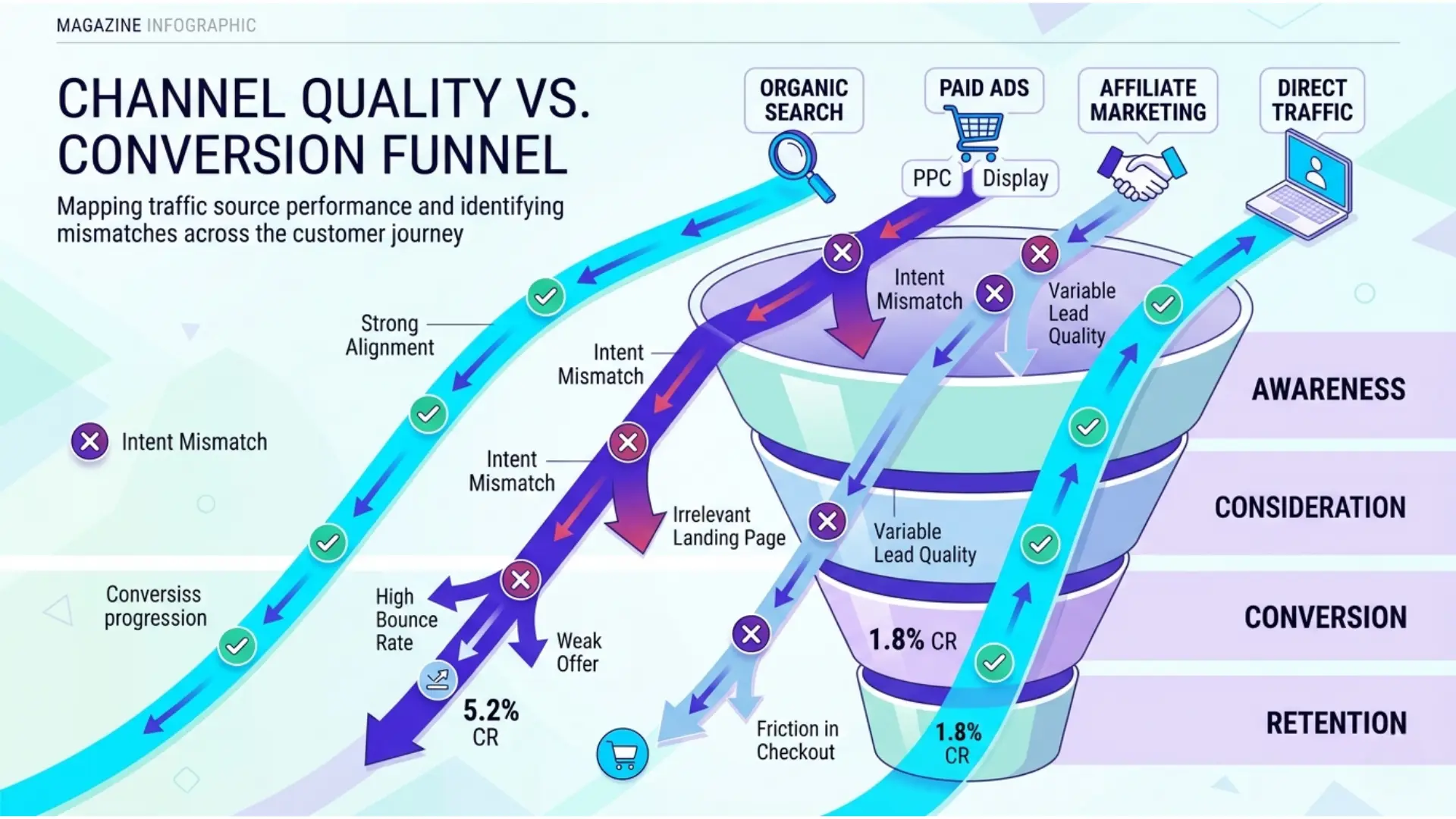
Recognizing poor traffic through behavior metrics
Behavior Metrics Indicative of Traffic Quality Issues
| Observation | Description | Interpretation |
|---|---|---|
| Wide conversion rate gaps between channels | Some sources perform strongly while others underperform drastically | Traffic quality varies significantly; poor intent in some channels |
| High bounce rates on display or sponsored content traffic | Visitors leave quickly despite good page experience | Inbound traffic intent does not match offer |
| Branded search converts much better than paid generic traffic | Branded campaigns have higher intent and trust | Paid channels may be driving unqualified leads |
Behavior tells the real story: look to your analytics for unmistakable signals that separate CRO issues from traffic quality drops.
Outlier bounce rates on specific paid channels, drastically short session durations, or a channel that drives volume but near-zero qualified leads?
These are all classic “traffic quality” fingerprints.
One client faced this pattern: organic blog readers stayed two minutes, but paid ad visitors bounced in under twenty seconds.
Same page, same offer – completely different outcomes.
The cause was intent, not execution.
Channel-by-channel comparison highlights hidden mismatches.
Do users from your branded campaigns convert at 5x the rate of display or content syndication traffic?
That delta points upstream: your targeting or creative is drawing the wrong crowd.
Your site’s conversion pain isn’t a generic problem; it’s a symptom spilled from your acquisition pipeline.
If your web analytics reveal a river of the wrong visitors, no page tweak will flip the script.
If your conversion engine is stalling, question the fuel before you replace the parts.
Conversions aren’t blocked by pixels – they’re blocked by intent.
If your current data points to a core traffic mismatch, consider stepping out of the CRO cycle and reviewing your acquisition or messaging approach.

When CRO teams are mistakenly asked to fix acquisition problems
Most teams call in conversion experts at the wrong moment.
They see a graph stuck flat or declining, assume a tweak will save them – and send the CRO team after a ghost.
But if the root issue is traffic quality, you can optimize every pixel and still get nowhere.
This disconnect eats budgets, stalls morale, and triggers months of circular diagnosis.
What CRO can’t fix: demand and offer clarity
Here’s what never gets mentioned in most post-mortems: no amount of A/B testing will create demand that doesn’t exist or clarify an offer muddied upstream.
If the majority of your visitors are just browsing, misinformed, or never intended to convert, all the button color changes and headline experiments in the world won’t flip the result.
We once audited a B2B SaaS client convinced their signup flow was broken.
But engagement data revealed a deeper story – more than 80% of paid traffic bounced on first view.
They weren’t confused by the product.
They simply never wanted it.
The ad had promised an unrelated benefit, so visitors hit the site, didn’t see what was claimed, and left.
Think of CRO like tuning a racecar – it can help you win, but it won’t turn a family sedan into a podium finisher.
When awareness and motivation are missing, the best on-page optimizations become window dressing.
If intent is wrong, the conversion lift is capped before you even start.
When to pause optimization and diagnose traffic strategy
How do you know it’s time to stop fiddling with the site and look upstream?
Three signals force a hard stop:
- exponentially worse conversion rates on paid or affiliate traffic versus branded or direct channels,
- repeated plateauing despite rounds of CRO tests showing minimal uplifts, and
- feedback loops showing friction is not on-page but in initial expectations or offer fit.
We’ve worked with high-growth brands that spent months chasing micro-wins before realizing their lowest-yield campaigns were simply dumping the wrong audience onto high-intent pages.
Once acquisition and messaging teams realigned the value prop with the promise made in ads, conversion rates rebounded – without another landing page test.
When the evidence piles up, the right call is to pause CRO sprints and shift focus to acquisition and messaging diagnostics.
Otherwise, you risk fixing symptoms while the cause continues unchecked.
CRO isn’t a magic fix for traffic mismatch or intent drift.
Knowing when to redirect effort upstream is what separates high-performing teams from those stuck tweaking in circles.
If your current data points to a core traffic mismatch, consider stepping out of the CRO cycle and reviewing your acquisition or messaging.

How to spot traffic-caused CRO symptoms reliably
The difference between a page problem and a traffic problem isn’t subtle – it’s hiding in plain sight inside your analytics, if you know where to look.
One of the most expensive mistakes we see: executives spend months reworking on-page elements while ignoring the real culprit – bad or misaligned traffic silently sabotaging conversions.
Channel-level conversion variance as diagnostic red flags
Channel Conversion Variance Diagnostic Checklist
| Behavior Metric | Description | Traffic Quality Implication |
|---|---|---|
| Bounce Rate (Paid Channels) | High bounce rates from specific paid sources | Visitors not matching intent, low-quality traffic |
| Session Duration | Significantly shorter sessions compared to other channels | Low engagement indicating poor alignment |
| Conversion Rate by Channel | Drastic drops in conversions from a specific channel | Traffic mismatch or wrong audience targeting |
If conversions drop but only certain traffic sources are affected, that’s no accident.
The best-performing channels almost always anchor your overall conversion rate, while low-intent sources act like a slow leak in a tire – subtle at first, eventually flattening everything.
We’ve audited funnels where display campaigns were clocking 80% bounce rates with zero pipeline, even as branded search powered healthy deal flow.
The contrast wasn’t in the copy or design, but who was arriving and what they expected.
Whenever you see wide conversion gaps between sources – think organic versus paid, branded versus generic, or even between different ad networks – you’re staring at a traffic quality issue, not a landing page flaw.
A simple analogy: blaming the airport lounge when your flight is delayed by the airline.
The comfort inside the room isn’t the cause; it’s the incoming pipeline that failed to deliver.
Ever ask why your Facebook and Google traffic convert so differently, when they hit the same page?
Or why referrals crush sponsored content every quarter?
This isn’t random variance – it’s pointing directly at intent mismatch and source misalignment.
Don’t gloss over that.
Find the outlier, then trace backward to the upstream promise.
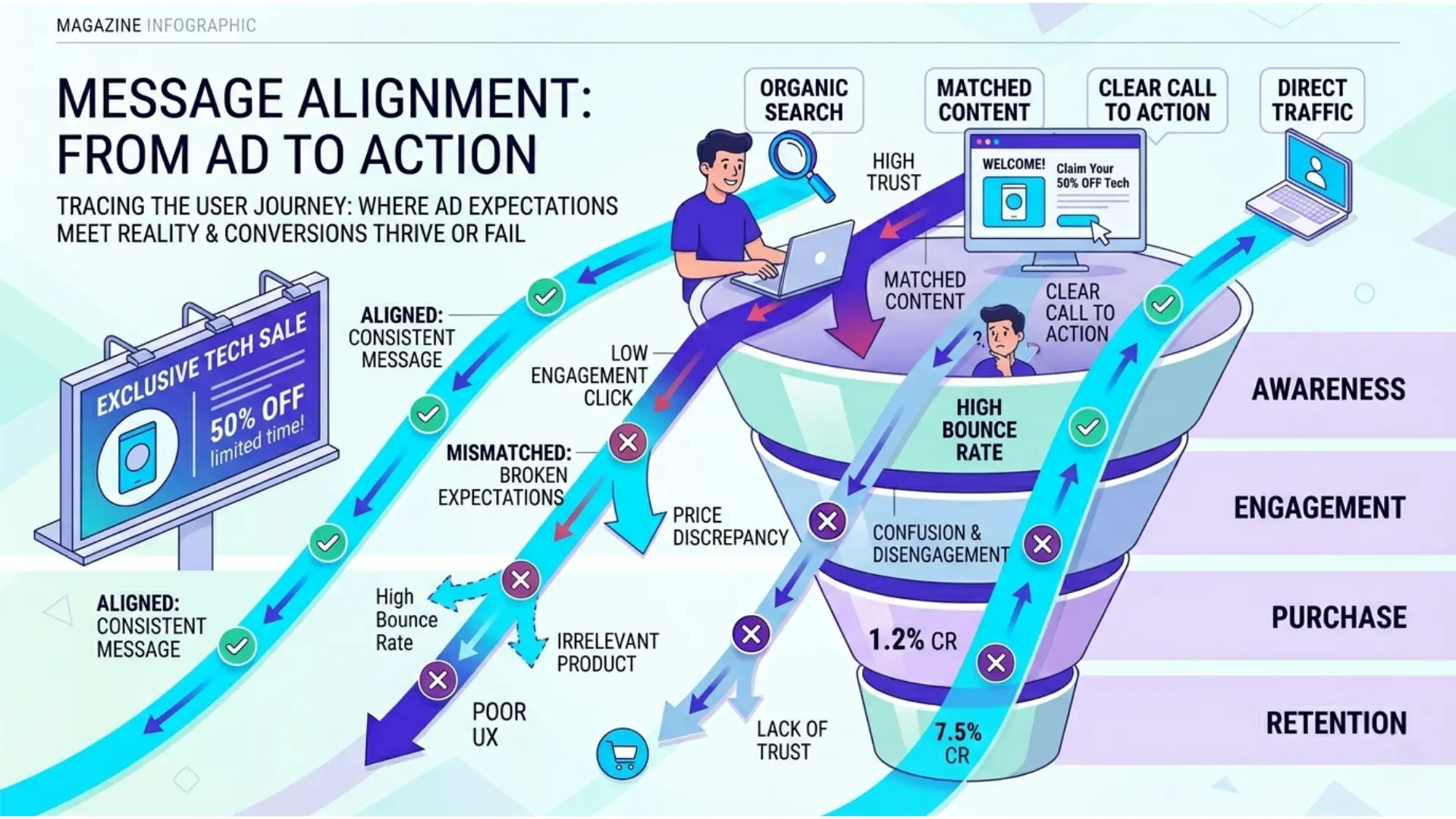
Message alignment mismatches between ads and landing pages
A strong landing page can’t recover from expectations set by the wrong message.
We’ve seen campaigns with click-ready headlines (“Free trial. No credit card”.) funneled to product demo requests – a bait-and-switch that instantly shatters trust.
Even the best CRO tactics drown when the ad primes one outcome and the page demands another.
Watch for telltale mismatch signals: spikes in bounce rate when new ad copy launches, or a surge in early exits just after the headline loads.
This isn’t defective page design – it’s context whiplash.
If the promise that earned the click doesn’t continue seamlessly onto the page, confusion drives visitors away before they ever weigh your offer.
The fastest way to spot this: stand in the shoes of each segment, click the ad, and feel the transition.
If your own expectation isn’t anchored from one step to the next, fix the upstream message first.
If your channel reports and landing page insights are painting two different stories, it’s time to stop overhauling what’s working and ask: is it the visitors, not the page, who are failing to convert?
That clarity saves cycles – and keeps resource focus where real gains live.
If your current data points to a core traffic mismatch, consider stepping out of the CRO cycle and reviewing your acquisition or messaging approach.

Deciding what to fix next: CRO or traffic
What if the true growth lever isn’t more optimization or more visitors – but choosing ruthlessly between the two?
Most companies cycle between A/B tests and campaign tweaks, never realizing that doubling down in the wrong place can sink months of effort and budget.
Here’s the uncomfortable reality: even data-driven teams confuse a traffic mismatch with a CRO issue, and it’s costing them more than slow growth.
That tension is both a threat – and an opportunity – if you know which signal to trust next.
When to double down on conversion optimization
There’s a sweet spot where CRO outperforms: when your traffic is decently qualified, intent matches offer, but subtle friction or clarity issues stall movement down the funnel.
In these cases, small tweaks amplify ROI rather than masking upstream mistakes.
We’ve watched a B2B SaaS client recover a plateauing signup rate by decluttering their call-to-action language – their traffic was narrow and targeted, so the fix paid off fast.
If channel-level conversions stay consistent across sources, bounce rates are moderate, and session durations suggest genuine engagement, your traffic likely passes the threshold.
In this scenario, tactical CRO delivers real gains; you’re tuning the engine, not building a new one.
But is this really the problem you’re facing, or are the symptoms pointing elsewhere?
When to halt and redirect focus upstream
If your analytics paint a picture of high traffic and low conversions, but deeper dives reveal dramatic gaps between sources, intent mismatch is the silent killer.
Think of it like funneling casual passersby into a high-stakes sales meeting: no amount of on-page optimization can transform disinterest into action.
We’ve seen ecommerce brands pour six figures into landing page iterations with negligible uplift, only to realize their campaigns targeted the wrong search intent.
Tell-tale symptoms – spiking bounce rates, minimal time on page, and conversions isolated to one or two channels – are not design issues but acquisition problems.
When channel variance overshadows page wins, pulling CRO levers is a distraction.
Trade perfectionism for decisiveness – sometimes walking away from optimization is the boldest move.
The real advantage isn’t guessing which lever to pull; it’s deciding based on evidence, not hope.
Diagnose fast, act faster, and invest where the next 10% actually lives.
If your current data points to a core traffic mismatch, consider stepping out of the CRO cycle and reviewing your acquisition or messaging approach.

Scientific context and sources
The sources below provide foundational context for how decision-making, attention, and performance dynamics evolve under scaling and constraint conditions.
- Understanding Decision-Maker Constraints
“Bounded Rationality: The Adaptive Toolbox” – Gerd Gigerenzer & Reinhard Selten – MIT Press
Examines how business and marketing teams make effective choices under information overload, relevant to diagnosing upstream vs. on-page performance issues.
https://direct.mit.edu/books/edited-volume/4232/Bounded-RationalityThe-Adaptive-Toolbox - Traffic Quality and Conversion Science
“Online Advertisers Bidding Strategies for Search, Experience, and Credence Goods: An Empirical Investigation” – T. Animesh et al. – Second Workshop on Sponsored Search Auctions
Provides data-driven insight into how traffic source characteristics directly influence conversion efficacy – echoing the article’s claim on traffic mismatch.
https://www.researchgate.net/publication/229001142_Online_Advertisers_Bidding_Strategies_for_Search_Experience_and_Credence_Goods_An_Empirical_Investigation - Message-Expectation Alignment
“The Impact of Feelings on Ad-Based Affect and Cognition” – Marian Chapman Burke and Julie A. Edell – Journal of Marketing Research
Explores how expectation management between ad messaging and experience strongly shapes user action and trust.
https://journals.sagepub.com/doi/10.1177/002224378902600106 - Channel Attribution and Conversion
“Cross-Industrial User Channel Preferences on the Path to Online Purchase” – Ingo F. Becker, Marc Linzmajer and Florian von Wangenheim – Journal of Advertising
Analyzes methods for properly attributing conversion variance to source effects rather than to on-page factors, informing decisions about CRO vs. traffic.
https://www.jstor.org/stable/48542204 - User Intent Dynamics in Web Behavior
“Informational, transactional, and navigational need of information: relevance of search intention in search engine advertising” – Carsten D. Schultz – Information Retrieval Journal
Empirically evaluates how search intent alignment or mismatch is predictive of conversion performance, matching central article themes.
https://link.springer.com/article/10.1007/s10791-019-09368-7
Questions You Might Ponder
How do I know if traffic mismatch or CRO is the real issue with my conversions?
If high-traffic pages yield low conversions especially from specific sources, check analytics for channel-level differences in bounce rates, session times, and engagement. If paid, affiliate, or cold sources underperform compared to direct or branded, traffic mismatch is likely the culprit rather than a CRO flaw.
What metrics indicate a traffic mismatch versus a CRO problem?
Traffic mismatch surfaces in metrics such as high bounce rates, single-page sessions, or conversion gaps across acquisition channels. If CRO were the issue, poor performance would be evenly distributed. Marked disparity between traffic sources indicates upstream issues in visitor quality or intent.
Can changing my landing page fix problems caused by poor traffic quality?
No, even optimally designed landing pages cannot compensate for visitors lacking purchase intent or who were misled by ads. Only aligning traffic acquisition strategies and messaging with actual offer relevance improves such conversion outcomes – page tweaks alone won’t solve intent mismatches.
When should I pause CRO tests and focus on traffic strategy instead?
If repeated CRO iterations fail to boost conversions and analytics consistently highlight conversion disparities by source, pause on-page work. It’s time to review acquisition, creative targeting, and alignment between ad promises and on-page content to resolve traffic mismatch.
What happens if I ignore traffic mismatch and keep optimizing pages?
Ignoring traffic mismatch wastes resources and leads to diminishing returns – conversion gains plateau, and diagnosis cycles become circular. Teams risk budget loss, morale issues, and missed growth opportunities by not addressing the root cause in traffic quality or channel alignment.