
What You’ll Learn
Why content doesnt convert is usually not because the content is poor, but because it attracts attention before the audience has enough intent, trust, urgency, or context to act.
Content often prepares decisions by educating, framing problems, and reducing uncertainty, while conversion depends on a later handoff to lead-generation assets, offers, forms, sales pages, or direct contact points.
High traffic, long time-on-page, or social engagement can show interest, but they do not prove buyer readiness.
Content converts only when the right reader reaches the right stage, sees a relevant next step, and has a clear reason to move from learning to action.
Key Takeaways
- High content engagement does not guarantee conversions; attention and intent are distinct stages in the buying journey.
- Content is most valuable as a system for preparing, informing, and building trust – conversion relies on proper readiness and timed handoff to lead-capture assets.
- Over-delivering answers can stall pipeline growth; optimal content triggers further action while leaving room for engagement.
- Separating content, lead gen, and optimization functions and tracking intent signals enables measurable impact beyond vanity traffic metrics.
Core Promise: Content prepares decisions; it rarely closes them.
Most content does not directly convert, but systematically creates the trust and context that make conversion possible later.
How often have you reviewed a high-traffic blog and wondered: “If users spend minutes on this page, why are leads flatlining?”
This is the paradox at the heart of modern content marketing – a paradox many leaders don’t see coming.
Engagement metrics (like scroll depth or time-on-page) feel safe and positive, yet they hide a deeper risk: assuming attention equals intent to buy.

Expectation vs Reality: Why Teams Assume Content Should Convert
Here’s a real conversation we’ve had with SaaS founders: “Our case study went viral on LinkedIn – over 4,000 likes, but not one demo booked. Did we do something wrong?”
It’s easy to assume the answer is “bad call-to-action” or “weak offer”.
The truth is sharper. Most content consumers are just that – consumers.
They drop in for insight, not because they’re ready to buy.
Ever read a wire cutter review just to dream?
If people read it, they should act
Think of attention as initial interest – it opens the door, but does not guarantee further action.
Most content primes the audience for future decisions, but does not initiate conversion directly.
Have you ever felt that subtle resistance internally – “Why don’t our numbers line up? We did everything right”.
That’s the mismatch: treating visibility as if it were already demand. High attention is not demand.
Traffic without leads: the misconception of self-converting content
Definition: “Content engagement vs leads” refers to the distinction between people consuming information and those expressing interest in buying or moving further down the funnel.
Let’s put a number on it: We’ve seen B2B teams celebrate record-breaking organic traffic (think 60,000+ monthly visits) and then get walloped by a lead drought that stretches for quarters.
This situation isn’t rare – it’s a warning signal.
Traffic is movement.
Leads are momentum in a very specific direction.
Here’s a typical executive question: “Doesn’t content marketing drive leads?”
It can – but only if the right reader hits the right stage, at the right moment, with the right motivation.
The funnel isn’t a straight slide from first click to conversion.
Most content draws in wide curiosity, not specific buying intent.
The effect is like setting hundreds of kites afloat and hoping one lands in your backyard.
During workshops, leadership teams often ask if there’s a “conversion switch” – one template, tool, or headline tweak that turns pageviews into pipeline overnight.
There isn’t.
Why?
Most content does the heavy lifting that comes before sales conversations – it prepares, informs, and shapes perceptions.
That indirect influence is harder to measure but foundational for long-term growth.
Content marketing expectations vs reality isn’t just an analytics issue; it’s a maturity leap in how companies view their digital footprint.
One analogy we use with skeptical product teams: expecting a single article to generate leads is like scattering seeds on concrete and hoping for a harvest.
The real work is hidden, gradual – nurturing readiness, not triggering impulse.
So, if you have traffic but no conversions, stop blaming CTAs and formatting.
The gap isn’t cosmetic; it’s strategic.
The core: content engagement vs leads is a slow handshake, not a lightning deal.
Expectation blinds teams to the preparation content does before conversion even enters the picture.
Next, we’ll explore why content’s biggest influence is indirect, spanning trust-building and demand shaping – often out of sight until opportunity is ripe.

Content as a System: Preparation, Not Transaction
What if your strongest performing article – thousands of reads, peak shareability – generated not a single qualified opportunity?
It’s common, and here’s the kicker: most B2B teams still act surprised.
The reason is surprisingly simple.
They still expect content to act like a buy button, not a system quietly priming the room long before the purchase.
Trust accumulation and demand shaping over time
Recall those campaigns where nurturing content – thought leadership, guides, and provocative market commentary – looked like a slow burn in Google Analytics?
A client in SaaS once said to us, “This piece only nudged new sign-ups six months after it launched!”
Their initial disappointment flipped when we mapped user journeys: multiple content touches, trust built incrementally, and a final lead capture only when timing synced with urgency.
Trust is like gravity – it isn’t obvious, but it pulls.
Content does this in layers.
Each blog post, resource, or insight strengthens credibility drip by drip. In practice, executives click, read, and return.
But decisions usually bloom weeks or months later, especially with high-ticket offers.
Think of content as a greenhouse: you can’t force seeds to sprout with more water.
You just set the right conditions over time.
Myth-buster: “Great content sells itself”.
Actually, it prepares the field. It shapes how teams frame problems. Influence starts invisibly, and often clients tell us they felt ready to buy after a pattern of recognition – not after a single call-to-action.
So, ask yourself: are you measuring the length of engagement, or how many doors your content quietly opens before you ever get face time?
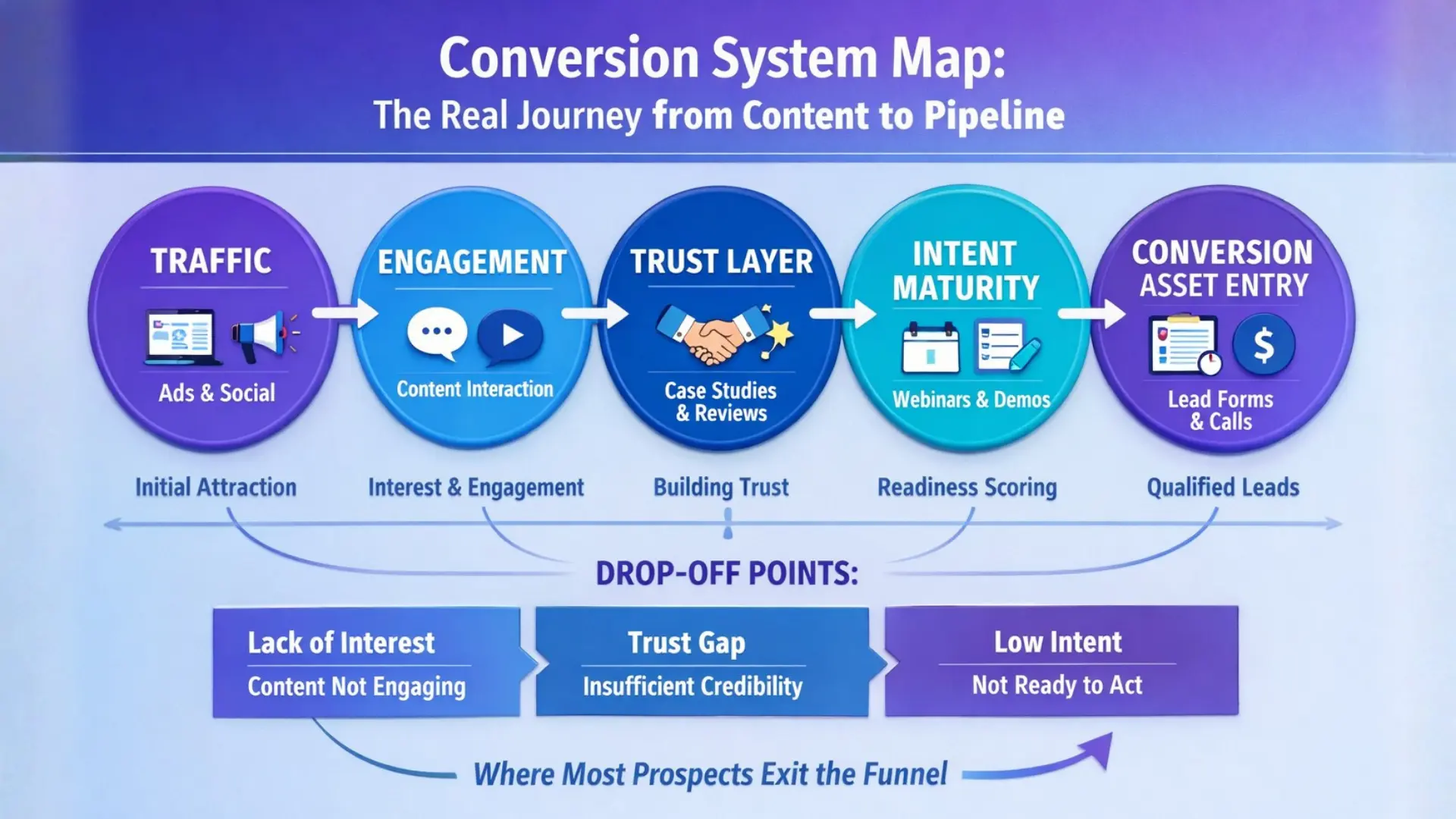
Attention is not demand: separating visibility from readiness
Definition: ”Attention is not demand” means that even high engagement or visibility does not equate to sales readiness or conversion intent.
Let’s confront a common trap: chasing viral shares and pageviews while scratching our heads about stagnant pipelines.
We’ve watched brands scramble when an infographic explodes but conversions flatline.
Why?
Because mere attention is eye contact.
Demand, though, is eye contact plus hand raised.
Here’s an everyday analogy: Imagine a packed showroom where everyone glances at the cars but no one asks for a test drive.
Page views are the sideways glances; intent is when someone sits in the driver’s seat and asks questions.
In client strategy sessions, we often see two dashboards – impressions and sales – living in parallel universes.
They only sync when content purposely guides the audience from interest to a deeper problem-awareness, then to action readiness.
Content engagement vs leads is not a zero-sum game, but a relay race.
Your best performing content usually hands off to a new channel or asset; it doesn’t always cross the finish line itself.
Curious?
How often are you equating high dwell time with readiness to buy?
Is your team collecting attention and calling it demand?
Content’s real power is in shaping decisions upstream, not delivering direct conversions.
If teams treat it as a system – one that primes, not transacts – they start seeing results that go well beyond the “traffic but no conversions” frustration.

Hard Borders: What Content Controls – and What It Doesn’t
Where content ends and conversion assets begin
Ever noticed how the highest-traffic blog on your site fails to move the revenue needle – and wondered if something’s broken?
Here’s the friction no one likes talking about: content doesn’t draw the finish line for conversions. It draws the running track.
Some teams drop a button at the end of an article and expect form fills to spike. It almost never works that way.
Through client workshops, we’ve seen stellar content convince, educate, and even spark desire – but stall completely when conversion assets (landing pages, forms, CTAs) are missing or mismatched.
Think of content as the road and conversion as the on-ramp.
The on-ramp needs to be in the right spot and built for the right speed, or nobody makes the turn.
Data shows intense content engagement rarely correlates directly with conversions unless the conversion asset is context-matched and visible at peak decision moments.
It’s not a relay race where a baton gets handed cleanly – it’s more like an orchestra.
If one section plays too soon or too late, the whole performance falls flat.
Do you ever catch yourself wondering why your “outstanding” resources don’t generate leads?
Or why people rave about an article but never call sales?
The answer is boundaries: content’s job is to prepare, not close.
Here’s a myth: “A strong CTA in every blog drives more leads”.
In practice, it often pushes the audience away or just gets ignored.
Content shouldn’t morph into a conversion engine.
That job belongs elsewhere.
The difference between content, lead generation, and optimization
Comparison of Content, Lead Generation, and Optimization Roles
| Failure Pattern | Description | Impact on Conversion |
|---|---|---|
| High content engagement but flat lead pipeline | Attention does not equal demand; users consume content without intent to convert | Leads remain stagnant despite high traffic |
| Traffic without qualified leads | Visitors are engaged but lack signals of purchase intent | Low conversion rates despite good engagement metrics |
| Premature or excessive CTAs | Calls-to-action push readers away or get ignored | Reduced effectiveness of conversion prompts |
Content pulls eyes and minds. Lead generation pulls names and intent.
Optimization tunes the machine for smooth handoff and lower leakage.
These are distinct, interdependent gears.
A recent client had dazzling content with zero conversions.
Why?
The lead magnets required a level of commitment nobody was ready for.
We mapped the flow and saw clear separation points: content drew people in, but only proper lead gen tools (like staged micro-conversions) captured true intent.
Still wondering why you see traffic but no conversions?
Here’s the missed step: content marketing is about creating context and emotional readiness – it shapes, but doesn’t harvest.
Think of these systems like lenses in a microscope: content adjusts the focus, lead gen captures the sample, optimization sharpens the image.
Use the wrong lens at the wrong moment and everything blurs.
The real difference?
Content sets up a story arc.
Lead generation invites action at the tipping point.
Optimization makes the path frictionless.
Muddling these domains creates confusion, not results – and that confusion sits at the core of why content doesn’t convert.
Set the boundaries, let each asset do its work, and conversions follow – it’s not magic, it’s mechanics.

Diagnostic Failure Patterns: Naming What’s Broken
We get views but no leads
What if thousands read your latest piece but your pipeline looks the same?
Here’s the gut punch – attention isn’t demand, and content engagement isn’t lead flow.
You can rack up impressive view counts and time on page, yet watch your CRM stay stubbornly flat.
We once saw a tech client hit 50,000 monthly blog views yet the sales dashboard barely flickered.
Their team puzzled over the disconnect (they’d imagined traffic was a precursor to intent). Instead, their audience skimmed, learned, left – no behavioral signal moved down-funnel.
The missing ingredient? Intent maturity.
Prospects often circle content like birds circling a seedbed – they notice, perch, and move on, without commitment.
If your call-to-action arrives before readers are practically or emotionally ready, they gloss right over it.
It’s like offering dessert before anyone’s hungry.
Would you fill out a demo form just because an article caught your eye?
Here’s the silent culprit: the assumption that one piece, or even a single topic cluster, always builds enough trust or urgency to tip someone into direct action. In reality, content prepares decisions over time, not in a single scroll session.
A helpful analogy: content is the rehearsal, but conversion is the opening night – just being present at practice doesn’t mean you’ll take the stage.
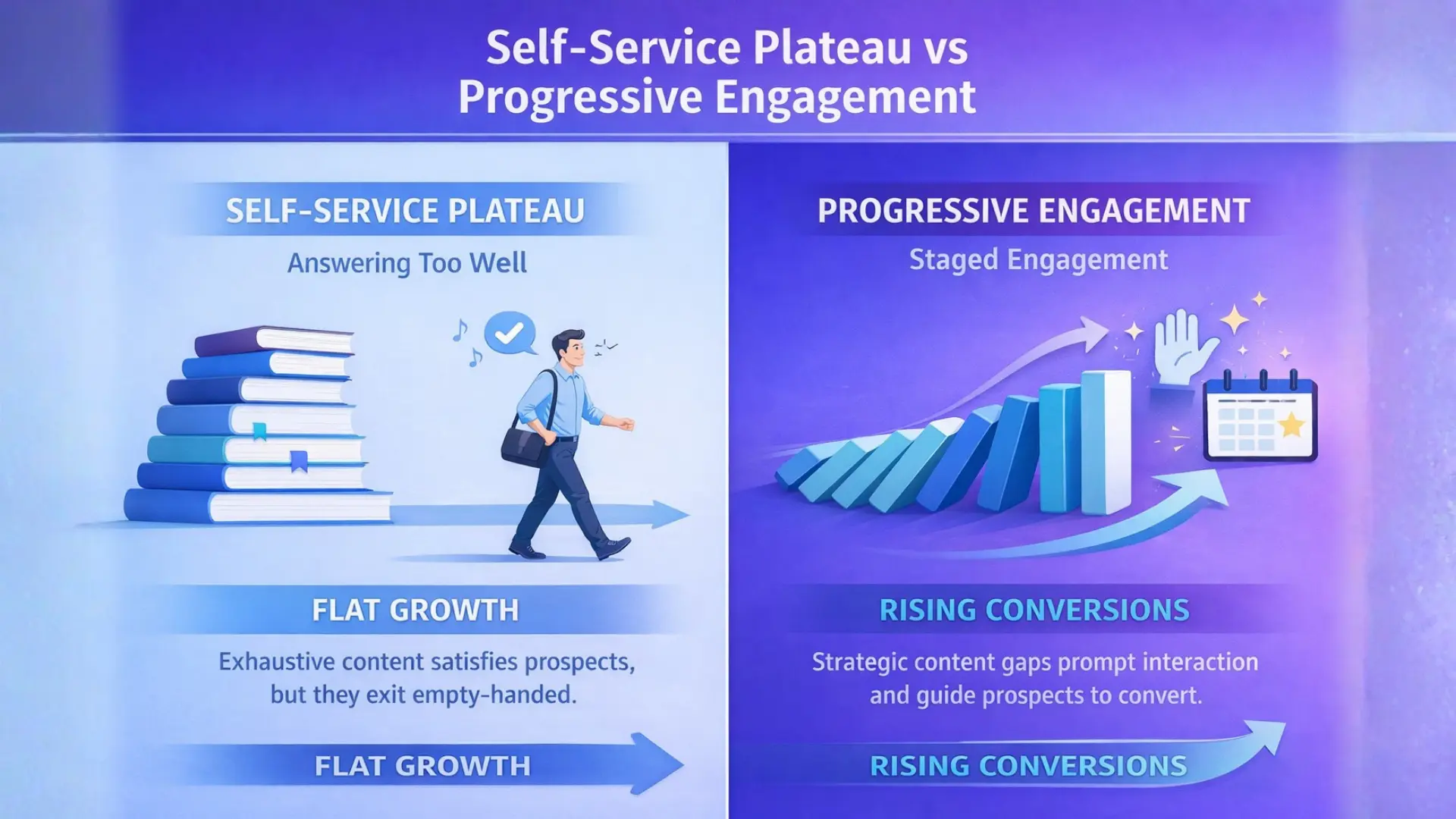
Content answers too well – it removes the need to convert
Diagnostic Checklist: Why Content Doesn’t Convert
| Function | Primary Goal | Key Activities |
|---|---|---|
| Content | Attract & Inform | Create blog posts, guides, thought leadership to pull eyes and minds |
| Lead Generation | Capture Intent & Leads | Use lead magnets, gated content, forms to pull names and intent |
| Optimization | Improve Conversion Flow | Refine CTAs, reduce friction, optimize handoff between assets |
Diagnostic Checklist: Why Content Doesn’t Convert
- High content engagement but flat lead pipeline (attention ≠ demand)
- Traffic without qualified leads (engaged, but intent signals missing)
- Premature or excessive CTAs resulting in resistance or ignored offers
- Content answers every question, removing the need to reach out (self-service plateau)
- No clear system handoff: missing progression from awareness to readiness to conversion assets
Now for the trap almost no one talks about – over-delivery.
It sounds like a win, right?
Your FAQ explainer is so comprehensive visitors no longer need to ask questions.
The asset is airtight…and your forms stay silent.
We’ve seen B2B teams publish deep-dive guides that cover every scenario, troubleshooting step, and cost breakdown.
But leads drop rather than surge.
What’s really happening?
When content resolves objections and answers practical needs too completely, it can leave prospects satisfied – enough to DIY, never needing to reach out.
Experts call this the “self-service plateau”.
This isn’t an argument for shallow advice.
It’s about calibrating what the reader accomplishes solo vs. what triggers reaching out for help.
Sometimes, the best-performing content introduces just enough clarity to make action – booking a demo or starting a conversation – the obvious next step.
Think less “encyclopedia”, more “first domino”.
A persistent myth says great content should eliminate all friction. But friction, in the right form, fuels motion. Subtle information gaps can nudge readers forward, creating productive discomfort that signals, “If you want the result, let’s talk”.
Recognizing these two patterns – views with no lift, and answers that cut off follow-up – lets you zero in on why content doesn’t convert, where the real levers are, and how not to starve your pipeline by accident.

Next Steps: Route to Appropriate Diagnostics
When readiness mechanics belong – intent and timing hubs
Ever discover an explosion of content engagement… but almost zero leads?
That’s not just bad luck or broken design.
Here’s the twist: traffic and time-on-page are signals, not closing tools.
Think about watching a chef cook – aroma, sizzle, anticipation – but until hunger spikes, you’re not ordering. B2B buyers act the same way.
For one client, we saw a 40% jump in content views after launching a resource hub. Stakeholders expected pipeline growth overnight.
Sound familiar?
The result was flat conversions for six months.
Why?
Audience interest was high, but intent lagged.
Content preps the stage, but readiness – the moment someone feels their problem or ambition is urgent – comes from a different set of triggers.
That’s why maturity diagnostics exist.
Content must cue the next move, not force it.
The real tell: every time marketing chases leads without checking intent signals, teams burn out chasing cold traffic.
What problem is your buyer actively solving right now?
If you can’t say it in a sentence, intent is absent and content alone won’t “convert”.
The myth: “High engagement equals sales opportunity”.
Reality: Engagement is a precondition, not a cause.
Without intent maturity – measured by explicit actions, pain admission, and time-sensitive context – most content simply prepares the ground.
Think airport runways: long, flat, built for preparation – not the actual takeoff.
Struggling to move from content engagement to real demand?
Try mapping content by buyer readiness, not just persona.
That’s where intent hubs – dedicated spaces or tools tracking readiness signals – move teams from passive measurement to actionable next steps.

Scientific context and sources
The sources below provide foundational context for how decision-making, attention, and performance dynamics evolve under scaling and constraint conditions.
- Attention as a mediator, not a driver of action
“What I see is what I want: Top-down attention biasing choice behavior” – Vriens (2020), Journal of Business Research
Demonstrates that attention influences choice indirectly through external cues and context, meaning visibility alone does not guarantee action. A mediation analysis shows cues attention choice, not direct effects
https://www.sciencedirect.com/science/article/abs/pii/S014829631930520X - Trust as a distributed, non-linear process in digital environments
“Consumer Decision-Making in the Digital Age: A Literature Review” (2026)
Shows that trust builds cumulatively across repeated interactions, shaped by social proof, personalization, and platform dynamics rather than single exposures
https://www.ijfmr.com/papers/2026/1/65702.pdf - Non-linear decision journeys and limits of funnel models
Sharma et al. (2023), Emerging digital technologies and consumer decision-making
Provides empirical evidence that consumer journeys are recursive and non-linear, where attention does not reliably translate into conversion
https://www.sciencedirect.com/science/article/abs/pii/S0747563223002649 - Information overload and the limits of self-service content
“How Does Information Overload Affect Consumers’ Online Decision Process?” – Peng et al. (2021), Frontiers in Neuroscience
Demonstrates that excessive information increases cognitive load, reduces decision quality, and suppresses action through fatigue and avoidance
https://www.frontiersin.org/journals/neuroscience/articles/10.3389/fnins.2021.695852/full
Questions You Might Ponder
Why does high content engagement not lead to more conversions?
High content engagement signals curiosity or interest but does not equate to buying intent. Most users come for insights, not immediate purchases, so attention builds trust and knowledge but rarely initiates direct conversions until readiness and urgency align.
How can you diagnose if your content is the reason for low conversions?
Diagnose content mismatch by mapping user journeys and intent signals. If you have high organic traffic but no qualified leads, review whether CTAs are aligned with readiness. Use readiness scoring and intent maturity frameworks to isolate where prospects drop off.
What role does trust play before content converts leads?
Trust is accumulated over multiple interactions, not in a single session. Effective content gradually positions your brand as a credible source, which primes future buying decisions. Without trust, even intense engagement does not translate to sales or lead generation.
Why might answering every user question in content harm conversions?
Over-comprehensive content often satisfies visitors’ needs so fully that they leave with no reason to act or reach out, known as the ‘self-service plateau’. Maintain strategic information gaps to drive conversation and nudge users toward the next step.
What is a content-conversion system, and why is it important?
A content-conversion system separates content (which prepares and informs) from conversion mechanics (lead gen tools, landing pages). Each must be context-matched and serve its role. Without proper handoff, even great content fails to drive measurable pipeline growth.