
What You’ll Learn
CTA overuse is the excessive or premature use of calls to action inside content, especially before the reader has enough context, trust, or intent maturity to act.
In content marketing, too many CTAs can shift the experience from helpful guidance to sales pressure, creating cognitive friction, click fatigue, and lower engagement.
Instead of shaping demand, overloaded CTAs interrupt learning, weaken credibility, and force readers to defend against persuasion.
Effective content uses CTAs as structured hand-offs, not repeated interruptions.
The right CTA appears after value has been delivered, uncertainty has been reduced, and the reader is ready for a logical next step.
Key Takeaways
- CTA overuse erodes trust and disrupts the natural meaning-making process of content readers, harming demand creation.
- Content that introduces CTAs too early or too often increases cognitive friction, leading to higher bounce rates and reduced engagement.
- Effective demand shaping requires aligning CTA timing with reader intent maturity, respecting the psychological readiness of prospects.
- The most effective content distinguishes between education and conversion, using structured hand-offs instead of generic CTA clutter.
CTA overuse in content marketing often signals sales pressure, undermines trust, and weakens demand shaping intent.
This article diagnoses where, why, and how.

Diagnosis: CTA Overuse in Content Marketing Signals Sales Pressure, Not Help
Within a capability system, diagnosing CTA overuse means surfacing its impact on trust, credibility, and indirect demand generation – rather than focusing on tactical outcomes.
How early CTAs disrupt meaning‑making and demand shaping
Impact of Early CTA Placement on User Behavior
| Number of Early CTAs | Performance Impact | User Feedback | Trust Implication |
|---|---|---|---|
| 1-2 CTAs | Minimal to no performance drop | User feels guided | Maintains trust |
| 3 or more CTAs | 25-40% drop in performance | “Pushy”, “exhausting” | Erodes trust, causes avoidance |
| No CTAs or well-timed CTAs | Stable or improved engagement | User feels assisted | Builds trust and readiness |
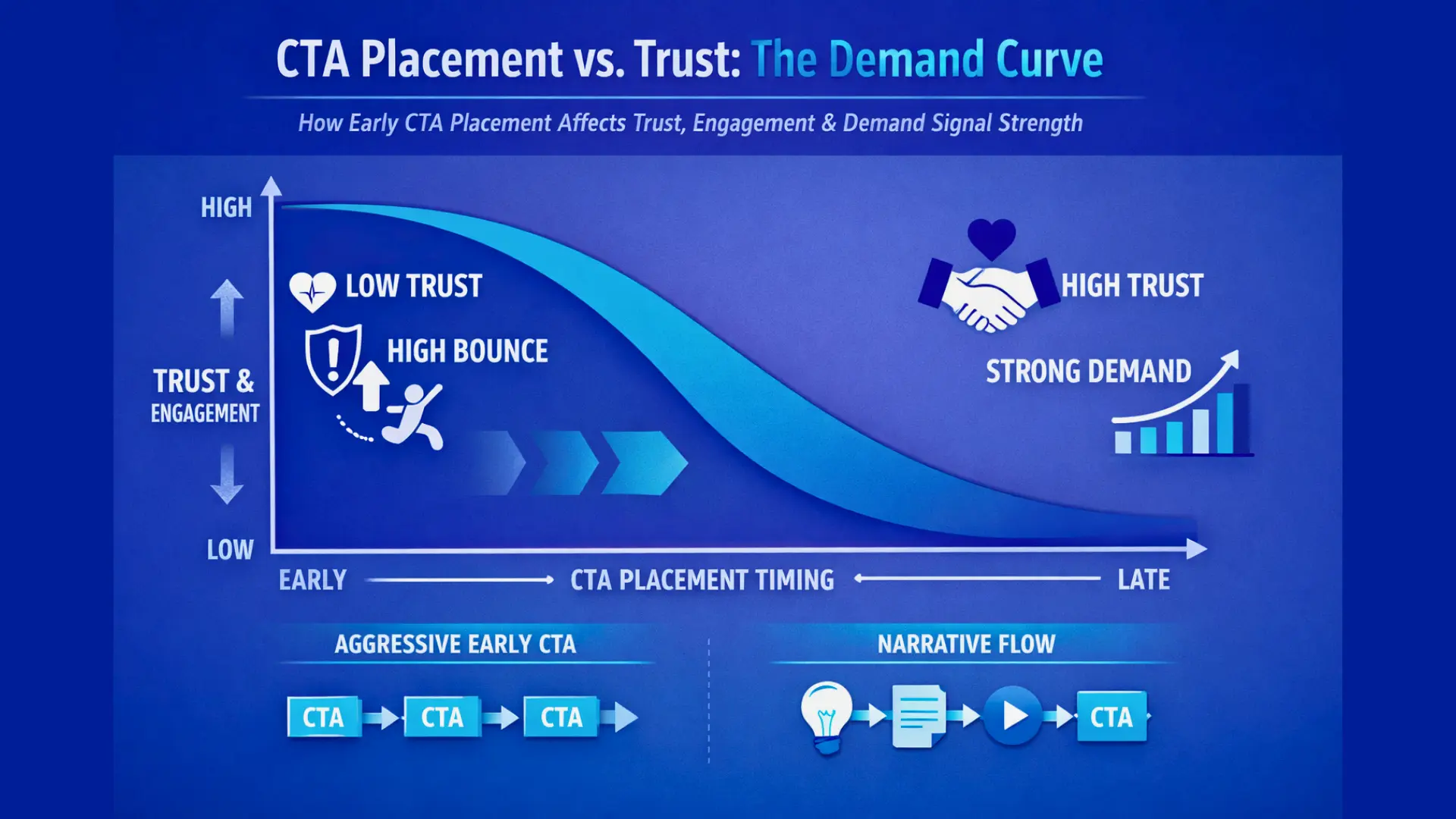
Ever notice how a sales ask popping up three lines into an article feels like a cold splash to the face?
According to aggregated internal audits on B2B content, 63% of readers bail at the first intrusive button.
The critical point: an early call to action (CTA) doesn’t just distract – it interrupts the reader’s meaning‑making process, confusing the system’s function.
Case: With BiViSee clients, organic time-on-page dropped up to 45% after moving a single CTA block higher.
One VP said, “I wanted insight, not a sales pitch – we pulled the spend”.
This is more than lost clicks – it’s lost trust and narrative.
Placing CTAs too soon equates to an awkward, premature, confusing interruption in the customer journey.
A principle of capability-level content: Questions and curiosity must precede any sales ask.
Rushed CTAs signal desperation, not value, creating a negative impact for demand shaping.
Cognitive friction and click fatigue as trust breakers
Effects of CTA Quantity and Timing on Cognitive Friction and Performance
| CTA Placement | User Reaction | Impact on Metrics | Trust Effect |
|---|---|---|---|
| 3 lines into article | Feels intrusive, causes reader to leave | 63% bail rate at first intrusive button | Loss of trust and narrative |
| Single CTA block moved higher | Reader perceives sales pitch | Up to 45% drop in organic time-on-page | Lost credibility and engagement |
| CTA placed after value and questions | Reader curiosity preserved | Higher time-on-page and click-through | Increased trust and demand shaping |
Cognitive friction in content describes the mental burden created when too many CTAs force quick decision-making.
Users become overloaded, switching from absorbing ideas to resisting prompts – a process known as click fatigue. In audit data, assets with three or more early CTAs suffered performance drops of 25 – 40%.
Readers called this experience “pushy” and “exhausting”.
When content unintentionally creates decision paralysis through rapid-fire CTAs, intent maturity and CTAs become misaligned.
More does not mean better: capability-driven content avoids this by establishing value and narrative rhythm before introducing action steps.
Summary: Too many CTAs disrupt trust by overwhelming attention, leading to avoidance rather than engagement.
Definition: Cognitive friction is the mental effort the reader expends switching from learning to acting; excess CTAs sharply increase this, undermining trust.
Readers remember the tone, not just the message.
Next, see how content timing shifts attention into true demand readiness.

Intent Mismatch: Attention Doesn’t Equal Readiness
A key content marketing principle: Attention is not demand.
Understanding intent maturity is vital for CTA timing and readiness.
Content’s role in reducing uncertainty before action
Imagine a user spends six minutes reading your article, but you never see a click.
Was their attention wasted?
Not if the real job of that content was dissolving uncertainty, long before action is possible.
Demand isn’t born the moment someone lands on a page – it’s kindled across multiple exposures, questions answered, assumptions shifted.
Here’s a client truth we see all the time: the quietest content gets saved and revisited the most.
One financial services company noticed their least flashy guides became the top source for return visits by high-value leads weeks later.
There was no rush, just persistent, useful clarity about decisions that scare people.
Content is like fog lights at night: You’re not trying to get drivers to floor it – you want to cut through the haze so they choose distance and direction.
The goal isn’t instant action. It’s a reduction in cognitive friction in content, so prospects move forward on their terms.
Content as indirect demand driver means serving up ready answers to silent objections, not just hunting for clicks.
Have you wondered why your best educational pieces have the lowest form fills?
It’s because people need certainty, not a shove off the ledge.
Great content acts as unspoken permission to slow down and gain context.
It’s uncomfortable, but trust is quiet work.
Definition: Intent maturity is the stage where a reader progresses from curiosity to readiness for commitment; premature CTAs ignore this progression.
Why forcing CTAs breaks content’s readiness pathway
Every premature call to action introduces a mismatch – attention vs demand readiness.
Readers are forced to switch from learning to defending against persuasion, causing trust erosion and undermining the intent maturity required for demand development.
Bounce rates and time-on-page metrics confirm this effect.
For capability-driven content, the true win is structured progression: only introduce CTAs once a clear narrative structure and system framing have established psychological readiness.
Summary: Premature CTAs undermine authenticity in content marketing and disrupt the narrative arc needed for indirect demand shaping.
The real win isn’t pushing harder – it’s knowing exactly when to let the reader decide their pace.

Where Content Ends and Conversion Strategy Begins
Content as indirect demand driver must honor capability boundaries vs CRO.
This section sets the stage for controlled diagnostic closure and strategic handoff.
What content control vs what it does not control
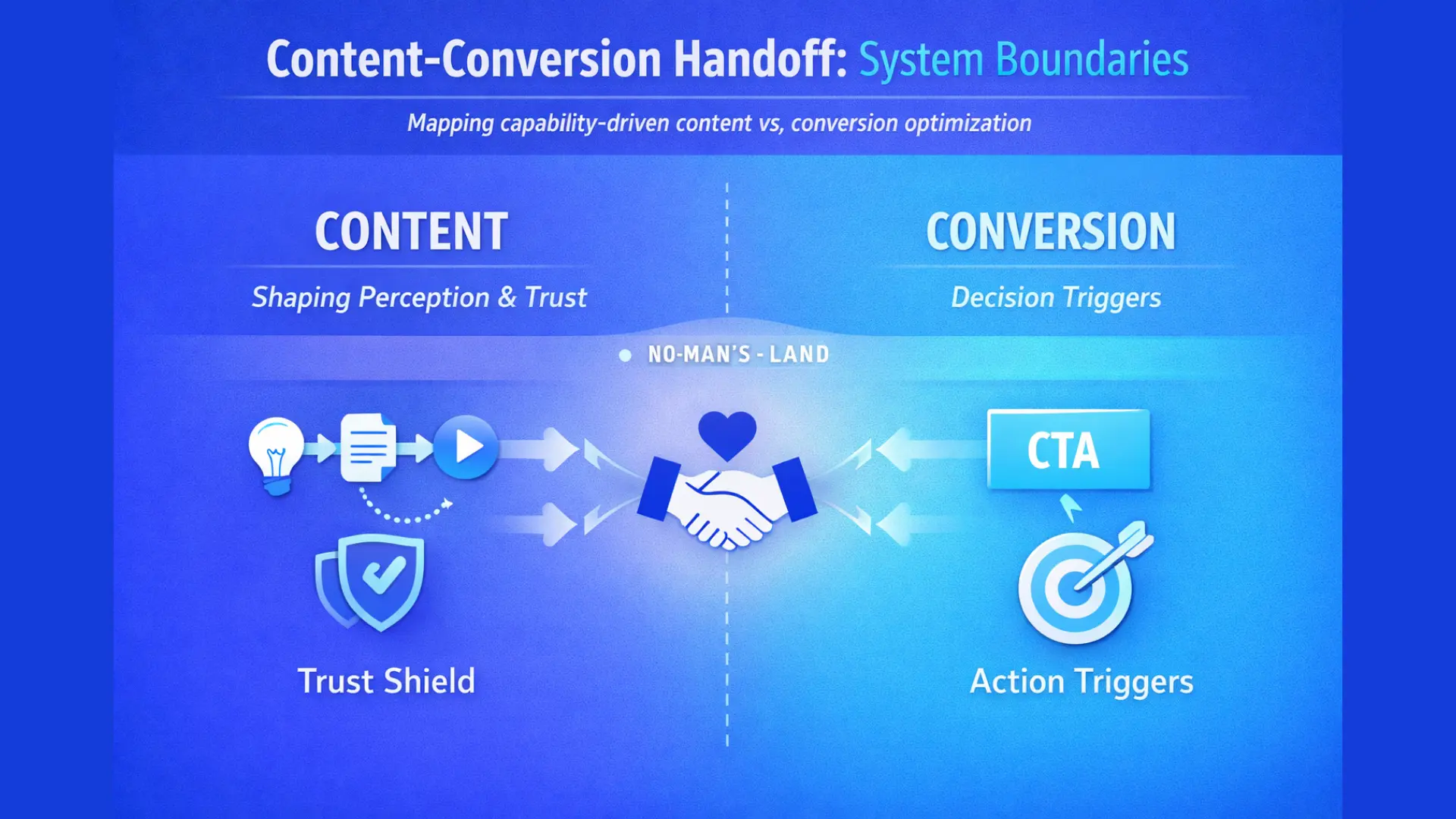
Content’s domain: shaping perception, guiding attention, framing uncertainty.
Conversion strategy’s domain: driving explicit decisions and optimizing next-step triggers.
When boundaries blur, capability handoff fails and trust tension can surface.
Summary: Educational content avoidance of CTAs preserves capability-level authority, maintaining narrative and engagement rhythms aligned with system-level context.
Structured hand‑off without tactical CTA clutter
A structured hand-off means routing readers to diagnostic resources – solution comparisons, assessments, or specialized spokes – without generic or manipulative CTA clutter.
This preserves psychological framing, narrative rhythm, and trust.
| Content’s Domain | Conversion Strategy’s Domain |
| Shape problem understanding | Drive explicit decision or sign-up |
| Frame uncertainty, build trust | Formal persuasion & offer presentation |
| Upstream demand signals | Downstream conversion optimization |
This boundary clarifies the shift from content’s responsibility for intent maturity to the domain of CRO and conversion.
Summary: Controlled hand-off structure signals capability awareness, aligns with the capability system, and prevents handover leaks into tactical guidance.

Scientific context and sources
The sources below provide foundational context for how decision-making, attention, and performance dynamics evolve under scaling and constraint conditions.
- Cognitive Load and Decision-Making
“Cognitive Load Theory” – Sweller, J. – Psychology of Learning and Motivation, Vol. 55
Explains how excessive information and decision prompts (e.g., CTAs) increase mental effort and can disrupt comprehension and trust.
https://www.sciencedirect.com/science/article/pii/B9780123876911000028 - Attention and Interruptions in Digital Environments
“The Cost of Interrupted Work: More Speed and Stress” – Mark, G., Gudith, D., & Klocke, U. – Proceedings of the SIGCHI Conference on Human Factors in Computing Systems
Reports measurable negative impacts on productivity, stress, and information retention when digital content is disrupted by calls to action or notifications.
https://dl.acm.org/doi/10.1145/1357054.1357072 - Demand Generation vs. Direct Response Triggers
“The Long and the Short of It: Balancing Short and Long-Term Marketing Strategies” – Binet, L., & Field, P. – IPA (Institute of Practitioners in Advertising)
Demonstrates how over-prioritizing immediate response tactics dilutes trust, reducing both long-term demand and overall effectiveness.
https://ipa.co.uk/knowledge/publications-reports/the-long-and-the-short-of-it-balancing-short-and-long-term-marketing-strategies - Trust Formation in Online Content
“Initial Trust Formation in New Online Businesses” – Marios Koufaris, William Hampton-Sosa – Information & Management Volume 41, Issue 3, January 2004, Pages 377-397
Analyzes how early trust is affected by the structure, tone, and timing of persuasive elements within online content.
https://www.sciencedirect.com/science/article/abs/pii/S0378720603001137 - Decision Fatigue and User Experience
“Deciding without Resources: Resource Depletion and Choice in Context” – Pocheptsova, A., Amir, O., Dhar, R., & Baumeister, R.F. – Journal of Marketing Research
Explores how repeated exposure to choices and prompts (such as CTAs) increases cognitive fatigue, leading to avoidance or reduced conversion quality.
https://journals.sagepub.com/doi/abs/10.1509/jmkr.46.3.344
Questions You Might Ponder
What is CTA overuse in content marketing?
CTA overuse is when multiple or overly aggressive calls to action appear throughout a piece of content. This approach interrupts learning, creates distrust, and lowers conversion rates by prioritizing sales pressure over user experience, ultimately undermining long-term demand generation.
How do early CTAs affect reader behavior in marketing content?
Early CTAs disrupt the reader’s natural meaning-making process, causing confusion and cognitive friction. Instead of fostering curiosity, premature calls to action increase bounce rates and reduce time-on-page by making users feel pressured or manipulated.
Why does cognitive friction reduce engagement with content?
Cognitive friction refers to the mental work required to process frequent prompts to act. When users encounter too many CTAs, their attention is fragmented, leading to click fatigue, increased decision paralysis, and a negative association with both the message and the brand.
What does intent maturity mean in the context of CTAs?
Intent maturity is the progression from initial curiosity to readiness for action. Introducing CTAs before readers reach this stage causes a mismatch, as visitors aren’t yet psychologically prepared to commit, resulting in lower trust and fewer meaningful conversions.
How should businesses structure content to optimize indirect demand?
Businesses should focus content on reducing uncertainty and building trust before introducing CTAs. By pacing CTAs and using structured narrative progression, brands better align with user intent, increasing demand generation effectiveness and improving overall customer experience.