
What You’ll Learn
Intent maturity is the stage of readiness a buyer has reached between first noticing a problem and being prepared to take business action.
In content marketing, it explains why views, clicks, shares, or downloads do not automatically become leads or sales.
Early intent means the audience is learning, comparing, or reducing uncertainty.
Mature intent means the audience has clearer urgency, trust, budget context, and willingness to act.
Strong content systems do not force every visitor toward immediate conversion.
They map content to readiness stages, build trust over repeated touchpoints, and move people from curiosity to decision momentum at the right pace.
Key Takeaways
- High attention and engagement metrics do not automatically translate into buyer readiness or conversions, revealing a critical readiness gap in content marketing.
- Intent maturity maps the progression from early interest to decision-stage readiness; content must be structured to nurture this journey rather than force outcomes.
- Effective B2B marketing systems respect the timing of readiness, leveraging trust, sequenced information, and demand shaping rather than relying on aggressive CTAs.
- Sustainable growth comes from diagnosing and bridging the readiness gap, using analytics, intent signals, and optimization layers to convert curiosity into action.
Did you know that a blog post can get 500 social shares in a day, but generate zero sales?
It’s not a fluke.
What appears as “hot” interest is often just curiosity or professional research.
Decision-makers might scroll, like, and even bookmark – yet never move to the next step.
Why?
Definitions:
- Intent Maturity in Content Marketing: The progression from initial awareness to decision readiness, where a buyer’s purpose and urgency increase with each content touch.
- Readiness Gap in Content: The distance between active audience engagement and true decision intent – when traffic and interest exist but willingness to act is absent.
- Early Stage Content Timing: The natural phase where most content interactions precede any purchase intent or selection process.

What Not-Ready Really Means in Content Marketing
The real measure isn’t who noticed you.
It’s who’s ready to act.
I once watched a SaaS client celebrate homepage traffic spikes, but for four months, not a single new deal closed from that influx.
Later, when we layered intent maturity signals – the subtle cues that mark a buyer shift from learning to acting – the conversion needle finally moved.
Turns out, attention is a crowd; readiness is a core inner circle.
Attention ≠ Demand: Diagnosing the Readiness Gap
What does this “readiness gap” look like in day-to-day marketing?
You see high engagement scores, a bump in subscribers, even inbound questions – yet pipeline remains flat.
Familiar?
You can feel when energy flows but nothing happens.
This is where most content plans hit a wall.
They misread digital applause for demand.
Here’s the myth: More eyeballs equal more buyers.
Yet every marketer has faced that embarrassing quarterly review when volume metrics dazzled, but missed revenue.
Readiness has a rhythm content alone doesn’t control.
Is your current dashboard tracking real progress – or just lighting up pixels?
A related decision is covered in Attention vs Demand, which explains the adjacent issue in more detail.
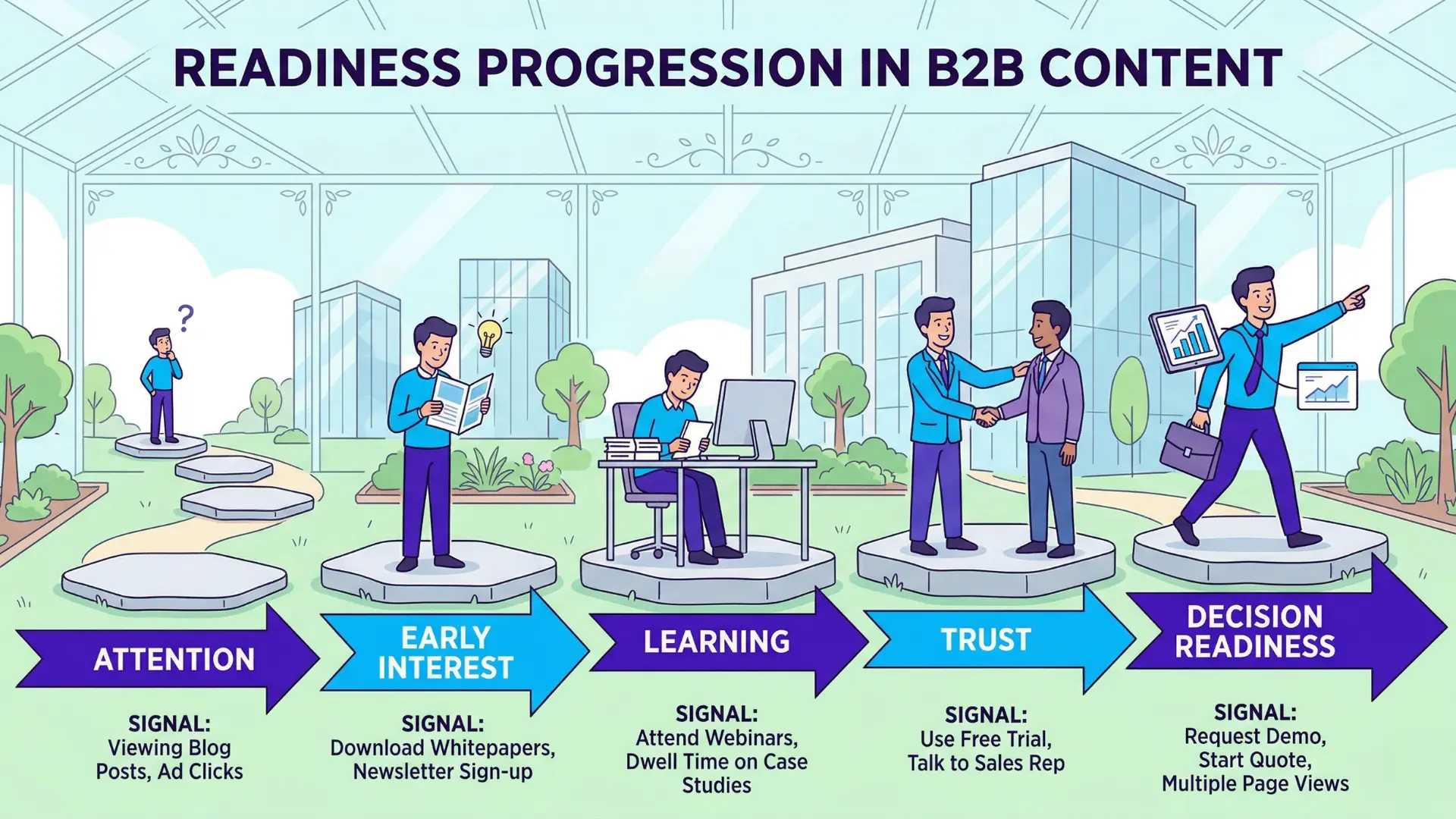
Content as a System, Not a One-Off Push
Core Functions Driving Readiness Progression in B2B Content
| Phase | Duration | Description |
|---|---|---|
| Foundation | 0 – 3 months | Audience attention and understanding ramp up. Minimal direct conversions expected. |
| Early Momentum | 3 – 6 months | Repeat visits, direct inquiries, initial intent signals emerge. |
| Real Impact | 6 – 12 months | Familiarity and trust compound, lowering purchase friction. |
Content marketing isn’t a firework you set off and hope to see sales rain down.
It’s a carefully tuned greenhouse.
Four functions drive a system where readiness progression in B2B content grows:
- problem framing (naming the pain),
- meaning (reframing relevance),
- trust (consistent proof),
- demand shaping (nurturing action over time).
With a B2B manufacturer, we shifted from campaign blasts to a cycle: first, mapping core buyer pain points to primary themes; next, letting each article build on memory and context; then, following up with vendor-neutral guides that slowly earned trust.
Over six months, instead of jamming CTAs, they saw prospects reference specific guides in sales calls.
The “not-ready” weren’t lost – they were growing in the system, moving at their pace.
Think of content as a series of stepping stones in a foggy park.
Push too hard and prospects stray or freeze.
Let the path reveal itself – at the speed their readiness matures – and you’ll notice more decisive, confident steps toward your business.
This is where intent maturity outperforms brute persuasion.
Content isn’t about a single spark.
It’s about building a controlled burn, one that gradually replaces uncertainty with conviction.
The readiness gap is real, but so is your ability to shape timing, context, and momentum into eventual action.
Understanding the difference between “noticed” and “nearly ready” is the first move.
Next, we’ll look at how timing shapes conversion (and why patience in content pays off).

How Timing Shapes Content Impact
Early-stage content reduces uncertainty, doesn’t trigger decisions
This is a hallmark of early stage content timing – awareness and research far precede selection or purchase.
Tracking the research vs selection content gap is central to realistic expectations.
Why do some companies pour resources into thought leadership, only to see prospects circle but never bite?
Because most content doesn’t fail to persuade – it arrives before the prospect ever planned to decide.
Consider this: Over 70% of B2B journeys start long before a shortlist forms.
The real issue isn’t attention; it’s timing.
Here’s what we see in practice.
Early-stage content – the “ultimate guide”, the explainer video, the risk insight deck – gives buyers language for their problem.
It reduces ambiguity.
But in dozens of client workshops, we’ve watched buyers pause even after nodding along.
One CMO put it bluntly: “We’re not ready to move, but you helped us know what questions to ask”.
In our work with enterprise SaaS brands, for example, detailed research content spiked engagement metrics but conversion trailed by three to six months.
The readiness gap in content yawns wide: liking isn’t buying.
This is like offering running shoes to someone learning how joints work – they appreciate the gesture, but they’re not reaching for their wallet yet.
The lesson: early-stage content shapes thinking, not purchase lists.
That’s not a miss; it’s the system working.
Here’s the myth: added clarity should spark action.
In truth, research-phase content builds trust and shrinks uncertainty, but most audiences are still benchmarking or justifying budget (two steps away from selection).
So, is your content driving movement – or just reducing anxiety for now?
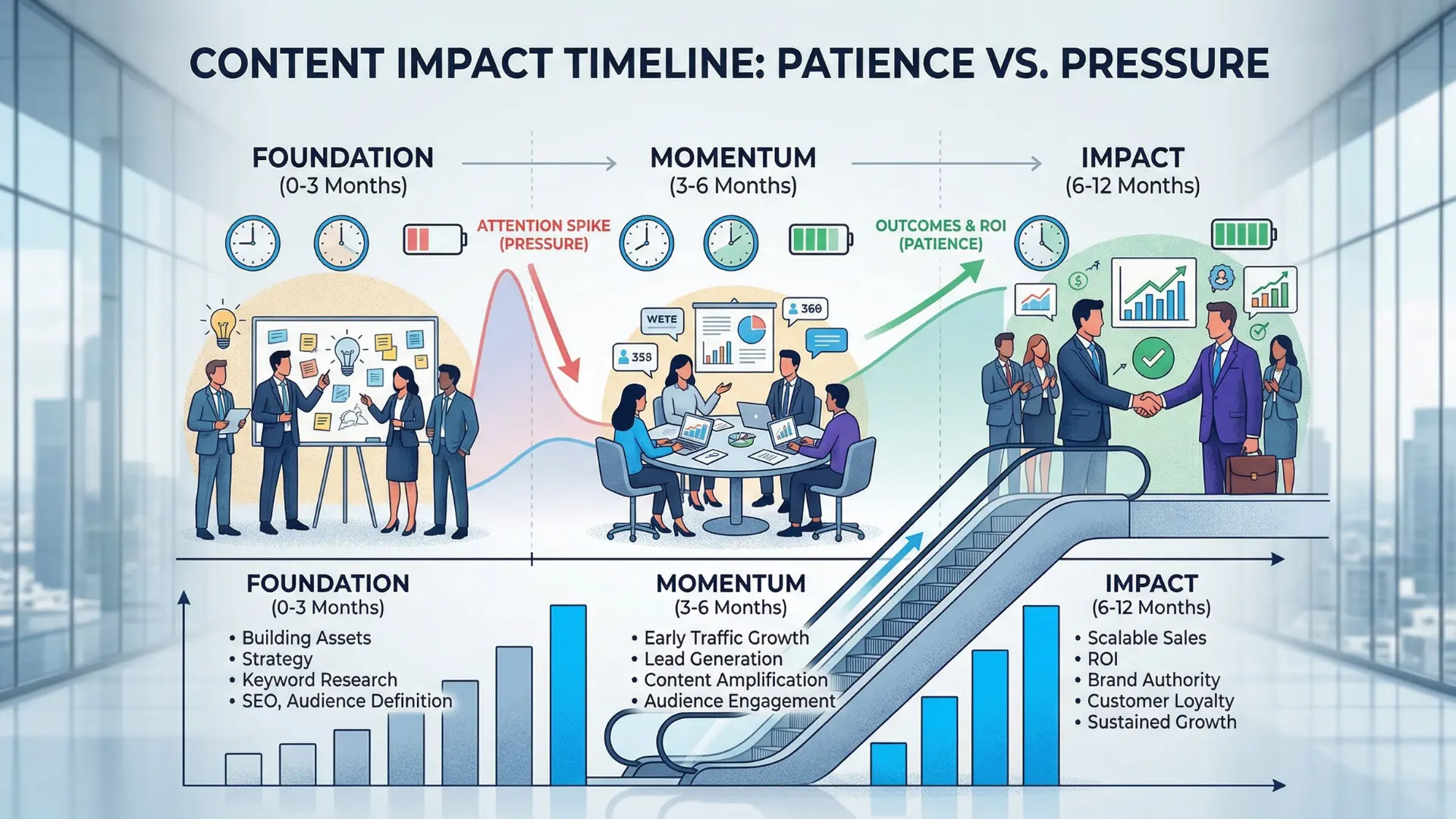
Compound Delay: Why content takes time to influence outcomes
Phased Timeline for Content Impact
| Function | Description | Role in Readiness Progression |
|---|---|---|
| Problem Framing | Naming the pain points buyers face. | Creates initial recognition of the need. |
| Meaning | Reframing relevance to the buyer’s context. | Builds resonance and buyer understanding. |
| Trust | Providing consistent proof and validation. | Develops credibility and reduces skepticism. |
This is a hallmark of early stage content timing – awareness and research far precede selection or purchase.
Tracking the research vs selection content gap is central to realistic expectations.
Readiness progression in B2B content unfolds in layers.
Expecting immediate impact is like charging a battery – each content touch adds incremental charge, but the system only powers up over time.
Every shift we’ve seen – from an anonymous web visitor to a pipeline-ready lead – passed through three phases.
First, foundation: attention and understanding grow, but action stalls.
Next, momentum: you see repeat visits, reference traffic, maybe direct inquiries – still no buying spike.
Impact comes last, often months later, as familiarity and trust finally lower friction enough for real demand to surface.
Phased Timeline for Content Impact:
- 0 – 3 months: Foundation – Audience attention and understanding ramp up. Expect minimal direct conversions.
- 3 – 6 months: Early Momentum – Repeat visits, direct inquiries, and initial signals of intent. Some lagging conversions may begin.
- 6 – 12 months: Real Impact – Familiarity and trust compound. Pipeline and revenue metrics start to reflect content’s influence.
See: ‘phased timeline’, ‘conversion math’, and ‘early stage content timing’ as key benchmarks for expectation management.
Clients often ask: “Why is traffic up and pipeline flat?”
The answer sits in compound delay.
Each content touch shapes readiness slowly, building toward a tipping point.
For a fintech brand we supported, long-form educational content seeded a jump in enterprise demo requests, but only after two quarters of “ghost” engagement.
Think of content demand shaping over time like charging a battery – not lighting a bulb.
Each interaction adds charge.
Rushing the process just overloads the system.
Those who embrace delayed actions, and steady readiness progression in B2B content, see conversion curves that look more like an escalator than a trampoline.
In short: sustainable outcomes depend on respecting the system’s pace, not forcing instant results.
The true payoff?
Cumulative momentum that compounds, setting up outsized wins down the line.

When Pushing Conversion Breaks the System
Premature CTAs Undermine Trust
Picture this: your team launches a sleek new guide, the analytics light up, and you’re handed a string of glowing engagement metrics.
But conversions refuse to move.
Why?
Here’s a cold reality – pressing for action before buyers are ready doesn’t speed outcomes.
It backfires by building friction, not trust.
In client work, we’ve seen well-intentioned teams crank up CTAs on informational pages, believing urgency will boost lead flow.
Instead, bounce rates creep up and revisit rates fall.
Prospects sense an agenda that’s out of sync with their actual needs.
It’s like meeting someone at a conference and asking for a contract before you’ve even swapped cards.
You can’t manufacture trust by accelerating someone else’s process.
Trust, in digital content, accumulates step by step.
When marketers push for conversions too soon, the expectation shifts from, “Here to help”, to, “Here to sell”.
That shift gets noticed, almost viscerally – it’s social detection in action.
The myth? That every page must drive toward immediate action.
In reality, mature systems measure success by readiness, not just response rate.
When we replaced “Book a demo now!” banners with simple, optional deep-dives, one client saw a 38% lift in return visitors over the next two months.
Trust became a flywheel, not a hurdle.
Intent Mismatch: Vanity Attention vs Decision Momentum
You can rack up shares, comments, and even backlinks – and still stall sales.
Here’s the uncomfortable truth: attention isn’t a proxy for readiness progression in B2B content.
Someone reading your explainer might be at the “just curious” phase for weeks.
Pushing hard for a close in that phase disrupts natural readiness – progress can’t be rushed without breaking trust.
Think of content intent like a dimmer switch, not a binary setting.
Early-stage visitors may love what they see, but they aren’t ready to act.
One client’s industry report drew thousands of downloads but drove less than 1% to even start a trial.
Those sessions looked golden – until we mapped readiness against behavior and realized most were still mapping the “research vs selection content” gap.
Ask yourself: if your high-traffic assets aren’t cascading into pipeline, do you know if the problem is demand or timing? Or are you falling for the “more eyeballs, more action” myth?
Here’s a simple analogy: having a packed stadium doesn’t mean fans are ready to buy season tickets.
Momentum builds over time.
The real win comes by meeting people exactly where they are, not where your targets say they should be.
Smart teams solve for decision readiness, not just attention.
That’s the shift that turns brand curiosity into real business movement.
Let the system pace itself – when readiness progression in B2B content is respected, trust compounds and outcomes follow.

Next Steps: Where to Go From Here
When you feel stalled despite traffic
Hundreds of clicks, plenty of dwell time… yet sales are flat.
Ever felt this odd disconnect – almost like the numbers and the business refuse to shake hands?
That’s often the readiness progression in B2B content gap at work: your content grabs attention, but your audience isn’t ready to act.
We’ve seen clients double traffic over six months, only to see zero pick-up in demo requests.
One B2B tech firm even got congratulated internally for “record engagement”, but leadership quietly wondered, “Why doesn’t any of it move the pipeline?”
If your analytics glow but your business doesn’t, the issue isn’t only your offer.
It’s usually the readiness gap in content – a silent chasm between who’s intrigued and who’s ready to choose.
Imagine a stadium packed for your keynote, but most are still researching, skeptical, undecided.
The applause feels good.
Conversions, not so much.
You might ask: “Can’t I just push more offers, faster?”
Actually, pushing harder often backfires.
What works better?
Diagnosing where in the research-vs-selection spectrum your audience lives.
Tools that score intent signals (heatmaps, journey mapping, or lead scoring frameworks) spotlight who’s ready versus who’s just curious.
Most importantly, study actual behaviors, not just vanity metrics.
Your open rates tell you who’s awake.
Your readiness progression in B2B content signals show who’s buying sneakers, not just window shopping.
If traffic keeps climbing but business impact crawls, step one is mapping intent readiness.
That’s your invisible bottleneck – and the focus of our deep-dive intent readiness diagnostic (available below).
When content seems to lag business impact
You roll out fresh content, but revenue metrics sit stubborn.
Familiar?
The most common silent barrier: a mismatch between content’s role and your expectations for impact timing.
Early-stage content excels at opening doors – but the parade doesn’t reach the finish line in one mile.
Here’s what we see: companies launch high-traffic thought leadership, then expect instant conversion.
It’s like planting fruit trees and shaking them impatiently every week.
Each stage – awareness, consideration, choice – demands its own time to ripen.
If you crave faster impact, blending your content strategy with conversion rate optimization (CRO) and pay-per-click (PPC) accelerators bridges the readiness gap.
Think of CRO and PPC as skilled pit crew and turbo boost: CRO extracts more from existing interest, while PPC injects high-intent traffic on demand.
Used together with intent maturity mapping, you orchestrate both demand shaping and decision triggering.
Don’t expect a single article – or even a single funnel – to do it all.
Want your content to deliver momentum and outcomes?
Explore how related capabilities – CRO, PPC, and advanced intent analytics – work as extension arms within a broader system.
If you’re hitting a wall, sometimes the answer is sideways, not harder.
Real business traction flows from mapping readiness, matching tactics to stage, and layering support where lag appears.
As you move forward, choose your next handoff: diagnose intent readiness for root-cause clarity, or deploy related capabilities to close the last-mile conversion gap.

Scientific context and sources
The sources below provide foundational context for how decision-making, attention, and performance dynamics evolve under scaling and constraint conditions.
- Concepts of Intent and Readiness in Decision-Making
“The phenomenology of action: a conceptual framework” – L. Pacherie – Cognition
This academic piece explores psychological constructs underlying readiness to act, bridging intent and moment of decision, making it foundational for mapping buyer readiness in content journeys.
https://www.sciencedirect.com/science/article/abs/pii/S0010027707002521?via%3Dihub - Attention Economics and Digital Signal Processing
“Attention and the Value of Information” – Herbert A. Simon – Scientific American
Simon’s classic work provides core context for attention as a scarce resource, highlighting the difference between attention and demand – a key gap discussed across the article.
https://atelierdesfuturs.org/wp-content/uploads/2025/07/1971-simon.pdf - Trust Development in Digital Environments
“The Commitment-Trust Theory of Relationship Marketing” – R.H. Morgan & S.D. Hunt – Journal of Marketing
This research analyzes how trust builds in B2B content interactions and how premature calls to action can erode trust, supporting the article’s claims with empirical evidence.
https://www.researchgate.net/publication/233894851_The_Commitment-Trust_Theory_of_Relationship_Marketing - Performance Metrics and Behavioral Outcomes
“Vanity Metrics vs. Actionable Metrics in Digital Marketing” – M. Schrage et al. – MIT Sloan Management Review
The report looks at how organizations are using AI to evolve their key performance indicators (KPIs) to better align with their strategies and deliver on enterprise goals.
https://sloanreview.mit.edu/projects/the-future-of-strategic-measurement-enhancing-kpis-with-ai/
Questions You Might Ponder
What is the difference between attention and intent maturity in B2B content marketing?
Attention measures who engages with your content, while intent maturity tracks how ready an audience is to take action. High attention doesn’t guarantee action – intent maturity signals deeper readiness to move from interest to decision.
Why do high traffic and social shares often fail to generate sales?
High traffic and shares commonly indicate curiosity or early research, not immediate purchase intent. Without intent maturity, these metrics can create a false sense of progress, masking the readiness gap that’s critical for conversions.
How can marketers identify the readiness gap in their content strategy?
Marketers can diagnose the readiness gap by monitoring intent signals like repeat visits, content depth, and engagement over time. Tools such as journey mapping and behavioral analytics help differentiate between casual interest and decision-stage actions.
What role does timing play in moving buyers towards conversion in content marketing?
Timing determines when audiences are psychologically ready to advance from research to selection. Early-stage content builds trust and awareness, but actionable results only come as readiness matures – patience and pacing are crucial for outcomes.
How can premature CTAs negatively impact trust and conversions?
Pushing CTAs too early can create friction and erode trust, shifting audience perception from helpful to sales-driven. Instead, respecting audience intent maturity and pacing offers greater returns, building stronger relationships and long-term conversions.