
What You’ll Learn
Content vs SEO is the boundary between what makes a page valuable and what makes it discoverable.
Content owns meaning, clarity, problem framing, trust, and the substance that helps readers understand or decide.
SEO owns discoverability, retrieval, metadata, internal links, technical structure, authority signals, and the context search systems need to rank and surface that content.
Strong content can still fail if search engines cannot find, interpret, or trust it.
Strong SEO can still fail if the page lacks useful meaning.
Effective organic growth happens when content makes a page worth finding, and SEO makes sure the right audience can actually find it.
Key Takeaways
- Effective organic ranking requires a clear division between content creation (meaning, trust) and SEO (discoverability, authority signals).
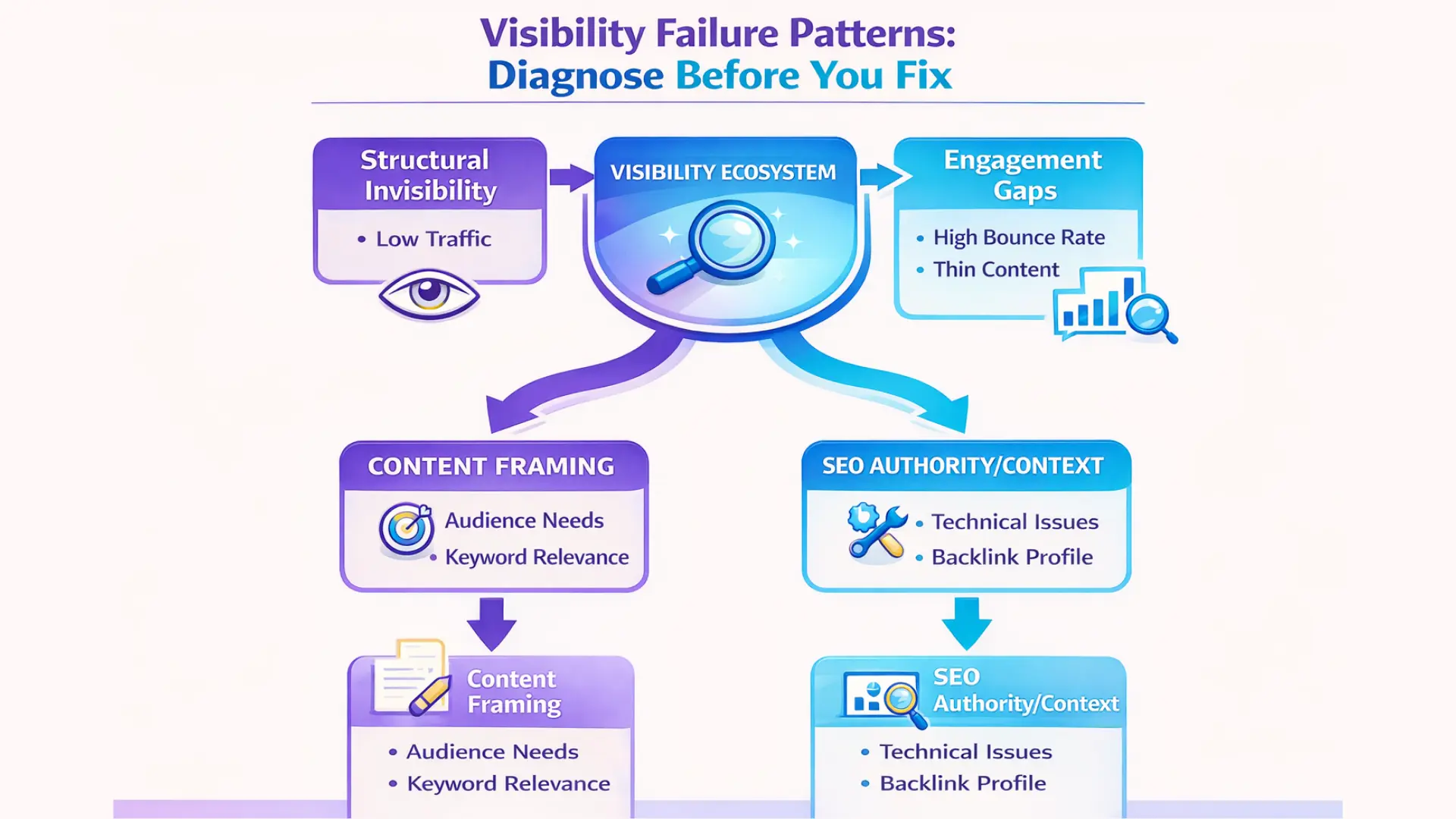
- Structural invisibility occurs when insightful content lacks the SEO ecosystem needed for visibility, even if the content itself is exceptional.
- Many ranking failures stem from fixing the wrong system – either over-editing content or overlooking technical/authority gaps in SEO.
- Diagnosing whether issues are content-based or SEO-driven is essential to efficiently resolve ranking and ROI constraints.
This article explores the content vs SEO boundary – defining where content’s responsibility ends and SEO’s begins to help diagnose why content fails to rank.

Clarifying Roles: What Content Owns vs What SEO Owns
Content’s Domain: Meaning, Clarity, Trust
What if your most insightful content is practically invisible to your market?
Picture a 25-page blueprint on risk mitigation, crafted by your team, yet not a single prospect reads it – simply because no one can find it.
The biggest myth in digital strategy: “If the message is right, buyers will come”.
This belief silently erodes budgets and morale.
In every engagement, we see executives pour time into content, thinking depth alone creates connection.
Content creates meaning.
It shapes trust – not just through words, but through the pulse of real expertise and Barricade-simple logic.
At its best, content can take a vague market demand and turn it into clear, actionable conversations.
Meaning shows up as clarity, directness, and proof clients feel in their bones.
But here’s the hard limit: content alone can never guarantee discovery.
We’ve helped firms whose pitch decks landed global deals – but whose thought-leadership articles sat unread, out of any organic result.
The structural invisibility of content is real: no matter how original, a masterpiece locked in an attic won’t drive results.
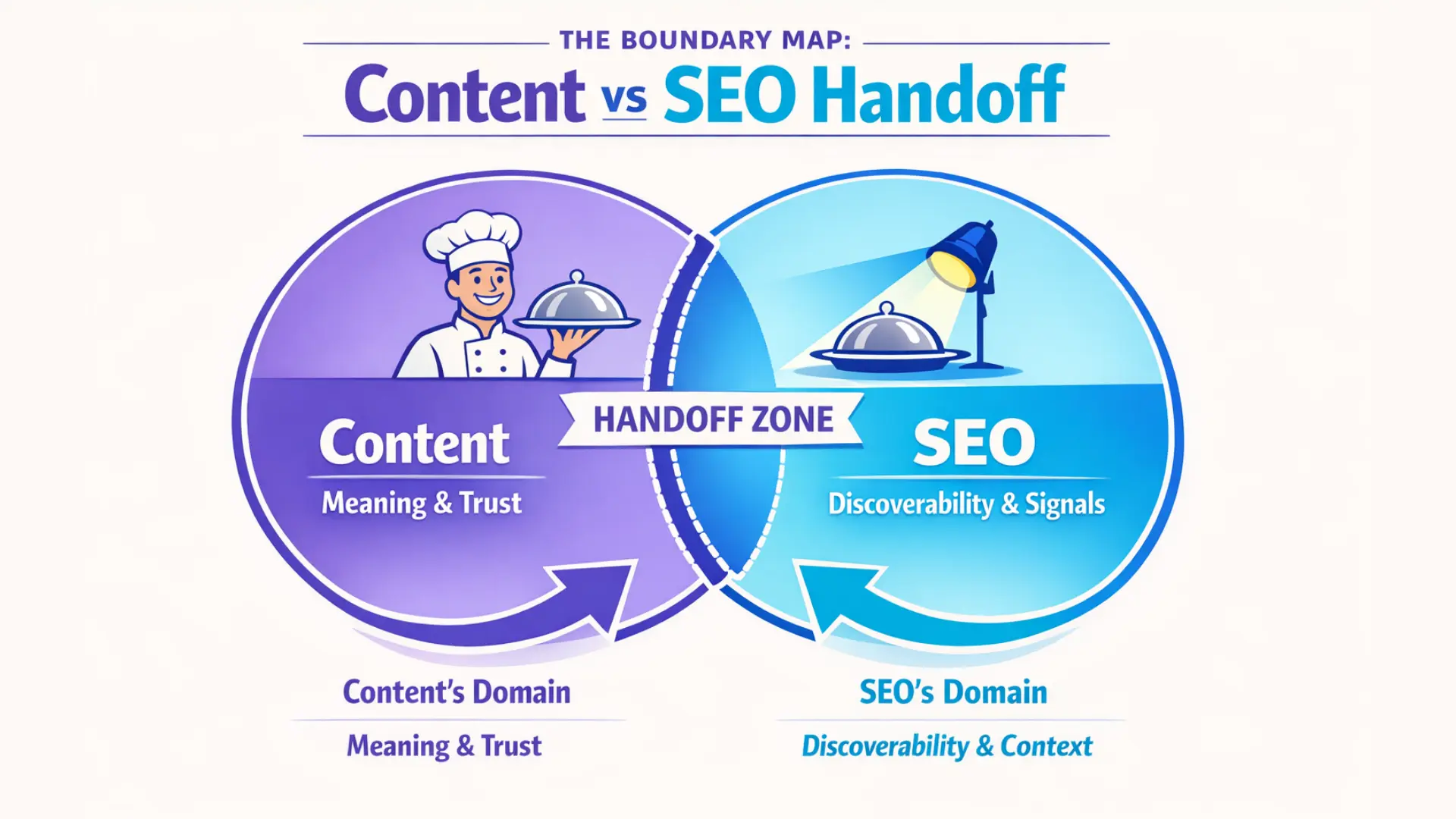
Defining “content’s domain” is like separating the chef from the waiter.
The chef’s job is to make food people crave; but food alone doesn’t fill the tables if the restaurant sits on an unmarked alley.
So ask yourself: Is your content truly answering buyer intent, or just answering itself?
SEO’s Domain: Discoverability, Context, Authority Signals
When discussing the content vs SEO boundary, it’s critical to note: even the best content doesn’t publish itself into the world’s memory.
SEO is the engine of visibility – helping search systems recognize, retrieve, and display your message.
SEO’s role is discoverability through context and authority signals such as metadata, link structure, and reputation.
When teams confuse the content vs SEO boundary, they may rewrite meaning-rich pages but miss the visibility ecosystem content SEO demands.
One SaaS client spent months perfecting prose without building authority context vs retrieval, causing even their best work to remain unretrievable.
In this scenario, content is the story; SEO is the spotlight operator.
A gripping play in darkness still leaves empty seats.
A question many execs wrestle with: Who owns ranking – content or SEO?
The truth is, “ownership” is shared only at the handoff, never in the core.
Content owns meaning and trust.
SEO owns discoverability, context, and visible authority signals.
Each system has a clear boundary.
Overlap is failure, not synergy.
The sharpest growth teams keep these boundaries crisp, using frameworks like the “visibility ecosystem” check, to diagnose gaps before spending another budget cycle fixing the wrong thing.
Content is what makes you worth finding.
SEO is why you get found.
Forget that split, and you risk living in the digital dark.
Summary Table: Content vs SEO Boundary
| Content System | SEO System |
| Meaning & clarity | Discoverability |
| Trust building | Context signaling |
| Problem framing | Authority & retrieval |

Failure Patterns When Roles Blur
Publishing Meaningful Content That Nobody Sees
Ever seen a content masterpiece – clear, helpful, even inspiring – vanish into digital obscurity?
It’s a punch to the gut.
Here’s the twist: the most meaningful content can sit completely invisible, lost behind a wall the audience never scales.
One large B2B Services brand we worked with invested months in educational guides loved by their internal teams.
Result: organic search delivered fewer visitors each month than a single sponsored LinkedIn post.
Why?
Because meaning and discoverability operate in separate universes.
Content creates meaning vs SEO discoverability: meaning is built for people; discoverability is engineered for machines.
It’s like hanging captivating art in a windowless basement – no matter how much you polish the painting, nobody outside will ever stumble in to see it.
The visibility ecosystem content SEO relies on is more than the sum of its parts.
The content’s job is not to yell louder but to wait where the visitors actually roam.
If your analytics show a long average time on page – on the handful of views you get – chances are you’re facing structural invisibility of content, not a content quality issue.
Here’s the irony: leaders often feel visibility frustration content SEO brings, blaming teams for not writing “hard enough”.
But the symptom isn’t boring content.
It’s a content marketing failure visibility – a wall, not a weakness.
Top Failure Patterns (content marketing failure visibility):
- Structural invisibility of content (content is unseen despite quality)
- Excessive focus on rewriting without addressing discoverability
- Teams mistaking meaning for visibility, resulting in wasted effort
Fixing Content Instead of Authority or Context
When the numbers stall, what’s the go-to solution?
Rewrite.
Edit harder.
Fire up more drafts.
But here’s a quietly brutal truth: fixing content instead of authority or context is like repainting a billboard no one can see from the highway.
We saw this with an industrial client – hundreds of rewritten product pages, without a single new referring domain or clear authority-context improvement.
Four months, zero ranking movement.
The real culprit?
Their authority context vs retrieval game was missing – search engines could not connect their expertise with what audiences sought.
Think of the handoff between content and SEO as a relay race.
Content passes the baton – meaning, clarity, trust.
SEO picks it up – builds authority, signals relevance, places you in the path of hungry searchers.
If that baton drops, running faster won’t matter.
You’re just running alone.
It’s a common myth that everything starts with better writing.
In reality, authority, context, and technical retrieval often bottleneck performance.
The right tool in these scenarios?
A structured audit that surfaces not just the copy, but your authority footprint and how machines parse relevance.
Bottom line: if your team keeps tweaking copy, but rankings refuse to budge, you’re almost always looking at a SEO system handoff problem, not a creative one.
The real unlock?
Recognizing where meaning ends and discoverability begins – so you plug the right gap, without chasing your tail.
Common Pitfalls:
- Authority context vs retrieval missed (weak external signals)
- The visibility ecosystem content SEO interplay ignored
- Content revisions made where a technical/SEO system audit was needed

System-Level Diagnosis: Is It a Content Issue or an SEO Issue?
What if your content is exceptional – but invisible, like a billboard hung on the inside wall of a tunnel?
Most teams fixate on rewriting, believing stronger messaging alone earns more eyes.
But the deeper problem often sits outside the words, in the invisible handshake (or lack of one) between content and SEO.
That blurry boundary is where missed growth lives.
Indicators of Content-System Breakdown
Indicators of Content-System Breakdown
| Symptom | Description | Example |
|---|---|---|
| Low Organic Impressions | High-quality pages receive consistently few impressions | Topical expert articles not surfacing in search |
| Stagnant Rankings | Rankings not improving despite strong content quality | No ranking movement over months |
| Weak Authority Signals | Few reputable inbound links or poor metadata/schema implementation | Lack of referring domains or missing schema markup |
Here’s a quick shocker: Strong technical SEO won’t save content that confuses, bores, or misleads.
We once audited a SaaS blog with 50+ posts ranking on page five, despite perfect SEO hygiene.
The reason?
The articles sounded like instruction manuals – precise, but empty of story or empathy.
Content-system breakdown reveals itself when:
- Readers bounce mid-page, never reaching the call to action.
- You see high impressions but meager time-on-page or conversion.
- Stakeholders ask, “But what does this actually solve for me?”
If your content reads clearly in a team meeting but falls flat in the wild, you’re seeing a meaning gap.
This often shows up when content chases topics purely for keywords, forgetting the core customer’s pain or aspiration.
Ever notice that some pages get decent traffic but no engagement?
That’s structural invisibility – your content is findable, but not felt.
A client once said their product pages were like product datasheets in a silent warehouse.
All the facts – no context, no story, and no trust.
If you change headlines or tweak paragraphs and nothing budges, you’re likely facing a content creates meaning vs SEO discoverability problem.
Symptoms of Content-System Breakdown:
- Traffic arrives but no meaningful user actions (conversions, inquiries)
- Readers indicate confusion or disengagement
- Content lacks problem framing, original insight, or trust signals
Indicators of Visibility-System Breakdown
Indicators of Visibility-System Breakdown
| Symptom | Description | Example |
|---|---|---|
| Low Meaningful Actions | Traffic arrives but users don’t convert or take expected actions | High impressions but low demo signups |
| Reader Confusion or Disengagement | Users indicate the content is confusing or irrelevant | High bounce rate mid-page, no call-to-action clicks |
| Lack of Trust or Insight | Content missing problem framing, original insight, or trust signals | Content feels like dry datasheets without storytelling |
Flipping the script: Sometimes your content earns real praise from customers, but traffic fizzles – like hosting the perfect event and forgetting to send invitations.
We see this when brands pour resources into thoughtful, expert content that nobody but insiders can locate.
Is this you?
Visibility-system failure often looks like:
- Consistently low impressions on high-quality pages
- Rankings stuck far below brand or topic authority
- Your content is referenced by partners – but doesn’t surface in natural search
One executive asked: “Shouldn’t Google recognize quality and just rank us?”
Here’s the myth: Quality isn’t self-announcing online.
Search engines need context, authority signals, and technical clarity to retrieve content at all.
Imagine building the best car in a hidden garage.
Without roads and signage (SEO structure, links, retrieval signals), nobody arrives.
We’ve seen growth stall simply because two hyperlinks or a schema tag were missing.
Sometimes, sites pour dozens of hours rewriting prose, not realizing their visibility ecosystem content SEO interplay is broken, not their message.
Trying to rewrite content when the issue is retrieval is like repainting the walls when the light switch is off – you’ll never see the improvement.
Your next move gains efficiency when you distinguish content vs SEO boundary failures by symptoms – not by gut feel.
Diagnose first, invest second.
Symptoms of Visibility-System Breakdown:
- Content praised by clients but not surfacing in organic search
- Stagnant rankings despite strong content quality
- Weak authority context vs retrieval signals (few reputable inbound links, poor schema/metadata)

Next Diagnostic Surfaces
Ever noticed a page get completely ignored by search engines – only to outperform everything else when shared through email or in a sales deck?
Here’s the hidden catch: visibility isn’t about meaning, and meaning can’t brute-force its way into organic discovery.
Some of the strongest content we’ve audited – from $2M thought leadership PDFs to six-figure video scripts – stalled at the gate simply because the wrong team owned the next move.
The pain wasn’t quality.
It was handoff.
Content specialists poured hours into sculpting authority context only for their work to become structurally invisible.
SEO teams, on the other hand, sometimes tried patching context or authority signals onto pages that didn’t deserve the click, just to make something “work”.
A good handoff prevents this whiplash.
It starts by asking: “Are we solving a framing problem or a discoverability problem?”
If It’s a Content Framing Problem Route to Meaning & Trust Spoke
If your diagnostics reveal that meaning, message-framing, or trust-building are off, don’t pass the brief to SEO next.
Instead, focus on content-system improvement.
In our work with a SaaS analytics firm, reworking two headline blocks and a trust badge quadrupled demo signups – yet their organic traffic stayed flat.
What moved the business?
The improved framing, which turned traffic into actual action once people arrived.
Picture it like a beautifully wrapped gift no one thinks to open.
Until the invitation (the content) speaks directly to what the recipient values, discoverability upgrades won’t fill the void.
The real levers here: narrative clarity, user-first structure, and earned trust signals inside the content body – before the search engine matters.
If It’s a Discoverability Problem Route to Visibility/SEO Capability
On the flip side, maybe your content is strong, but organic reach is anemic.
Hallmarks: Few impressions, missed topical authority, no ranking even on branded terms.
Here, turning up the content volume is the wrong tool (and burns time).
In one retail pilot, pages with clear and original product guidance lingered two clicks from Google for months.
Only when the SEO team mapped internal links and applied visibility ecosystem thinking (using a tool like Screaming Frog for crawl diagnostics) did these assets surface.
Volume turned into visibility – fast.
Here’s the myth: “Google rewards only the best answer”.
In practice, it redistributes visibility to content uniquely discoverable and contextually supported.
Think of search as an airport conveyor.
Only properly-ticketed luggage reaches the right carousel.
The content/SEO handoff assigns the correct label.
The diagnostic handoff creates clarity, reduces visibility frustration, and stops the endless debate over who owns ranking content vs SEO performance.
Precision in diagnosis stops wasted cycles.
The next surface determines if your next move belongs to the content meaning team or the SEO visibility crew.
Definition – The Handoff Between Content and SEO: The handoff between content and SEO is the point where meaning, clarity, and trust (content) transfer to discoverability and retrieval (SEO). Each side must deliver on its specific system responsibility for ranking to occur.
Visibility ecosystem content SEO is the combination of content and technical/authority elements that collectively drive discoverability and ranking.

Scientific context and sources
The sources below provide foundational context for how decision-making, attention, and performance dynamics evolve under scaling and constraint conditions.
- Human Information Processing and Attention Allocation
“The Concept of Information Overload: A Review of Literature from Organization Science, Accounting, Marketing, MIS, and Related Disciplines” – Martin J. Eppler, Jeanne Mengis – The Information Society
Explains that when information exceeds human processing capacity, attention fragments and important signals are ignored, which directly supports why unstructured content (no routing, no hierarchy) remains undiscovered despite volume.
https://doi.org/10.1080/01972240490507974 - Boundary Objects in Organizational Knowledge Transfer
“A Pragmatic View of Knowledge and Boundaries: Boundary Objects in New Product Development” – Paul R. Carlile – Organization Science
Shows how “boundary objects” enable knowledge transfer across domains by translating meaning between systems, directly paralleling the interface between content systems and SEO/discovery systems.
https://doi.org/10.1287/orsc.13.4.442.2953 - Signal Theory and Online Trust
“Trust and TAM in Online Shopping: An Integrated Model” – David Gefen, Elena Karahanna, Detmar W. Straub – MIS Quarterly
Demonstrates that trust in digital environments is built through visible signals (credibility, structure, predictability), reinforcing the need for clear authority and trust cues in content systems.
https://www.jstor.org/stable/30036519 - Retrieval Performance and Authority Signals
“Relevance Weighting for Query Independent Evidence” – Nick Craswell, Stephen Robertson, Hugo Zaragoza, Michael Taylor – SIGIR / Information Retrieval research
Explores how authority signals (e.g., link structure, prior importance) influence ranking independently of query text, directly supporting the role of internal linking and authority flow in content systems.
https://doi.org/10.1145/1076034.1076106 - Human Decision and Attention in Digital Choice Environments
“Nudge: Improving Decisions About Health, Wealth, and Happiness” – Richard H. Thaler, Cass R. Sunstein – Yale University Press
Introduces how choice architecture shapes decisions by guiding attention and reducing friction, mapping directly to how structured content systems guide users toward action instead of leaving them lost.
https://yalebooks.yale.edu/book/9780300262285/nudge/
Questions You Might Ponder
What is the main difference between content and SEO responsibilities?
Content focuses on crafting meaning, clarity, and trust, making information valuable to the reader. SEO, by contrast, ensures that content is discoverable by search engines using authority signals, metadata, and contextual framework, so quality messages reach the intended audience.
Why can high-quality content still fail to rank on Google?
High-quality content may fail to rank if it lacks SEO elements such as proper metadata, internal linking, or external authority signals. Without these, search engines might not find or contextualize the content, resulting in low visibility despite strong messaging.
A related decision is covered in Why Good Content Doesn’t Rank, which explains the adjacent issue in more detail.
How do you diagnose whether your ranking issue is content or SEO-related?
Analyze user engagement signals (like bounce rate and conversions) for content issues and impression/ranking data for SEO problems. If users don’t engage, it’s likely a content issue; if content is praised but not found, visibility and SEO are probably the root causes.
What happens when teams blur the boundary between content and SEO?
When responsibilities aren’t clearly defined, teams might over-edit copy without improving visibility, or optimize technical SEO for weak content. This overlap wastes resources and results in either unseen masterpieces or findable but uninspiring pages.
What is a visibility ecosystem in the context of content vs SEO?
A visibility ecosystem combines effective content creation (meaning, trust) with the SEO system (authority, technical signals, discoverability). Only both together ensure content is easily found and valued, preventing structural invisibility in organic search.