
What You’ll Learn
Authority and context gaps are visibility failures that occur when strong content is not supported by enough trust, topical consistency, internal structure, entity clarity, or machine-readable signals.
In SEO and AI search, authority is not just a page trait – it is built across a connected content ecosystem through internal links, topic clusters, credible references, schema, and consistent entity signals.
Context gaps appear when search systems cannot clearly understand how pages, topics, brands, and expertise relate to each other.
These gaps can make high-quality content hard to rank, cite, or retrieve, even when the page itself is accurate, useful, and well written.
Key Takeaways
- Authority and context gaps block content visibility by disrupting trust signals across the interconnected content ecosystem, not just on isolated pages.
- Systemic topical consistency and cohesive schema are crucial for compounding SEO authority and relevance – expanding content alone cannot solve visibility failures.
- AI search prioritizes entity authority and structured data; without these, even high-quality content can be filtered out of results.
- Common visibility failures trace back to structural barriers and misaligned systems, requiring diagnosis at the system, not content, level.
Why is it that some sites with fewer pages end up outranking vast content empires? Here’s a clue: search engines look for patterns of trust and coherence – across entire networks of content, not just isolated posts.

Authority as a System Property, Not a Page Trait
Definition: Authority as a System Property – System-wide authority is trust and relevance accumulated across an interconnected network of content assets, reinforced by topic consistency and internal linkage – unlike page trait authority, which assumes trust can be earned by optimizing a single URL.
Topical consistency and authority compounding
We see this every week in digital growth audits.
One midsized B2B Services provider tripled organic pipeline in nine months not by adding more articles, but by reinforcing a single theme across 20 assets.
The effect was like building an antenna calibrated to a single frequency – every additional post multiplied the reach.
Think of topical consistency as compounding interest for trust.
If your platform “talks about everything”, it’s like a radio jumping between static-filled stations.
But when every topic is linked, reinforced, and predictable, the system feels knowable.
That’s when search engines and users both lean in: patterns = trust = visibility.
Are you spreading topical breadcrumbs, or are you leaving search systems hungry for context?
We find that even sophisticated marketing teams assume more content equals more authority – a quiet myth that wastes budgets and silently tanks results.
Even for transactional keywords, the winning asset is rarely just better optimized – it’s plugged into a dense web of surrounding topics.
We often use a topical authority system tool to visually map and score these connections.
Executives are often surprised to find their “hero” content weakened by gaps just one jump away.
Authority is not a sticker slapped on a page – it’s a pulse measured across your entire content visibility ecosystem.
That pulse grows stronger the more consistently you reinforce your story.
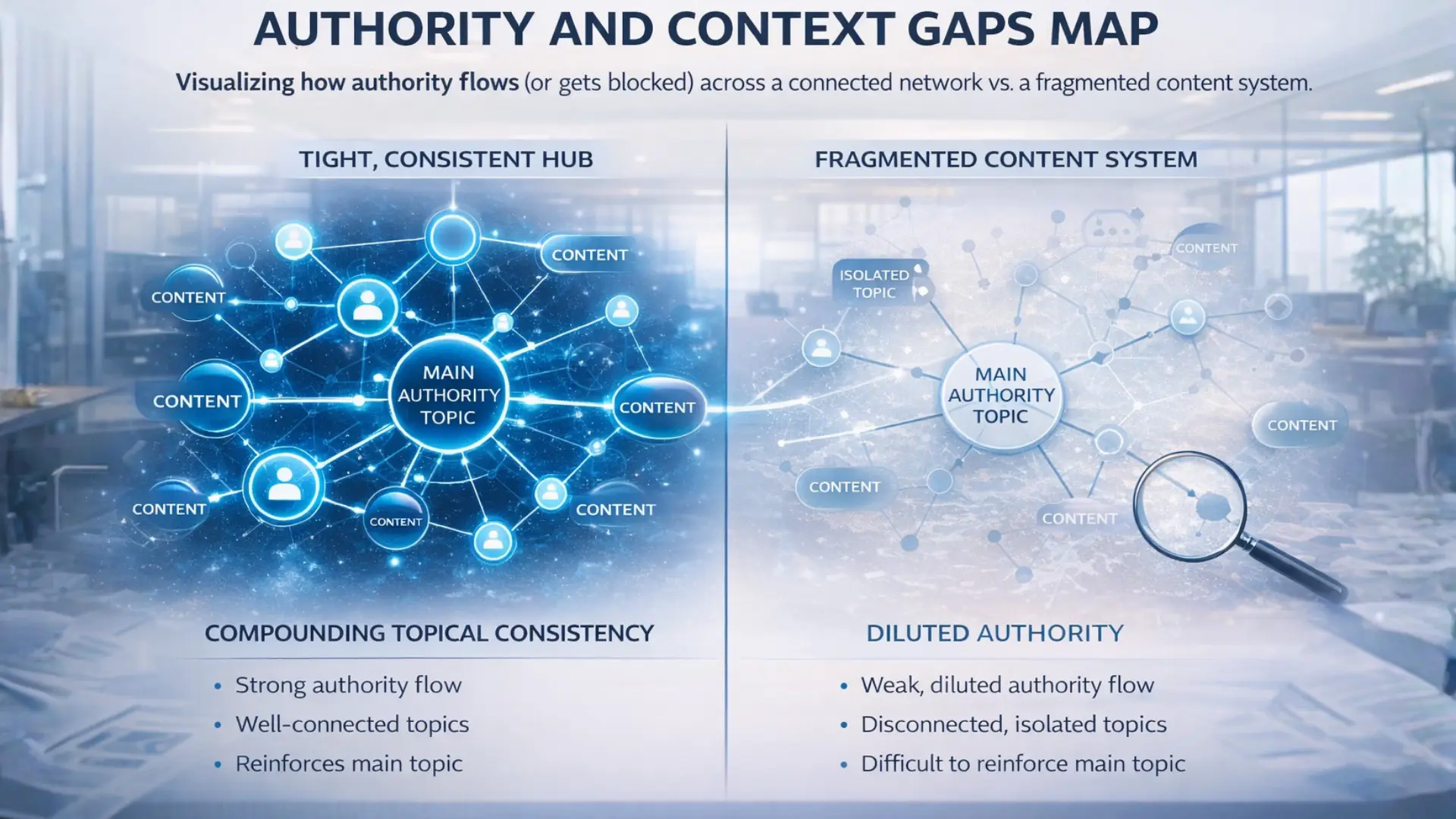
Authority erosion: when content volume dilutes trust
Here’s a harsh reality: more content can actually make your authority weaker.
If your library balloons with thin, unfocused posts, the trust you’ve spent months building starts to leak away.
This process leads directly to user trust erosion, reducing both page and domain authority visibility.
Often, conversion decline signals that authority dilution has started impacting business results, not just rankings.
We’ve watched a financial services client publish 60 new guides in a quarter, only to see core rankings wobble, not rise.
Why?
Half those guides diluted the site’s focus, making machines – and people – question what the brand actually stands for.
Imagine your content system as a cup of strong coffee.
Each off-topic or low-value page is a splash of water.
Over time, the flavor – the authority – fades.
Once blurred, the original strength becomes hard to restore.
This pattern confuses not just algorithms but buying committees, too.
If every third asset feels off-theme, trust erodes.
Authority as a system property means every asset contributes – or subtracts – from a larger signal.
The real win comes from pruning and aligning, not endless expansion.
It’s the quality of the pattern, not just the count, that keeps authority compounding instead of slipping away.
That’s when authority and context gaps in content visibility become the silent blockers.
Next, see how these systemic holes show up even as AI search raises the stakes.

Entity and AI-Era Visibility Requirements
AI search and the entity-first model
The recent ‘AI visibility shift’ means that traditional SEO signals alone may no longer influence discovery: search engines now prioritize sources with clear entity authority.
Why do hundreds of “perfect” SEO pages get ghosted by AI-driven engines overnight – while a one-page site, mapped tightly to a well-known entity, suddenly appears above industry giants?
The answer isn’t about keywords or backlinks anymore.
It’s about entity authority, the hidden passport to visibility inside today’s content visibility ecosystem.
Think of an entity as a digital identity – brand, product, concept – structured out in language the AI can read.
Schema markup is how you present that ID crisply, giving search engines a neural map for connections.
If Google or ChatGPT can’t map your pages to recognized entities, your content floats past their filters, unseen.
One B2B SaaS client came to us with 100+ guides – all expertly optimized – but visibility flatlined until we re-engineered their markup around clear, consistent entities.
In three months, major AI-powered search surfaced their pages for twice as many high-value entity queries.
Here’s the twist: even top-ranking old content will get bypassed if it’s not woven into the web of associated entities.
Imagine a library where each book sits in a vacuum, disconnected from topics and authors – would you ever find what you need?
That’s how siloed content looks to AI.
You need a topical authority system that fuses your authority and context gaps into a smooth, machine-parseable cluster.
Otherwise, your brand gets filed in the digital attic.

Comprehension budget and schema governance
This modern AI-era framing requires technical depth in schema, entities, and structured data; without it, even the best content is filtered out of AI overviews and search results.
Search engines – especially generative AI – have limits on how much context they process (think: comprehension budget).
They prioritize sources that use structured data fluently and consistently.
If your schema markup is sporadic, conflicting, or outdated, your site squanders its budget fast.
We’ve seen a publisher with hundreds of seemingly relevant articles bottlenecked by a scattershot schema approach; once streamlined using an entity-aware framework, their AI search entity authority visibility improved in eight weeks flat.
It sounds tedious, but managing schema is like tuning a radio – too much static (inconsistency) and you drop out of frequency.
The myth?
That Google’s smart enough to “figure it out” for you.
Reality: if your structured entity signals scatter, your authority and context gaps expand, not shrink, and even authoritative content becomes invisible.
Here’s a simple analogy: managing schema is no different from updating signage in a growing airport.
If gates, lounges, and exits aren’t consistently labeled, even the best flyers get lost – and planes (your content assets) simply circle above and never land.
No surprise – those who govern their content system schema with discipline earn a direct route into the AI search spotlight.
The rest just compete harder for vanishing organic shelf space.
Clear, consistent entity authority and schema management don’t just tick SEO boxes – they decide whether you’re seen or simply indexed.

Why Strong Content and SEO Don’t Guarantee Visibility
Visibility is an ecosystem outcome
Ever noticed a page with expert writing and flawless SEO languishing in Google’s graveyard?
Here’s the punchline: Strong content doesn’t mean automatic visibility – because authority and context gaps in content visibility operate like invisible walls.
Clients often ask, “We checked every SEO box. Why don’t we rank?”
After auditing hundreds of domains, the pattern is clear.
Pages don’t win in isolation.
They live (or die) inside a content visibility ecosystem. Just as a single high-performing athlete won’t make a team a champion, standalone content rarely builds authority.
Authority functions more like gravity felt across the topical and contextual network, not as a trait of a single page.
One client, a SaaS provider, refreshed more than 50 strategic assets in six weeks.
Results?
Traffic flatlined.
The missing ingredient: Each asset operated without a hub or cluster – authority just didn’t have room to compound.
The topical authority system rewards coherent depth.
Think of it like a tree: The roots (domain), trunk (topic clusters), and leaves (individual URLs) all connect.
Without context, even the best leaves fall unseen.
Most execs still believe content performance is a matter of quality or keyword density.
The real driver: system-level authority accumulation across your network.
So, if your team has “done everything right” and outcomes still lag, what if the problem isn’t the page, but the forest it’s lost in?
Understanding structural discovery barriers
Structural Discovery Barriers to Content Visibility
| Diagnostic Sign | Description / Impact |
|---|---|
| Site ranks for branded keywords but not unbranded queries | Shows narrow visibility and inability to capture broader high-intent search demand |
| AI-generated overviews credit competitors incorrectly | Indicates weak entity authority causing misattribution by AI systems |
| Conversion decline as authority signals weaken | Reflects lost user trust and degraded business results |
Here’s a common surprise – high quality, original content sometimes hides in plain sight.
Why?
Three silent saboteurs operate across organizations:
- Friction: Internal linking gaps, orphaned pages, or poor site structure block authority flow. One fintech client saw 40% of its most valuable guides going undiscovered by Googlebot for months – all because pillar-cluster links evaporated during a CMS migration.
- Invisibility despite quality: Without system visibility (hubs, taxonomy, schema), even “best in category” guides stay invisible. It’s like writing the perfect book and shelving it in a locked room.
- Mis ownership: When content creation is spread across silos (e.g., SEO, brand, product) without unified architecture, domain authority fragments. Authority as a system property never accumulates, so context gaps widen.
A quick analogy: Building digital authority isn’t a race where each runner competes alone. Instead, it’s a symphony – each piece builds on, echoes, and reinforces the other.
Many still cling to the myth that “if we produce enough top-tier content, we’ll eventually win”. Real-world data disagrees.
Only content built inside a connected authority system closes visibility gaps and compounds results.
Structural discovery barriers don’t just waste efforts – they cap growth potential.
The entire content visibility ecosystem needs to function as one unit.
In short: Visibility failures signal system issues, not just content shortfalls.
Next, let’s clarify how to spot authority and context breakdowns before rewriting a single word.

Navigating Authority Gaps: Route to Capability Diagnosis
Signs you’re facing authority-context breakdown
Authority Gaps Diagnostic Checklist
| Barrier | Description |
|---|---|
| Friction | Internal linking gaps, orphaned pages, or poor site structure block authority flow |
| Invisibility despite quality | Lack of hubs, taxonomy, or schema causes even best guides to remain unseen |
| Misownership | Fragmented content creation across silos prevents domain authority accumulation |
Authority Gaps Diagnostic Checklist:
- Does your site rank for branded keywords but not for unbranded, high-intent queries?
- Do AI-generated overviews incorrectly credit your insights to competitors (AI overviews impact)?
- Has conversion declined as authority signals weakened in analytics?
- Do internal links cluster by business silo instead of user intent or topic? (Trust erosion)
Why do some high-quality sites become invisible after a redesign – while competitors with thinner content dominate the AI search results?
If you’ve stared at a traffic curve that drops for no obvious reason, you’re not alone: in client interviews, the phrase “our best guides just disappeared from discovery” keeps surfacing.
Even a large investment in content can backfire if you’re unwittingly stacking authority and context gaps right into your architecture.
Ask yourself: Do your most linked resources respond to new industry questions, or do they linger in isolated corners of your site?
Do tools like Semrush or Ahrefs flag you for topical gaps you thought you had covered?
One global B2B Services brand we worked with saw search impressions halve after their product team fragmented ownership – you could smell the anxiety in their war room the day they realized even their foundational posts had become algorithmically “untrusted”.
Authority and context gaps look like:
- Your content ranks for branded queries, but is nowhere for rich, intent-driven searches.
- AI-generated summaries regularly misattribute your best work to competing entities.
- Internal links cluster by legacy silos instead of usage or intent – think of this as organizing a library by book color, not by subject.
The hidden mechanics are cruel: modern visibility is earned through authority as a system property, not just page-level signals.
One myth persists – that fresh, well-optimized posts automatically compound sitewide trust.
In reality, pushing undifferentiated content or scattering topic focus is like watering the edges of a lawn and hoping the roots will connect.
Next Steps
So what’s the next move if you recognize these patterns?
At this point, deep keyword tweaks aren’t a fix.
Start with a fast, structured review of your content visibility ecosystem.
Map your topical authority system against cluster-level signals and identify where authority fails to accumulate or reinforce discovery.
Want a simple first filter?
Track where you own context-rich rankings versus where entity authority falls off.
If your topic clusters read as disjointed – or schema shows missing connections – move directly to a capability rewrite or system architecture diagnostic.
We’ve found that even companies with sophisticated SEO teams miss the signal here because traditional audits stop at surface-level factors.
Sudden traffic vanishing acts often trace back to hidden visibility failure due to authority gaps. Before deploying new content, run a capability diagnosis.
It’s the most direct way to spot – and solve – the root causes instead of endlessly optimizing symptom-level SEO factors.

Scientific context and sources
The sources below provide foundational context for how decision-making, attention, and performance dynamics evolve under scaling and constraint conditions.
- Organizational Trust Systems
The Case for e-Trust – Mariarosaria Taddeo, Luciano Floridi – Ethics and Information Technology
Defines trust in digital environments as a systemic relationship shaped by interactions between agents, infrastructure, and information flows, showing that trust emerges from coherent systems rather than isolated elements.
https://link.springer.com/article/10.1007/s10676-010-9263-1 - Authority Flow in Networks
Authoritative Sources in a Hyperlinked Environment – Jon Kleinberg – Journal of the ACM
Introduces the HITS algorithm, demonstrating that authority emerges from link structures and mutual reinforcement between hubs and authorities, establishing authority as a network-level property rather than a content-level trait.
https://dl.acm.org/doi/10.1145/324133.324140 - Effects of Information Overload
The Concept of Information Overload: A Review of Literature – Martin J. Eppler, Jeanne Mengis – The Information Society
Shows that excessive, unstructured information reduces decision quality and increases neglect of relevant signals, directly explaining how high content volume without structure dilutes authority and trust.
https://doi.org/10.1080/01972240490507974 - Semantic Schema in Machine Learning
Schema.org: Evolution of Structured Data on the Web – R.V. Guha, Dan Brickley, Steve Macbeth – Communications of the ACM
Explains how structured schemas enable machines to interpret entities, relationships, and meaning, forming the backbone of modern search, retrieval, and authority attribution systems.
https://dl.acm.org/doi/10.1145/2844544 - Ecological Models of Attention Allocation
The Attention Economy: Understanding the New Currency of Business – Thomas H. Davenport, John C. Beck – Harvard Business School Press
Describes how attention operates as a scarce resource within interconnected systems, where structure and signaling determine what gets noticed, reinforcing the idea that content visibility depends on system design, not volume.https://www.researchgate.net/publication/31715197_The_Attention_Economy_Understanding_the_New_Currency_of_Business_TH_Davenport_JC_Beck
Questions You Might Ponder
What are authority and context gaps in SEO, and why do they matter?
Authority and context gaps refer to missing or weak connections between content assets and topics. They hinder a website’s ability to build trust and relevance as a system, reducing the likelihood that search engines will favor content – even when it’s high quality.
How does topical consistency impact organic search visibility?
Topical consistency ensures content clusters reinforce each other, compounding system trust in the eyes of search engines. When each asset supports a unified theme, the whole site receives more authority and is surfaced more often for relevant, high-intent searches.
Why can producing more content hurt a site’s authority and rankings?
Excess content that lacks focus or relevance dilutes the perceived authority of the site. Search engines and users may struggle to trust or understand the site’s expertise, resulting in lower visibility and conversion, despite increased publishing volume.
How has AI-driven search changed what matters for ranking and visibility?
AI-enhanced search prioritizes clearly defined entities and structured schema data over traditional SEO signals. Without coherent entity authority, even optimized pages are filtered out, making systemic context and markup critical for search visibility.
What are practical signs a business is suffering from authority and context gaps?
Symptoms include declining rankings for unbranded queries, AI summaries attributing insights to competitors, misaligned internal linking, and conversions dropping despite strong content, signaling systemic rather than individual page-level issues.