
What You’ll Learn
Rewriting doesnt fix ranking when the cause of poor visibility sits outside the words on the page.
A content rewrite may improve clarity, freshness, or keyword alignment, but it usually does not change the authority signals that search engines use to decide which pages deserve visibility.
Rankings depend on the wider content visibility ecosystem: backlinks, citations, internal links, topical clusters, crawlability, domain trust, and competitive context.
If those signals are weak, repeated rewrites create churn without durable gains.
Ranking improves when better content is supported by stronger authority, clearer architecture, and credible external references – not by editing the same page again and again.
Key Takeaways
- Rewriting content rarely fixes ranking drops because it doesn’t impact the site’s external authority signals or the visibility ecosystem.
- Sustainable search growth depends on building reputable backlinks, citations, and domain-level trust – not word edits on individual pages.
- Repeated content rewrites without new authority signals can cause statistical decay, leading to further loss in ranking and impressions.
- System-level SEO strategies, focused on authority-impact and ecosystem relevance, are essential for enduring ranking recovery and performance.
Did you know that 70% of marketing teams admit their first reaction to dropping search rankings is to rewrite the page – before asking why it fell?
Why do rational teams, chasing big outcomes, slip into patterned rewrite loops?

Why rewriting feels like a fix but isn’t
Definition – System-level visibility ownership: System-level ownership means visibility is controlled by the total trust, context, and architectural authority of your web presence – not by individual word changes.
Perceived control and low-effort hope
Here’s the catch: rewriting creates visible action.
It signals progress.
Changing words gives the illusion of control.
That’s comforting in uncertainty, especially when the algorithm’s logic is hidden.
The rewrite is fast, safe to justify, and satisfying – compared to wrangling with messy, multi-team SEO projects.
We saw this first-hand with a fast-growth SaaS client.
Their blog updates “fixed” the old copy to match new search trends but changed nothing about rankings.
The team kept rewriting because no one wanted to challenge what felt like momentum.
Behind closed doors?
They called it “content therapy”.
But if you’re asking, “Is anyone really fooled by the rewrite?” – not for long.
Yet when executive pressure mounts to “do something”, visible tweaks win out over slower structural shifts almost every time.
Symptom treatment vs ecosystem cause
The real trigger for broken rankings isn’t stale words – it’s a shift in the content visibility ecosystem.
Think about it: ranking causation is not root-cause obvious.
Most symptoms sit downstream from external authority-impact, backlink shifts, or system-level visibility ownership – factors a rewrite won’t touch.
When a healthcare client lost their #1 keyword, rewriting the main article did nothing, even after three attempts in six months.
It wasn’t until we audited their ecosystem – links, mentions, competitive context – that they saw the true cause: an authoritative newcomer now owned the search conversation, and Google rewired the SERP signals.
Here’s a myth worth breaking: “You can rewrite your way back to page one”.
Ranking causation vs symptom: Ranking causation comes from the interaction between your authority signals and the search ecosystem – rewrites only treat symptoms unless those ecosystem variables move.
In reality, the same words in a different wrapper rarely move the needle if the ecosystem’s supply-and-demand has shifted.
A simple analogy: Changing the text on a billboard in an empty field doesn’t bring an audience.
It’s the placement – traffic patterns, neighboring billboards, nighttime illumination – that drives actual visibility.
So, ask yourself – are your rewrites treating search symptoms, or shaping the real game?
For companies growing past content churn, this distinction shapes every win.
Rewriting scratches the itch for action but doesn’t fix the system.
Under the surface, ranking is shaped by deeper forces waiting for a different kind of decision.

What rewriting fails to change in the ranking system
Authority, backlinks, and citation context
Imagine spending hours rewriting your site’s content – only to watch rankings barely move.
Here’s the surprise: search algorithms rarely reward content changes alone.
They care more about how many other reputable sites reference or link to you.
A beautifully rewritten page with zero external signals still hides in the digital shadows.
One client rewrote thirty product pages after a dip in traffic.
The copy was sharper, the headlines more engaging – yet Google’s visibility barely budged.
Their direct competitors, meanwhile, attracted consistent organic growth simply by earning a handful of high-quality backlinks over three months.
The difference?
Authority flows in networks, not in silent rewrites.
Ranking is a lot like voting in an election. Internal changes are like putting up new campaign posters inside the office; but if no one outside knows or vouches for you, you never win.
Your ranking power lives in the ecosystem around your content, not just inside the words themselves.
Most teams still believe fixing their copy ‘should’ fix rankings.
That’s the myth – content alone can’t overcome an authority gap.
Pause and ask: has that fifth rewrite actually increased your trustworthiness in the eyes of the broader web, or just made your writing shinier?
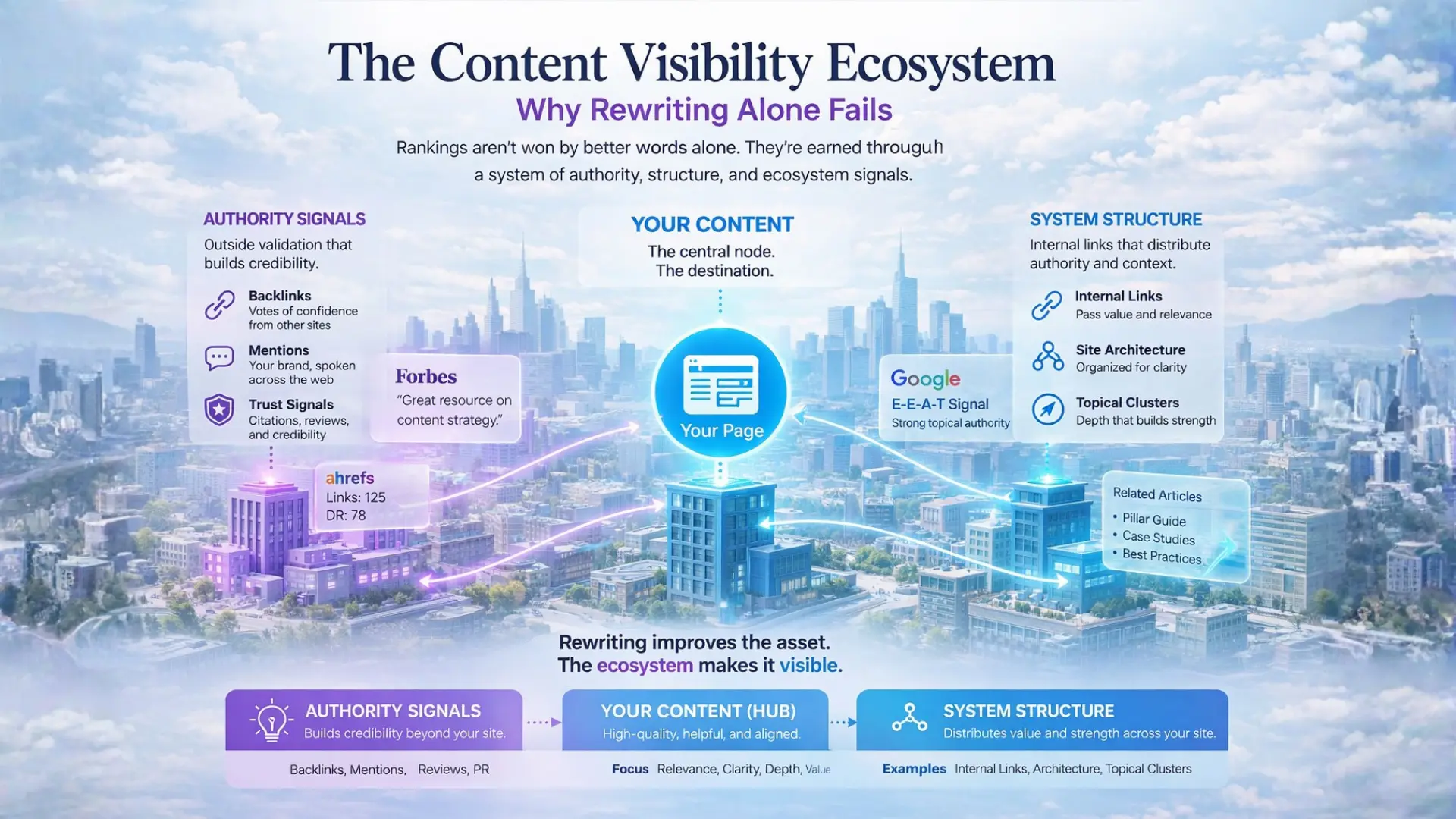
Visibility ecosystem vs individual page traits
Another overlooked truth: a single page doesn’t rise on its own.
Even near-perfect content is at the mercy of broader system dynamics – your overall domain authority, the relationships of your pages, and how search engines map trust signals across your site.
Think of your website like a suspension bridge.
Strength comes not from a single plank, but the network of cables and supports holding the whole span.
We’ve seen teams get stuck upgrading one landing page a dozen times, thinking another polish will finally propel it forward.
Yet, the real breakthrough only came when they mapped and improved internal linking, built supporting resources, and expanded their contextual footprint across the domain.
Visibility is emergent.
Search engines weigh how your pages fit together, how frequently others cite your brand, and the quality of sites linking back.
The higher your “system-level” authority, the more quickly new – or freshly rewritten – content can surface.
If you’re still optimizing isolated pages in hopes of a lift, ask: what signals does this send about your whole content visibility ecosystem?
Definition – Content visibility ecosystem: The network of internal and external factors – links, mentions, relationships, domain structure – that together drive a page’s search discoverability.
Smart leaders look beyond content rewrites and invest in domain-level credibility.
That’s where the durable ranking gains live.

Rewrite loops: diminishing returns and decay traps
Statistical content decay over time
Effects of Repeated Content Rewrites on Search Impressions
| Strategy | Primary Focus | Typical Outcome | SEO Ranking Impact | Recommended For |
|---|---|---|---|---|
| Content Rewriting | Improving page copy and keywords | Improved user experience, minor ranking bumps | Limited unless supported by authority signals | Freshening content, minor updates |
| Authority & Contextual Networks | Building backlinks, mentions, domain authority | Sustained visibility and ranking growth | High; drives durable improvements | Long-term SEO strategy and competitive gains |
Statistical content decay is a well-documented phenomenon in SEO.
Multiple analyses, including research and guidance from Ahrefs, show that pages tend to lose visibility over time as competition increases, user intent shifts, and information becomes outdated.
In many cases, content can lose a significant share of its peak traffic within a year if it is not meaningfully updated or supported by new authority signals such as backlinks or expanded coverage.
This leads to a recurring question: why do teams rewrite content multiple times – sometimes three, four, or more iterations – yet still see rankings decline?
The answer lies in how search systems evaluate relevance and authority.
Rewriting alone often improves internal quality metrics, but it rarely changes the external signals that drive rankings.
In practice, performance frequently plateaus or declines after repeated rewrites because the competitive environment continues to evolve.
New content enters the SERP, existing competitors expand their coverage, and search engines prioritize fresher or more authoritative sources.
Content decay is not caused by rewriting itself, but by the absence of net-new signals relative to the market.
Recent industry data reinforces this pattern: pages that are updated without adding new information, links, or scope may still lose visibility over time.
Studies indicate that neglected or insufficiently improved content can lose around 20% or more of organic traffic annually, even when surface-level quality improves.
The cause?
The rest of the content visibility ecosystem – authority signals, competitive link activity, and search intent shifts – moves forward.
A single rewrite acts like a fresh coat of paint on a sinking ship.
Without system-level visibility ownership, even the shiniest content can’t float far.
Ever notice how web teams celebrate launch day, but avoid talking about the sudden decline that creeps in three months later?
Decay isn’t just about aging information.
It’s about missed adaptation to ecosystem shifts.
Meanwhile, rewrite loops give a false sense of progress – like mistaking busy hands for moving the needle.
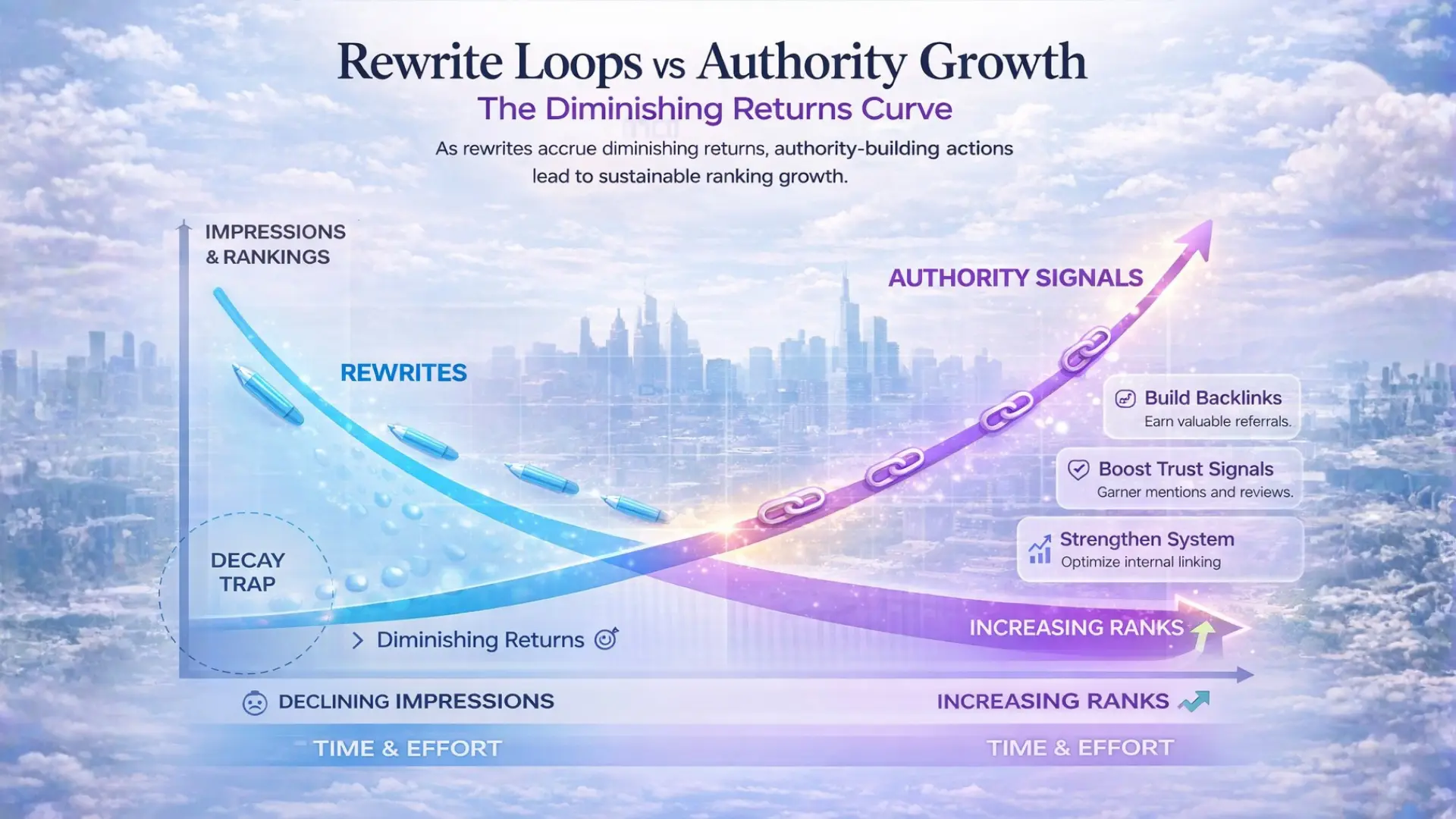
Rewrite fatigue and churn escalation
Here’s one few leaders expect: The more you rewrite, the less the system “trusts” updates.
When Google or another engine sees multiple rewrites in short succession without corresponding authority-impact on ranking (like new backlinks or fresh context), two things happen.
First, the algorithm may “cool” a page – reducing crawl and display.
Second, the content team experiences rewrite fatigue, where each cycle feels longer but yields weaker returns.
We’ve watched organizations repeat the same content churn strategy across dozens of articles. The consequence?
Writers disconnect from the system’s real needs.
The editorial calendar fills with rewrites while ecosystem investment (think: citation context, authoritative mentions) starves.
One content lead confided, “Our best people lost sight of demand shaping content visibility – everyone just kept tuning the same pages”.
It’s like polishing a mirror that’s already fogged from the inside: more buffing doesn’t fix the view.
So, how do you break the loop – and what’s the actual lever to pull?
Rewrite loops don’t just fail to fix ranking; they quietly erode both the team’s clarity and the site’s authority.
Understanding this sets the stage for real progress.

What actually improves visibility – and when
Investing in authority and contextual networks
Comparison of SEO Strategies: Content Rewriting vs Authority & Contextual Networks
| Number of Rewrites | Year-over-Year Impression Change | Quality Metric Change | Primary Cause | SEO Implication |
|---|---|---|---|---|
| 1-2 Rewrites | Minimal to moderate drop | Improvement observed | Normal content aging | Some benefit if supported |
| 3+ Rewrites | 15-30% decline | Further quality gains possible | Lack of new authority signals | Decay despite improved content |
Definition – Authority-impact on ranking: ”Authority-impact” refers to the measurable effect that external signals (like backlinks, citations, and mentions) have on a page’s ability to rank, above and beyond any changes to the content itself.
Imagine a page rewritten five times still vanishing on page three, while an old, clunky resource with thousands of citations clings tightly to page one.
Surprised?
Here’s why: Google’s ranking system cares far more about off-page authority and credible links than fresh phrasing alone.
In our work, we’ve seen clients pour months into rewrites, only for net visibility to remain flat – until an industry site linked a guide, catapulting traffic by 120% in just twelve weeks.
Page authority is simple: it’s the sum of your page’s external trust and its integration within the broader content visibility ecosystem (think: relevant backlinks, structured internal connections, and external citations).
The only thing that actually lifts it is adding more buoyant connections – credible references and influential websites mentioning or linking back.
Are you asking the right question: “Why aren’t we earning trusted mentions and domain-level authority instead of rewriting copy?”
Effective SEO investments build what we call contextual networks – groups of industry sources, partners, or high-signal sites that amplify your content’s credibility and reach.
One client’s infographics landed three fintech newsletter mentions; rankings doubled the same quarter.
There’s a reason “content churn” delivers diminishing returns: search engines measure site-wide authority, not just the latest update.
A quick mental model – think of your website like a city: more roads (links), respected neighbors (citations), and social proof make your property more valuable, regardless of brick color (copy tweaks).
That’s the real engine behind search visibility.
Correct routing: when to invoke SEO capability
Many teams mistake rewriting for execution; the real inflection point arrives when you route visibility challenges to system-level SEO expertise.
But when should that handoff happen?
If metrics like impressions, clicks, or new backlinks stagnate for multiple cycles – even with new content or copy rewrites – the answer is clear: you’ve hit a systems barrier, not a quality wall.
Here’s a pattern we see often: after several rewrites and still no ranking lift, frustration rises.
“Do we need to rewrite again, or is there something else we’re missing?”
Sound familiar?
This is the moment for specialist intervention.
Bring in dedicated SEO partners with the authority-impact frameworks to audit your site’s architecture, competitive context, and link equity.
Tools like Ahrefs or SEMrush reveal visibility weaknesses invisible in a text editor – think missing high-value links, orphaned pages, or poorly integrated topic clusters.
Another tell: when stakeholders push for urgent changes just to “show progress”, use it as a chance to shift the focus.
Reinforce that success means owning the system-level levers: earning strategic backlinks, weaving content into expert networks, and shifting from page-level edits to visibility architecture.
Google’s Helpful Content Update reinforced that quality signals alone rarely drive ranking recovery – system authority and integration are now primary decision factors.
When to move from rewrites to system-level SEO: If performance metrics (impressions, clicks, backlinks) stall after multiple qualified rewrites, this signals a structural, not content, issue.
Visibility isn’t a reward for effort. It’s an outcome of authority, trust, and the network around your assets.
The sooner you move from rewrite reflexes to strategic systems-thinking, the sooner rankings follow.

Scientific context and sources
The sources below provide foundational context for how decision-making, attention, and performance dynamics evolve under scaling and constraint conditions.
- Content authority and information diffusion
The Anatomy of a Large-Scale Hypertextual Web Search Engine – Sergey Brin, Lawrence Page – Computer Networks and ISDN Systems
Early academic exposition of PageRank, demonstrating that authority is derived from link structure and network signals rather than isolated on-page factors, establishing authority as a system-level property.
https://www.sciencedirect.com/science/article/pii/S016975529800110X - Decision bias and perceived control in marketing teams
Managerial Fads, Fashion, and the Role of Social Pressure in Organizational Decision Making – Eric Abrahamson – Academy of Management Review
Explains how organizations adopt visible but low-impact actions to maintain perceived control, aligning with repetitive content rewriting patterns despite limited effectiveness.
https://www.jstor.org/stable/258919 - Systemic SEO factors and domain-wide impacts
The PageRank Citation Ranking: Bringing Order to the Web – Lawrence Page, Sergey Brin et al. – Stanford InfoLab
Demonstrates that ranking depends on global link structure and domain-level authority signals, reinforcing that system-wide factors drive sustained visibility rather than isolated page updates.
https://www.semanticscholar.org/paper/The-PageRank-Citation-Ranking-%3A-Bringing-Order-to-Page-Brin/eb82d3035849cd23578096462ba419b53198a556 - Organizational fatigue and productivity decay in repetitive cycles
Exploration and Exploitation in Organizational Learning – James G. March – Organization Science
Shows that repetitive, low-variation activities lead to diminishing returns and stagnation, explaining why repeated optimization cycles without structural change fail to improve outcomes.
https://www.researchgate.net/publication/355228363_Exploration_and_exploitation_in_organizational_learning
Questions You Might Ponder
Why doesn’t rewriting content restore lost rankings?
Rewriting content alone doesn’t restore lost rankings because it fails to address core ranking factors such as domain authority, backlinks, and ecosystem context. Search engines prioritize trusted external signals over internal copy changes, making visible improvements insufficient for real ranking recovery.
What are ‘system-level authority signals’ in SEO?
System-level authority signals refer to the combined trust and credibility a site earns through quality backlinks, citations, and domain relationships. These broad, external factors outweigh single-page improvements and are critical for improving and sustaining search visibilities across content assets.
How do repeated rewrites lead to content decay?
Repeated rewrites without new external signals often lead to “statistical content decay,” where search engines perceive the page as stale or low-authority. This causes impressions and ranking to drop over time even as the perceived quality of the writing goes up, highlighting diminishing returns.
What is the ‘visibility ecosystem’ and why does it matter?
The visibility ecosystem includes all internal and external factors – like links, mentions, domain structure, and site-wide authority – that drive a page’s discoverability. Focusing on ecosystem improvements, rather than isolated rewrites, ensures sustained ranking and resilience to algorithm updates.
When should you stop rewriting and invest in system-level SEO?
If rankings, impressions, or backlinks stagnate after several quality rewrites, it’s time to refocus on system-level SEO. This means conducting comprehensive audits for technical, authority, and ecosystem gaps – shifting from copy updates to strategies that build domain-wide credibility and trust.