
What You’ll Learn
Attention vs demand is the difference between people noticing your content and people becoming ready to take business action.
Attention measures exposure, such as views, impressions, clicks, likes, or shares.
Demand measures commercial movement, such as qualified conversations, demo requests, pipeline growth, purchases, or sales intent. In content marketing, attention can create awareness, but it does not prove buyer readiness.
Demand forms when repeated, relevant content builds trust, clarifies the problem, and connects with the audience’s timing and need.
The goal is not just to attract more eyes, but to turn recognition into intent, action, and measurable business outcomes.
Key Takeaways
- Attention measures exposure, but only content that cultivates demand drives real business outcomes.
- High engagement is not a reliable indicator of buyer readiness or pipeline movement.
- Trust and multi-touch relevance are crucial for converting interest into action over time.
- Diagnosing content intent mismatches enables strategic shifts from vanity metrics to true demand generation.
Picture this: A campaign video racks up 500,000 views, but sales don’t budge.
Why?
Here’s a question almost no one asks – are your viewers buyers, or just browsers killing time on Thursday afternoon?
This is a trap we’ve seen smart teams fall for: equating attention with commercial intent.
Those high view counts can feel like success, but awareness doesn’t mean readiness.
In content marketing, “attention vs demand” is often the difference between someone vaguely aware there’s a problem and someone pressing “buy now”.
This topic is one part of the broader Content Marketing system, where strategy, execution and measurement reinforce each other.

Redefining the Role of Content Beyond Attention
Here’s the definition everyone skips: Attention is measured by the number of eyes on your content.
Demand is measured by the number of wallets opening or conversations starting.
Most content gets the first, almost none drive the second without a system bridging intent.
Think about the “attention economy” – likes, shares, and impressions stack up, but unless viewers are actually in-market, it’s like handing out menus to people who just ate.
Attention Means Awareness, Not Readiness
Direct Contrast: Attention vs Demand
| Measures exposure, impressions, or views | Measures intent, readiness, or pipeline movement |
| Indicates curiosity or interest | Indicates commitment to action |
| Acquired quickly and passively | Developed gradually through trust and meaning |
| Often driven by superficial connection or broad topics | Driven by relevance, need, and timing |
| Not predictive of sales/conversions | Necessary precursor to business outcomes |
One client in SaaS had a blog post with 70,000 monthly readers.
Leads?
Five, on a good month.
The right people read it, but they weren’t ready.
Their intent wasn’t mature.
They were researchers, not decision-makers.
So, ask yourself: Are the people noticing your brand actually in a position to care about the next step?
Or are they just passing through, soaking up info with zero urgency?
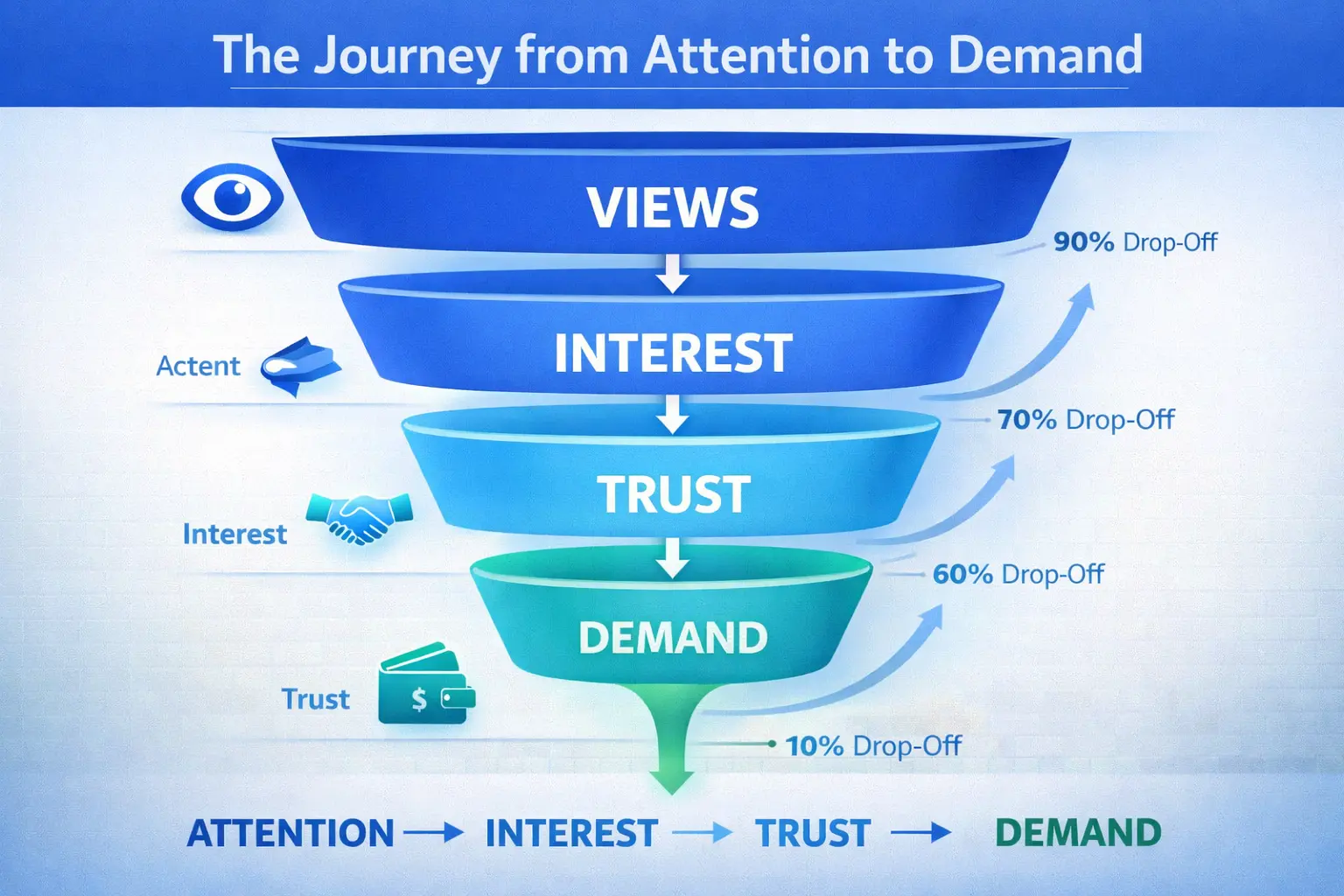
Interest Isn’t Action: The Attention Fallacy
Attention vs Interest vs Demand: Audience States Comparison
| Pattern | Diagnostic Signal | Strategic Implication | Example |
|---|---|---|---|
| Content intent mismatch | High traffic, low conversion; readers are not buyers | Indicates timing or audience segment misalignment | Viral blog posts with 100k+ views but <5 demo requests |
| Misaligned format vs intent | High engagement on entertainment or thought-leadership, low action on product pages | Content format does not match buyer readiness | Thought-leadership video gets likes but no sales inquiries |
| System warnings | Repeated spikes with no pipeline movement | System-level signal for indirect impact or broken handoff | Newsletter syndication drives bursts of traffic but no demos |
Let’s tackle a big myth: If people engage with content, they must be moving down the funnel.
Reality check – just because someone lingers doesn’t mean they’ll click “talk to sales”.
In a recent engagement, a B2B fintech firm spent six months chasing “viral” posts.
Their LinkedIn numbers soared – thousands of likes per week.
Pipeline?
Frozen.
Their attention wasn’t demand.
The numbers created a comforting illusion; internally, teams mistook popular posts for progress.
The difference between content attention and demand?
It’s the gap between applause and action.
Interest is like window shopping.
Real intent is when someone reaches for their wallet.
The analogy?
Think of airport duty-free: Thousands browse (attention).
Very few actually walk out with a purchase (demand).
That difference is where most reporting falls down.
Want to know why content views often don’t convert?
Most audiences aren’t primed for action when they see your post.
They’re curious, not committed.
Demand shaping vs attention isn’t a battle; it’s a handoff that rarely lands unless you design for it.
Here’s the executive’s silent frustration: “Everyone’s talking about us, but no one calls”. Lively dashboards can hide empty calendars.
Content shouldn’t just attract eyes.
It should build interest into intent – over time, with trust, and relevance.
Remember the core idea: Attention is noise.
Demand is movement.
Content only drives change when it nurtures readiness, not just recognition.
Next, we’ll unpack why engagement alone doesn’t move the needle.
This mismatch is called a content intent mismatch – a key system warning for content strategy.

Why Engagement Doesn’t Translate to Demand
Intent Maturity and Timing Mismatch
Ever see a post attract 100,000 views – and zero sales?
You might ask, “How can all those eyeballs mean so little movement?”
Here’s the catch: attention versus intent.
A reader’s interest isn’t the same as buyer readiness.
We’ve worked with SaaS founders who celebrated viral LinkedIn threads, expecting pipeline gold.
Reality?
Sky-high traffic, but demos stayed flat for weeks.
The missing piece was intent.
Most visitors were just browsing or comparing, not buying.
Demand develops in stages, like heat blooming under coals before it flares.
Imagine a stadium at halftime.
Everyone’s looking at the jumbotron, but almost no one is racing to sign up for season tickets.
The majority in your audience aren’t even close to acting.
Sometimes, it takes days – or months – of nurture before a click becomes a conversation.
Here’s the myth: “If they’re watching, they must want it”.
But most engagement measures the volume of the crowd, not the focus of the buyer.
Attention fallacy in content marketing, right?
It’s routine to publish an analysis or case story and watch quiet lurkers convert weeks after the peak, not in the moment.
So, is every viral flash a failure? Hardly. It’s a signpost, not a sale.
Trust and Meaning Precede Conversion
Ask yourself: Would you share your credit card with someone whose name you barely remember?
Your buyers won’t either.
Trust and meaning take repetition – and relevance – before they push someone to act.
Inside client campaigns, we notice the leads that close fastest almost always mention repeated exposure: “I’ve read your breakdowns for months”.
They’re primed, not because of a single catchy headline, but the steady drumbeat of substance.
Sometimes, it’s the third or fourth resource that tips them over the line.
Think of trust like marinating steak.
Quick sizzle is nice, but depth comes from sitting in the flavor.
Demand shaping vs attention isn’t a volume game, it’s absorption over time.
The biggest myth: “If we explain it perfectly once, buyers will move”.
In reality, most buyers stew in uncertainty.
They watch, weigh, and only when meaning stacks up – aligned to their needs – do they cross the line.
Engagement is a useful signal, but it’s not a finish line.
The real trigger happens when trust and timing sync up, turning attention into business movement.
Results come not from spikes, but from engineered momentum.

When Attention Feels Like Failure – and Why It’s Not
Views Without Leads: A Symptom, Not Strategy
Here’s a situation that rattles even smart executives: a piece racks up 50,000 views, social buzz follows, but the lead sheet stays painfully empty.
Ever ask yourself, “Are we missing something fundamental – or is content just a vanity play?”
We’ve heard this, verbatim, from more than one CEO after seeing viral engagement result in zero pipeline movement.
The surprise: High attention isn’t a sign of success or failure by itself.
It’s revealing something deeper – a system diagnostic, not a business KPI.
Attention vs demand in content marketing works like this: views show people noticed you; demand means they actually want to work with you.
They’re distant cousins, not twins.
We’ve reviewed dozens of analytics dashboards across SaaS and B2B services.
A recurring pattern?
Spikes in traffic have little to do with buyer interest if the content is optimized for shareability, not solving real pain.
Engagement metrics (likes, comments, views) sound impressive at board meetings but mask intent gaps if taken at face value.
Don’t confuse applause for acceleration.
Think of a flashing sign on a highway – drivers see it, maybe even remember it, but if it doesn’t point to their destination, they’ll keep driving.
That’s the content attention fallacy in action.
The myth: “Massive attention equals pent-up intent”. In reality, most content gets read by people who are interested, but not yet committed (a recurring content intent mismatch).
Your numbers aren’t broken – they’re showing you where the true business signal isn’t yet coming through.
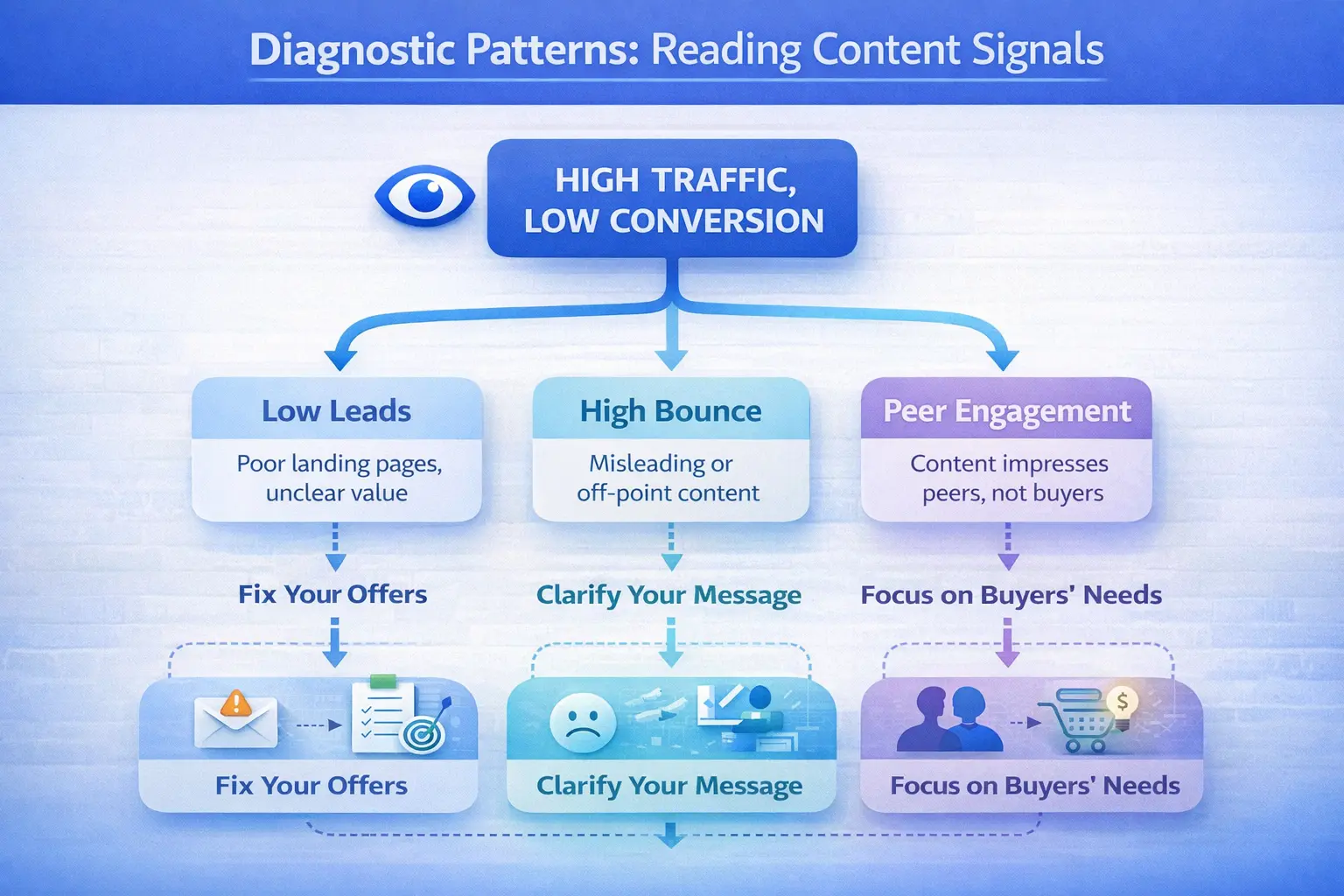
Common Failure Patterns as Diagnostic Signals
Common Content Failure Patterns with Examples
| Metric | Description | Audience Behavior | Business Implication |
|---|---|---|---|
| Attention | Exposure to content or brand | Browsers or casual viewers | Signals awareness but no commitment |
| Interest | Engagement with content | Curious or researching prospects | Indicates curiosity but not buying intent |
| Demand | Readiness to take action | Decision-makers or buyers | Leads to pipeline movement and sales |
Diagnostic Patterns Table
| Pattern | Diagnostic Signal | Strategic Implication |
| Content intent mismatch | High traffic, low conversion; readers are not buyers | Indicates timing or audience segment misalignment |
| Misaligned format vs intent | High engagement on entertainment or thought-leadership, low action on product pages | Content format does not match buyer readiness |
| System warnings | Repeated spikes with no pipeline movement | System-level signal for indirect impact or broken handoff |
Let’s get granular.
What does content attention not demand look like in the wild?
- Sharp surges on content syndicated to industry newsletters, but no uptick in demo requests (the audience browses while waiting for their coffee; intent is low).
- Viral LinkedIn posts celebrated by peer marketers, yet zero impact downstream – no MQLs, no sales meetings (attention economy content marketing without targeting buyers, just peers).
- Blog series ranking for high-volume keywords, with bounce rates north of 85%. Readers? Yes. Buyers? Not yet.
We’ve sat with CMOs staring down these dashboards, asking: “Is all attention useless?”
Actually, these are signals.
High traffic and disengagement often marks either a content intent mismatch or a timing gap (the right people aren’t ready yet).
One signal to watch: repeated patterns where readers are not buyers content dominates your top traffic, while conversion-focused pieces languish unseen.
This isn’t just noise.
It’s feedback from the market – demand shaping vs attention at work, hinting you may be speaking to the wrong moment in your prospect’s journey.
That sting of seeing big numbers and small results?
It’s not a setback.
It’s your early warning system that your content can move from broadcasting to real business movement – when you recognize attention as a signal, not your north star.

Strategic Boundaries
What This Article Explains
Ever wonder why the sharpest spike in views rarely predicts tomorrow’s pipeline?
Here’s the shock: content that racks up millions of eyeballs can have almost zero impact on revenue if the underlying intent isn’t there (we’ve watched a viral campaign drive website traffic up 80% – and sales flatline).
This page unpacks the system-level difference between attention and demand in content marketing, zeroing in on why content attention does not mean content demand, no matter how compelling the numbers look at first glance.
Our clients often ask, “Does high engagement mean our audience is ready to buy?”
The uncomfortable answer: Not even close.
Attention signals exposure, not commercial intent.
The why content views don’t convert dilemma hits hardest when teams treat content like a billboard – seen by many, acted on by few.
You’ll see how timing, intent-maturity, and demand shaping vs attention dynamics work together, sometimes invisibly, over weeks or even months before a sale emerges.
One CMO described it as “feeding the soil, not the plant”.
That’s the analogy: building demand is more like preparing earth for a future harvest than watering a fully grown crop.
We explore the attention economy content marketing trap – optimizing for metrics that feel satisfying but rarely move true buyer readiness.
If you’re thinking, “How can I tell if my content is actually shaping intent?”
You’ll find diagnostic signals and system-framing here, but not a checklist of tactical hacks. Those belong elsewhere.
What It Doesn’t Cover – and Where to Go Next
If you’re hungry for tactics or playbooks to close the intent gap instantly, this page intentionally sets limits.
We don’t prescribe content calendars, copywriting templates, or channel-specific advice.
We do not break down influencer marketing, SEO technicalities, or retargeting tricks – those live in our practical spokes linked at the end.
This guide is purpose-built to change how leaders understand the true job of strategic content: indirect, gradual, often invisible impact – timing, not traffic.
For tools that map intent-maturity, or frameworks to diagnose conversion drop-offs, follow intent maturity mapping for next steps.

Scientific context and sources
The sources below provide foundational context for how decision-making, attention, and performance dynamics evolve under scaling and constraint conditions.
- Decision, Attention, and Performance
“The Psychology of Attention” – Harold Pashler – MIT Press
Provides in-depth analysis of how attention is measured, how it differs from deeper intent, and its cognitive limitations in real-world tasks, forming the basis for distinguishing ‘attention’ from ‘demand’ in business content.
https://mitpress.mit.edu/9780262661560/the-psychology-of-attention/ - Interest vs. Commitment
“The theory of planned behavior” – Icek Ajzen – Organizational Behavior and Human Decision Processes
Explores how attitudes, subjective norms, and perceived control shape the difference between visible engagement and actual behavioral intent, mapping directly to readiness vs simple exposure.
https://www.sciencedirect.com/science/article/abs/pii/074959789190020T - Demand Generation Models
“When is it Worthwhile Targeting the Majority Instead of the Innovators in a New Product Launch?” – Vijay Mahajan, Eitan Muller – Journal of Marketing Research
Outlines empirical distinctions between market attention and true demand formation, with insights on conversion lag and intent maturity.
https://journals.sagepub.com/doi/abs/10.1177/002224379803500407 - Trust Development in Marketing
“Are the Drivers and Role of Online Trust the Same for All Web Sites and Consumers? A Large-Scale Exploratory Empirical Study” – Bart, Shankar, Sultan, Urban – Journal of Marketing
Examines how trust is built over repeated exposure and engagement, emphasizing why multiple substantive interactions – not just attention – precede conversion in digital business.
https://journals.sagepub.com/doi/10.1509/jmkg.2005.69.4.133 - Funnel Dynamics and Content Impact
“Consumer behavior in digital environments” – Richard P. Bagozzi, Utpal M. Dholakia – Wiley
Covers the difference between mere exposure, engagement, and actual purchase decisions, explaining why content touchpoints must bridge the gap from attention to actual demand.
https://www.econbiz.de/Record/consumer-behavior-in-digital-environments-dholakia-utpal/10001599864#tabnav
Questions You Might Ponder
What is the difference between attention and demand in content marketing?
Attention refers to measuring exposure – such as views or impressions – while demand represents actual intent or readiness to buy. Attention measures curiosity, but demand reflects commercial action, making it critical for content to bridge the gap to drive real business results.
Why don’t high content views always translate to more leads or sales?
High views may reflect broad interest, but conversions only happen when the audience is ready to act. Most content attracts browsers, not buyers, so alignment with buyer intent and timing is essential for turning attention into pipeline movement.
How can businesses diagnose an attention versus demand mismatch?
Repeated spikes in traffic without corresponding increases in qualified leads or sales indicate a content intent mismatch. Monitoring conversion rates by content type and audience segment helps identify where attention is not aligning with demand.
What role does trust play in moving from attention to demand?
Trust is developed over multiple, meaningful exposures. It transforms casual engagement into genuine interest, eventually prompting action. Without trust, even interested audiences rarely convert, making repeated relevance a key ingredient for shaping demand.
How should content strategies evolve to focus on demand, not just attention?
Effective strategies go beyond generating exposure – they build trust, map to intent maturity, and synchronize timing. This involves designing content journeys that nurture readiness, address real buyer needs, and prioritize long-term relationship building over vanity metrics.