
What You’ll Learn
Trust timing in positioning is the point in the buyer journey when a brand establishes enough credibility, clarity, and relevance for a prospect to feel safe engaging.
When trust arrives early, buyers understand why the brand matters, who it is for, and why it is credible before comparison or doubt takes over.
When trust arrives too late, prospects hesitate, research elsewhere, compare alternatives, ask for extra proof, or drop out.
Strong trust timing depends on clear positioning, consistent cross-channel messaging, specific value claims, and visible credibility signals from the first touchpoint.
Its goal is to reduce friction before the sales process begins.
Key Takeaways
- Trust timing in positioning shapes whether buyers engage or stall – credibility must be established before decision-making even begins.
- Common failure modes include generic benefits and inconsistent cross-channel messaging, which force buyers into comparison and hesitation.
- Diagnosing trust friction relies on recognizing where prospects hesitate due to lack of clarity, consistency, or credibility – not on missing product details.
- Front-loading trust prevents friction, accelerates qualification, and enables growth to become more predictable and scalable.
Delayed trust isn’t just a slow start – it’s structural friction that shuts the door before buyers even see what you offer.
Most teams assume that credibility builds naturally as prospects move down the funnel.
In reality, trust timing is the unseen gatekeeper: if you front-load credibility, buyers lean in; if you don’t, they hesitate or walk.
That broader decision frame is mapped in Brand Positioning.

Why trust timing in positioning matters before a single decision
Every time trust lags, you force your prospect into a spreadsheet mindset.
Instead of absorbing your difference, they default to comparing features, prices, or third-party reviews – often before they even understand why you’re relevant.
We’ve watched buying teams bounce between tabs, searching for any source that tells them, “You’re safe here” – because your own signals came too late.
How misplaced trust pushes prospects into comparison
The common myth is that trust is a reward, “earned” after your messaging proves itself.
But by the time you make your case, buyers have already put you in a line-up with competitors – or ruled you out completely.
The analogy is simple: delayed trust is like handing your guest a contract before you offer them a seat.
Why would they ever relax enough to listen?
This friction isn’t subtle.
In one executive roundtable, half the group admitted they “park” unfamiliar vendors for later review, simply because credibility wasn’t instant.
That pause creates space for competitors to enter and doubts to calcify.
If your positioning forces buyers to do their own background check, you’re already behind.
Why positioning – not messaging – sets the trust timeline
Messaging tweaks can sharpen perception, but they can’t compensate for positioning that leaves prospects guessing.
Trust timing isn’t a creative flourish – it’s baked into your strategic foundation.
The companies that build early trust don’t just sound confident; they occupy a space that tells buyers, “You belong here and your risk is minimized”.
Here’s the key distinction: positioning determines when trust is possible, messaging only shapes how it feels.
We see leaders pour budget into testimonials, content, or branding – hoping credibility will accrue – but if your core offer lives in a gray zone, trust stays out of reach.
Ask yourself: does your positioning answer an immediate strategic need or does it leave the buyer unsure, over-researching, and hesitating?
Structural trust failure is rarely fixed with surface-level persuasion.
The decision friction from doubt is built upstream.
Front-loaded credibility isn’t a luxury – it’s a requirement.
When trust arrives before questions even form, readiness replaces hesitation.

Common failure patterns when trust is delayed
Common Failure Patterns When Trust is Delayed
| Diagnostic Question | Focus Area | What To Look For | Consequence if Negative |
| Is your offer understandable in under 10 seconds? | Clarity | Clear value prop communicated quickly | Buyers stall from vague value props |
| Does every channel project the same core identity and promise? | Consistency | Uniform messaging across website, ads, email, etc. | Mixed messages fracture credibility |
Most teams think they have a trust problem because buyers “don’t know enough yet”.
In reality, delayed trust is almost always the fault of foundational choices upstream – not the audience’s caution.
Here’s what happens when companies get this wrong: the friction isn’t gradual, it’s instant.
Your offer gets filtered out long before the competition even appears on screen.
Generic benefits that collapse under scrutiny
Imagine telling someone you’re “better, faster, smarter” – then expecting a handshake deal.
That’s what broad, copy-paste positioning does.
When your claims sound just like everyone else’s, you force prospects into a holding pattern: the only way out is for them to dig for evidence themselves.
We’ve seen B2B SaaS firms drop 40% of otherwise-qualified leads because the benefits on their homepage were so generic, buyers bounced to look for hard proof elsewhere.
The biggest myth is that you can earn trust by stacking testimonials or case studies later in the journey.
But buyers don’t wait to be persuaded – they use any whiff of vagueness to disqualify brands before even booking a call.
Think of generic benefits as a paper shield: looks fine until prodded, then falls apart instantly.
Trust kicked down the funnel becomes friction everywhere else in the funnel.
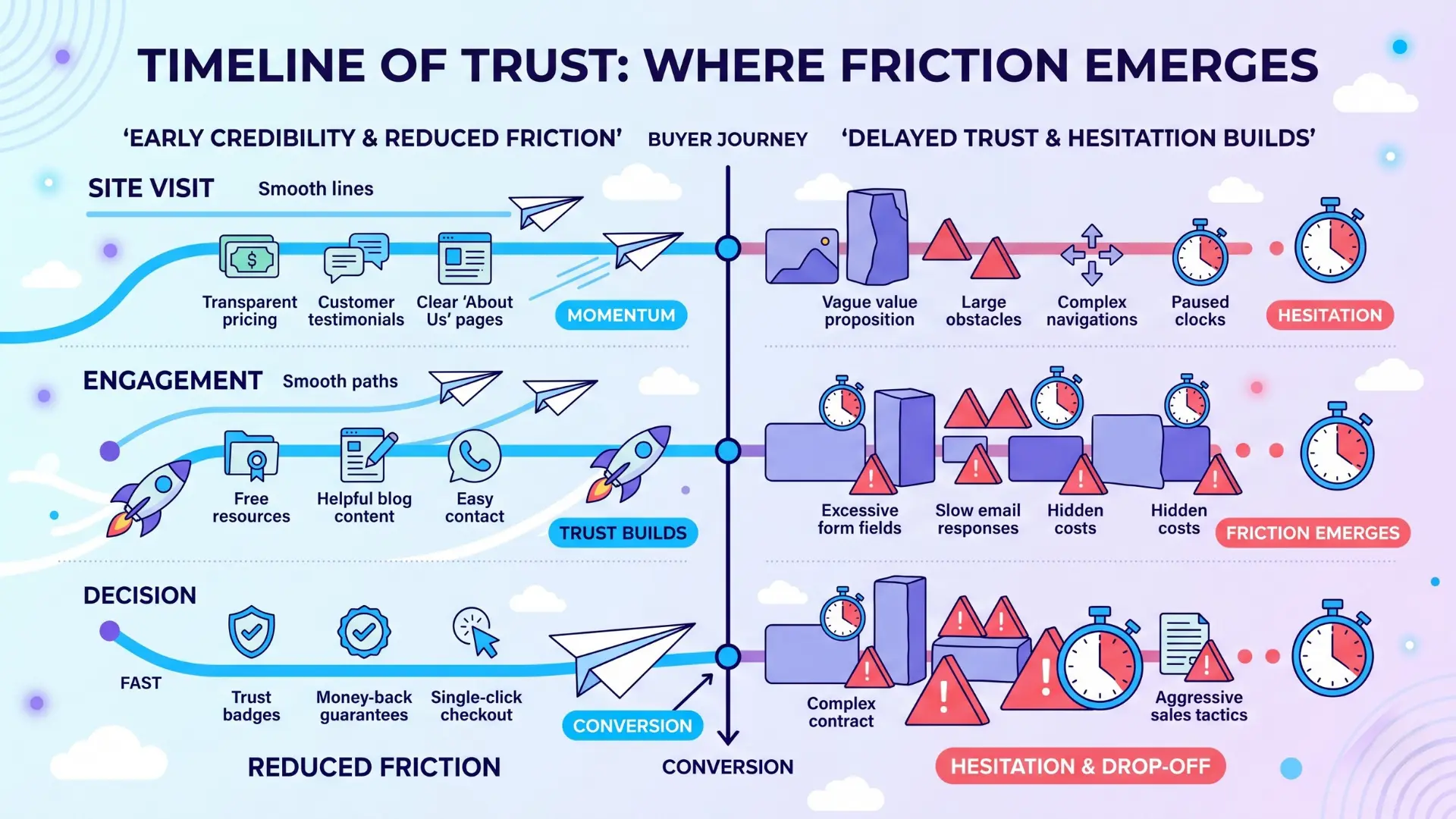
Channel-switching messages that fracture credibility
Another silent killer: seeing your own claims change depending on the channel.
On the website, you talk speed; in paid ads, you highlight savings; in email, you play up support.
To a prospect, this doesn’t feel like nuance – it feels like confusion or evasion.
One enterprise client we advised saw 20% of pipeline opportunities stall or go dark, largely because their narrative shifted from LinkedIn to landing page.
If trust is a bridge, every cracked plank makes the crossing riskier.
Why would a decision-maker continue if the story changes with every step?
Cross-channel inconsistency doesn’t just postpone belief; it triggers what we call structural trust failure.
Instead of building cumulative credibility, you’re forcing people to weigh which story (if any) is real.
This is where decision friction blooms from doubt, not lack of detail.
To sum up: most trust failures aren’t about missing proof – they’re about giving people too many reasons to second-guess what they’re really being offered.
Tidy these at the root, and much of the downstream friction disappears.

How to evaluate if your positioning is delaying trust
You won’t catch trust friction on a dashboard.
Unlike click-through or lead conversion, the impact of trust timing only becomes clear once buyers start hesitating, stalling, or ghosting after first contact.
Most teams believe bolting on more social proof or product data eventually wins confidence – but that’s not where readiness is lost.
The truth: if your positioning doesn’t deliver the right signals upfront, every subsequent pitch is fighting a hidden headwind.
What signals do prospects need before engaging?
What prospects really want isn’t a laundry list of proofs; it’s one clear signal that “people like me trust companies like yours – before I invest another second”.
We’ve seen this in client reviews: two products with equal performance, yet the one that signals fit and credibility within the first 20 seconds moves buyers directly into engaged evaluation.
When that signal is missing, no amount of late-stage persuasion gets buyers off the fence.
Think of readiness as a combination lock – if even one early number is off, the rest of your sequence won’t matter.
So: are you surfacing relevance, authority, and intent as soon as someone lands on your page, or are you hinting at value and expecting buyers to piece it together?
If a new prospect can’t answer “why should I trust you, right now?” without digging, your trust timeline is already lagging.
The myth: prospects will work for answers if they’re curious enough.
In reality, they won’t.
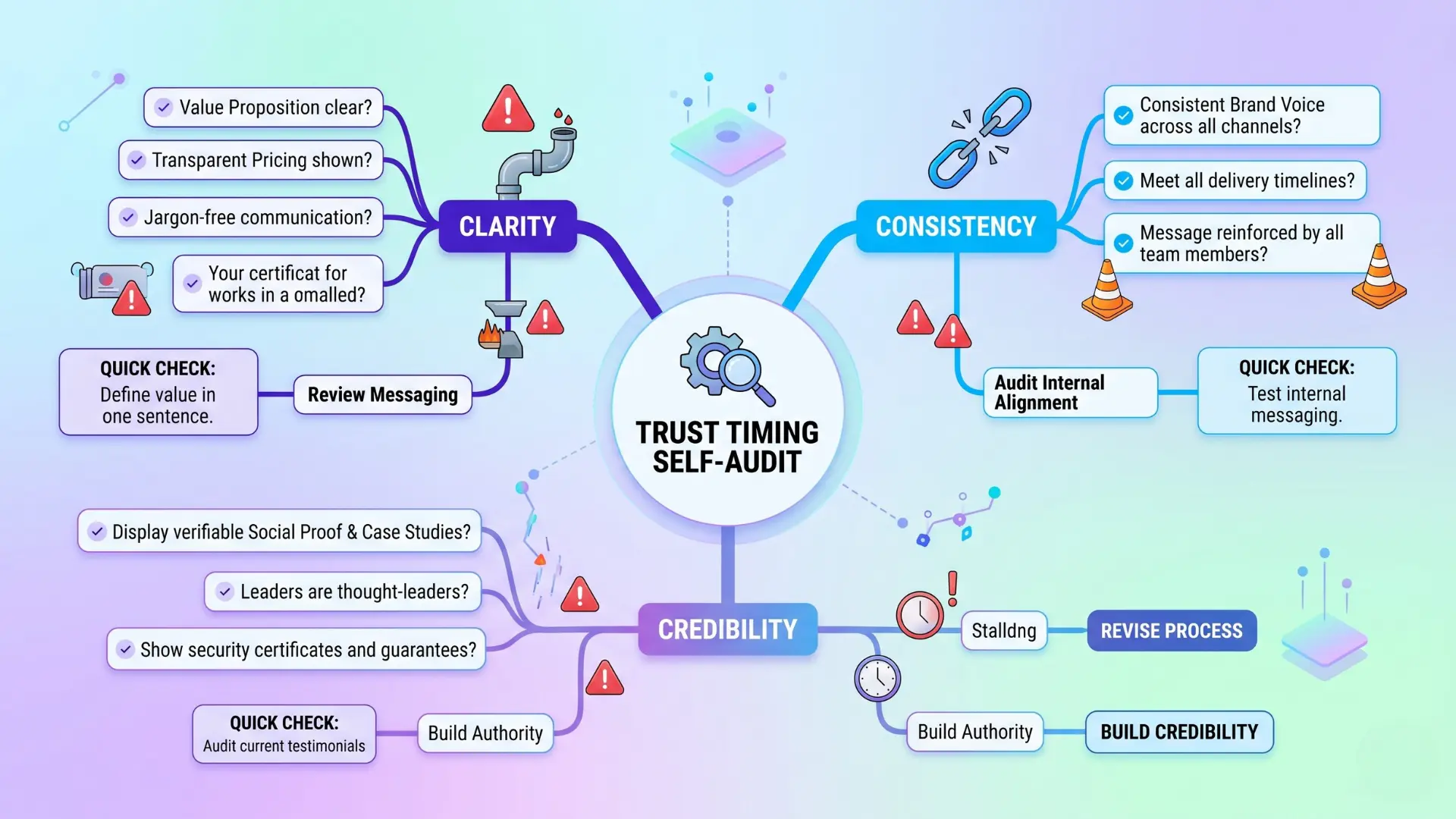
Where do prospects stall: clarity, consistency, or credibility?
Diagnostic Checklist for Trust-Related Stalls in Positioning
| Failure Pattern | Description | Impact on Buyer Behavior | Example Metrics |
| Generic benefits that collapse under scrutiny | Broad, copy-paste claims that sound like everyone else | Buyers bounce to find hard proof or disqualify brand early | 40% drop of otherwise-qualified leads (B2B SaaS example) |
| Channel-switching messages that fracture credibility | Inconsistent claims across channels (website, ads, email) | Confusion leads to stalling or lost pipeline opportunities | 20% of pipeline stalls or goes dark (enterprise client example) |
Buyers rarely say out loud, “I don’t trust this” – instead, they stall where your positioning wobbles.
Watch for three stalling points: vague value props (lack of clarity), mixed messages across channels (consistency gaps), and recycled claims with no substance (credibility gaps).
In our audits, the longest lead conversion times almost always trace back to one of these: friction from doubt, not from too few features.
Ask: Is your offer understandable in under 10 seconds?
Does every channel project the same core identity and promise?
Can a stranger describe your difference in a single line?
If you don’t know, your prospects definitely don’t.
Positioning that front-loads trust removes these stalls.
Instead of prospects searching for evidence, they get orientation, confidence, and a reason to engage.
Early trust isn’t a bonus; it’s the license to play.
If trust timing feels invisible, check for places where buyers pause or disappear.
That’s where delayed trust is costing you most.

What changes when trust is front-loaded
Unlocking growth is rarely about a better pitch – it’s about what happens before the selling ever starts.
Most teams burn cycles on persuasion tactics that wouldn’t even be needed if trust showed up on page one.
What’s actually possible when credibility arrives before the first real objection?
The answer isn’t longer pipelines or happier sales reps – it’s a pipeline that almost cleans itself.
Less need for persuasion or sales heroics
Here’s the overlooked reality: sales “skills” become a crutch when positioning delays trust.
In client after client, we’ve seen that when trust is established early, nearly half of the typical objections disappear – sometimes before discovery calls even happen.
Conversations shift from “Why should I believe you?” to “How do we make this work?”.
One SaaS client saw a 22% drop in negotiation cycles the quarter they overhauled for front-loaded credibility.
No deep case studies, no “pitch deck theater” – simply a sharper promise, proven early, that lowered the urge for back-and-forth.
The core insight: when buyers feel certainty up front, there’s less oxygen for doubt to grow.
It’s the difference between pushing a stalled car and rolling downhill with the brakes off.
Why do so many companies obsess over sales enablement when trust, supplied early, shrinks cycles by days or weeks?
It’s not about scripts or chasing the “perfect close” – it’s about removing the friction of delayed trust before it ever slows the pipeline.
Prospects self-select in and avoid friction
When trust is built into positioning from the first touch, prospects instantly recognize whether they belong.
The right buyers lean in.
Unqualified or misaligned leads quietly walk away.
We worked with a B2B services firm whose pipeline volume dipped 13% after clarifying their early positioning, but their win rate doubled as irrelevant prospects stopped clogging the funnel.
Think of front-loaded trust as a filter, not a net: it sifts for fit by turning decision friction into a self-sorting process.
The well-matched accelerate, the wrong-fit self-disqualify – saving collective cycles and energy.
The powerful effect: qualification happens upstream, not after endless email threads or forced demos.
What if your sales team never had to “save” deals that shouldn’t be there in the first place?
That’s the downstream impact of trust timing: you don’t just move faster – you move only with prospects that already believe.
The payoff is profound but simple: when trust arrives early, friction leaves with it.
Growth stops being heroic.
It becomes predictable, compounding, and – most importantly – replicable across every new prospect journey.
Delayed trust increases perceived risk – a principle expanded in Trust Risk Perception.

Scientific context and sources
The sources below provide foundational context for how decision-making, attention, and performance dynamics evolve under scaling and constraint conditions.
- Trust as a Determinant of Buyer-Seller Relationships
An Examination of the Nature of Trust in Buyer-Seller Relationships – Doney, P.M., Cannon, J.P. – Journal of Marketing
This foundational study shows that trust materially influences buyer behavior in commercial relationships, reducing perceived risk and transaction friction at early stages of engagement.
https://doi.org/10.1177/002224299706100203 - Decision Making Under Uncertainty
Thinking, Fast and Slow – Daniel Kahneman – Farrar, Straus and Giroux
This landmark book explains how heuristics, cognitive shortcuts, and biases shape fast trust judgments, supporting the importance of strong early credibility signals.
https://en.wikipedia.org/wiki/Thinking,_Fast_and_Slow - Positioning and Marketplace Differentiation
Positioning: The Battle for Your Mind – Al Ries, Jack Trout – McGraw-Hill
This foundational positioning book explains how clear differentiation creates mental shortcuts in buyer perception, making brands easier to trust, remember, and choose.
https://books.google.pl/books/about/Positioning_The_Battle_for_Your_Mind.html?hl=it&id=_BHj1OYgF7wC&redir_esc=y - Signaling Theory and Trust Formation
Signaling Theory: A Review and Assessment – Connelly, B.L., Certo, S.T., Ireland, R.D., Reutzel, C.R. – Journal of Management
This widely cited review explains how organizations communicate trustworthiness through observable signals under uncertainty, directly supporting the role of front-loaded credibility.
https://journals.sagepub.com/doi/10.1177/0149206310388419 - The Effects of Inconsistent Messaging on Brand Credibility
The Impact of Perceived Corporate Social Responsibility on Consumer Behavior – Becker-Olsen, K.L., Cudmore, B.A., Hill, R.P. – Journal of Business Research
This research shows that low-fit or inconsistent brand messaging reduces consumer trust and increases skepticism, directly supporting the argument that inconsistency damages credibility.
https://doi.org/10.1016/j.jbusres.2005.01.001
Questions You Might Ponder
How does trust timing in positioning influence B2B sales performance?
Trust timing in positioning ensures that credibility is established before buyers compare alternatives. Early trust reduces hesitation and positions your brand as the default choice, resulting in shorter sales cycles and higher close rates among qualified leads.
What are common signals that indicate delayed trust in positioning?
Signals of delayed trust include high drop-off rates before engagement, prospects “parking” your offer for later review, inconsistent messaging across channels, and buyers defaulting to feature or price comparisons due to lack of early clarity.
Why can’t messaging alone resolve trust delays in the buyer journey?
Messaging influences perception, but it works only if core positioning delivers credible, relevant signals upfront. Without strategic positioning, no amount of persuasive copy or testimonials can overcome foundational doubts or fill early credibility gaps.
How can companies diagnose if their trust timeline is lagging?
Teams should audit for stalls in the buyer journey tied to clarity, consistency, or credibility gaps – such as prospects taking excessive time to engage, abandoning forms, or expressing confusion in discovery calls. Early hesitation is a key diagnostic indicator.
What benefits result from front-loading trust in positioning?
Front-loaded trust means qualified buyers enter the pipeline confident and ready to engage, objections decrease, and poorly matched prospects self-select out. This leads to more efficient sales processes, higher win rates, and scalable, predictable growth.