
What You’ll Learn
Perceived risk delay decision positioning is the pattern where unclear or weak positioning makes buyers feel uncertain, exposed, or unsafe, causing them to slow down decisions instead of moving forward with confidence.
When a brand does not clearly explain why it is different, credible, and worth choosing, buyers manage risk by comparing prices, requesting more proof, delaying approval, ghosting after early interest, or involving extra stakeholders.
This hesitation is often not a pricing or sales problem.
It signals that trust arrived too late.
Strong positioning reduces perceived risk by front-loading credibility, relevance, and differentiation before doubt turns into delay.
Key Takeaways
- Unclear positioning amplifies perceived risk, causing buyers to hesitate and prolong decision cycles.
- Common hesitation patterns – like price obsession and ghosting – signal a breakdown in trust, not just process or pricing issues.
- Delayed trust increases customer acquisition costs and opportunity loss, highlighting the need for early, decisive value communication.
- Positioning that front-loads credibility and differentiation eliminates uncertainty, shrinking cycles and boosting buyer confidence.
Most executives assume prospects are slow to decide because of internal delays or pricing doubts.
But hesitation is often a mirror held up to your brand positioning – when your differentiation isn’t sharp, buyers hesitate to protect themselves from risk they can’t quite name yet.
The result: every unanswered question turns into another checkpoint, and every vague value claim gets weighed like a liability, not an asset.
The silent truth?
Every stalled deal flashes risk management, not just lack of urgency.

Why unclear positioning raises perceived risk and stalls decisions
When prospects can’t see a clear structural difference between you and competitors, they default to lining up specs, prices, and features – side by side.
We see this pattern repeatedly with B2B clients in crowded SaaS and service markets: the more similar the claims, the more buyers start building spreadsheets instead of conviction.
How ambiguity fuels comparison and hesitation
It’s a myth that more information automatically builds confidence.
If your positioning doesn’t frame a clear, ownable difference up front, prospects start searching for footholds – often by comparing you on commoditized terms.
Why pay a premium or move quickly if you seem replaceable, or your promise blends into the background?
That’s when “let me think about it” isn’t a time request; it’s a flag that anxiety and risk have replaced real momentum.
Think of vague positioning like a fogged window: the more prospects try to peer through, the more they squint, compare, and wait.
At this point, every new touchpoint is just more noise until the fog clears.
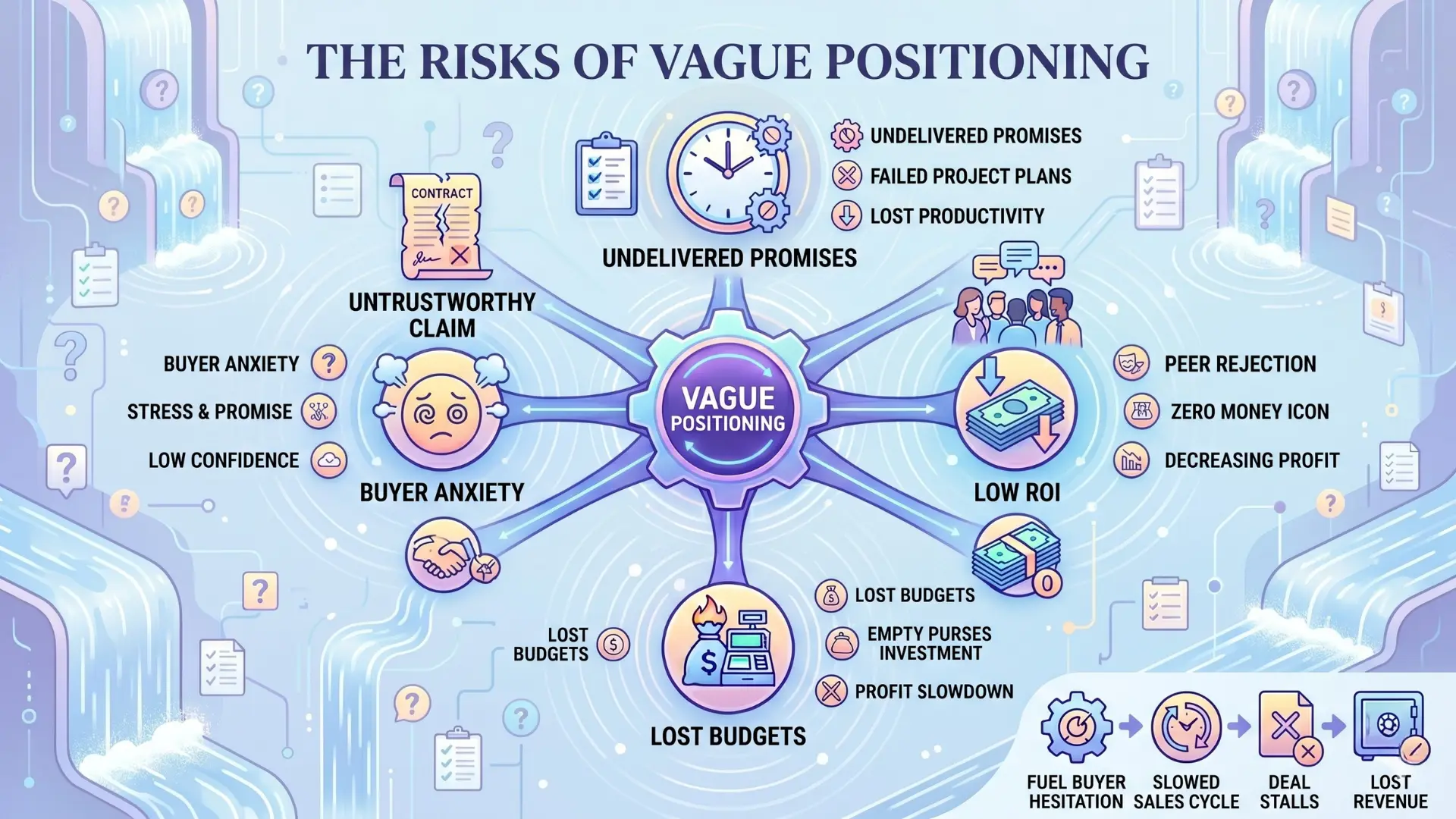
Which dimensions of perceived risk emerge from vague positioning
Dimensions of Perceived Risk from Vague Positioning
| Hesitation Pattern | Description |
| Repeated ‘just price’ comparisons | Buyers keep returning to pricing discussions without progressing. |
| Ghosting after initial interest | Prospects vanish after showing early enthusiasm. |
Unclear positioning doesn’t just trigger financial caution.
It multiplies risk into four flavors: performance (will this actually work?), social (will I look foolish for backing this?), financial (is this worth the cost versus safer bets?), and psychological (am I uneasy because something’s off?).
One BiViSee client in enterprise consulting saw decisions stall for months – not because of price, but because buyers couldn’t articulate what was truly unique about their approach.
That lack of clarity translated to personal anxiety on the buyer’s side (“If I’m wrong, I own the mistake”).
When buyers can’t see an obvious answer to these risks, they slow down or disengage entirely.
Consider: would you invest quickly in something you don’t fully understand, especially when the consequences land on your reputation or budget?
When positioning clarity is missing, perceived risk fills the gap.
That’s why hesitation isn’t just a pipeline problem – it’s your prospect’s defense against uncertainty.
The bottom line: vague positioning forces buyers into self-protective mode.
If your brand promise blurs into competitors, hesitation is the natural outcome – risk management dressed as indecision.
To move deals forward, clarity trumps cleverness every time.

Which hesitation patterns signal positioning breakdown
Hesitation Patterns Indicating Positioning Breakdown
| Risk Dimension | Description |
| Performance | Will this actually work? |
| Social | Will I look foolish for backing this? |
The difference between a healthy sales cycle and one torpedoed by uncertainty isn’t deal size – it’s the shape of your hesitation patterns.
Most leaders chase the wrong signal: they see stalled deals and assume they’re just facing lengthier procurement or persistent discount hunters.
But in reality, certain forms of delay don’t just slow the deal – they diagnose a flaw in how your value lands at the trust stage.
The real tell?
When buyers offer surface-level objections but their anxiety sits deeper: in your positioning,not your pricing.
Repeated “just price” comparisons as red flags
If you hear buyers looping back to price – “just to confirm, what does this cost again?”, “How do you compare on price to X?” – it’s rarely about the number on the page.
Price becomes the default metric when buyers don’t understand the difference you claim.
In our client reviews, anytime we see discussions stuck on pricing by the third touchpoint, it reliably points to trust timing: your positioning didn’t anchor enough value early to earn a more strategic conversation.
The myth says obsessing on price means your offer is too high.
But the real risk is your differentiation isn’t clear or credible yet.
Think of the price fixation as a blinking dashboard warning light – it’s signaling a breakdown upstream, not at the final negotiation.
One B2B client saw nearly every deal devolve into spreadsheet comparisons, with no serious interest in their unique offer.
We mapped the conversation flow and found the problem: product claims were technically strong but unmoored from any urgent, category-defining risk.
Instead of defensively justifying numbers, wise teams pause and ask: where did our positioning fail to transfer conviction?
Ghosting after initial interest as anxiety signaling
Silence tells its own story.
Most sales teams treat ghosting as a pipeline quality issue – wrong lead source, poor follow-up, or simple busyness.
But when prospects go dark after showing initial enthusiasm, you’re often seeing unresolved risk at work.
The truth: people avoid decisions that feel exposed.
If your brand promise introduces more questions than it answers, decision makers protect themselves by stalling out of sight.
We’ve seen executives burned by this: a flurry of early engagement, then nothing as buyers disappear for weeks or months.
The myth here is that silence means they were never truly interested.
More often, the anxiety triggered by ambiguous claims or unclear fit triggers wait-and-see behavior.
It’s like stepping to the edge of an elevator whose floor’s misaligned by just an inch – most people choose not to take the risk.
Which signals matter?
When your pipeline is littered with “circling back” messages and noncommittal delays following demos, don’t write it off as bad timing.
Treat ghosting as a pulse-check on how well your positioning reduces uncertainty and projects credibility.
If price preoccupation and disappearing prospects show up together, that’s not just friction – it’s the positioning warning system you can’t afford to ignore.

What makes trust arrive too late – and why that matters strategically
We see trust arrive too late in the sales process – often after the proposal instead of at first contact.
Most teams labor under the myth that they can nurture their way out of skepticism, but every extra touchpoint is really a tax imposed by delayed credibility.
If your value is foggy at the start, each step afterward gets harder, not easier.
Why do so many brands burn resources trying to win over prospects who were never convinced in the first place?
Cost of persuasion vs. cost of clarity
Every extra call, deck, or nurture campaign is a symptom – not a fix.
When positioning is unclear, persuasion becomes an arms race against suspicion.
We’ve seen brands spend months romancing leads with endless content, only to watch them sign with a competitor who explained their worth in a single, precise minute.
It’s the marketing equivalent of patching leaks instead of fixing the main valve.
The cost of persuasion compounds quietly: longer sales cycles, increased customer acquisition costs, repeated discount demands.
Reactivity drives up the price, while strategic clarity short-circuits friction before it starts.
Would you rather spend your budget smoothing doubts, or stop the doubt before it appears?
How delay breeds inertia and lost opportunities
Hesitation isn’t just a stall – it’s a cue that something vital was missed upstream.
Delayed trust breeds inertia: prospects remain “interested” for weeks, then drift as excitement cools and options multiply.
In our work, we’ve watched strong early conversations freeze when credibility arrived after the fact, not at the first point of contact.
The analogy: it’s like showing an emergency exit only after the fire drill has finished.
Opportunity cost mounts quietly – the pipeline fills with maybe-laters, while truly qualified buyers slip away.
Each day trust is deferred turns momentum into friction, and every friction point risks another lost decision.
Trust delivered late is trust discounted.
Front-load credibility, or get used to longer cycles and lost ground.

What leaders should evaluate next to re‑anchor trust timing
Trust isn’t just missing – it’s often late on arrival.
The real risk is subtle: most positioning lulls prospects into postponing belief until deep in the funnel.
When teams only realize this at deal review, the damage is already done.
If your messaging doesn’t front-load credibility, you’re not fighting skepticism – you’re fueling it.
Does your positioning pre‑qualify or defer credibility?
Most branding frameworks teach you to “build rapport and prove value” over time.
Here’s the myth: that trust naturally accumulates with exposure.
In reality, hesitation spikes when your value is ambiguous upfront.
If prospects must work to see why you’re credible, many quietly opt out before objection-handling ever starts.
From our work: the fastest-moving deals occur when positioning functions like a strong reference – a point of social proof, direct relevance, or exclusive angle offered on the first touch.
Compare this to brands who save their best evidence for after qualification; their pipelines always have more drop-offs and stalled cycles.
Think of positioning as airport security: the earlier you show clear credentials, the smoother the journey.
Ask directly: Does your website, sales deck, or outbound message instantly answer “why should I believe you now?” Or does it postpone proof until later stages?
Many teams overestimate how much patience buyers have.
Plot your current journey – if credibility is a late reveal, prospects have already begun their comparison shopping.
Strong positioning removes friction by letting buyers trust early and decide faster.
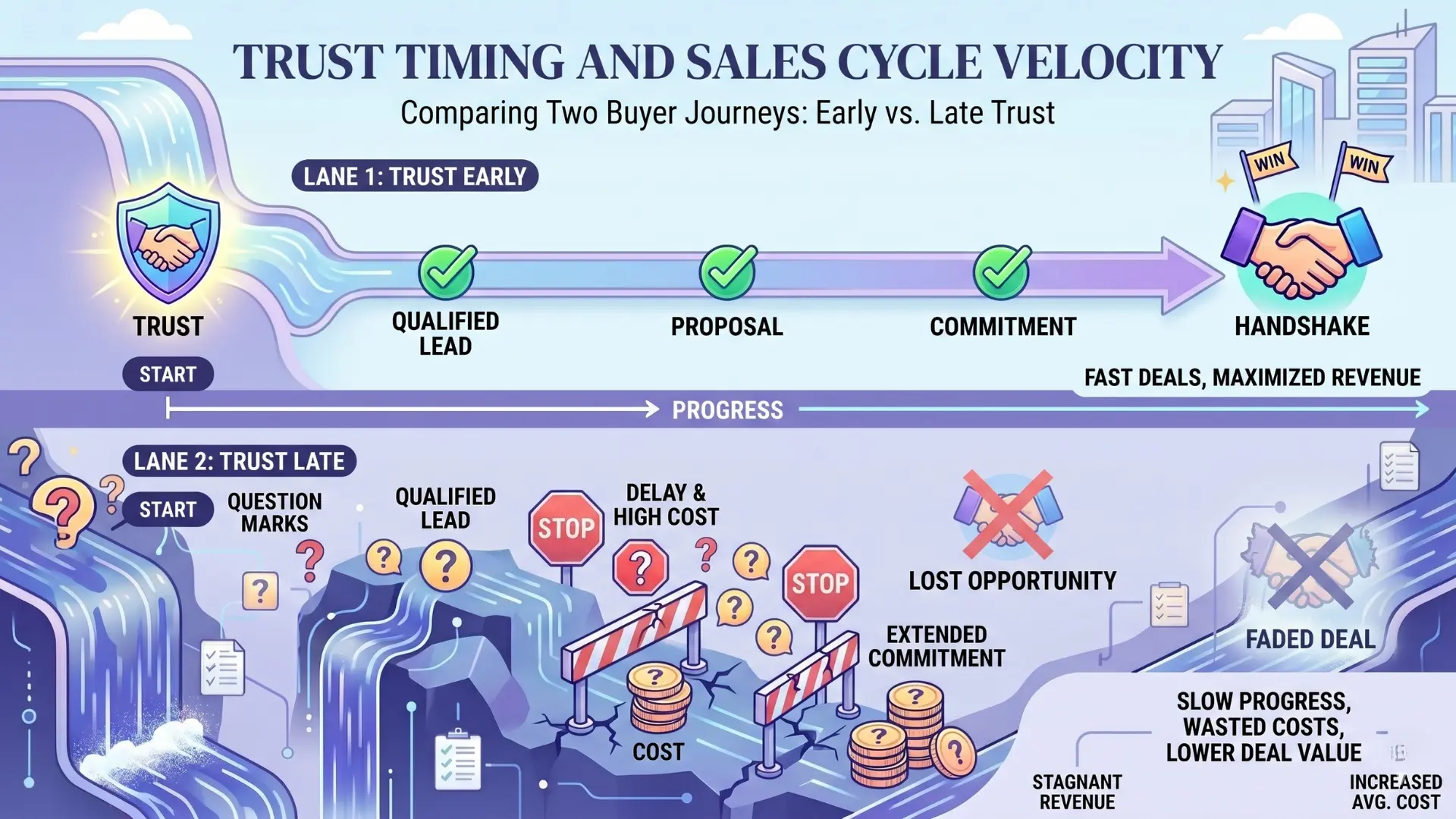
Are hesitation signals consistent across channels or changing shape?
Not all hesitation looks the same.
If you only see ghosting in one channel but decisiveness in another, you may have a messaging mismatch; but if delay patterns repeat everywhere, the issue is structural.
We’ve watched clients blame slow prospects, only to discover their positioning failed to hold up across digital, in-person, and partner channels alike.
Start mapping: where are prospects pausing or pushing back most?
Are the same questions or doubts surfacing across your website, ads, and outreach?
Consistent hesitation is a positioning diagnostic, not a sales objection.
If the shape of delay varies by audience or environment, messaging design may be to blame.
But if no channel feels immune, trust isn’t simply missing – it’s been deferred across the system.
Positioning clarity is the remedy for chronic hesitation: front-load credibility everywhere buyers land, and hesitation morphs from a pattern into an exception.
Executives who tune trust timing see not just faster decisions, but more decisive ones.
If you want predictable velocity, inspect how and where your brand makes trust feel instant.
Increased risk leads to comparison behavior, which is unpacked in detail in Comparison Patterns in Positioning.

Scientific context and sources
The sources below provide foundational context for how decision-making, attention, and performance dynamics evolve under scaling and constraint conditions.
- Decision-Making Under Uncertainty
Thinking, Fast and Slow – Daniel Kahneman – Farrar, Straus and Giroux
This landmark book explains how people make judgments under uncertainty using heuristics and cognitive shortcuts, directly supporting the role of perceived risk in early positioning decisions.
https://us.macmillan.com/books/9780374533557/thinkingfastandslow/ - Perceived Risk and Its Effect on Consumer Decision-Making
Consumer perceived risk: conceptualisations and models – Mitchell, V.-W. – European Journal of Marketing
This review explains how ambiguity and uncertainty increase perceived purchase risk, causing hesitation, delayed decisions, and more comparison behavior among buyers.
https://www.emerald.com/ejm/article-abstract/33/1-2/163/43804/Consumer-perceived-risk-conceptualisations-and?redirectedFrom=PDF - Trust Repair and Buyer Behavior
Trust and Distrust: New Relationships and Realities – Lewicki, R.J., McAllister, D.J., Bies, R.J. – Academy of Management Review
This foundational paper explains how uncertainty and broken trust alter decision behavior, supporting the argument that trust must be established early to reduce friction in buyer decision journeys.
https://doi.org/10.5465/amr.1998.926620 - Ambiguity Aversion in Strategic Contexts
Risk, Ambiguity, and the Savage Axioms – Ellsberg, D. – Quarterly Journal of Economics
This seminal paper established that people prefer known risks over ambiguous uncertainty, making it one of the strongest theoretical foundations for why unclear positioning slows decisions.
https://doi.org/10.2307/1884324 - Information Processing and the Role of Positioning
Choice in Context: Tradeoff Contrast and Extremeness Aversion – Simonson, I., Tversky, A. – Journal of Marketing Research
This classic research demonstrates that how choices are framed and differentiated changes buyer evaluation behavior, supporting the strategic importance of clear positioning to reduce excessive comparison.
https://doi.org/10.1177/002224379202900301
Questions You Might Ponder
How does perceived risk delay decision-making in B2B positioning?
Perceived risk increases buyer hesitation by making prospects wary of differences they can’t easily understand. In unclear positioning, this often leads to more comparison and longer decision cycles as buyers seek reassurance, stalling progress and increasing the chance of lost opportunities. The timing of reassurance matters as much as the proof itself, which is why When Trust Arrives Too Late examines what happens when credibility appears only after the buyer has already formed a risk judgment.
What are the main types of risk buyers perceive from vague positioning?
Buyers perceive four major risks: performance (will it work?), social (will I be blamed?), financial (is it worth the cost?), and psychological (does something feel off?). Clarity in positioning reduces these risks, accelerating trust and purchase decisions.
Why do prospects focus on price when positioning is unclear?
When buyers can’t identify your unique value, price becomes their main comparison metric. This price fixation is often a sign of weak differentiation, not just budget sensitivity. Strengthening your positioning moves the discussion away from cost toward strategic benefits.
What signals point to a breakdown in positioning during the sales cycle?
Repeated price comparisons and ghosting after initial contact are key signals that your positioning isn’t clear. These patterns indicate unresolved buyer anxiety and highlight the need for upfront value and credibility, not just more information.
How can companies accelerate trust and reduce perceived risk up front?
Companies can accelerate trust by clarifying unique value and credibility early – through social proof, clear differentiation, and immediate answers to “why believe us now?” This proactive approach minimizes risk perception and reduces decision delays throughout the buying journey.