
What You’ll Learn
Comparison as doubt is the buyer behavior where side-by-side comparison becomes a response to uncertainty rather than a purely rational evaluation process.
It happens when a brand has not built enough trust, familiarity, or clear differentiation before the buyer reaches the decision stage.
In that moment, buyers use feature charts, pricing tables, reviews, and competitor lists as a safety mechanism to reduce perceived risk.
For brands, comparison as doubt signals a positioning problem: credibility arrived too late, value felt interchangeable, or trust signals were too weak.
The solution is to front-load proof, context, and credible differentiation before buyers feel forced to compare.
Key Takeaways
- Early trust gaps trigger comparison as a fast response to doubt, not just logical evaluation.
- Undifferentiated positioning makes your brand interchangeable, fueling side-by-side comparisons.
- Over-comparison creates pipeline friction, slows deals, and undermines your value narrative.
- The solution is to surface visible, credible trust signals before buyers reach the stage of comparison.
Most teams assume that buyer comparison is just a sign of “doing homework”.
Here’s the problem: almost every time buyers start side-by-side charting, it signals something deeper – an unaddressed trust gap.
The moment trust is delayed, comparison becomes a substitute for confidence, not a confirmation of it.
That’s the shift most brands miss.
That wider dynamic is mapped in Brand Positioning.

Why comparison emerges when trust hasn’t been built early
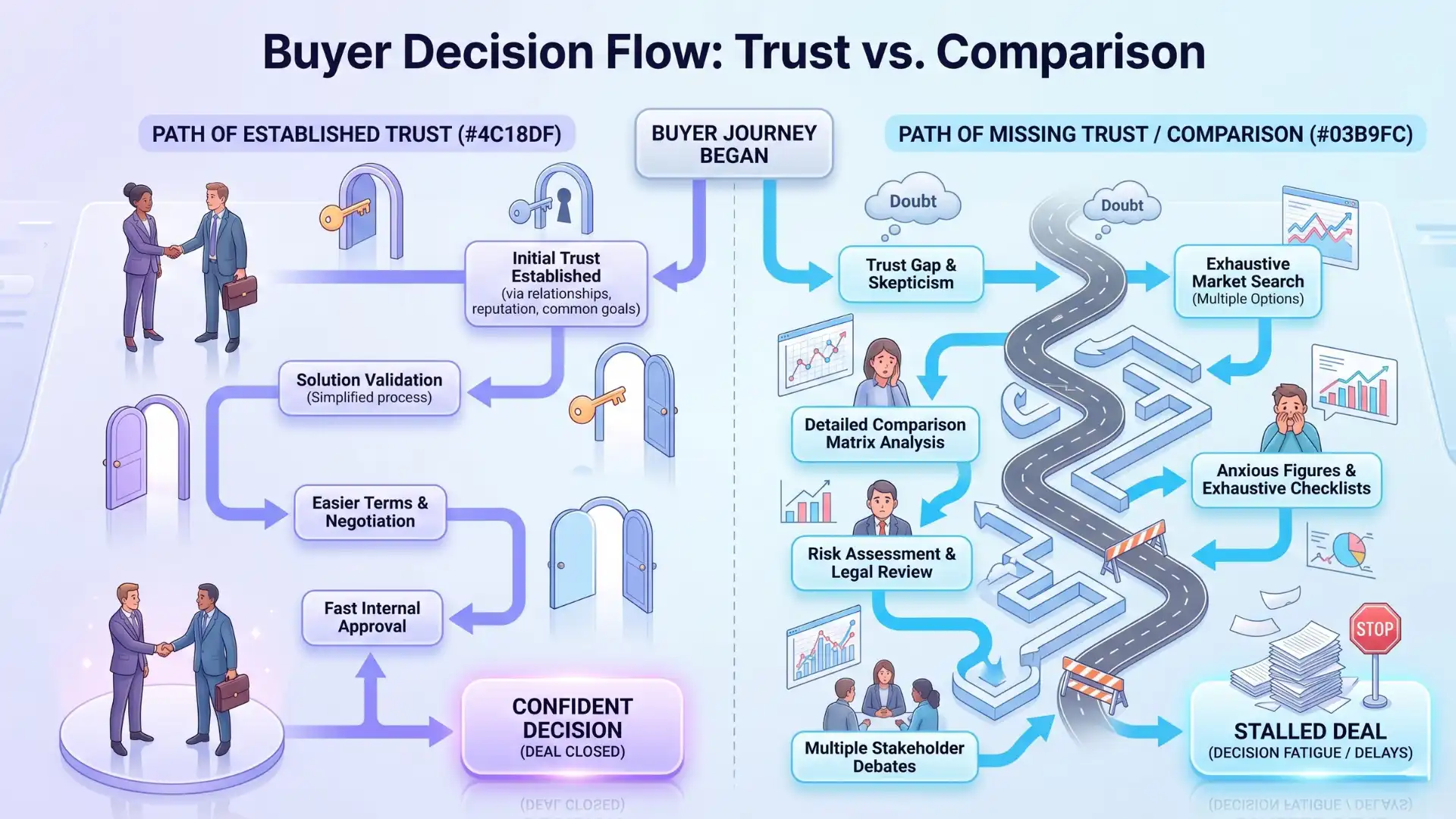
Ever noticed how buyers default to “let’s compare options” the second uncertainty creeps in?
The brain isn’t hunting for the best; it’s scanning for safety.
From years in client war rooms, we’ve seen that when trust signals are missing up front, decision makers lean on easy heuristics: price columns, feature lists, the comfort of checkboxes.
It’s less about logic, more about quelling anxiety fast.
This is a classic case of psychological safety influencing choice long before features or pricing.
The mere exposure effect – where familiarity breeds trust – is often what buyers seek when direct signals are missing.
How insecurity triggers cognitive shortcuts
One B2B SaaS prospect told us, “We came in with checklists because we honestly couldn’t tell who to trust first”.
When the initial impression is neutral, buyers go into what’s basically risk control – comparison as insurance against making the “wrong” call.
Myth: buyers compare only for rational thoroughness.
Reality: it’s mostly a relief response to discomfort.
Comparison in these moments is a quick bandage on doubt.
Like switching lanes for the illusion of momentum in a traffic jam, the act feels proactive but rarely leads to a stronger conviction.
Do your trust signals give buyers a reason to pause the checklist, or just sharpen their pencils?
Why comparisons feel safe when positioning is undifferentiated
If your positioning sounds interchangeable, you hand buyers permission to default to the safest tool – comparison.
No structural uniqueness?
Buyers subconsciously flatten your value into commodity territory.
Time and again, we’ve seen that undifferentiated brands invite “apples-to-apples” reviews, even when their solution is fundamentally different beneath the surface.
The analogy: buyers shopping for helmets in a pile of identical hard hats may choose solely on price or a small feature, not safety or reputation.
How else could they decide?
Without early, credible markers of difference, comparison feels like the only protection from risk.
Ask yourself: are prospects comparing you because they want to, or because your positioning doesn’t give them a reason not to?
The brands that front-load trust practically evaporate the urge to spreadsheet their way to comfort.
Comparison explodes not because buyers are thorough, but because the environment you create doesn’t give their brains a faster path to safety.
Trust, delivered early, is both your moat and your multiplier.

Which trust gaps in positioning lead to over-comparison
Trust Gaps Leading to Buyer Over-Comparison
| Diagnosis Focus | Key Question | Recommended Action |
| Context Visibility Before Engagement | Is your brand top-of-mind in relevant networks and trusted spaces prior to buyer outreach? | Embed credibility triggers in community content, forums, and industry channels. |
| Trust Signal Timing | Are trust indicators presented before the main pitch or after? | Re-sequence proof and authority mentions to early touchpoints to reduce buyer anxiety and comparison. |
If your product forces buyers to compare, odds are you’re not suffering from too much scrutiny – just too little certainty.
Familiarity and timing are the culprits most teams overlook: buyers reaching for a comparison chart aren’t being diligent, they’re reacting to missing signals.
The trust gaps aren’t surface-level; they’re embedded upstream in how and when you position credibility.
Familiarity gap: when your brand isn’t recognizable in context
Imagine walking into a conference where every brand is a stranger – buyers default to comparing because context offers no anchor.
The myth: “If they’re comparing us, we must at least be on the shortlist”.
Reality: comparison spikes hardest when your credibility is invisible from the first touch.
We’ve watched brands hemorrhage pipeline quality after simple signals – a known partner logo, a relevant client example, a sentence that matches industry shorthand – were stripped from their site redesign.
What looked like minor details were actually context beacons.
In their absence, every new prospect reverted straight to industry review tables and peer lists, hunting for safety in others’ choices.
When there’s no instant recognition, buyers use side-by-side charts as cognitive air bags – a reaction to unstable context, not true preference.
Timing gap: trust scheduled too late in the journey
Pacing matters.
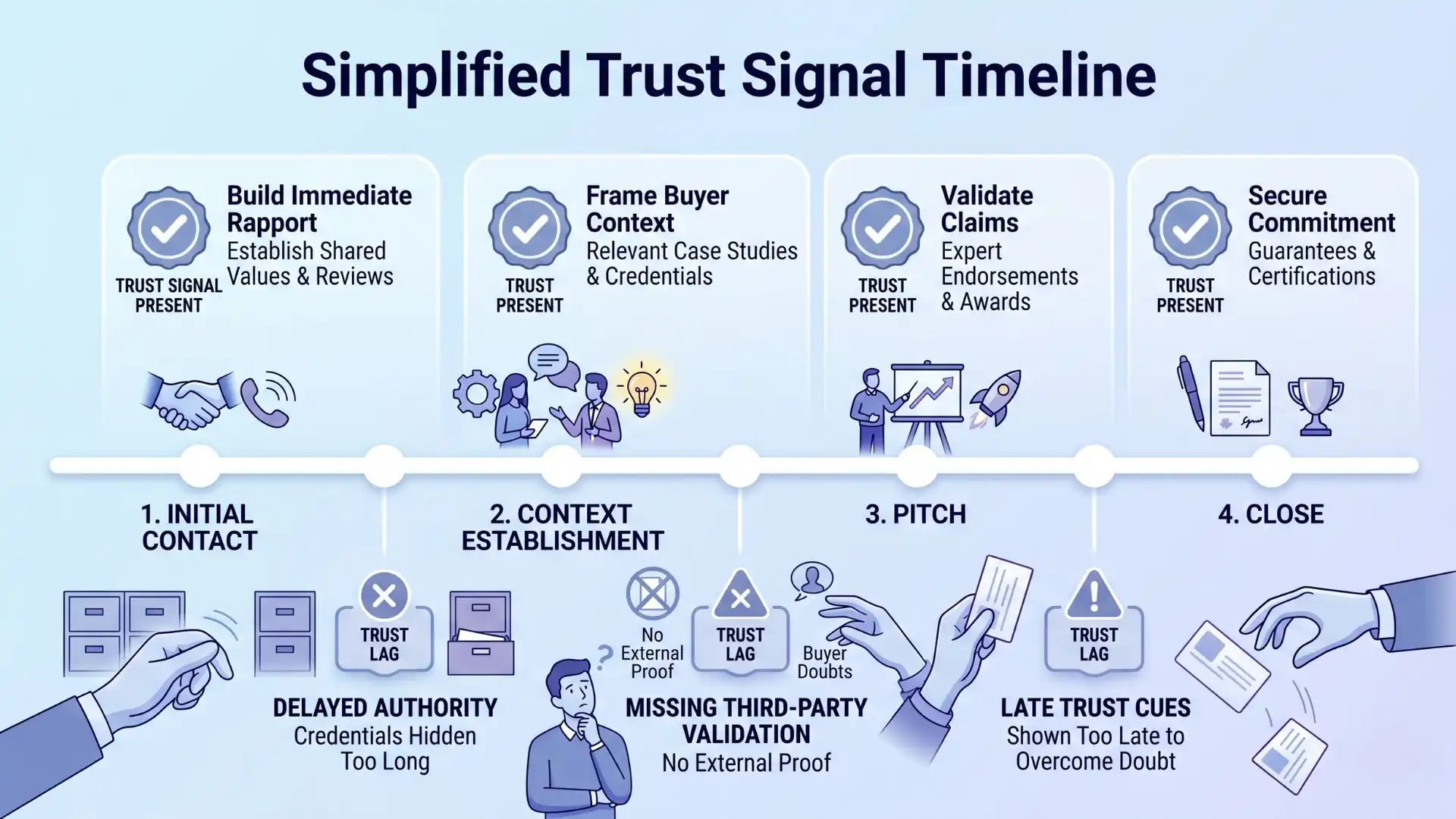
Too many teams treat trust as a closing tactic – rolling out customer proof or market leadership only after the initial pitch.
The result: buyers step into discovery calls already deep in comparison mode, searching for weaknesses to justify their safety net.
We’ve seen deal cycles stretch an extra quarter simply because trust cues were buried post-pitch, forcing buyers to gather their own ammo before feeling safe enough to choose.
Trust as a late-stage add-on won’t reverse the psychological momentum of comparison; it’s like sending the life raft after the ship’s already taken on water.
If your trust signals lag, you forfeit early clarity – that means comparison will drive the agenda before you ever get to tell your story.
The most persistent over-comparison problems hide upstream.
Miss the right trust cue in the first act, and buyers will spend the rest of the journey searching for reassurance elsewhere – often straight into your competitor’s arms.

How comparison behavior distorts strategic positioning decisions
Most execs assume every pipeline stuffed with options is a healthy sign of demand.
Here’s the twist: a cluttered pipeline is often a symptom of uncertainty, not market appetite.
When trust isn’t frontloaded in positioning, you aren’t opening a path to conversion – you’re inviting a parade of comparisons that choke your funnel, waste resources, and erode your advantage at every step.
From cluttered pipelines to friction-filled funnels
What actually happens when buyers enter the funnel with doubts?
They default to side-by-side evaluation, transforming your pipeline into a traffic jam of stalled deals and repetitive back-and-forth.
The irony: more leads chasing you doesn’t mean more revenue.
In our own client audits, funnels overwhelmed by overqualified “tire kickers” almost always trace back to fuzzy upfront trust signals and undifferentiated brand context.
Here’s the myth: volume fixes uncertainty.
In truth, comparison as doubt intensifies friction – sales teams burn cycles answering the same risk questions, while buyers struggle to distinguish anything except surface-level features.
One client faced a triple-length sales cycle after credibility was scheduled too late; every prospect demanded multiple demos just to reduce ambiguity.
Comparison is not just time-intensive; it actively filters out the best-fit deals by attracting those least ready to commit.
Comparison, here, is like trying to choose wine in a supermarket with generic labels – the effort rises, but confidence never follows.
How much of your team’s pipeline is real engagement versus manufactured busyness?
Why comparison undermines long-term choice clarity
Repeated comparison doesn’t just drag on sales – it erodes your positioning’s sharpness.
Each cycle buyers run through their spreadsheets, your solution becomes just another row in the matrix: safe, replaceable, and forgettable.
Even brands with a strong initial hook can end up blurred in the buyer’s memory if trust isn’t established up front.
We’ve seen entire verticals turn into low-margin bidding contests simply because no provider mastered the discipline of early credibility signals and trust-frontloaded positioning.
Here’s the overlooked effect: persistent comparison trains buyers to ignore your difference.
When your unique signals aren’t anchored early, buyers revert to price, broad features, or the most familiar logo.
Over time, your value narrative frays – making long-term loyalty and word-of-mouth nearly impossible.
Comparison as doubt doesn’t just slow down deals.
It breaks the trajectory of your brand in the market.
To reverse this drift, the next move is diagnosing where trust leaks begin – and rebuilding signal strength before your buyers ever reach the spreadsheet.

Next steps: Where to diagnose and strengthen trust timing
Diagnostic Framework for Strengthening Trust Timing
| Trust Gap | Description | Effect on Buyer Behavior |
| Familiarity Gap | Brand isn’t recognizable or doesn’t provide contextual anchors at first encounter. | Buyers default to side-by-side charts as cognitive air bags due to lack of immediate credibility. |
| Timing Gap | Trust signals and credibility proof arrive too late in the buyer journey. | Buyers enter discovery and decision stages in comparison mode, extending sales cycles and increasing deal friction. |
Most growth teams overcomplicate sales audits, searching for hidden objections or messaging tweaks – when the true problem sits upstream: buyers never felt safe enough, early enough, to stop comparing.
The strongest position isn’t having the best answer, it’s being seen as the lowest-risk option the moment a prospect first encounters your name.
How do you surface and close trust gaps before competition even enters the mental shortlist?
Assess your context visibility before engagement
The invisible win isn’t a better demo – it happens before buyers ever reach your pitch.
In every campaign BiViSee rescues, we flag the same early warning: if prospects don’t see credible signals in their trusted networks, comparison reflex activates on autopilot.
Imagine walking into a boardroom where everyone reads the same trade publication – if your brand is absent from those spaces, you lose share of trust before the conversation begins.
One executive client was convinced reworking their deck would cut sales cycles.
The real leverage came from embedding credibility triggers directly into community content and niche forums where their audience sought advice.
Their pipeline shifted from skeptical shortlist reviews to quicker, more confident yeses.
The analogy: don’t just show up for the game – warm up in view of the crowd that matters.
Is your brand top-of-mind in the right context, or do buyers only uncover you during forced vendor searches?
If the answer feels uncertain, start there before refining anything downstream.
Shift trust signals ahead of the pitch
Teams love polishing value props and chasing story polish – but these efforts pay far less than re-sequencing how and when trust is established.
In our work remapping funnel conversion for startup SaaS, we’ve repeatedly seen a pattern: simply moving proof, authority mentions, and customer voice to appear before (not after) the main offer slashes comparison time and friction.
Treat trust like scaffolding, not decoration: it should hold up your positioning from the first interaction, not decorate the close.
If your narrative delivers reassurance only after the fact, you’re asking buyers to accept risk alone.
Ask: Are your credibility triggers embedded in early touchpoints – industry events, analyst briefings, customer-powered intros – or do they arrive as section slides deep in the pitch?
Inconsistent trust emerges as delayed trust, and delayed trust guarantees side-by-side spreadsheets.
Teams who frontload credibility reframe the whole experience – their offer becomes the default, not just another option.
The clearest symptom you’ve succeeded: prospects stop comparing because, by the time the conversation starts, the decision already feels safe.
Trust that arrives early eliminates the need for comparison.
For leadership, the next step is brutally simple: audit every phase before the pitch and build trust where risk first appears.
That’s the shortcut to fewer questions, faster deals, and ownership of the market’s mindshare.
That same burden-shifting dynamic is central in Delayed Trust Shifts Burden Onto Sales.

Scientific context and sources
The sources below provide foundational context for how decision-making, attention, and performance dynamics evolve under scaling and constraint conditions.
- The Cognitive Foundations of Trust in B2B Relationships
An Examination of the Nature of Trust in Buyer-Seller Relationships – Doney, P.M., Cannon, J.P. – Journal of Marketing
This landmark study identifies the cognitive mechanisms through which industrial buyers develop trust in suppliers, directly supporting the importance of early trust signals in B2B positioning.
https://journals.sagepub.com/doi/10.1177/002224299706100203 - Uncertainty, Social Comparison, and Information Seeking
A Theory of Social Comparison Processes – Festinger, L. – Human Relations
This foundational research explains that under uncertainty, people seek comparison cues from others to evaluate judgments and decisions, directly supporting the idea that comparison behavior often signals unresolved doubt.
https://doi.org/10.1177/001872675400700202 - Heuristics Under Uncertainty
Judgment Under Uncertainty: Heuristics and Biases – Kahneman, D., Slovic, P., Tversky, A. – Cambridge University Press
This seminal work explains how people make decisions when information is incomplete, relying on heuristics rather than exhaustive analysis – directly relevant to trust formation and comparison-driven decision behavior.
https://www.cambridge.org/core/books/judgment-under-uncertainty/6F9E814794E08EC43D426E480A4B412C - The Psychological Safety-Performance Relationship
Psychological Safety and Learning Behavior in Work Teams – Edmondson, A. – Administrative Science Quarterly
This influential empirical study shows that psychological safety reduces defensive behavior and improves collaborative performance, supporting the broader principle that trust lowers risk-avoidant evaluation behavior.
https://doi.org/10.2307/2666999 - The Mere Exposure Effect
Attitudinal Effects of Mere Exposure – Zajonc, R.B. – Journal of Personality and Social Psychology
This classic study demonstrates that repeated exposure alone increases familiarity and positive affect, supporting the idea that early brand recognition can increase trust before explicit evaluation.
https://psycnet.apa.org/doi/10.1037/h0025848
Questions You Might Ponder
Why do buyers rely on comparison charts in B2B purchasing?
Buyers often use comparison charts not only to evaluate features but as a fast way to cope with uncertainty and lack of trust. This behavior reflects a need for psychological safety when brand credibility or familiarity is missing early in the buying process.
How can brands reduce over-comparison by prospects?
Brands can reduce over-comparison by establishing trust signals – like customer proof, industry recognition, or authority mentions – early in the buyer’s journey. Immediate credibility enables buyers to feel secure, decreasing the need for exhaustive, risk-driven comparisons.
What does “comparison as doubt” mean in sales and marketing?
“Comparison as doubt” describes when side-by-side evaluation is a defense mechanism against risk, not just rational diligence. It indicates buyers haven’t received enough initial trust cues, making comparison a shortcut to reduce anxiety rather than confirm preference.
How does weak brand positioning increase deal friction?
Weak or generic brand positioning causes buyers to default to comparison, stalling sales cycles and inflating back-and-forth. Without differentiation or upfront credibility, buyers become spreadsheet-driven “tire kickers”, slowing conversion and draining sales resources.
What early trust signals most effectively prevent over-comparison?
The most effective early trust signals are relevant partner logos, recognizable customer examples, and visible presence in industry forums. These cues build psychological safety, making your offer feel familiar and secure before buyers feel the need to compare.