
What You’ll Learn
Sales burden from poor positioning is the extra persuasion work sales teams must do when a brand’s positioning fails to build trust, differentiation, and buyer confidence before the first conversation.
It appears as longer sales cycles, repeated “why you?” questions, more demo and reference requests, stalled deals, frequent discounting, and high effort spent clearing confusion instead of deepening buyer insight.
This burden is not mainly a sales execution problem.
It is a positioning failure where credibility arrives too late and reps must compensate for unclear value, weak differentiation, or unresolved buyer risk.
Strong positioning reduces sales strain by making trust visible earlier.
Key Takeaways
- Sales burden from poor brand positioning occurs when unclear messaging forces reps to build trust during every buyer conversation, slowing sales cycles.
- High “persuasion load” and repeated price objections indicate a breakdown in brand differentiation, not simply weak sales execution.
- Stalled deals, ongoing discount requests, and decision inertia are key symptoms that trust is being built too late due to positioning failures.
- Addressing sales burden from poor positioning requires structural brand realignment and risk reframing – not just enhanced sales training or scripts.
Most executives assume sales struggles are tactical – more training, better scripts, or new incentives.
The hidden drag often isn’t sales execution at all.
It’s trust, delayed and deferred by weak or ambiguous brand positioning, quietly loading extra weight onto every sales conversation.

Why unclear positioning forces sales to carry trust
The uncomfortable truth: When buyers can’t answer “why you?” before your team even enters the call, sales must build confidence from scratch.
This nearly invisible transfer of credibility is the root cause of long sales cycles, price haggling, and chronic deal friction.
Every rep becomes a substitute for a message that should have built trust in advance.
How delayed trust increases friction and comparison
Think of your positioning as the signal buyers use to sort and shortlist.
If that signal is vague, buyers don’t eliminate alternatives – they add them.
The result?
More meetings, extra decision-makers, longer evaluation windows, and rampant “let us compare your proposal” delays.
The absence of front‑loaded trust means prospects hedge their bets, not wanting to risk a mistake.
We see this repeat with clients who have a generalized brand promise.
Instead of drawing in pre-qualified, conviction-driven buyers, they encounter customers who behave like cautious tourists – scanning, scrutinizing, and hesitating.
One B2B SaaS firm watched deal velocity drop 30% after a website relaunch that softened their value claims, even though site traffic increased.
Impact of Delayed Trust on Buyer Behavior and Sales Friction
| Marker | Signs of Unresolved Doubt | Signs of Sales Execution Gaps | Implications |
| Deal Cycle Length | Deals stuck in evaluation with repeated objections | Deals stuck due to missed follow-ups or weak closing | Unresolved doubt requires repositioning; execution needs coaching |
| Buyer Questions | “Why you?” and repeated safety concerns after multiple calls | Few objections or questions, mostly behavioral | Doubt needs messaging; execution needs skill improvement |
| References/Demos | Frequent requests for additional demos and testimonials | Requests aligned with product complexity or new features | Doubt signals weak positioning; execution signals training gaps |
| Sales Load | Sales spending effort clearing confusion and skepticism | Sales focusing on relationship-building and insight deepening | High persuasion load points to positioning breakdown |
| Discount Usage | Discounts used as bandaids for doubts | Discounts used strategically | Overuse signals lack of perceived differentiation |
You can spot delayed trust in the frequency of questions like, “What makes you different?” and “Can you send references?” It’s a symptom that your positioning hasn’t earned the benefit of the doubt.
Like a store with no reviews and generic signage, you invite walk-bys, not loyal buyers.
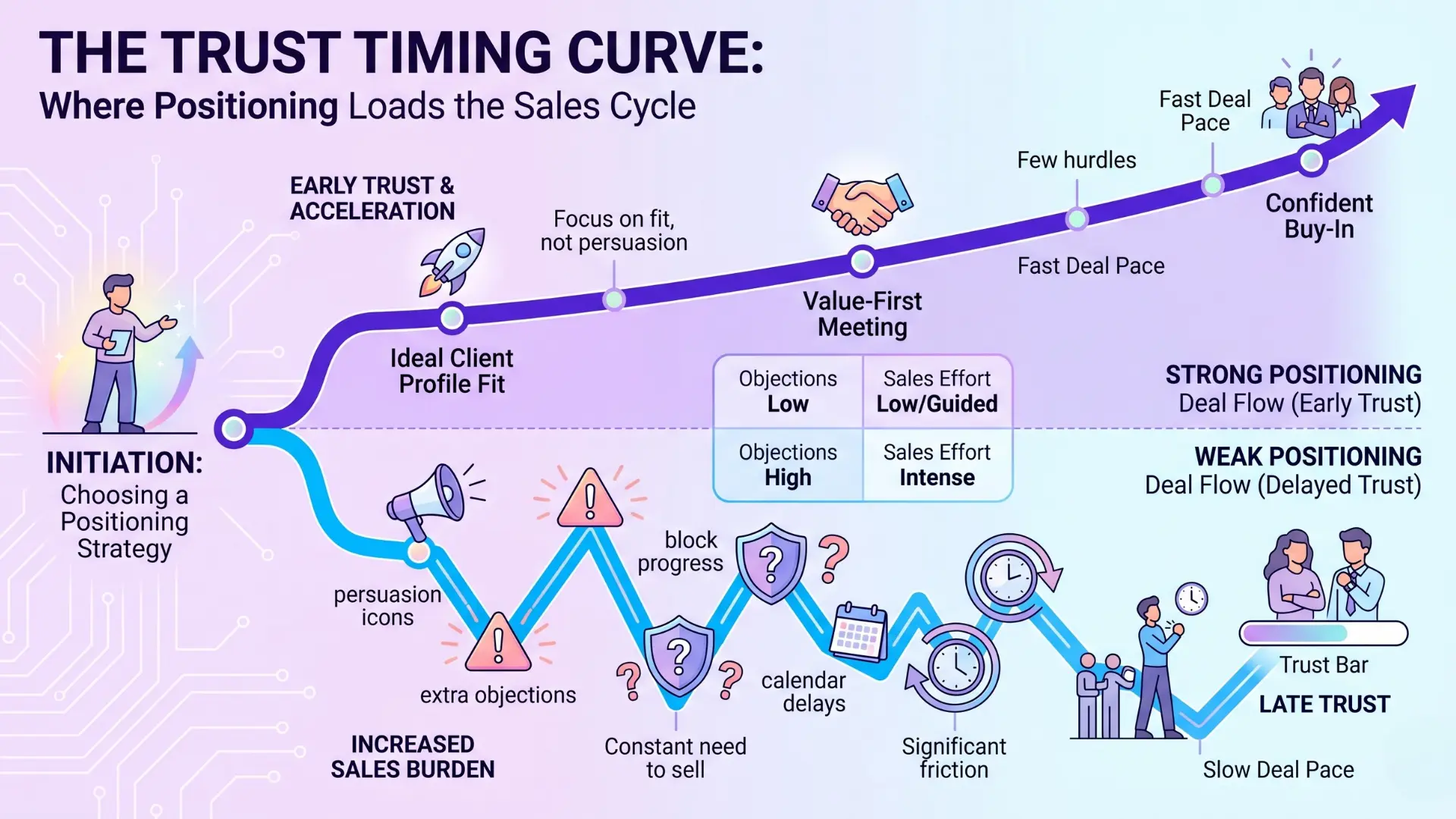
Why ‘persuasion load’ signals a positioning breakdown
If your salespeople sound more like convincing advocates than confident guides, it isn’t about charisma.
It’s a signal the positioning never settled core doubts.
This persuasion load – a constant need to justify, explain, and overcome skepticism – tracks directly to a failure to front-load trust and differentiation.
Persuasion load is the cumulative sales effort required to compensate for credibility not front-loaded by positioning.
We tell clients: any pattern of deals repeatedly hinging on custom demos, testimonies, or “one more call to persuade” means your messaging didn’t do the heavy lifting.
Sales persuasion load is diagnostic positioning in action – each extra round of convincing is the friction of unresolved value.
Just as a bridge with missing pillars dumps stress onto the remaining supports, weak positioning forces sales to absorb every doubt directly.
So ask yourself – does your team spend their energy on relationship-building and deepening insight, or just clearing confusion and doubt?
The answer reveals if you’re paying the hidden tax of sales burden from poor positioning.
Trust, when delayed, magnifies cost and time everywhere else.
Until credibility moves forward in your buyer’s journey, sales remains the fallback.
Move it up, and you trade exhaustion for acceleration.

What outcomes signal positioning is draining sales capacity
Imagine reviewing your pipeline and realizing most deals age out before you ever get to “yes” or “no”.
This is not a sign that your sales team needs more polish – it’s the fingerprint of a positioning breakdown.
The moment prospects pause, compare, or disappear mid-cycle, your brand has failed to answer the core question: “Why should I trust you – right now?”
Longer cycles and stalled deals as positioning red flags
With executive teams, we often see the earliest red flag in sales: deals that linger for months, marked not by a big loss, but by silence and serial delays.
Instead of swift resolution, you get a hall of mirrors – more stakeholders, more revisits, vague ‘timing’ objections.
The underlying pattern?
Decision-stage hesitation that traces directly to weak positioning, not sales process.
When this inertia surfaces, trust wasn’t earned early enough to prevent comparison cycles or repeated dropout.
A repeatedly stuck deal is rarely about missing follow-ups or outdated playbooks.
It’s about your value proposition not compounding trust early enough.
Sometimes, the first clue appears as endless requests for references or “one last demo”.
Not coincidentally, clients who fix positioning almost always report faster decisions and fewer ghosted opportunities within a quarter.
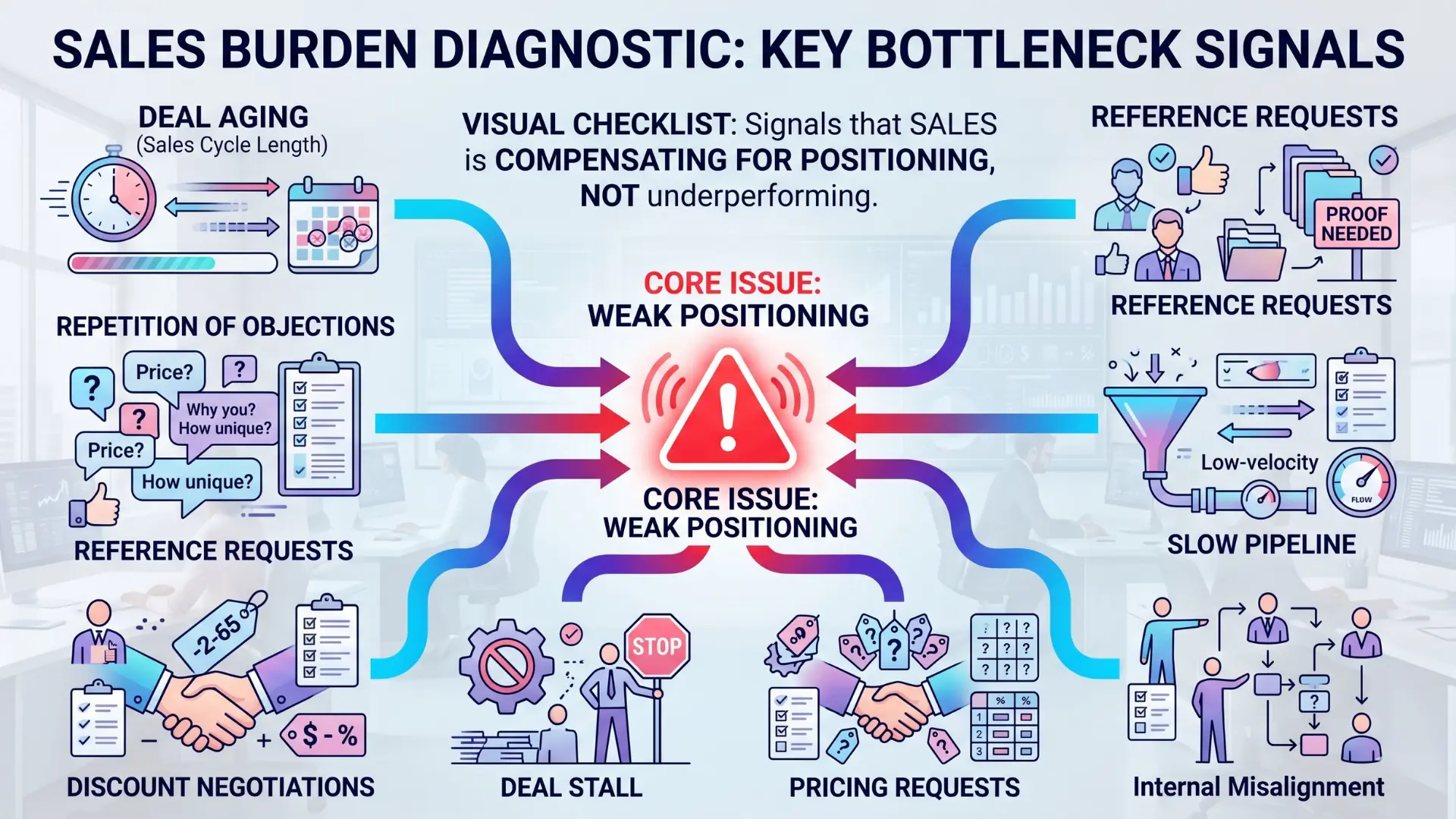
When price objections reveal absent structural differentiation
If your team hears, “Can you go lower?” more often than “How are you different?” price isn’t your actual problem.
It’s a symptom of missing differentiation – proof that buyers see your offer as a commodity.
We’ve seen teams forced into perpetual discounting simply because their pre-sales materials read like everyone else’s, making the safest path for a buyer negotiation on cost.
An analogy: weak positioning is like selling bottled water in a sea of clear bottles.
Only when you establish unique value before the price conversation does negotiation become about outcomes, not discounts.
Price pressure, recurring again and again, is a signal to leadership: you’re not losing on value delivered, but on value perceived.
When these symptoms cluster – elongated cycles, stalled deals, relentless price pushback – it’s not sales that needs fixing.
The real leverage is recapturing trust through sharper, earlier positioning.

How to assess whether sales strain is a symptom, not the root problem
Most sales performance reviews zoom in on rep behaviors: more calls, tighter follow-up, better closing lines.
But what if the real drag isn’t at the rep level at all?
When teams fixate on sales execution, they often overlook the silent, systemic drain: sales burden from poor positioning.
The difference between a rep who stumbles over objections and one who drives confident, short cycles is rarely training alone – it’s whether trust arrives before the first conversation or must be sweat for, line by line.
Markers of unresolved doubt vs execution gaps
Diagnostic Markers: Unresolved Doubt vs Sales Execution Problems
| Aspect | Expected Buyer Behavior with Clear Positioning | Buyer Behavior with Delayed Trust | Sales Consequences |
| Buyer Signal | Clear reasons to choose early | Vague or missing differentiation | Longer sales cycles, uncertain buyers |
| Buyer Behavior | Shortlists with conviction | Adds more alternatives, cautious evaluation | More meetings, more stakeholders involved |
| Deal Velocity | Fast and decisive | Slow, stalls mid-cycle | Deal velocity drops (e.g., -30%) |
| Common Buyer Requests | Minimal references needed | “What makes you different?” or “Send references” | Increased friction, distrust |
| Sales Role | Guide with confidence | Must build trust from scratch | Added persuasion load, exhaustion |
Here’s the myth: longer deal cycles always mean sales needs more grit or urgency.
But when buyers revisit the same basic questions – “Why you?
What makes this safe for me?” – after multiple calls, you’re seeing hesitancy that rep technique won’t fix.
At BiViSee, we’ve watched well-coached teams burn out against the same objections not because their demos faltered, but because buyers remain unconvinced by anything except new discounts or guarantees.
Compare this to reps who rarely get asked for references or deep explainer decks – their calls run on pre-formed trust, not persuasion acrobatics.
The analogy: it’s like asking runners to sprint with weights strapped to them – the strain isn’t their form, it’s what’s weighing them down.
The telltale signs?
Deals stuck in evaluation mode despite interest signals.
Multiple stakeholders requesting yet another round of justification.
Discounts leveraged as bandaids, not differentiators.
Leaders may see the churn and coach for hustle, but unless the ambient doubts are cleared upfront, process tweaks only treat the symptoms, not the disease.
Evaluating decision momentum built into positioning
Strong positioning acts like a tailwind: the decision builds velocity instead of dragging.
One reliable indicator is the speed with which buyers move from initial engagement to meaningful next steps without repeated reassurance.
At BiViSee, we track the percentage of prospects who self-qualify their fit or punctuate early calls with, “This is exactly the risk we’re trying to solve”.
When positioning is clear, buyers advance proactively; when it’s weak, every stage requires new persuasion.
What metrics matter?
Watch for low dropoff after the first meeting, minimal requests for more proof, and fast consensus among buyer teams.
Notice when your sales team is fielding fewer repeat objections and closing follow-up loops in fewer touches.
If trust accelerates, your positioning is doing the job before sales even enters.
But if every deal feels like a rescue mission, the issue runs deeper than sales tactics.
The core idea: Persistent sales strain points to a positioning failure when trust is earned late and sellers must act as ongoing validators.
Diagnose the root, and you lighten the load – revealing the path to more decisive, self-propelled deals.

When repositioning reduces sales strain, not just messaging revision
Most leaders assume improving sales outcomes means editing the pitch – not tearing up the foundations.
Yet, the difference between exhausted sellers and teams who spend their calls confirming, not convincing, is rarely a better script.
It’s a repositioned frame – one that shifts the entire trust equation before the first conversation.
If you’re still seeing sales teams scramble for credibility late in the cycle, you’re not just overdue for clearer messaging; you’re missing a structural change in how buyers experience risk.
Reframing buyer risk to shift trust forward
Imagine walking a tightrope – but discovering the net is actually under your prospect, not you.
That’s the gap true positioning fixes: moving risk out of your sales team’s hands and resolving it, visibly, before the live pitch.
We see client after client invest in incremental messaging tweaks, only to find nothing meaningful shifts until they attack the buyer’s hidden fears head-on – will your solution fail them, cost status, or create regret in front of peers?
One enterprise software group we worked with went from constant pricing fights to full‑price deal wins, and the turning point wasn’t a killer case study or new sales deck.
It was reframing the engagement around risk transfer: “Here’s how you get certainty – at our expense”.
The friction vanished, and so did endless cycles of buyer hesitation.
Real positioning neutralizes risk before the prospect ever asks, “But what if this doesn’t work for us?”
If your sales cycle feels like an endless negotiation, ask: what fear are you leaving unanswered?
Attack it directly, and you’ll see trust accelerate before your team even joins the call.
Relying on reps to paper over buyer anxiety isn’t just inefficient.
It drains your sales capacity – and leaves your best competitors with an open door.
Aligning message, market, and validation for instant credibility
Positioning isn’t the headline.
It’s the harmony between what buyers see, hear, and believe – across every channel and every contact.
The most trusted brands build an expectation of success before a word is spoken by sales.
Validation isn’t bolted on post-demo; it’s everywhere the buyer looks, signaling, “Others like you believed, and succeeded”.
In practice, we’ve watched mature go-to-markets sync proof points, market focus, and messaging so tightly that prospects rarely ask for extra references.
By contrast, disjointed positioning invites scrutiny: buyers pick at inconsistencies, and sales feels pressure to over-prove.
Picture a relay race – if your story hands the baton directly to decision assurance, your competition can’t catch up.
If executives want deals that race, not slog, remove obstacles to instant credibility.
That starts upstream: clear market focus, supported by visible third-party proof, and reinforced by messaging that resonates at every interaction.
When this alignment clicks, sales conversations shift from persuasion to validation – and the whole team feels the strain lift.
The difference is night and day.
Positioning that reduces sales burden isn’t a cosmetic message tweak; it’s a full-frame shift that makes trust automatic, risk obvious, and the buying decision near-inevitable.
For ambitious teams, anything less is just training harder for the wrong race.

Scientific context and sources
The sources below provide foundational context for how decision-making, attention, and performance dynamics evolve under scaling and constraint conditions.
- Decision Dynamics Under Uncertainty
Trust and Distrust in Organizations: Emerging Perspectives, Enduring Questions – Roderick M. Kramer – Annual Review of Psychology
This authoritative review explains how uncertainty shapes trust formation and distrust in organizational relationships, directly supporting the idea that unclear positioning increases friction and decision burden.
https://doi.org/10.1146/annurev.psych.50.1.569 - Buyer Perception and Signal Theory
Job Market Signaling – Michael Spence – Quarterly Journal of Economics
This Nobel Prize-winning foundational paper explains how signals reduce information asymmetry under uncertainty, directly supporting the idea that weak positioning creates signal failure and slower buyer decisions.
https://doi.org/10.2307/1882010 - Framing, Persuasion, and Cognitive Load
Cognitive Load Theory: Implications for Learning, Teaching, and Design – John Sweller – Educational Psychology Review
This research explains how excessive cognitive demands reduce processing effectiveness, directly supporting the argument that over-explaining or delayed trust increases mental friction in decision-making.
https://link.springer.com/book/10.1007/978-1-4419-8126-4 - Differentiation and Competitive Advantage
Competitive Advantage: Creating and Sustaining Superior Performance – Michael E. Porter – Free Press
This foundational strategy book explains why meaningful differentiation reduces competitive pressure and price sensitivity, supporting the argument that clear positioning lowers downstream sales friction.
https://www.hbs.edu/faculty/Pages/item.aspx?num=193 - Organizational Bottlenecks and System Constraints
The Goal: A Process of Ongoing Improvement – Eliyahu M. Goldratt, Jeff Cox – North River Press
This influential operations management book explains how upstream constraints create downstream performance bottlenecks, directly supporting the idea that weak positioning burdens later sales execution.
https://books.google.pl/books/about/The_Goal.html?id=6vdJLwEACAAJ&redir_esc=y
Questions You Might Ponder
How does unclear brand positioning increase the sales burden?
Unclear positioning forces sales teams to build credibility from scratch in every conversation. When buyers can’t quickly distinguish your value, sales must handle trust-building, slowing cycles and increasing deal friction, rather than focusing on solution alignment or relationship depth.
What does “persuasion load” mean in sales?
Persuasion load refers to the extra effort sales reps expend to convince skeptical buyers due to insufficient trust front-loaded by positioning. High persuasion load signals a positioning shortfall, not a rep skill gap, leading to longer cycles and more objections.
How can you identify if sales problems stem from poor positioning versus sales execution?
If sales teams repeatedly face the same fundamental questions or discount pressures, or if deals stall despite process improvements, the root issue is likely poor positioning, not execution. Execution gaps show as missed steps; positioning gaps show as chronic buyer hesitation.
Why do deals stall or lengthen when brand positioning is weak?
When positioning is ambiguous, buyers lack confidence and add more options for comparison. This triggers longer evaluation cycles, more stakeholder involvement, and frequent requests for more proof, stalling deal progress and reducing decision momentum.
What metrics reveal that positioning, not sales, is the bottleneck?
Look for high early-stage drop-off, repeated discounting requests, frequent reference checks, and slow decision velocity despite strong sales activity. These metrics signal trust is earned late, so sales must compensate for weak upstream positioning.