
What You’ll Learn
Positioning filters demand means a brand’s positioning acts as a pre-qualification system that attracts high-fit buyers while discouraging low-fit prospects before they enter the funnel.
Instead of maximizing lead volume, strong positioning clarifies who the offer is for, what problem it solves, what it does not serve, and why the right buyers should trust it.
This reduces misfit demand, shortens qualification, improves lead quality, lowers sales friction, and increases pipeline confidence.
When positioning is broad, vague, or inconsistent, it generates noise: more inquiries, but fewer qualified opportunities and slower decisions.
Key Takeaways
- High-fit positioning filters demand by attracting only qualified leads, reducing sales friction and resource waste.
- Broad, generic messaging increases pipeline volume but leads to lower conversion due to misfit prospects and diluted clarity.
- Effective positioning signals both fit and non-fit, accelerating trust and improving downstream business confidence and conversion rates.
- Persistent misfit in pipeline signals deeper capability or alignment issues that require structural, not just messaging, diagnostics.
Most companies reward their teams for top-of-funnel spike – yet the most damaging pipeline bloat starts with a single phrase: “Let’s not exclude anyone”.
In chasing maximum reach, brand positioning gets diluted into vague, catchall language.
This doesn’t just increase lead count; it actually impairs your ability to recognize fit at all.

Why positioning filters demand instead of expanding volume
Here’s the myth worth busting: more leads don’t equate to better opportunities.
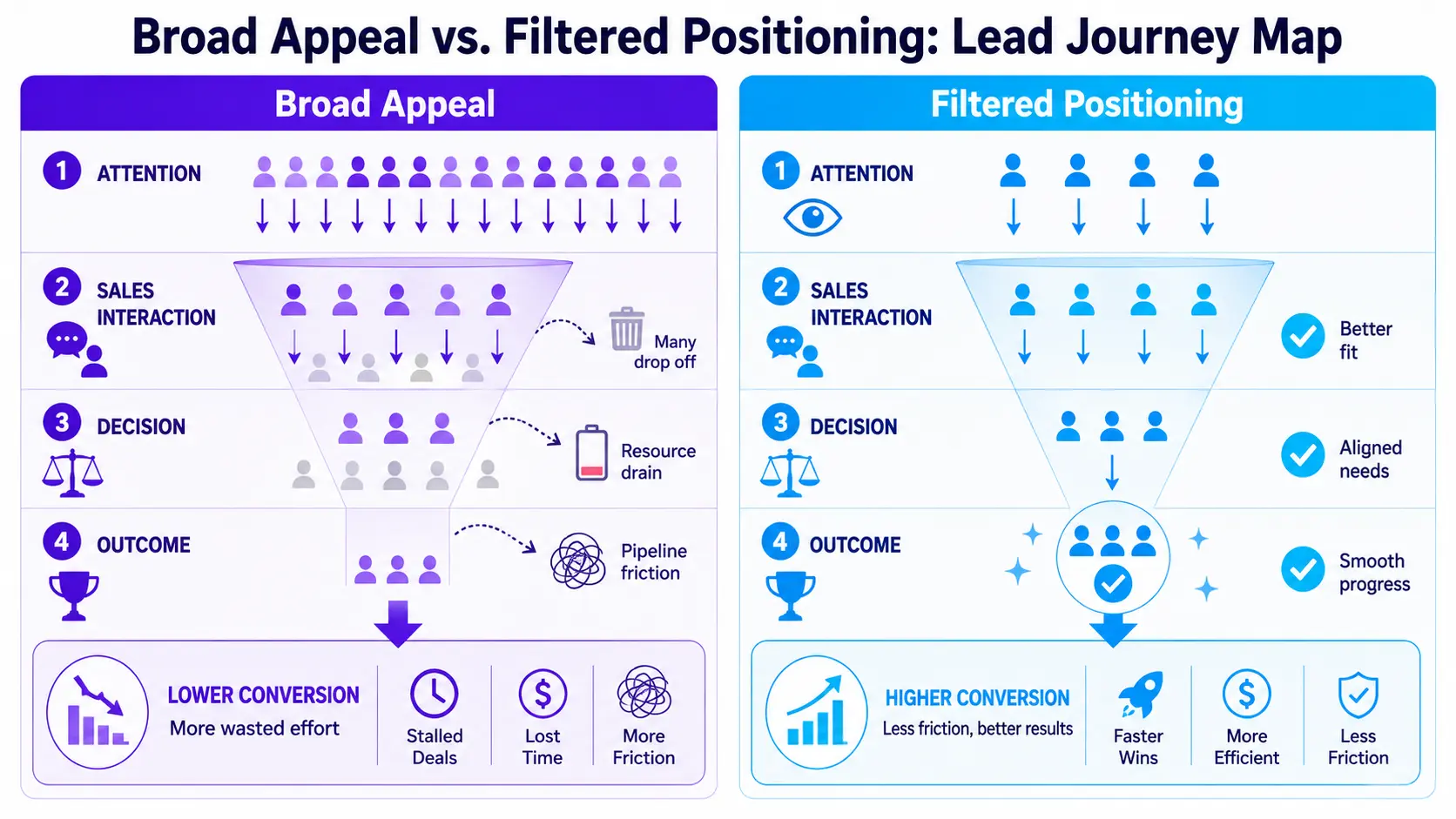
The dynamic is clear – generic messaging attracts volume, but also attracts those who will churn, dither, or hijack your sales team’s time.
In practice, we’ve seen firms struggle to explain why their pipelines are full of “interest” but conversion rates collapse.
One SaaS provider shared that less than 30% of their leads progressed past initial qualification after broadening messaging.
The hidden cause?
Most prospects didn’t understand what specific problem they solved, and simply disqualified themselves later – or worse, after draining internal resources.
How broad appeal invites mis‑aligned prospects
Think of your positioning like a magnet: set it too weak, and you gather every loose fragment – most of which won’t ever stick.
The excess isn’t neutral; it clouds pipeline visibility, raises sales cycle friction, and distracts teams from higher-value work.
Do you really want to optimize for attention, or for traction?
Comparison of Broad Appeal vs. Filtered Positioning Outcomes
| Symptom | Possible Cause | Recommended Focus Area |
| Qualification criteria mismatch forces excess discovery | Ambiguous ICP boundaries | Clarify ideal customer profile |
| Marketing hands over disqualified leads | Fragmented or inconsistent messaging | Align messaging across channels |
| Sales and marketing work at cross-purposes | Lack of channel enablement and internal alignment | Enhance cross-team coordination and enablement |
| Frequent debate over fit within funnel | Unclear filter criteria and trust triggers | Define and communicate clear filter rules |
Why clarity that excludes accelerates trust
Giving up on broad appeal feels risky.
But a positioning statement sharp enough to repel a bad-fit client is the same signal that wins confidence with the right ones – and this is the detail most overlook.
We’ve watched prospects thank our clients for clear messaging that “helped make my decision easy – even if I wasn’t the fit”.
That relief is trust, born from clarity.
You can’t separate trust and exclusion: they are two sides of the same filter.
Clarity up front screens out those you can’t deliver value to, reducing time wasted in qualification calls and eliminating pipeline theater.
It’s not about being aloof – it’s an intentional signal.
Every “no” gifted by a filtering message is a resource returned to your business.
Trust grows faster when your positioning disqualifies as visibly as it attracts.
Are your best-fit clients finding you and closing faster, or are your teams spending cycles debating if a lead is worth the second call?
The right positioning should make the answer automatic.
Exclude to clarify, and you upgrade confidence – on both sides.
Now, the real growth begins.

What high‑fit positioning avoids that generic messaging misses
Executives often focus on messaging tweaks when pipelines are overflowing – but the root problem is subtler.
Generic messaging and broad branding don’t filter; they crowd the funnel with false positives and hide real fit, leaving high-value leads buried in noise.
Positioning filters demand; messaging attracts attention.
The difference is not academic.
High-fit positioning serves as your team’s silent gatekeeper, pre-qualifying prospects before a word is even spoken.
In our work, the highest performing teams stopped tweaking taglines and started making bold claims that some buyers would instantly know weren’t for them.
The result: better-qualified first meetings, faster sales cycles, and less pressure downstream.
It’s like switching from a hotel reservation system that lets anyone pick any room, to one coded to only display available suites for VIP loyalty members – volume drops, but occupancy and satisfaction rates soar.
When identical claims collapse credibility under scrutiny
Everyone can spot the copy-paste approach: “Market leader. Unique value. Fast results”.
When claims differ only in word order, executives wonder: What’s real here?
The failure isn’t just bland messaging – it’s the collapse of filter logic.
When three companies echo each other with identical promises, best-fit buyers sense the game and start interrogating for missing proof.
We’ve watched high-caliber prospects leave after a single call, citing a lack of hard evidence or any point of real differentiation.
It’s not skepticism – they’re filtering you.
Cosmetic differentiation feels safe, but under scrutiny, it turns invisible.
If your strongest pitch sounds interchangeable in another firm’s deck, your filter is broken long before your funnel is.
Why inconsistent channel or salesperson positioning deepens friction
One overlooked friction point: your filter vanishes the moment positioning varies by channel or rep.
A campaign headline sets an expectation, but a salesperson with a different angle or a mismatched landing page creates instant static.
The result?
The wrong-fit lead lingers, the right-fit one questions your alignment, and trust debt sets in.
We’ve seen teams burn weeks debating “what’s really true for us”, as every channel or team improvises.
It’s like engineers in a relay race handing off batons shaped differently in every leg – nobody gets a clean grip, and momentum stalls.
The first sign isn’t always lost deals; sometimes it’s the costly drag as every touchpoint re-interprets the value.
When positioning works as a true filter, messaging and channel execution sync automatically, and every claim helps prospects opt in – or out – confidently.
That’s the difference executives can feel (and measure) before revenue even hits the board.

How to judge if your positioning is actually filtering demand, not generating noise
Most companies celebrate a packed pipeline – until they realize the volume is masking waste.
Here’s what almost no one talks about: attention spikes are meaningless if your positioning isn’t filtering demand at the source.
Noise looks like momentum on a dashboard, but it chokes execution where it counts.
Are you watching the right signals, or letting misfit leads drain confidence and margins?
Key indicators of misfit: early signals in interest quality
If your contact form is filling up but your sales team sounds exhausted, you have a filtering problem masquerading as market validation.
Early-stage misfit shows up through wrong-stage leads, slow or unclear qualification steps, and repeated patterns of “almost right, but not quite”.
One mid-market SaaS client sifted through a month of demo requests only to find 80% were unqualified – most hadn’t even reached basic readiness.
Qualification rates reveal more than weekly metrics.
When positioning acts as pre‑qualification, quality of inquiry actually improves as volume drops.
Notice how cycles get shorter when your language rules out wrong-fit interest.
If your team spends more time debating if a lead is worth the squeeze, that’s a misfit lead cause rooted in vague positioning – not pipeline health.
Watch for delay patterns: qualified prospects move forward decisively, unqualified ones ghost or stall.
The fastest way to spot noise?
Track the number of opportunities that skip steps or immediately trigger pricing pressure.
It’s like using tinted glasses – if everything looks like an opportunity, neither your team nor your prospects know when to say no.
Filtering demand doesn’t mean minimizing volume; it means the clarity excludes low‑fit leads before distractions can compound downstream.
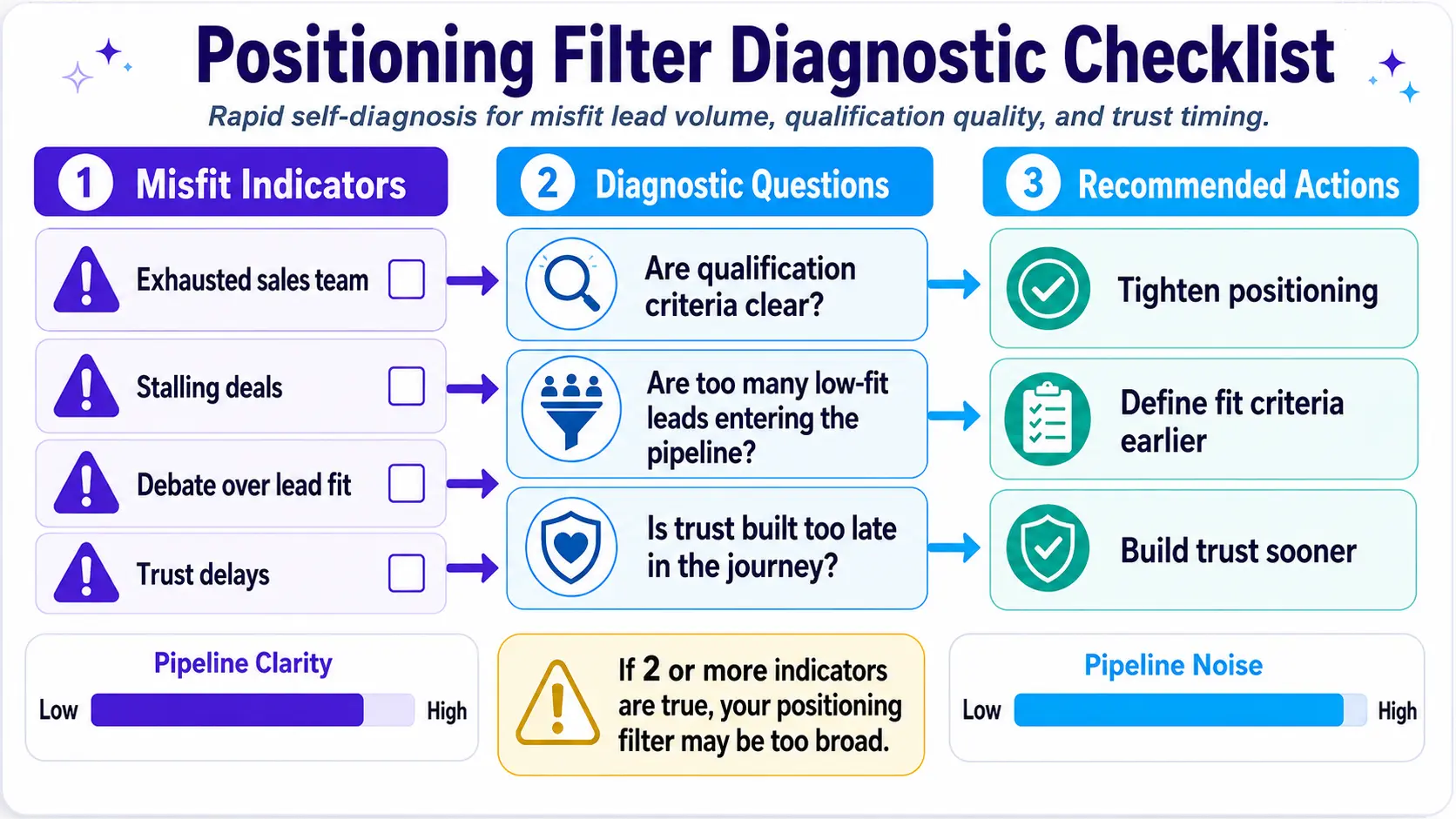
Decision-level criteria: what to compare when positioning fails
When volume surges but conversion doesn’t, pose three questions: Does our demand have fit clarity?
Do misfit leads cost us time or just ego?
When does trust actually begin – initial inquiry or after weeks of qualification friction?
True positioning as pre‑qualification answers these before the first sales call.
If you compare conversion rates alone, you’ll miss how long your team spends on fit checks or rescues downstream.
Calculate the % of leads requiring custom workarounds.
Does your pipeline contain warning signs like stalled deals or cycles dominated by negotiation, not value?
Trust timing is the diagnostic lever: if your positioning filters demand effectively, trust begins at the boundary, not after a filtering process.
A simple analogy: think of positioning as airport security – done right, only the intended travelers make it past the gate, and everyone relaxes because the wrong bags aren’t even on the carousel.
The clearest signal your filter is working?
Pipeline confidence rises even as volume becomes sharper.
If your sales team sees more clarity than chaos, your positioning filter is functional.
If every win feels like a struggle and every lead is a surprise, it’s back to noise – not demand.
Forward momentum comes from recognizing the difference, acting on the right signals, and refusing to settle for activity masking as progress.

When positioning as a filter is strongest: next‑step decisions
Most companies treat misfit leads like a traffic issue – the reflex is to push for more volume or tweak campaigns.
The real inflection point?
Recognizing that persistent pattern mismatch signals a deeper problem with how (not just what) you qualify upfront.
If your best-fit prospects seem invisible while misfits cluster at the top, your filter isn’t broken by chance – it’s revealing a hidden gap that surface-level tweaks won’t fix.
Which positioning failure needs a deeper capability diagnostic
One pattern we see among B2B growth clients: after tightening their messaging, teams still face odd prospect mismatches or late-stage dropoffs.
The assumption is often, “Our targeting’s off”.
In reality, it’s usually a structural gap – something about the core offer, value narrative, or internal alignment is out of sync with the external promise.
Imagine a water filter designed to catch rocks, but sand keeps slipping through.
Adjusting the flow won’t solve it; you need a different filter.
The myth: every misfit lead means your targeting is wrong.
But most chronic mismatch signals that your value articulation or sales enablement cadence needs a capability-level diagnostic – are you consistently signaling what you are not, as much as what you are?
Executive teams often skip this check, blaming campaigns instead of addressing the underlying calibration around trust, pricing power, or solution narrative.
Start here when you notice a pattern: churn in later funnel stages, repeated objections around relevance, or sales cycles where “they seemed ideal at first” unravels in discovery.
How positioning filters shape what to prioritize next in go‑to‑market alignment
Diagnostic Checklist for Go-to-Market Priorities After Positioning Filter Failure
| Aspect | Broad Appeal Positioning | Filtered Positioning |
| Lead Volume | High volume with many misaligned prospects | Lower volume focused on high-fit prospects |
| Lead Quality | Low – many false positives and misfits | High – leads better match ideal customer profile |
| Pipeline Visibility | Clouded by noise and misfit leads | Clearer, easier to identify real opportunities |
| Sales Cycle Efficiency | Longer cycles due to qualification and churn | Shorter cycles due to clarity and trust |
The clearest opportunity after a failed filter isn’t “find more leads” – it’s redesign how resources and go-to-market teams synchronize instead of working at cross-purposes.
We’ve seen companies pour budget into high-intent channels only to realize their qualification criteria force sales into unnecessary discovery, or worse – marketing hands over leads disqualified by the product roadmap months later.
A good analogy: a synchronized pit crew – if each member uses a different playbook, even the fastest engine stalls.
Filter clarity tells you where time and budget are leaking: is it ambiguous ICP boundaries, fragmented messaging, or lack of channel enablement that forces improvisation?
Ask: Which part of your funnel debates fit?
Where does trust collapse or hand-off friction spike?
These are signals that alignment, not activity, should drive your next priorities.
When your positioning filter works, every team acts with confidence – less time debating, more time closing or investing in true-fit growth plays.
That’s the moment to reallocate budget, sharpen roles, and treat clarity as a force-multiplier.
In sum: the real leverage comes from diagnosing and resolving the right filter failure, then using that clarity to rally teams and resources.
Get this right, and the next steps move from improvisation to intentional acceleration.
Misfit demand has hidden costs.

Scientific context and sources
The sources below provide foundational context for how decision-making, attention, and performance dynamics evolve under scaling and constraint conditions.
- Decision-Making Under Constraints
Bounded Rationality: The Adaptive Toolbox – Gerd Gigerenzer, Peter M. Todd, Reinhard Selten (eds.) – MIT Press
This book explains how humans make effective decisions using heuristics and constrained filtering rather than exhaustive optimization, directly supporting the value of positioning as a decision shortcut.
https://mitpress.mit.edu/9780262571647/bounded-rationality/ - Attention Economics and Information Overload
Attention and Effort – Daniel Kahneman – Prentice-Hall
This classic work established the idea that attention is a limited cognitive resource, supporting the argument that excessive messaging noise reduces decision quality and mental performance.
https://kahneman.scholar.princeton.edu/publications - Team Performance and Role Clarity
Role Ambiguity and Role Conflict Within Interdependent Teams – Mark R. Beauchamp, Steven R. Bray, Mark A. Eys, Albert V. Carron – Small Group Research
This empirical study shows that unclear roles reduce coordination and effectiveness in team environments, supporting the broader principle that clarity improves collective performance.
https://journals.sagepub.com/doi/10.1177/104649640103200202 - Filtering and Organizational Effectiveness
Person-Organization Fit – Amy L. Kristof – Personnel Psychology
This foundational review shows that filtering for alignment rather than broad matching improves organizational outcomes, retention, and effectiveness over time.
https://doi.org/10.1111/j.1744-6570.1996.tb01790.x - Signal Versus Noise in Business Strategy
Noise: A Flaw in Human Judgment – Daniel Kahneman, Olivier Sibony, Cass R. Sunstein – Little, Brown Spark
This modern evidence-based work explains how unwanted variability and informational noise distort judgment, reinforcing the strategic need for clearer decision filters and cleaner signals.
https://www.hachettebookgroup.com/titles/daniel-kahneman/noise/9780316451406/
Questions You Might Ponder
What does it mean for positioning to act as a demand filter in business?
Positioning as a demand filter means communicating your value so clearly that only ideal-fit leads are attracted, while misfit prospects self-select out early. This enhances team confidence, reduces wasted sales time, and raises close rates by focusing resources on genuinely convertible opportunities.
How does broad marketing messaging negatively impact qualified lead quality?
Broad, non-specific marketing messaging invites a larger volume of leads, but most do not align with your unique value. This clutters sales pipelines, lowers qualification rates, and increases the risk of resource drain on prospects who will likely never convert, decreasing business efficiency.
What are early warning signs that your positioning filter is not working?
Common early signals include large numbers of poorly qualified inbound leads, slow or unclear progression through qualification stages, recurring sales debates over lead fit, and declining conversion rates despite high initial interest, indicating noise is outpacing genuine demand.
Why does trust in sales accelerate when positioning messaging is exclusionary?
Exclusionary positioning builds trust by providing clarity – prospects instantly know if the solution matches their needs, removing uncertainty. This speeds decisions, makes qualification easier, and increases confidence on both sides, as the brand signals exactly who it serves best and who it does not.
How can you diagnose misalignment between messaging and true market fit?
You can diagnose misalignment by tracking where deals repeatedly stall, how many leads need manual qualification or custom solutions, and if post-inquiry trust takes weeks (rather than being immediate). These patterns suggest a deeper gap in your offer, ICP clarity, or go-to-market synchronization.