
What You’ll Learn
Misfit demand is pipeline activity generated by leads who appear interested but are poorly aligned with the brand’s real offer, ideal customer profile, budget, authority, urgency, or use case.
It often makes the funnel look healthy because lead volume rises, but it weakens revenue performance by increasing acquisition costs, slowing sales cycles, lowering conversion rates, and reducing forecast accuracy.
Misfit demand usually comes from vague positioning, broad targeting, unclear value claims, missing exclusion signals, or messaging that attracts curiosity instead of commitment.
Strong positioning reduces misfit demand by making it obvious who the offer is for, who it is not for, and why the right buyers should act now.
Key Takeaways
- A full-looking sales pipeline often masks deep inefficiency caused by misfit demand, which stalls true growth.
- Vague positioning attracts broad, unfocused leads, driving up acquisition costs and lowering sales conversion rates.
- Lack of exclusion signals allows non-buyers to enter the funnel, causing resource drain and buyer decision inertia.
- Systematically identifying and correcting pipeline misfit is essential for accelerating real progress and forecasting accuracy.
A pipeline packed with leads rarely means real leverage.
Most executives read a full funnel as traction – the surface-level metric they want for board updates.
But the twist?
Volume often disguises friction.
It’s possible to have top-of-funnel dashboards flashing green while underlying conversion stalls out.

How misfit demand disguises itself as pipeline strength
We’ve seen companies celebrate record inbound volume, only to discover less than 10% of leads move to proposal.
The myth is that more activity guarantees bigger opportunity.
But misfit demand – leads interested for mismatched reasons – creates artificial weight in your funnel.
Imagine your sales pipeline like a suitcase crammed with items you’ll never use on the trip.
It looks full, but none of it gets you closer to your destination.
That broader funnel dysfunction appears in Brand Positioning.
When full doesn’t mean fit: the illusion of a healthy funnel
One client launched a new campaign and watched demo requests double within weeks.
The catch?
Most came from segments with no real buying intent – freelancers seeking free tools, not enterprise decision-makers ready to purchase.
Activity spiked, but deals didn’t.
Are your dashboards measuring fit or just noise?
A high-activity pipeline full of misfits is as useful as a calendar packed with fake meetings – looks impressive, moves nothing forward.
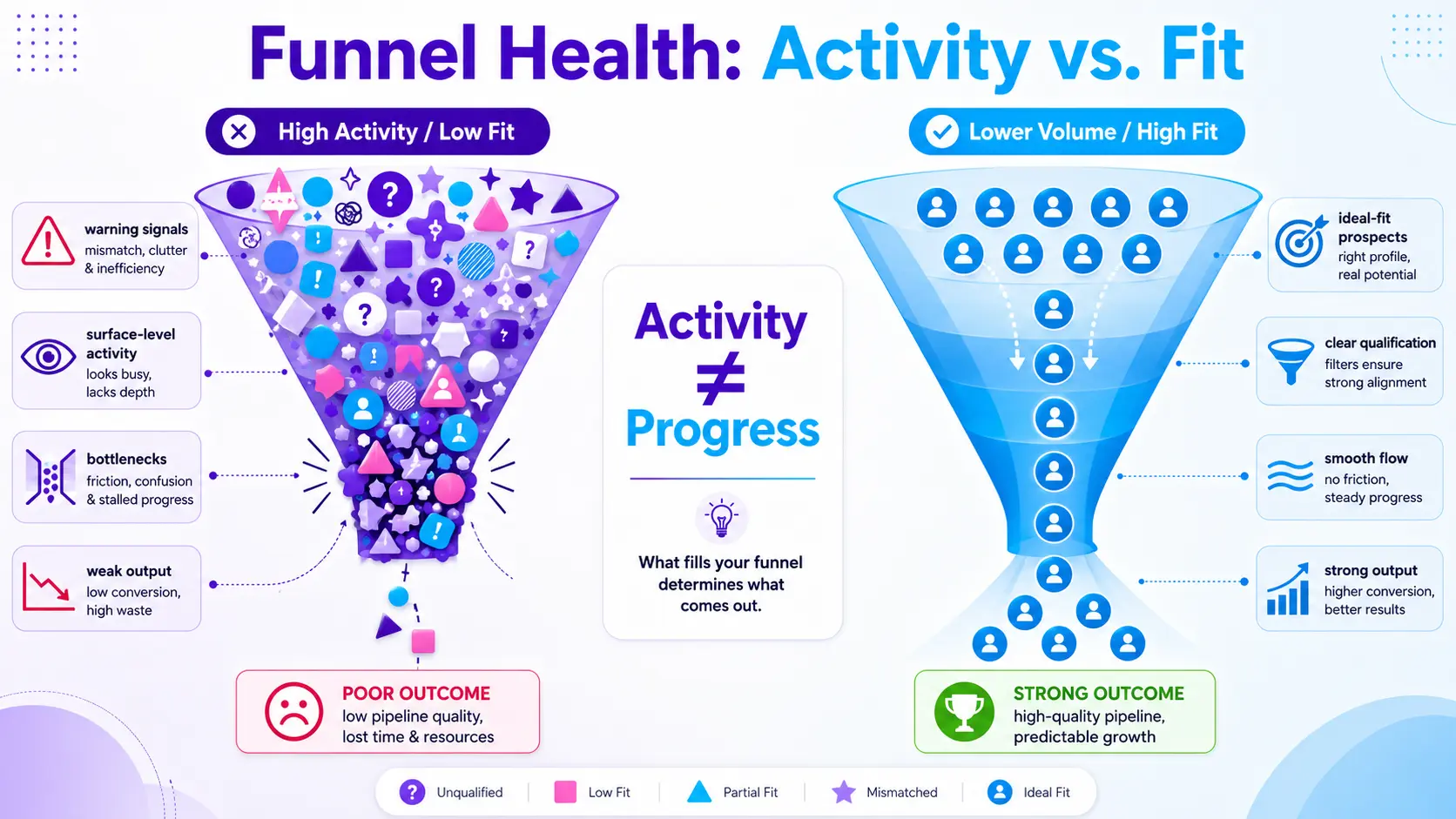
Trust delayed: why misfit leads stall before buying
The most expensive kind of pipeline bloat doesn’t show up as a hard cost.
It’s the slow drip: misfit leads that clog decision cycles, drain rep energy, and force buyers into holding patterns.
The core cause is usually positioning clarity tax – unclear value props that let the wrong-fit audience opt in, then stall out.
Time after time, we’ve seen reps spend cycles warming leads who never get contract authority.
This isn’t buyer hesitation; it’s a lack of mutual fit that surfaces only after the trust window closes.
And here’s the kicker: unclear positioning plants lingering uncertainty in even qualified buyers, prompting more comparisons, more internal debate, and longer delays.
Why would they buy now if your message doesn’t say “for you”?
If every lead needs a translation, pipeline velocity grinds down.
Is your process lending speed or friction?
When misfit demand sets the tone early, trust becomes a slow negotiation rather than a starting assumption.
Action drops, follow-ups drag, and forecast accuracy breaks down.
The hidden cost isn’t just lost deals – it’s time wasted waiting for decisions that never materialize.
Full pipelines can actually stall growth, not accelerate it.
True progress comes from clarity, not just volume.

The systemic cost of misfit demand across your funnel
Impact of Misfit Demand on Sales Funnel Metrics
| Positioning Signal Issue | Buyer Experience | Pipeline Impact |
| Vague Claims (e.g., ‘digital solutions’) | Buyer must translate meaning causing hesitation | Decision paralysis, stalled deals |
| Overly Broad Targeting (‘serving everyone’) | Attracts curiosity but not committers | Pipeline full of noise and non-buyers |
| Contradictory Headlines and Content | Confuses buyers on fit and value | High misfit leads, poor conversion |
| Lack of Exclusion Signals | Wrong prospects enter funnel | Wasted sales cycles, inflated CAC |
| Over-technical Messaging | Repels unfamiliar but viable buyers | Lost opportunities due to repelling |
Nobody budgets for friction, but every misfit lead inflates your costs in ways that aren’t listed on any invoice.
The shocking part?
Most pipeline bloat isn’t just annoying – it’s directly wired into higher acquisition costs and wasted quarters.
The real financial bleed doesn’t show up in pipeline volume, but in the penalties stacked at every stage.
Rising acquisition cost and extended cycles
Most teams blame channel inefficiency or sales performance for CAC creep.
The hidden driver they miss?
Reliance on broad, indistinct positioning attracts the wrong buyers, turning your funnel into a holding pen for non-decision-makers.
From our work with SaaS firms struggling to make every marketing dollar count, the pattern’s clear: as misfit demand rises, acquisition costs don’t just inch up – they spike.
Leads flow in, but sales cycles double as teams waste weeks qualifying, disqualifying, or persuading contacts who were never true buyers.
Suddenly, a single pipeline review reveals two months chewed up by buyers who ghost or stall after basics.
It’s like staff spending half their week in meetings with people who will never be customers.
In one B2B Tech client, acquisition costs quietly spiked 40% in a quarter – not from ad inefficiency, but from nurturing prospects who never converted.
The culprit: vague promises that appealed to broad swaths but failed to filter for urgency or authority.
How many of your sales cycles are extended because your messaging invited people to “learn more” rather than “act now”?
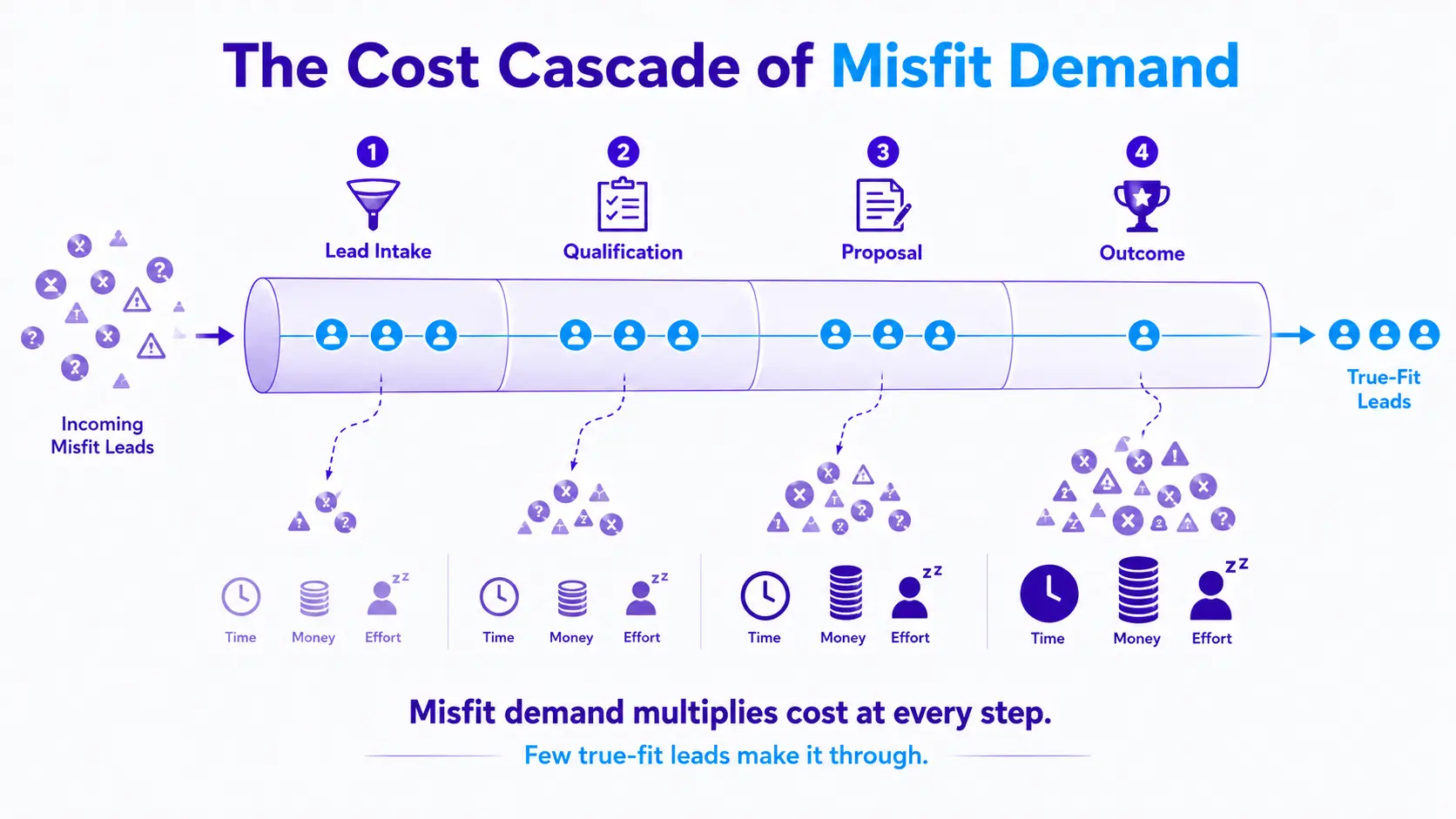
Lower conversion rates and buyer attrition before commit
The illusion: full-funnel activity means healthy conversion.
The reality: misfit demand hides falling close rates and a constant churn of buyers dropping out before any real commit.
Those high-funnel numbers mask a leaky middle where trust breaks down and deals evaporate.
Practitioner insight – conversion rates can halve when teams chase volume over fit.
As misfit leads accumulate, frontline reps lose conviction, and pipeline reviews become guessing games about who’s actually qualified.
In several client funnels, we’ve seen nearly 60% of “interested” leads quietly disappear before a second touch – not due to competitor poaching, but because the original promise didn’t match their real need.
Each ghosted lead represents silent sunk cost and saps team morale.
Think of your sales process as an airport security line.
If your sign says “everyone welcome”, you guarantee delays, rechecks, and massive dropout.
Now, ask yourself: How much of your funnel movement is real progress, and how much is just activity from buyers who’ll never make it to the gate?
When misfit demand dominates, every metric lags – CAC, cycle time, conversion, and forecast confidence.
The cost isn’t just financial; it’s cumulative fatigue.
If your pipeline feels heavy but fails to deliver, misfit demand is taxing every stage.
Forward pressure comes from clarity: Surplus activity isn’t strength – measurable progress is.
The true penalty of misfit demand is paid at every level, and spotting it is the first step to stopping the slow drain.

Why poor positioning filters too little and attracts misfits
Common Positioning Signal Issues and Their Pipeline Effects
| Metric | Effect of Misfit Demand | Example Outcome |
| Customer Acquisition Cost (CAC) | Increases due to wasted effort on unqualified leads | 40% spike in CAC reported by B2B client |
| Sales Cycle Length | Extends as more time is spent qualifying/disqualifying leads | Sales cycles doubled in some SaaS firms |
| Conversion Rate | Significantly decreases as many leads drop out before commitment | Close rates halved in client examples |
| Buyer Attrition | High dropout mid-funnel due to poor fit and trust delays | Nearly 60% of interested leads disappear before second touch |
| Forecast Accuracy | Degrades because misfit leads cause unpredictable outcomes | Forecasts become guessing games about qualified leads |
Most executives expect marketing to act as a magnet for new business – the real threat is when it turns into Velcro for the wrong prospects.
Volume alone tricks teams into believing their message is resonating widely, when in reality, broad or fuzzy positioning can quietly load the top of funnel with leads that will never close.
The result: Sales cycles stall, conversion rates sag, and resources get devoured by the wrong deals.
The assumption that casting a wider net delivers more wins yields the opposite.
If everyone could be a fit, no one truly is.
Vague claims force buyer translation, causing inertia
Ask three buyers what your company actually does – and count the different answers.
That’s the telltale sign of vague positioning: every prospect forced to fill in the blanks, each interpreting your offer through their own lens.
When messages are boilerplate (“digital solutions”, “next-level service”, “innovative platform”), buyers are left to translate claims into relevance.
The problem?
That extra cognitive load breeds hesitation or, worse, decision paralysis.
We’ve seen B2B teams burn through entire quarters chasing leads who engaged with an abstract promise, only to realize those prospects never clearly understood what differentiated the offer.
A repeat offender is the company page loaded with big claims but no specifics (“serving everyone from startups to the enterprise!”).
This positions the brand as background noise – the vendor who could do anything, and therefore, may get chosen for nothing.
Imagine an airport with no destination signs: travelers freeze, momentum dies.
The analogy fits.
When buyers can’t easily see themselves (or not themselves) in your message, they default to inaction.
Lack of clear exclusion signals attracts non‑buying interest
It feels counterintuitive, but refusing to say who you’re not for is the fastest way to fill your pipeline with expensive distractions.
In one review of inbound performance, we spotted teams spending weeks nurturing leads from the wrong sectors – simply because nothing in the messaging filtered them out.
Generalist claims attract generalist interest, often from buyers without budget, authority, or true intent.
Consider this: If your brand never says “we don’t serve companies with [X need] or under [Y budget]”, you become everyone’s fallback option – the backup vendor for curiosity-driven browsers, not committed buyers.
The hidden cost?
Sales teams get excited about raw numbers, not noticing that non-buyers are burning cycles and dragging out handoffs.
It’s the equivalent of a bouncer at the club who never checks IDs: the place fills up, but nobody’s buying drinks.
Companies that tell the market who they can’t help do more than avoid time-wasters – they signal conviction and gain trust from qualified buyers who see clarity as a sign of expertise.
Inclusion starts with exclusion; define your edge and watch fit quality rise.
When positioning tries to please everyone, you get the worst kind of growth: full dashboards, empty pipeline.
Filtering – by clarity, by exclusion, by unambiguous messaging – turns noise into signal and transforms pipeline surface area into real momentum.

Where to dig deeper when misfit demand is dragging your funnel
A pipeline full of the wrong leads feels like eating empty calories: it looks satisfying, but you’re still hungry for growth.
The numbers look strong – pipeline volume ticks upward, everyone’s forecasting against big targets – but revenue lags and sales teams grumble about wasted calls.
Most don’t realize: misfit demand rarely clusters at random.
There’s a pattern, and if you know where to look, the bottlenecks reveal themselves.
Evaluate misfit demand patterns by funnel stage
We’ve seen teams surprised when most drop-off isn’t at the first contact, but much later – deep in the pipeline, just as resources peak.
Why?
Misfit leads often breeze through early screens because they match surface-level criteria, yet choke progress where deeper alignment is required.
Once, a B2B tech client saw their demos-to-close ratio collapse simply because top-funnel forms were pulling in anyone with a pulse, not just the ideal buyers.
Their real signal?
Most misfit leads either lost interest mid-process or jammed up during decision reviews.
It’s rarely a single stuck spot.
Instead, misfit demand accumulates like silt in a river – at stage gates where qualification, solution fit, or budget clarity matter most.
For one e-commerce client, mid-funnel friction spiked around detailed requirements: prospects wanted features the team never planned to build.
Had they mapped lead quality by touchpoint, they’d have spotted the mismatch early.
Ask yourself: Where do conversations stall – top, mid, or handoff?
That’s almost always where your positioning gets lost in translation.
Identify which positioning signals are causing misalignment
Most positioning signals act like invitations – or bouncers – for your funnel.
Too vague or broad, and you let in every passerby.
Too technical, and you repel viable but unfamiliar buyers.
The myth is that clarity will shrink your funnel dangerously.
The reality?
Fuzzy messaging invites non-buyers who drain cycles and drive up acquisition cost.
Headline, value proposition, and page content often contradict each other or promise features you don’t – or shouldn’t – deliver.
In our work, simply reworking a lead-qualifying headline (“Best for scaling SaaS” instead of “Flexible for all businesses”) cut unqualified inbound by 30%, while actual sales velocity improved.
Most teams never audit exclusion signals at all – leaving unfit leads free to enter, interact, and then disappear without purchase.
If your calendar is packed but decisions stall, what’s the hidden message your homepage or forms are sending?
Pinpoint the weak signals.
Look for inconsistencies between what your site says, what your team repeats on every call, and where buyers disappear.
This audit isn’t about narrowing reach unnecessarily – it’s about eliminating ambiguity that pulls the wrong audience closer. Boundaries improve trust by reducing uncertainty in Boundary Signals and Trust.
Misfit demand always leaves breadcrumbs.
If you know where to dig, you’ll find the friction before it becomes a pipeline monument to lost opportunity.

Scientific context and sources
The sources below provide foundational context for how decision-making, attention, and performance dynamics evolve under scaling and constraint conditions.
- Decision Friction in Organizations
How to Reduce the Friction that Hurts You – and Harness the Friction that Helps – Huggy Rao, Robert I. Sutton – Harvard Business Review
This article explains how organizational friction, unclear priorities, and process overload slow execution and decision-making, directly supporting the argument that unfocused activity reduces real progress.
https://hbr.org/podcast/2024/01/how-to-reduce-the-friction-that-hurts-you-and-harness-the-friction-that-helps - Customer Fit and Pipeline Quality
The Effects of Solution-Oriented Selling on Customer Loyalty and Market Performance – Tuli, K.R., Kohli, A.K., Bharadwaj, S.G. – Journal of Marketing
This study shows that stronger alignment between customer needs and supplier solutions improves commercial outcomes, supporting the case that better prospect qualification leads to higher-quality pipelines and stronger conversion efficiency.
https://doi.org/10.1509/jmkg.71.3.1 - Positioning and Choice Architecture
Nudge: Improving Decisions About Health, Wealth, and Happiness – Richard H. Thaler, Cass R. Sunstein – Yale University Press
This foundational work explains how choice architecture shapes decision behavior, supporting the idea that clear positioning reduces friction while ambiguous options increase decision paralysis.
https://yalebooks.yale.edu/book/9780300262285/nudge/ - Information Overload in Lead Generation
The Concept of Information Overload: A Review of Literature from Organization Science, Accounting, Marketing, MIS, and Related Disciplines – Eppler, M.J., Mengis, J. – The Information Society
This review demonstrates how excessive information overwhelms decision systems, causing slower analysis, poorer judgment, and operational inefficiency – directly relevant to unqualified lead overload.
https://doi.org/10.1080/01972240490507974 - Boundary Setting for Brand Trust
Brands and Signaling Theory: A Review and Research Agenda – Connelly, B.L., Certo, S.T., Ireland, R.D., Reutzel, C.R. – Journal of Management
This research explains how credible signals build trust in uncertain markets, supporting the strategic case for clear boundaries and selective positioning rather than vague broad-market messaging.
https://doi.org/10.1177/0149206310388419
Questions You Might Ponder
How does misfit demand affect sales pipeline performance?
Misfit demand floods the pipeline with non-ideal leads who are unlikely to convert, resulting in bloated dashboards, lower conversion rates, and higher sales costs. This illusion of activity distracts from real growth and obscures underlying performance issues.
Why do vague positioning statements lead to increased acquisition costs?
Vague positioning attracts a broad, unfocused audience, making it hard for sales teams to qualify or convert leads efficiently. This lack of clarity wastes resources, extends sales cycles, and raises cost per acquisition as teams chase prospects who lack true intent.
What signals indicate misfit demand is clogging your funnel?
Rising drop-off in later funnel stages, extended decision cycles, and persistent lead stagnation are key signals of misfit demand. Frequent buyer ghosting, low demo-to-close ratios, and sales teams questioning pipeline quality further highlight the presence of non-buying leads.
How can clear exclusion signals improve pipeline health?
Clear exclusion signals set boundaries-telling prospects who is not a fit-which filters out low-intent or out-of-scope leads. This not only increases conversion rates but also boosts qualified buyer trust, speeds up cycles, and focuses resources on high-value opportunities.
What is the hidden cost of misfit demand in B2B sales?
The hidden cost includes wasted team time, eroded forecast accuracy, and unnecessary decision friction. Misfit demand creates a false sense of progress, causes cumulative fatigue, and diverts attention from real, high-probability opportunities, ultimately stalling actual business growth.