
What You’ll Learn
Boundaries as trust signal means using clear positioning limits – who a brand serves, who it does not serve, what it does, and what it refuses to do – to show confidence, competence, and fit.
Instead of weakening demand, strong boundaries help high-fit buyers feel safer because the brand appears focused, honest, and experienced in their specific context.
Boundaries filter misfit leads before contact, reduce wasted sales conversations, improve lead quality, and speed up decisions.
They work best when supported by transparent exclusions, relevant case studies, selective testimonials, and proof that the brand delivers better outcomes for the right audience.
Key Takeaways
- Clear boundaries signal competence and self-assurance, increasing trust from high-fit buyers while deterring misfits.
- Vague or broad positioning dilutes credibility, clogs funnels with low-quality leads, and lengthens sales cycles.
- Evidence such as selective testimonials and transparent “not for you” messaging solidifies boundary-based trust with executives.
- Healthy brands treat boundaries as adjustable hypotheses, continuously refining them to optimize both pipeline quality and market relevance.
Most companies fear exclusion – so they try to attract everyone.
But here’s the twist: stating “we’re not for everyone” is exactly what makes high-fit buyers lean in.
Vague positioning signals uncertainty to executives searching for signs of expertise.
Clear boundaries do the opposite: they quiet anxiety and demonstrate the self-assurance of a brand that knows its strengths (and its risks).
That broader pattern is clearer in Brand Positioning.

Why signaling ‘not for everyone’ builds trust
Imagine evaluating two agencies.
One claims it “serves all industries”.
The other says, “We reject work outside B2B SaaS with $10M+ ARR”.
Which one feels more credible to a SaaS exec serious about results?
It’s simple: specificity implies mastery.
When we help clients narrow their market language, we see two things happen – prospects ask sharper questions, and respect levels rise.
The hidden mechanism?
Confidence is contagious.
Stating exactly who you serve tells high-fit clients you’re less likely to waste their time or budget on guesswork.
How specificity signals competence to high-fit buyers
Here’s the myth: being broad feels safer.
Truth is, boundaries act like a velvet rope at an exclusive club – excluding low-fit guests while making the right people feel they’ve found an insider.
The clearer you are about who you don’t serve, the more qualified your inbound leads become.
But what if your offer is “too narrow”?
High-fit buyers are skilled at sniffing out competence.
When your positioning draws lines, it answers the question they’re quietly asking: “Are they actually built for our needs – or just chasing revenue?”
Comparison of Broad vs. Specific Positioning
| Attribute | Broad Positioning | Specific Positioning |
| Target Audience | All industries | B2B SaaS with $10M+ ARR |
| Signal to Buyers | Uncertainty, vague expertise | Mastery, confidence |
| Buyer Reaction | Low trust, guesswork concerns | High trust, sharper questions |
| Lead Quality | More misfit leads | More qualified inbound leads |
| Conversion Impact | Slower and defensive sales | Faster, focused sales conversations |
The cost of vague positioning: attracting misfit demand
Ambiguous positioning is a magnet for the wrong projects.
In practice, we’ve seen teams waste quarters buried in sales cycles with misaligned buyers – all because their message tried to please everyone.
The unspoken risk: trying to sound inclusive increases anxiety in both sides, as neither party knows where the real fit lies.
When brands use generic claims (“we help companies grow”), they collect leads who don’t self-filter.
Time gets burned defending scope, haggling over mismatched expectations, and untangling miscommunications.
The analogy: it’s like running a restaurant with no menu – everyone shows up, most leave dissatisfied, and your kitchen ends up making dishes you never intended.
Ask yourself: are you filtering your market, or letting your inbox fill with false hope?
Vague boundaries make every new inquiry suspect, which quietly saps team confidence and makes closing real opportunities tougher.
If credibility is your currency, specificity protects its value.
The result: clarity in boundaries reduces anxiety for both sides, attracts buyers who value what you offer, and signals you’ve earned the trust high-fit clients are searching for.

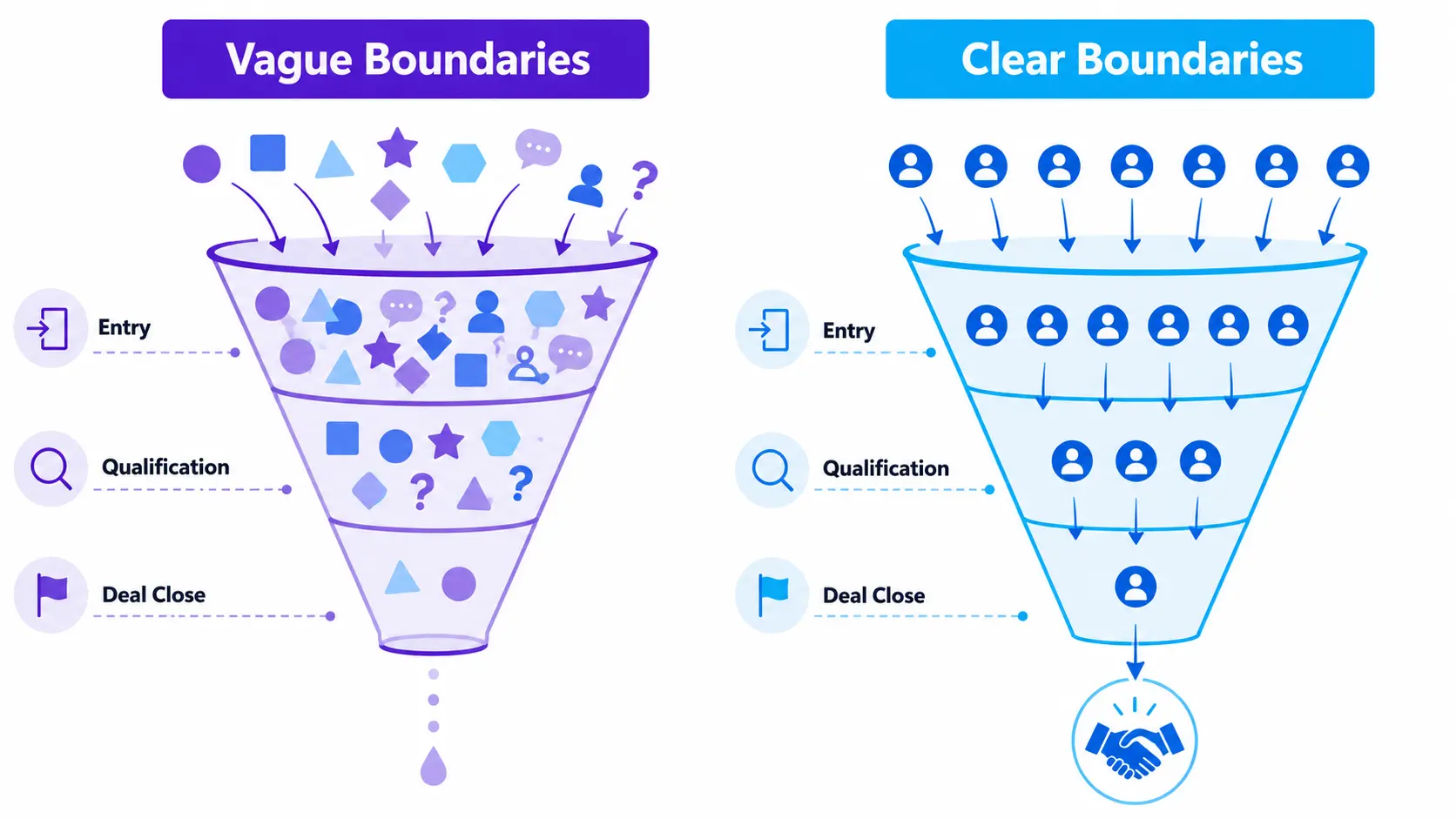
How boundaries filter the funnel before contact
Most brands spend far too much time managing conversations that never should have happened.
The real leak isn’t at the bottom of your funnel – it’s near the top, where unclear boundaries invite everyone and filter out no one.
Every executive has felt that sense of déjà vu on a call with a prospect who’s not even close to a fit.
The friction – on both sides – grows from one root cause: ambiguity about who belongs.
Why clarity excludes leads that waste time and trust
A brand without clear boundaries is like an open-door party with no guest list – predictable chaos.
What looks like “inclusive growth” really means cycling through mismatched demands, misaligned budgets, and painful expectation resets.
The myth?
Casting a wider net increases opportunity.
In practice, it clogs your sales pipeline with costly dead-ends.
One client we advised saw their lead-to-qualified ratio improve by 60% after rewriting their homepage to call out exactly which industries and company sizes they did not serve.
Suddenly, first conversations shifted from defensive qualification to focused fit.
Why?
Low-fit prospects filtered themselves out before contact.
Ask yourself – which scenario lowers risk perception for your team and for buyers: a brand that says yes to anyone, or a brand that signals “you may not belong here” to the wrong types?
If you’re asking sales to do all the filtering, you’re burning trust – and payroll – at the top of your funnel.
When exclusion increases conversion speed and quality
The fastest deals originate when buyers already know they’re in the right place.
Effective boundaries work like a bouncer at a club that only lets in VIPs – those who pass the criteria don’t just show up; they feel chosen.
In our work, brands that defined and displayed strict “not for you” language cut their average sales cycle time nearly in half.
Strong pre-qualification also reduced post-sale dissatisfaction, because expectations were set upfront.
The analogy is simple: a “members only” sign outside saves everyone the hassle of arguing at the door.
Would you rather spend your team’s energy sorting strangers, or welcoming believers ready to move fast?
When your positioning acts as a filter and not just a magnet, every step downstream gets easier and more profitable.
Boundary clarity means your pipeline fills with buyers who trust your confidence and mirror your values.
The right exclusions aren’t a brake on growth – they’re an accelerator for quality and speed.

What evidence executives look for to trust a positioning boundary
Most brand claims crumble under a microscope – until you show the receipts.
It’s not enough to say, “We’re not for everyone”.
Executives want to see evidence that those boundaries aren’t just marketing theater.
Can you prove the lines you’ve drawn actually improve outcomes?
Trust anchors: testimonials, case studies, and social proof that reinforce boundaries
Here’s the reality: without tangible proof, exclusion signals sound like empty bravado.
The most credible brands give outsiders as much attention as insiders – publishing case studies that highlight both who thrived and who wasn’t the right fit.
One B2B SaaS agency we advised included testimonials from clients who said, “They were honest – they told us we weren’t their typical client and explained why that mattered”.
That statement did more for their credibility than a dozen success stories.
Social proof works best when it’s paired with selective stories.
Instead of a generic cascade of five-star reviews, executives look for evidence the brand says “no” as often as “yes”.
A client portfolio filled with pattern-matching wins for one ICP, and absent in unrelated verticals, speaks volumes.
If every testimonial feels interchangeable, boundaries don’t exist.
Boundary-based credibility hangs on the repeatable logic: “Here are the real results – for the right fit”.
It’s the difference between a crowded restaurant with a line outside and one that seats anyone who walks in.
Which would you trust more?
Transparency about what you don’t do and why it matters
Most brands hesitate here – thinking that showing limitations will scare off opportunity.
But executives see through the omission.
In practice, the most trusted partners publish clear exclusions: “We do not support B2C ecommerce”, “We don’t manage awareness-only campaigns”.
The simple act of stating “We don’t do X” tells a buyer you’re serious about your specialty and not chasing quantity over fit.
Internally, we’ve seen that deals move faster when prospects hear, upfront, exactly where the relationship would break down.
One agency improved deal clarity (and trust) by posting “Here’s who should not hire us” on their home page.
Instead of shrinking demand, it filtered in buyers eager for that flavor of honesty.
Ambiguous positioning is like a map with missing roads – no one wants to drive off the edge.
Boundaries reduce perceived risk because buyers see your self-awareness: you know your limits, and you’re willing to show them.
Strong positioning boundaries aren’t a dare – they’re a filter and a promise.
When you back exclusions with proof and transparency, executives don’t just see a confident brand.
They see a safe bet.

Trade-offs of exclusion: when boundaries become too narrow
Pick a niche and own it – but what if the niche is too small?
Most companies underestimate just how easily their boundaries can double as blinders, clawing back all the flexibility they thought they’d gained with clarity.
Specificity might build trust, but over-specificity can erase you from view for anyone outside a razor-thin audience.
Risk of being ignored by adjacent but valuable segments
Draw the circle too tight and you risk locking out not just bad-fit leads, but entire segments of high-value customers you never realized overlapped with your core.
We’ve seen brands that prided themselves on B2B tech focus suddenly discover inbound inquiries from professional services fall by 80% – because their message drew an invisible line others wouldn’t cross.
The market doesn’t read between the lines; it takes the boundary at face value and self-selects out, even if they were a strong lateral fit.
Boundary-setting is less like fencing off real estate and more like shaping the walls of a maze – move them a few feet and you radically alter who finds the exit.
Consider the analogy of a spotlight: too broad, and you illuminate noise; too narrow, and important actors outside the cone vanish.
Which valuable segments are you unconsciously leaving in the dark?
A common myth is that hyper-specific positioning filters only the low-fit.
In practice, it filters probabilistically, sweeping out entire populations with minor messaging shifts.
Ask yourself: Is today’s boundary tuned to your best-fit buyers, or is it quietly excluding others you might want next quarter?
How to monitor and adjust boundaries without diluting credibility
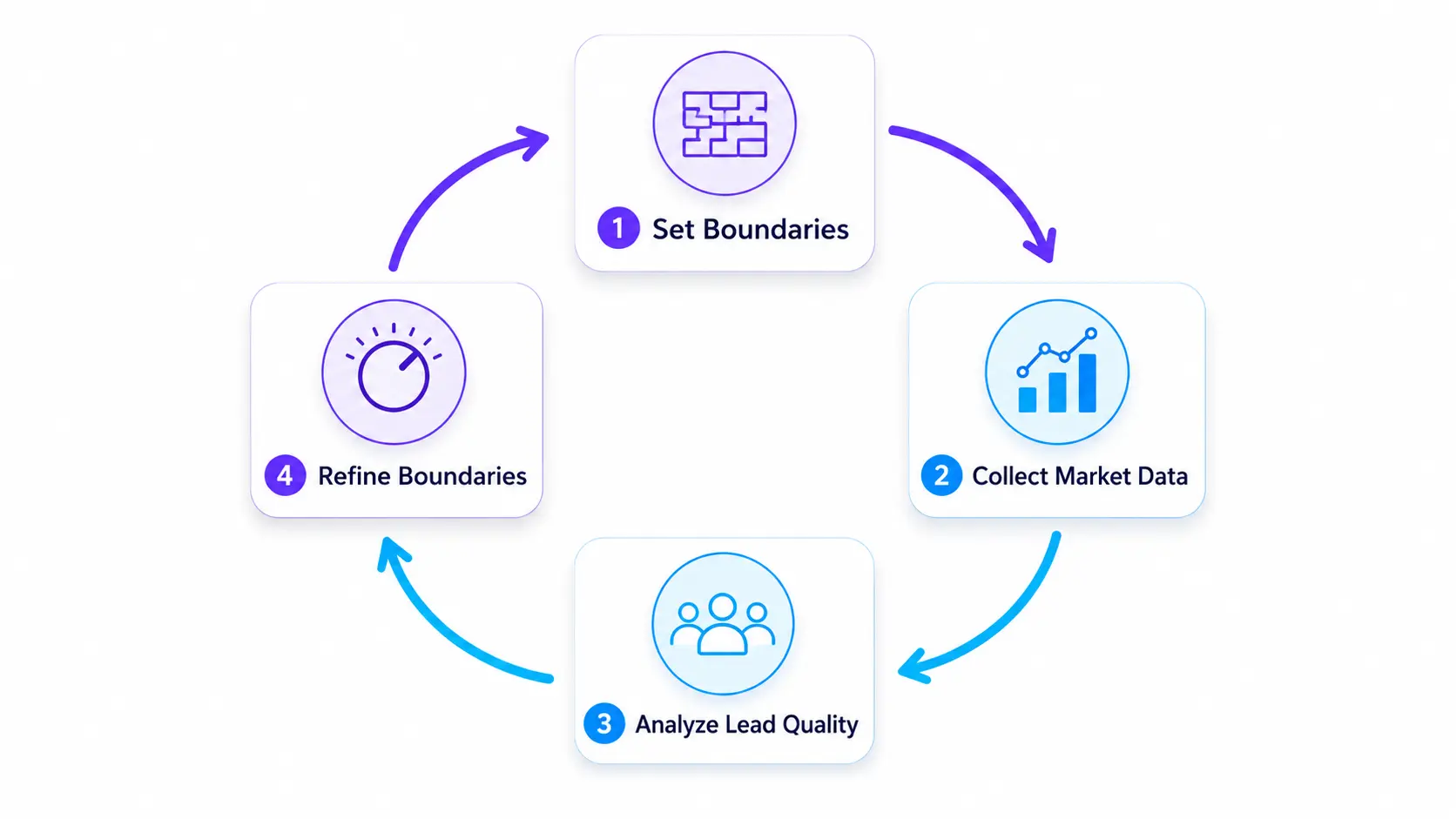
High-performing brands revisit boundaries regularly, monitoring for market shifts and changing fit – because the risk isn’t just missing out, but signaling inconsistency.
A practitioner tip: treat your boundaries as living hypotheses, not commandments.
Monitor not only who you attract, but who stops calling and why.
Set up simple feedback loops – ask lost opportunities why they self-excluded, track lead quality by segment, and watch deal velocity for signs of hidden bottlenecks.
One B2B client discovered that a single phrase (“only for SaaS founders”) was quietly repelling successful service-led companies, cutting average deal size without any obvious warning.
Tweak, test, and tune, but resist the urge to erase your edge every time you see a missed lead – dilution breeds skepticism faster than exclusion breeds volume.
Picture boundaries as the adjustable lens on a high-powered camera: too wide, and you lose focus; too tight, and the picture becomes irrelevant.
The healthiest brands don’t just set boundaries – they continually focus and refocus based on market feedback, never losing their sharpness.
If clarity is a trust signal, discipline is the real moat.
Keep the aperture precise enough to attract loyalty, but open enough to evolve as your ambitions expand.
This creates a volume vs quality trade-off explored in more depth on Adjusting Boundaries for Segment Fit.

Scientific context and sources
The sources below provide foundational context for how decision-making, attention, and performance dynamics evolve under scaling and constraint conditions.
- Signaling Theory in Organizations
Signaling Theory: A Review and Assessment – Connelly, B.L., Certo, S.T., Ireland, R.D., Reutzel, C.R. – Journal of Management
This widely cited review explains how signals reduce information asymmetry in uncertain environments, directly supporting the argument that clear boundaries and selective positioning increase credibility with informed audiences.
https://journals.sagepub.com/doi/10.1177/0149206310388419 - Brand Authenticity and Trust
Brand Authenticity: An Integrative Framework and Measurement Scale – Morhart, F.M., Malär, L., Guèvremont, A., Girardin, F., Grohmann, B. – Journal of Consumer Psychology
This research shows that authenticity strengthens consumer trust and emotional engagement, supporting the idea that clear, consistent brand boundaries create psychological safety and stronger trust signals.
https://doi.org/10.1016/j.jcps.2014.11.006 - Positioning, Differentiation, and Managerial Decision-Making
Organizational Boundaries and Theories of Organization – Santos, F.M., Eisenhardt, K.M. – Organization Science
This foundational paper explains how strategic boundary decisions shape resource allocation, organizational focus, and competitive positioning, directly supporting the trade-off between narrow expertise and broad scope.
https://doi.org/10.1287/orsc.1050.0152 - Boundaries, Categorization, and Performance in Markets
Two Sides of the Story: How Ambiguous Categorization Affects Market Performance – Pontikes, E.G. – Administrative Science Quarterly
This empirical study shows that category clarity improves audience understanding and market fit, while ambiguity can reduce recognition and performance despite broader appeal.
https://journals.sagepub.com/doi/10.1177/0001839212446689 - Transparency and Corporate Trust
The Transparent Organization: How Transparency Affects Trust in Organizations – Schnackenberg, A.K., Tomlinson, E.C. – Journal of Management
This paper demonstrates that transparency reduces uncertainty and builds organizational trust by improving perceptions of clarity, disclosure, and honesty – directly supporting the case for explicit positioning boundaries.
https://doi.org/10.1177/0149206314525202
Questions You Might Ponder
How do clear boundaries act as a trust signal for prospective clients?
Explicit brand boundaries demonstrate competence and focus, signaling to high-fit prospects that a company understands its limitations and expertise – reducing decision friction and anxiety for buyers seeking a strong, credible fit.
What are the risks of having vague or broad brand positioning?
Vague positioning attracts unqualified leads and wastes time in misaligned sales cycles. Companies with unclear boundaries must spend more resources defending fit, which diminishes team confidence and slows down deal velocity.
Can excluding certain customer segments improve lead quality and conversion rates?
Yes – strong exclusions prompt unqualified prospects to self-filter, increasing inbound quality and conversion rates. Companies see faster deal closings and happier clients when brand messaging clarifies who is not a fit upfront.
What evidence do executives require before trusting a brand’s positioning boundary?
Executives look for testimonial proof, case studies, and visible stories demonstrating the brand both serves a clear group and rejects misfits, confirming that boundaries are real and outcomes align with stated expertise.
How can brands avoid being too narrow with their positioning boundaries?
Brands must regularly review market feedback and analyze lost opportunities to ensure boundaries don’t exclude valuable adjacent segments. Treating positioning as a “living hypothesis” allows for smart adjustments without losing credibility.