
What You’ll Learn
Positioning volume vs quality is the trade-off between attracting more leads through broad messaging and attracting better-fit buyers through clear, selective positioning.
Volume-focused positioning may increase form fills, MQLs, or low-cost leads, but it often floods the pipeline with poor-fit prospects, weak intent, longer sales cycles, and lower conversion.
Quality-focused positioning narrows the audience on purpose by making fit, non-fit, value, and urgency clear before contact.
This can reduce lead volume, but it improves pipeline confidence, deal speed, conversion quality, sales efficiency, and trust because the remaining prospects are more likely to understand the offer and be ready to buy.
Key Takeaways
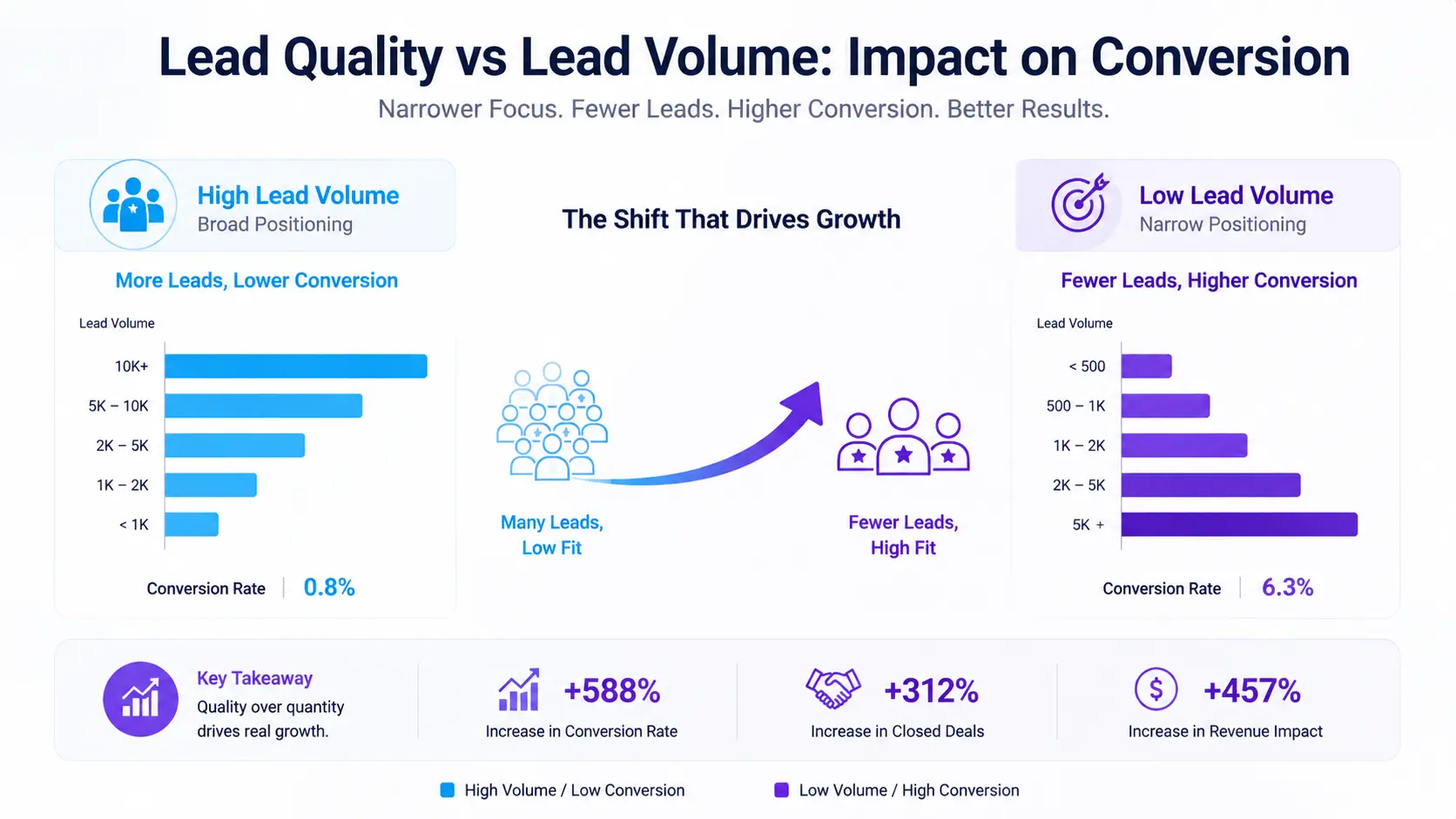
- Sharper positioning reduces lead volume but drives higher-fit, faster-moving prospects who convert at higher rates.
- Broad, volume-driven strategies create inefficiency by flooding pipelines with poor-fit, low-intent leads.
- Metrics like conversion quality, time-to-decision, and ICP fit are far more reliable than raw lead volume to gauge positioning success.
- When lead volume drops after refining positioning, it’s a sign to double down on clarity – not widen the net.
Most teams believe more leads mean more growth – the safety-in-numbers instinct kicks in fast.
But the hidden reality: The clearest brand positioning actually pushes the wrong prospects away, and that’s where exponential value starts.
Let’s unpack why embracing exclusion feels risky and yet delivers outsize results for fit, trust, and conversion quality.

Why narrowing positioning feels risky but increases fit
Volume feels safe.
Clarity feels risky – because drawing visible lines naturally shrinks the crowd.
But in practice, specifying who you’re for (and just as loudly, who you’re not) makes the right prospects move faster.
Well-defined positioning silently tells the wrong leads to opt out before wasting anyone’s time.
Those who enter are not just random passersby – they’re already most of the way to yes.
How clarity excludes the wrong leads and accelerates decision‑making
Most brands are afraid to sound exclusive.
They worry about “leaving money on the table”.
But in our client work, placing confident boundaries increased trust, reduced noise, and cut time-to-decision, because prospects quickly self-qualify.
When your message is a spotlight instead of a floodlight, evaluators feel seen – and move predictably forward.
Trying to attract everyone slows your strongest buyers and floods your team with analysis paralysis.
Trust builds fastest when prospects know you’re not angling for every deal.
When clarity signals, “We are not for everyone”, decision-makers feel safer to commit.
That’s the counter-intuitive edge: the best-performing positioning filters demand, not maximizes it.
Why reduced volume often masks stronger outcomes downstream
Here’s the myth: Less lead flow means underperformance.
But over and over, we’ve seen the opposite.
Lower top-of-funnel numbers – when driven by sharper messaging – predict higher conversion rates, better average deal sizes, and less sales friction.
It’s a ripple effect.
Quality in, compounding value out.
What many overlook is that chasing high lead volume usually pulls in prospects with poor intent, weak fit, or no purchase authority.
The pipeline looks busy – but performance lags because the system is clogged and teams are chasing ghosts.
Narrower positioning acts like a refining screen: fewer leads, but every prospect left is a serious contender.
One B2B client saw qualified close rates double within a quarter simply by tightening their pitch.
They ditched generic appeals, focused hard on clarity, and watched both team confidence and win rates climb.
Think about filtering as pre-qualification.
Would you rather wade through dozens of lukewarm form fills, or speak to five prospects who already know they’re in the right room?
Time, morale, and acquisition costs all benefit.
In conversion quality over volume, the math is simple: Specificity is the force multiplier.
Reducing lead volume isn’t loss; it’s the indicator that your positioning is finally starting to work for you, not against you.
The reward is more than just efficiency – it’s the confidence to double down next quarter.

What makes volume‑focused positioning fail in decision systems
Most companies blame “not enough leads” for pipeline issues.
The real problem – hidden in plain sight – is an overflowing pipeline filled with people who were never the right fit to begin with.
How did they get there?
By making the front door as wide as possible, hoping more traffic means more wins.
The result: sales teams spend their days sorting, not closing.
When wide positioning attracts leads without fit or purchase intent
Imagine a job listing that says, “Any skill welcome”.
You’d get high response rates – but mostly from those with no relevant experience.
Wide positioning in B2B works the same way.
When your messaging appeals to everyone, you attract browsers, not buyers – curious visitors and non-decision-makers far from a purchase.
For one SaaS client, intake forms soared after relaxing positioning in ads, but close rates flatlined.
The numbers looked healthy on the surface yet masked a lack of readiness and intent.
Here’s the trap: form fills and downloads aren’t commitment.
A lead with no strategic pain or direct buying power exhausts your team’s time and weakens real opportunities.
Volume hides mismatched demand.
If your lead flow suddenly surges with little increase in conversion, you’re pouring water into a leaky bucket rather than filling a glass.
How misaligned positioning defers trust and increases friction
When a brand’s pitch tries to satisfy every potential buyer, it breeds suspicion.
Prospects sense when a message is generic.
Does this actually solve my problem – or just any problem?
That pause drains momentum from your funnel.
In our advisory work, ambiguous positioning consistently delayed the first true qualifying call.
We saw prospects hedge, ask “Is this really for me?” – and delay real engagement for weeks.
Every inch of ambiguity creates friction.
Just as a roadmap without clear destinations leaves travelers second-guessing every turn, teams with hazy positioning face repeated questions, complex buying cycles, and constant clarification.
The more a lead doubts your relevance to their pain, the less urgency they feel to act.
Often, executives believe keeping options open will appeal broadly and speed up growth.
In reality, clarity drives velocity, not hesitance.
The sharper your message, the faster you convert trust to action.
The core: Volume-driven positioning promises safety but injects friction and misfit that quietly erode outcomes.
Precision in positioning, while unnerving at first, is what clears the path for real, eager buyers to say yes.

What metrics hide poor positioning masks as volume success
You can set records for lead volume and still bleed opportunity.
Most leadership teams see a full pipeline and assume momentum – but those headline numbers often camouflage deeper weakness.
What if the metrics you celebrate are actually rewarding the wrong behavior?
Metrics that inflate volume but erode fit
Comparison of Metrics: Volume-Focused vs. Quality-Focused Indicators
| Observation | Possible Interpretation | Recommended Action | Expected Outcome |
| Lead volume drops sharply after messaging update | Message is clearer and exclusive, filtering out poor-fit leads | Monitor conversion quality and deal velocity carefully | Higher close rates and shorter sales cycles |
| Lead volume drops but conversion rate declines or stagnates | Potential positioning or targeting issue reducing qualified inquiries | Review messaging alignment and audience targeting | Refined messaging or funnel adjustments needed |
| Lead volume steady but sales cycles lengthen | Possible ambiguity causing friction and mistrust | Simplify positioning, clarify value propositions | Faster decision making and better trust signals |
| Lead volume increases but low engagement and close rates | Volume inflated with low-fit leads causing inefficiencies | Reintroduce stricter filters, sharpen positioning | Pipeline stabilizes with more qualified prospects |
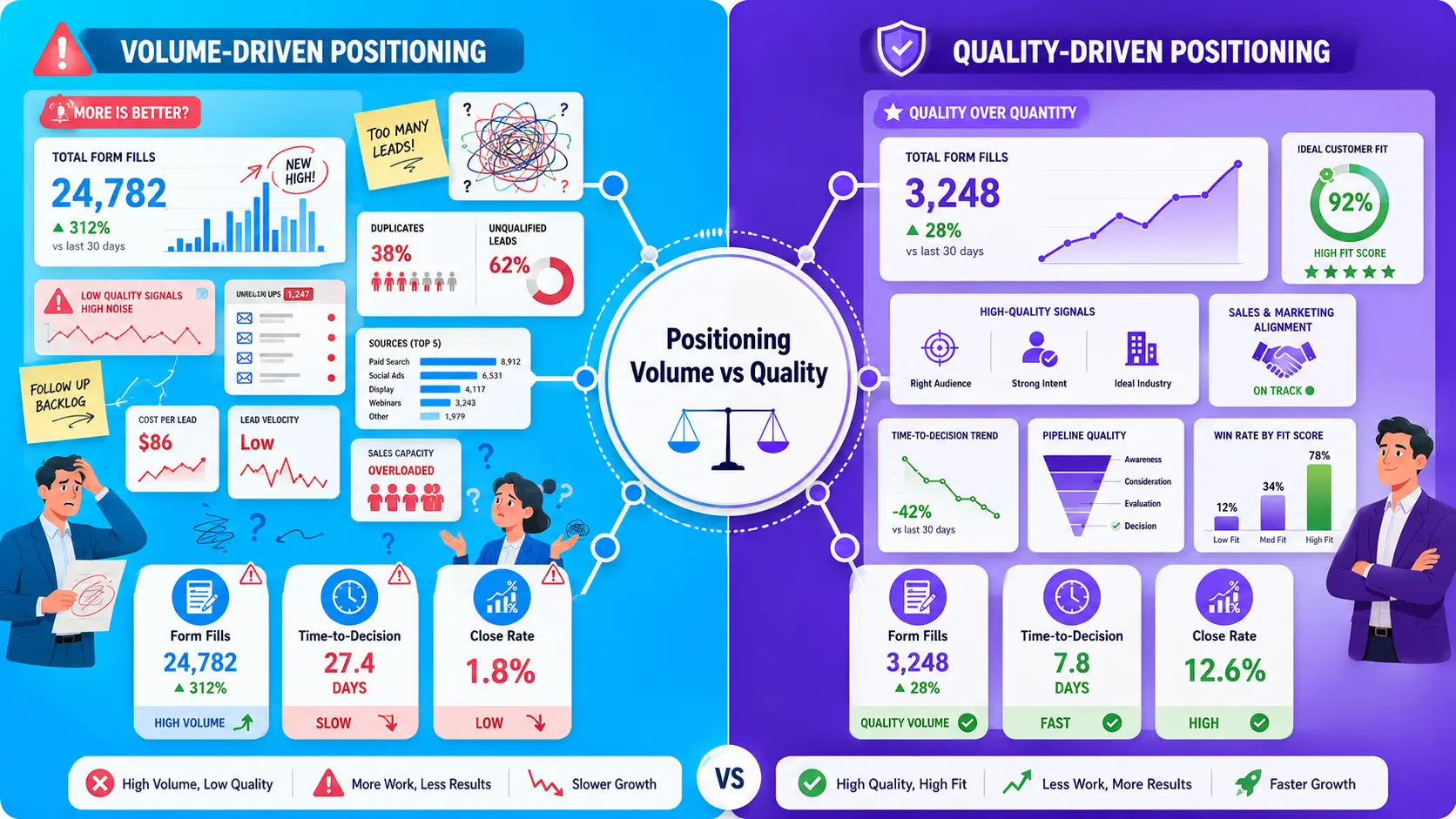
Form fills, MQL counts, and lower cost per lead look impressive in dashboard snapshots.
But these metrics easily balloon when your messaging is broad and your filters are weak.
One client tripled top-of-funnel volume with generic positioning, then discovered that over 70% of those leads never interacted after the first call.
The lead count was up; actual interest down.
Friction in the sales process spiked, with lengthy cycles and constant misfit.
Here’s the trap: rewarding volume alone incentivizes teams to strip out qualifiers and cast a wider net.
The result?
Your sales team spends time sorting junk, not selling.
It’s like judging a restaurant’s success by how many make reservations, not how many enjoy the meal – or ever pay.
Ask yourself: do impressive numbers mask that you’re attracting the wrong crowd?
Alternative indicators of quality and positioning clarity
The indicators that really matter show up in flow, not flash.
Conversion quality – the percentage of leads who match ICP and move efficiently through the pipeline – offers an immediate signal of health.
Time-to-decision is another: when positioning is clear, prospects self-select faster, and deals move more predictably.
In one engagement, tightening messaging dropped lead counts by 40%, yet close rates more than doubled and sales cycles shortened by weeks.
Viewing lead flow through these lenses reverses the narrative: fewer, better-matched leads drive sharper ROI.
A simple analogy – we’d rather have 10 qualified, motivated buyers at the table than a hundred browsers who never order.
When your key metrics emphasize fit, not just fill, every number regains meaning.
In short: the right metrics act as a mirror, not a mask.
Volume can mislead – quality always tells the truth.
Read the signals carefully and what looks like slowdown could be the start of your strongest results.

How to interpret lower volume as a diagnostic indicator – not failure
It feels like a paradox: the more clearly you draw boundaries, the more you fear you’re pushing opportunity away.
Most leadership teams equate slower lead flow with something broken – a sign to widen the net.
But, in our work with clients, the opposite pattern emerges: when positioning sharpens and messaging refuses to apologize for its edges, lead volume dips, and the right prospects lean in.
The myth?
That sounding exclusionary damages growth.
The truth: true confidence in what you offer weeds out distractions and makes your ideal customers feel recognized – almost like being called by name in a crowded room.
Why confidence sounds exclusionary – and how to reframe it
One B2B client refined their message so much that initial inquiries dropped by nearly half.
Panic set in.
Then close rates doubled, average deal value ticked up, and sales cycles shortened.
The change wasn’t luck.
Filtering demand, not maximizing it, funneled energy toward decisions instead of dead-ends.
Sounding exclusionary isn’t a liability; it’s a magnet for the people who care to listen.
Ask yourself: when was the last time you passed on a service because it sounded too generic to fit?
Clarity is the ultimate trust signal – people trust companies willing to stand for something specific.
Like a high-end restaurant with just five signature dishes, focus signals quality and discipline.
Good leads don’t want to feel like one of the crowd – they want proof you get them.
Next steps when volume drops: evaluate positioning, not ramp up quantity
Diagnostic Checklist for Interpreting Lower Lead Volume
| Metric | Description | What it Measures | Issue/Benefit |
| Form Fills / MQL Counts | Number of leads who express initial interest | Lead volume | Inflates volume, may include unqualified leads |
| Cost per Lead | Average spend per generated lead | Marketing efficiency | Looks cost-effective but can attract poor-fit leads |
| Conversion Quality | Percentage of leads matching ICP progressing efficiently | Lead fit and pipeline health | Indicates strong positioning and better outcomes |
| Time-to-Decision | Duration for a prospect to commit after engagement | Sales velocity | Faster decisions show clarity and trust |
When volume falls, most teams rush to add campaigns, loosen filters, or chase anyone who might say yes.
This panic response burns budget and breeds inefficiency.
Smart teams pause and ask: is the drop telling us our message is finally reaching only those who matter?
Several client turnarounds started not with more pipeline, but with sharper diagnostics.
Instead of increasing spend, they mapped which segments remained, tracked meeting quality, and pressure-tested whether lower volume was actually a symptom of better fit.
In almost every case, conversion quality over volume won out, with marketing and sales finally rowing in sync for the first time all year.
Filtering isn’t failure.
It’s pre-qualification made visible.
When lower demand arrives after a positioning refresh, treat it as signal, not setback.
Volume feels safe.
Clarity – and the courage to keep filtering – actually builds the results you want.
Confidence in specificity excludes, but it also transforms outcomes.
The companies that resist the urge to widen their net when numbers dip are the ones that realize the strongest downstream performance.

Scientific context and sources
The sources below provide foundational context for how decision-making, attention, and performance dynamics evolve under scaling and constraint conditions.
- Decision-Making and Limited Attention
Scarcity: Why Having Too Little Means So Much – Sendhil Mullainathan, Eldar Shafir – Times Books / Henry Holt and Company
This book explains how scarcity narrows cognitive bandwidth and decision capacity, supporting the argument that constrained systems often make sharper, more efficient decisions than overloaded ones.
https://www.hks.harvard.edu/centers/cid/publications/books/scarcity-why-having-too-little-means-so-much - Choice Architecture and Filtering
Nudge: Improving Decisions About Health, Wealth, and Happiness – Richard H. Thaler, Cass R. Sunstein – Yale University Press
This foundational work shows how structuring choices and defining boundaries improves decision quality, directly paralleling strategic filtering and positioning in business.
https://yalebooks.yale.edu/book/9780300262285/nudge/ - Resource Allocation and Performance
The Concept of Information Overload: A Review of Literature from Organization Science, Accounting, Marketing, MIS, and Related Disciplines – Eppler, M.J., Mengis, J. – The Information Society
This review demonstrates that excessive information reduces decision quality, slows processing, and creates organizational inefficiency, directly supporting the lead quality versus lead volume argument.
https://doi.org/10.1080/01972240490507974 - Fit, Trust, and Buying Signals
Value-Based Differentiation in Business Relationships: Gaining and Sustaining Key Supplier Status – Ulaga, W., Eggert, A. – Journal of Marketing
This research shows that stronger alignment between supplier capabilities and customer needs improves trust, relationship quality, and commercial outcomes, supporting the logic behind selective qualification.
https://doi.org/10.1509/jmkg.70.1.119.qxd - Performance Metrics and Diagnostic Traps
Marketing Metrics: The Manager’s Guide to Measuring Marketing Performance – Paul W. Farris, Neil T. Bendle, Phillip E. Pfeifer, David J. Reibstein – Wharton School Publishing
This evidence-based resource explains why overreliance on volume metrics can distort decision-making and emphasizes quality-focused measurement frameworks for better performance management.
https://dl.acm.org/doi/10.5555/2886187
Questions You Might Ponder
How does narrowing positioning impact lead quality versus lead volume?
Narrowing your positioning typically reduces lead volume but attracts more relevant, well-matched prospects. This approach leads to higher conversion rates, shorter sales cycles, and deeper trust, outperforming strategies that maximize raw lead quantity with generic messaging.
Why is high lead volume not always a sign of healthy growth?
Large lead numbers may signal busy pipelines, but often mask poor fit, low buyer intent, and higher sales friction. Volume-focused strategies can overwhelm teams with unqualified leads, driving inefficiency and hiding the real performance indicators that matter for growth.
What are the risks of a broad positioning strategy in B2B marketing?
Broad positioning attracts non-ideal prospects, increases complexity, and decreases win rates. Teams spend more time sorting and disqualifying leads, which raises acquisition costs and slows the buying journey, ultimately reducing overall business performance.
Which metrics best indicate effective positioning in lead generation?
Key indicators of effective positioning include conversion rates of qualified leads, time-to-decision, deal size, and client retention. These metrics emphasize the value of fit and trust over volume, giving a clearer picture of pipeline health and outcomes.
How should companies respond when a positioning change lowers lead volume?
A drop in lead volume following a positioning shift often signals improved audience fit, not failure. Instead of ramping up quantity, companies should analyze conversion quality, retention, and average deal value to determine if their new messaging is attracting more valuable opportunities.