
What You’ll Learn
Narrative drift in brand positioning is the gradual loss of message coherence that happens when a brand’s story shifts across teams, channels, campaigns, sales conversations, product materials, support content, or AI-generated summaries.
Each small change may seem harmless, but together they weaken the buyer’s mental shortcut for understanding what the brand stands for.
Narrative drift creates expectation gaps, trust delays, customer confusion, longer sales cycles, and higher support friction.
In AI-mediated search, the risk grows because assistants may compress inconsistent signals into a simplified or inaccurate version of the brand.
Strong positioning requires consistent narrative inputs across every touchpoint.
Key Takeaways
- Narrative drift in brand positioning occurs through subtle, cumulative shifts, undermining buyer trust and predictable decision shortcuts.
- Internal misalignment across teams amplifies meaning decay, leading to fragmented messaging and customer confusion.
- AI-driven channels aggregate and compress messaging, magnifying the impact of even minor inconsistencies and rapidly repositioning your brand.
- Revenue erosion from narrative drift accumulates silently, extending sales cycles and support loads long before visible profit loss appears.
Few teams spot it in real time: buyers rarely lose trust in a single glaring moment.
More often, small, well-intentioned changes stack up – each one almost invisible – and over time, fracture the very shortcuts buyers use to predict what you deliver.
Most brand positioning failures don’t come from big pivots; they start with narrative drift so subtle, even insiders miss the warning signs.
Yet these micro-shifts can silently sabotage buyer momentum and seed doubt long before symptoms surface.

When small shifts sabotage buyer expectations
Picture a consistent lane marker suddenly zigzagging on a highway without warning.
That’s what expectation misalignment feels like to your customer – tiny narrative shifts, multiplied across digital touchpoints, throw off their mental model in a heartbeat.
One VP at a SaaS brand described how their sales team celebrated speed, while web copy stressed security, and customer support defaulted to “personal touch”.
None of these claims were false, but together, the friction was immediate: prospects stopped trusting the core promise and started second-guessing next steps.
This is the cost of touchpoint inconsistency.
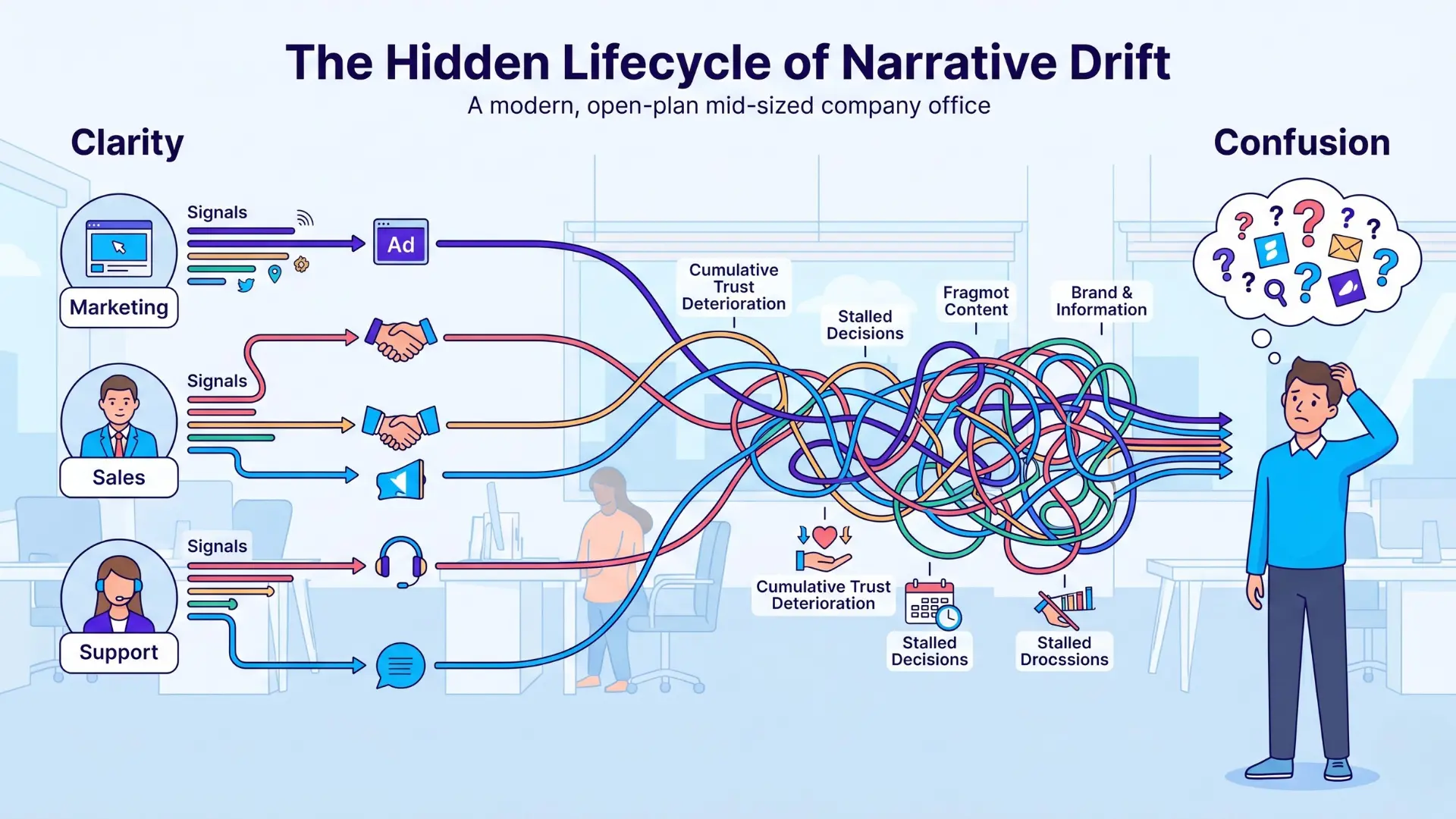
When digital ads, landing pages, product demos, and support cues each spotlight a slightly different value, buyers struggle to build a reliable shortcut: “What will I really get?”
How inconsistent signals break the buyer’s mental shortcut
Myth: more channels mean greater reach.
Reality – every added channel is a potential source of narrative drift.
Positioning coherence suffers because small teams treat messaging as interchangeable, unaware that buyers scan for alignment subconsciously, not line-item consistency.
The analogy: Like reading a map with some road names switched – once enough inconsistencies creep in, confidence drops off a cliff.
Every client we work with who experiences unexpected drop-offs mid-funnel tends to have a trail of mixed signals leading right to decision friction.
Do your own materials pass the quick-scan test, or does each owned channel quietly nudge buyers in conflicting directions?
Why narrative drift doesn’t register until decisions falter
You rarely see drift build up – until suddenly cycle times stretch, support tickets spike, and conversion tanks.
Drift is cumulative, hiding in plain sight: nobody notices the pattern mismatch until trust takes longer to earn, or deals go dark after “promising” calls.
The danger isn’t the size of any one inconsistency – it’s the compounding effect over time.
Narrative continuity breaks not with a bang, but with weeks or months of gradual meaning friction.
It’s telling how often leadership doesn’t connect these dots: most write off erratic close rates or increased buying hurdles as market conditions, skipping right past the root cause.
In practice, when expectation misalignment shows up, decisions slow and drop-offs rise – long before anyone adds “incoherence” to the post-mortem.
Narrative drift is silent until it’s expensive.
Trust, once fractured, demands far more effort to restore than it ever did to maintain with consistent positioning at the start.
Step back from the day-to-day messaging grind – does your story genuinely feel the same on every channel, in every sales conversation, across every decision stage?
Because buyers notice when it doesn’t, even when you don’t.

Why internal fragmentation amplifies meaning decay
Most leadership teams assume that as long as every function knows the brand “north star”, their narrative is safe.
But the real hazard isn’t neglect – it’s the subtle mutation of meaning between teams that undermines positioning coherence from the inside out.
Every executive has heard it: “That’s not how we talk about it”.
The marketing deck says one thing, sales tells something sharper, product rewrites it for their demo.
It’s like three musicians reading the same sheet music, each improvising their own rhythm – the tune might share a melody, but at the point of customer contact, the notes clash.
The cost of divergent stories in sales, product, and marketing
Comparison of Narrative Divergence Across Sales, Marketing, and Product Teams
| Symptom | Description | Consequence | Reported Impact |
| Extended Decision Timelines | Buyers take longer to decide due to unclear or conflicting messaging | Prolonged sales cycles and increased opportunity costs | Deals delayed by months beyond industry norms |
| Increased Support Tickets | Buyers require more post-sale clarifications and assistance | Higher support volume and team workload | Support tickets sometimes double |
| Buyers Express Skepticism | Repeated clarifying questions highlight unmet expectations | Lost trust and stalled pipeline progression | Funnel drop-off spikes by 8-15% |
What looks like healthy debate often masks a more corrosive problem: positioning failure modes multiply as teams edit the narrative to fit their own incentives.
We’ve seen tech companies where sales pitches the product as customizable (to close faster), marketing stresses simplicity (to drive demand), and product teams quietly build for complexity (to satisfy their vision).
To the buyer, the story shifts from clean to complicated in a single sales cycle – expectation misalignment cut straight from internal meaning friction.
This isn’t just a theoretical tension.
One SaaS client watched its pipeline velocity grind down for months, only to realize support tickets were doubling – root cause traced to clients expecting one thing, receiving another, then blaming delivery teams for “broken promises”.
The translation error didn’t start at the front line, it started when strategy became fractured between departments.
Ask yourself: if your teams presented separately to a customer, would the buyer get a coherent view – or a different brand at every touch?
Narrative continuity is not a slogan, it’s an internal operational discipline.
Divergence on the inside translates directly to confidence gaps on the outside.
How growth without governance seeds long-term erosion
Growth multiplies the number of people and systems shaping your story, and each small tweak – intentional or not – has the power to alter its direction.
The more unchecked inputs in play, the greater the risk that meaning will erode out of sight, surfacing only when the cost is measured in lost deals or market share.
Here’s where the analogy fits: a scaling brand without guardrails is like a river with failing banks.
At first, the current seems manageable.
But over time, erosion accelerates, sides crumble, and the water – your message – spreads and loses force.
Before you notice, the channel is unrecognizable.
In our experience, brands that front-load trust and guard meaning with simple governance – think quarterly alignment calls, shared narratives, and message audits – see far less narrative drift even in hypergrowth stretches.
The warning sign: when middle managers start “tweaking” the story for their own region or team, long-term trust erosion is already ticking up.
The takeaway: Internal fragmentation is rarely visible in dashboards, but it is the silent architect of customer confusion.
Unchecked, it seeds positioning drift that compounds – not just across campaigns but across every interaction, grounding future growth.

How AI‑mediated framing rewrites your narrative before you know it
Most teams don’t realize their brand isn’t what they publish – it’s what external systems decide to display.
The moment AI-powered summarizers, chatbots, and search engines ingest your public touchpoints, your carefully designed positioning faces a new editor: algorithms that thrive on pattern, not precision.
In this environment, subtle narrative drift no longer unfolds slowly across months – it can happen overnight, and you might never see it until damage is done.
AI compression and narrative averaging as silent repositioning
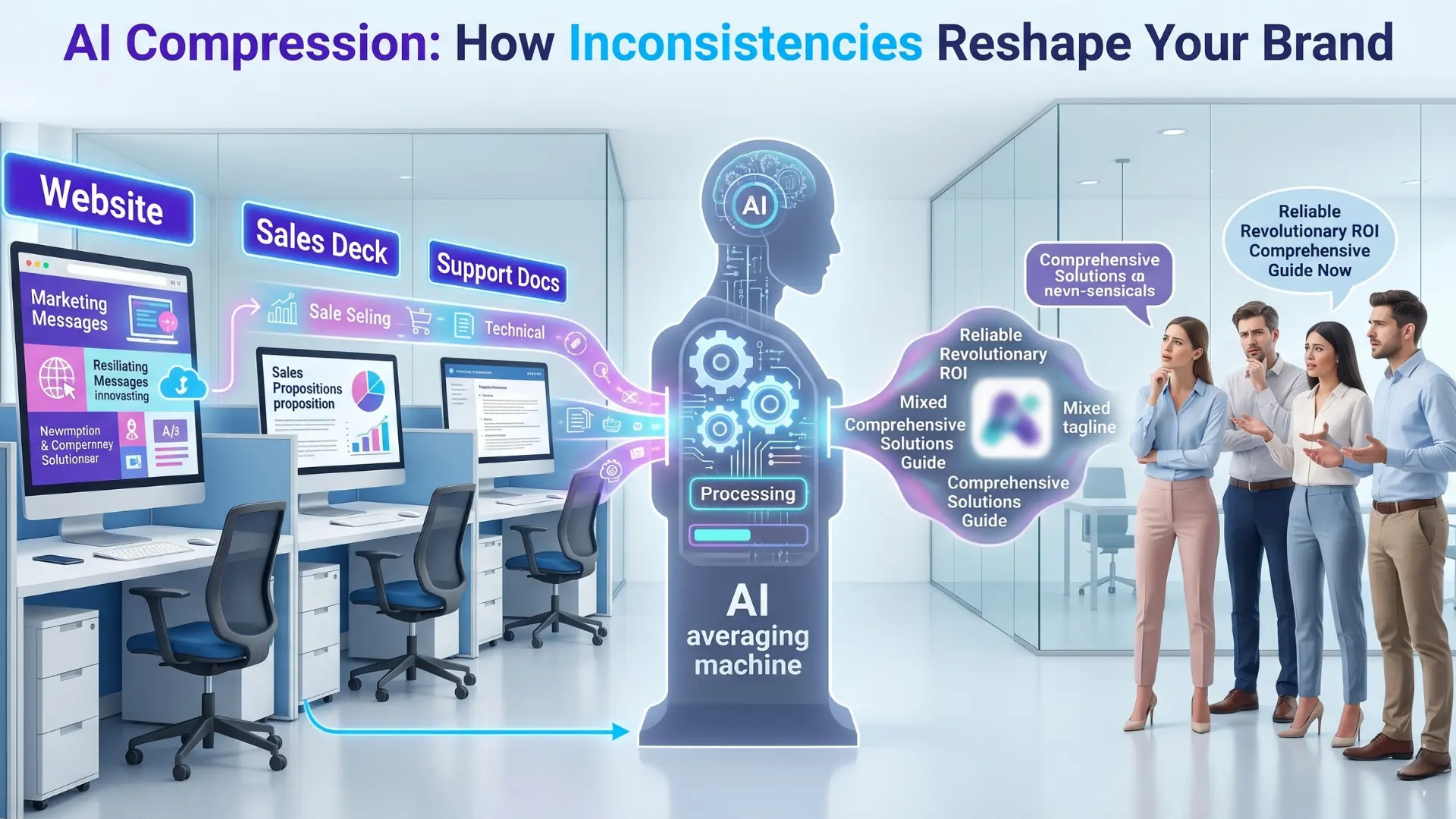
Think of LLMs and automated assistants as interpreters with tunnel vision; they distill everything you broadcast down to the “gist” that fits their training.
But gist isn’t nuance.
If your brand messaging lacks brutal consistency – if your homepage, product page, and third-party listings echo slightly different versions of your promise – AI will compress these fragments into the lowest-common-denominator narrative.
The myth?
That your strongest message wins.
In practice, unguarded positioning coherence invites AI to average conflicting themes, birthing a version of your brand that only partially resembles your intent.
We’ve seen this firsthand with clients: string together three or four nearly-synonymous taglines across touchpoints, and suddenly industry chatbots start describing you in off-radar terms.
One B2B client aiming for “enterprise security leader” was recast as a “compliance workflow tool” simply because AI saw more recent signal volume on support documentation than on thought leadership.
Narrative continuity breaks down, and you get silently repositioned before you spot a single customer complaint.
Is your message distinct enough to withstand algorithmic flattening – or are you already subject to narrative averaging without realizing it?
The analogy here: letting scattered storylines seep into the market is like leaving an unfinished puzzle on the table – whatever AI can piece together, it declares complete, even if key parts are missing.
What happens when AI tells buyers who you are, not you
What happens when buyers rely on search summaries, ChatGPT, or AI-powered reviews to learn what your brand stands for?
The answer: authority shifts.
The risk isn’t just expectation misalignment – it’s the rapid erosion of trust front-loading you never even see coming.
You lose position at the most vulnerable point in the funnel: the zero-moment-of-truth, before a single decision maker lands on your site.
Practitioner insight: in several recent engagements, we tracked deals stalling not because of poor sales execution, but because early-stage buyers reported confusion from conflicting AI-generated overviews.
Support teams spent triple the time clarifying “what you actually do”.
Expectation misalignment then inflates support costs, while decision timelines extend and friction compounds.
If you think you control your own story, pause.
You control inputs, but not the AI-shaped outputs your buyers now depend on.
Imagine briefing a room by phone – and half the words are dropped.
The meaning friction isn’t accidental; it’s structural.
The only reliable defense: relentless narrative coherence at every surface AI might scrape.
Consistent positioning is no longer about internal discipline.
It’s a risk shield against a new kind of drift – one invisible, fast-moving, and out of your hands.
Guard your inputs, or accept that someone – or something – else will write your story.

When narrative drift turns into revenue friction
Most leadership teams don’t see profit eroding until it’s reflected in quarterly numbers – yet the real culprit often starts with scattered signals, not strategy.
Narrative drift doesn’t just break trust; it compounds costs in ways budgets rarely anticipate.
If a buyer senses even subtle inconsistencies, every touchpoint feels riskier, prolonging decisions and jamming support queues.
Why do brands discover the damage only after revenue stalls?
Because drift alters trajectories at the atomic level – subtle misalignments accumulate, then surface as measurable friction right when buyers should be saying yes.
How misalignment extends cycles and inflates support costs
Effects of Narrative Misalignment on Sales Cycles and Support
| Team | Messaging Focus | Goal/Incentive | Impact on Buyer Narrative |
| Sales | Customizable product pitch | Close deals faster | Portrays flexibility, may promise features not emphasized elsewhere |
| Marketing | Stress simplicity | Drive demand and awareness | Highlights ease of use, may downplay complexity |
| Product | Build for complexity | Satisfy product vision and roadmap | Introduces feature depth that may confuse or contradict sales/marketing |
The myth: brand positioning simply drives awareness and loyalty.
The reality?
Even a minor wobble between what’s promised and what shows up – on a website, in proposals, via support – can double decision timelines.
We’ve seen teams chasing deals for months longer than industry average, exclusively because buyers “didn’t quite get it” – feedback that traces to narrative jitter, not product gaps or pricing.
Every time your pitch, FAQ, and onboarding sequence contradict each other, buyers pause.
Each pause means more hand-holding, more explainer calls, and – critically – more support tickets after the sale.
It’s like a conveyor belt that jerks every few meters: every jolt adds delay, rattles confidence, and makes the journey harder to finish.
If positioning coherence isn’t managed tightly, support volume inflates – sometimes by 30% or more – while cycle time sneaks up, quietly draining both delivery teams and margins.
Why do so few brands spot this?
Because the dollar drain is split across departments, not visible as “narrative cost” on any P&L.
Trust delays as decision‑stage disadvantages
When a buyer asks a clarifying question two or three times, that’s not curiosity – it’s skepticism, a signal your promise didn’t transfer cleanly.
Missed connections here don’t just slow the pipeline; they invite doubts that fester through the deal.
Instead of confident progression, buyers stall for extra demos, consult peer forums, and escalate basic concerns to support – turning what should be a confident checkout into a minefield.
What’s hidden: trust front-loading is cheaper than long-tail recovery.
In client engagements, we’ve seen a single quarter-point trust delay spike funnel drop-off by 8-15%.
The analogy: think of delayed trust like a high-friction gear at the critical moment – you can push harder or wait longer, but momentum never feels secure.
Every delayed yes represents a moment when your narrative drifted outside the buyer’s comfort zone.
Are these tiny lags worth millions?
Over a year, yes – through inflated CAC, wasted rep time, and customer churn that compounds.
Revenue friction doesn’t announce itself – it accumulates in silent, preventable increments every time buyers lose narrative confidence.
Consistency isn’t cosmetic; it’s commercial.
The question isn’t if drift costs you – but how much certainty you’re willing to leave on the table.
Channels often cause drift by pulling positioning toward their incentives.

Scientific context and sources
The sources below provide foundational context for how decision-making, attention, and performance dynamics evolve under scaling and constraint conditions.
- Decision-Making under Uncertainty
Thinking, Fast and Slow – Daniel Kahneman – Farrar, Straus and Giroux (Book)
This landmark book explains how humans rely on heuristics, cognitive shortcuts, and rapid trust judgments under uncertainty, directly supporting how subtle inconsistencies can affect buyer decision efficiency.
https://us.macmillan.com/books/9780374533557/thinkingfastandslow/ - Organizational Alignment and Brand Consistency
Strategic Alignment: Leveraging Information Technology for Transforming Organizations – Henderson, J.C., Venkatraman, N. – IBM Systems Journal
This foundational research explains how internal organizational misalignment creates execution fragmentation and coherence breakdowns, directly supporting the argument that narrative inconsistency often starts inside the organization.
https://doi.org/10.1147/sj.382.0472 - Brand Promise and Trust
Signaling Theory: A Review and Assessment – Connelly, B.L., Certo, S.T., Ireland, R.D., Reutzel, C.R. – Journal of Management
This widely cited review explains how inconsistent or weak signals increase uncertainty and reduce trust, directly supporting the role of coherent brand promises in buyer perception.
https://journals.sagepub.com/doi/10.1177/0149206310388419 - AI and Information Compression
The Mythos of Model Interpretability – Zachary C. Lipton – Queue (ACM)
This paper explains how simplified model explanations can distort underlying system behavior, making it relevant to the broader argument that AI-mediated compression can unintentionally alter intended meaning.
https://queue.acm.org/detail.cfm?id=3241340 - Performance Dynamics under Scaling
Requisite Organization: A Total System for Effective Managerial Organization and Managerial Leadership for the 21st Century – Elliott Jaques – Cason Hall (Book)
This work explains how organizational scaling without structural coherence creates coordination breakdowns and performance drag, directly supporting the argument about growth without governance.
https://www.taylorfrancis.com/books/mono/10.4324/9781315088846/requisite-organization-elliott-jaques
Questions You Might Ponder
What is narrative drift in brand positioning and why does it matter?
Narrative drift in brand positioning occurs when subtle, cumulative messaging changes cause misalignment across touchpoints, eroding buyer trust and predictability. This matters because even micro-inconsistencies can disrupt mental shortcuts decision-makers use to evaluate brands, slowing sales cycles and increasing friction.
How can small inconsistencies affect customer trust in a brand?
Even minor inconsistencies across channels – such as mixed messaging between website, sales, and support – can break the mental model customers use, causing uncertainty and reducing confidence in your promises. Over time, this leads to hesitation, support escalations, and lost opportunities.
Why do internal teams often fail to notice narrative drift?
Internal teams rarely notice narrative drift because the changes are incremental and spread across functions. Each department may adapt the story to fit their needs, but the overall effect is only visible externally – manifesting as customer confusion and inconsistent experiences.
How does AI amplify the risks of inconsistent brand messaging?
AI tools like LLMs and chatbots aggregate all public signals about your brand, compressing them into simple summaries. If your messaging lacks total coherence, these systems can “average out” inconsistencies, presenting buyers with distorted or diluted versions of your positioning that undermine trust.
What commercial consequences result from narrative drift in brand positioning?
Narrative drift increases decision timelines, inflates support costs, and boosts customer churn. Brands find that deals stall, support tickets stack up, and pipeline velocity drops – not from product issues, but from fractured trust and buyer friction, ultimately eroding revenue and margins.