
What You’ll Learn
Channel fragmentation in brand positioning is the breakdown of a unified brand message across marketing, sales, partner, website, social, email, and product touchpoints.
It happens when each channel presents different promises, benefits, pricing cues, audience focus, or value claims, making the brand feel inconsistent or unstable to buyers.
This fragmentation erodes trust before the decision stage, increases evaluation friction, attracts misfit leads, weakens market self-selection, and forces prospects to reconcile conflicting stories.
Strong positioning requires shared ownership, aligned incentives, and consistent messaging logic so every channel reinforces the same core meaning.
Key Takeaways
- Channel fragmentation in brand positioning erodes buyer trust by signaling instability and inconsistency across touchpoints.
- Internal misalignment of incentives and siloed control are primary drivers of messaging divergence within organizations.
- Fragmented messaging inflates buyer friction, lowers lead quality, and disrupts efficient market self-selection processes.
- Detecting early channel drift and realigning ownership of positioning logic is critical to preventing systemic brand and revenue decline.
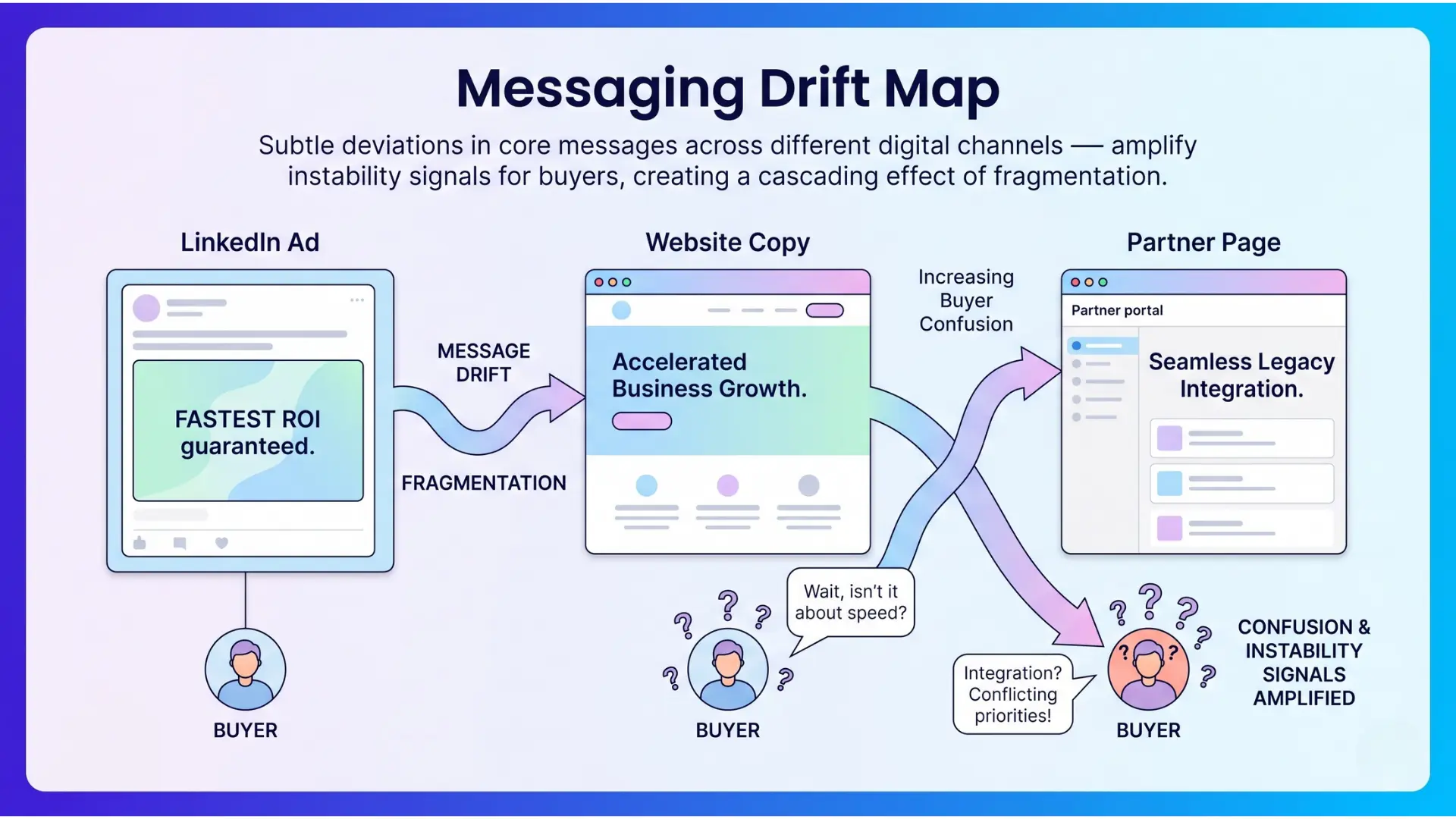
Most buyers spot a mismatch before they ever talk to sales.
One LinkedIn ad offers “zero onboarding fees”.
The website headline promises “premium onboarding at no extra cost”.
Meanwhile, a solution partner’s landing page hints at setup charges buried in the fine print.
These competing signals don’t just confuse – they broadcast instability.
When channels disagree, the question isn’t which offer to trust, but whether the company can be trusted at all.

How channel fragmentation erodes trust before buyers decide
Decades of client-side work has revealed a simple pattern: The more channels, the higher the odds that critical messaging slips out of sync, especially around pricing, promises, and outcomes.
We found that once even two customer-facing teams diverge on benefits or guarantees, buyers recognize the fracture almost immediately.
The myth?
Channel-specific customization always improves relevance.
In reality, it often seeds doubt.
Most executives underestimate how little it takes for fragmented messaging to break credibility; one off-brand nurture email can ripple through a six-figure pipeline.
Why inconsistent promises signal instability
Think of it like a house with uneven floors.
No matter how polished the kitchen is, if the hallway tilts or creaks, every guest questions the building’s safety.
The same applies to buyer trust: One lopsided promise can make the whole structure feel shaky.
That broader pattern is clearer in Brand Positioning.
How fragmentation increases friction in buyer evaluation
When buyers notice drift between sales decks, website claims, and third-party reviews, their work multiplies.
Instead of a single, coherent story, they now have to puzzle together what’s actually on offer.
This extra cognitive load doesn’t just annoy – it introduces risk, raising the odds of analysis paralysis or outright exit from the funnel.
One global SaaS client saw qualified lead conversion drop by 15% after a new product launch.
The culprit?
Campaign, web, and field teams interpreted “all-in-one” differently, sending prospects hunting for clarity that never materialized.
The channel-led messaging split forced buyers into detective mode at precisely the moment momentum was needed.
Here’s the repeatable pattern: Every messaging divergence adds friction; every friction point becomes an off-ramp.
Why would a buyer keep digging when every channel tells a slightly different story?
Would you?
Coherent positioning does the heavy lifting so buyers don’t have to.
When brands throw up obstacles – intentional or not – by splintering their voice, trust erodes before the real decision even gets made.

What causes positioning to fragment across channels
Few executives realize this: the risk of channel fragmentation starts inside your org chart, not in the market.
Before a brand’s message drifts in public, it splits at the incentive and governance level – usually invisible until sales numbers slip or buyer trust dries up.
If you’re seeing a fragmented brand experience, the divergence probably didn’t start in your ad copy.
Incentive misalignment between sales, marketing and partners
Incentive Misalignment Impact on Brand Messaging
| Indicator | Description | Impact on Buyer Perception |
| Shifting Core Claims | Public channels and sales calls present different core promises | Buyer confusion, loss of trust |
| Variable Pricing / Guarantees | Prices or guarantees change by partner or campaign | Perceived instability, distrust |
| Mismatched Pain Points | Marketing and sales highlight different problems or segments | Poor alignment, fragmented audience targeting |
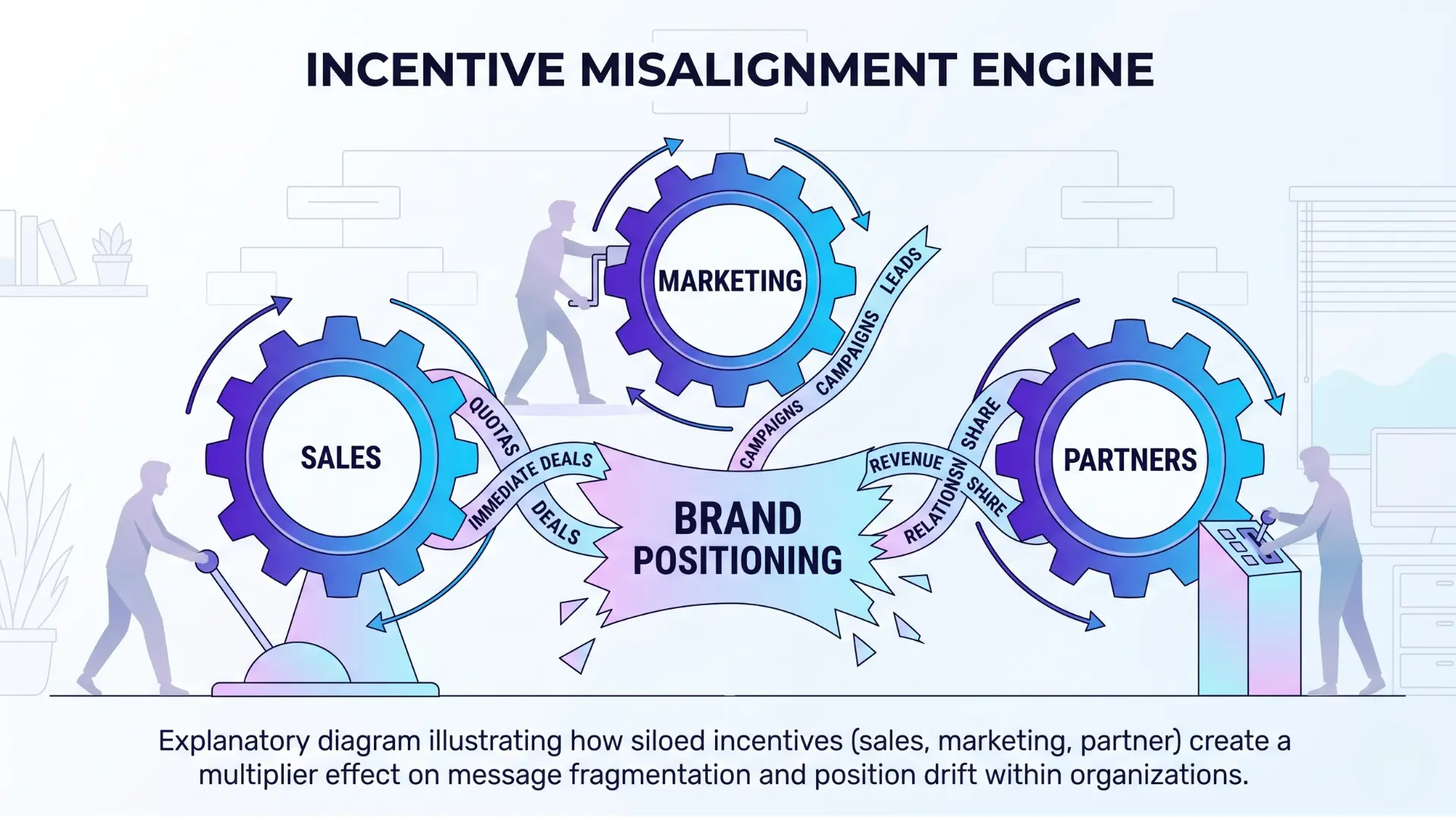
Power struggles and quota pressure quietly nudge each team to rewrite the brand story.
Sales gets comped on bookings, so reps promise speed or flexibility sales leadership never approved.
Partners chase their own margins, adapting messages for their account bases.
Marketing is judged on lead volume or awareness, so each campaign tilts the message toward attribution wins, not coherence.
The result?
Incentives don’t pull in one direction – they splinter the message line by line.
We’ve watched cross-functional teams argue over taglines in a go-to-market kickoff.
Each group believes their micro-story is more effective for “their” audience, and so fragmentation begins with good intent.
For one SaaS client, every channel head was rewarded on their own metrics.
Within six months, the same product carried three different guarantees depending on which channel owned the prospect first.
Are the best buyers confused, or are the right buyers simply never seeing the story designed for them?
The myth: more stakeholders mean more reach.
In practice, every new channel or sales overlay is a multiplier on message drift if incentives aren’t shared.
Siloed control without shared positioning logic
Fragmentation also thrives where governance gets fuzzy.
Each team publishing without a unified logic turns positioning into a game of telephone – the message morphs, drifts, or fractures entirely.
Without a single vantage point, no one catches subtle mutations until the disconnect is obvious and market-facing.
At BiViSee, we’ve seen otherwise disciplined brands run into channel-led messaging split because authority over website copy, partner pitch decks, and outbound emails was scattered.
One client had three stakeholders each “owning” a slice of messaging and none accountable for coherence.
Predictably, positioning coherence collapsed.
The analogy: it’s like multiple architects building additions on one house with no shared blueprint – every new room may look useful, but the house stops making sense as a whole.
Think about it – if your go-to-market leaders can’t recite the same value promise in the same words, why expect buyers to internalize it?
Each messaging owner, acting alone, introduces tiny variations that cascade into buyer confusion and trust erosion through fragmentation.
The longer silos persist, the less likely a unified brand story survives even a single campaign cycle.
Channel fragmentation in brand positioning isn’t an accident.
It’s incentivized and systematized by invisible structures you can – and must – surface before they choke buyer clarity.

When messaging splits mean market self‑selection breaks down
Most companies think fragmented messaging simply confuses prospects.
The bigger problem is this: when your channels don’t agree, the wrong audience walks in – and the right one quietly walks away.
Why inconsistent messaging attracts unqualified interest
If each channel tells a different story, you’re not just risking diluted brand recall.
You’re inviting prospects who match only a piece of your narrative – often the least relevant piece.
We’ve reviewed outbound programs where sales emails promised scale-as-a-service, but social channels hyped “no-code innovation” instead.
The result?
Demos loaded with buyers chasing quick wins, not long-term partnerships.
Here’s the myth: more volume means better leads.
In reality, channel fragmentation in brand positioning creates a magnet for mismatched expectations.
When messaging drifts, you’re effectively shifting the door sign every week – first advertising luxury, then affordability, then speed.
How would a customer choose which door to trust?
Inconsistent messaging across channels doesn’t just lower lead quality.
It pulls in traffic at the wrong stage of awareness – buyers who barely skim, compare on price alone, or never fit your solution.
Think of your funnel like a water filter: if the initial mesh is full of holes, debris flows through, forcing your team to strain downstream.
If you’re suddenly fielding twice as many demo requests but win rates stall, ask yourself: is channel drift overwhelming your demand filter?
How misaligned storytelling delays trust front‑loading
Most brands imagine trust is built gradually, one touch at a time.
The reality: trust is front-loaded for the best-fit buyers – their pattern match fires in seconds.
But when storytelling diverges between paid campaigns, website, and outbound, buyers lose the plot before trust has a chance to anchor.
Practically, we’ve seen this with enterprise teams where product marketing anchors stories on ROI and partnership in case studies, yet webinars center on “instant deployment”.
Prospects spot the gap fast – they hear a short-term promise but see a long-term contract.
The snap judgment?
Something’s not syncing.
They wait, delay, or vanish.
It’s like reading three introductions to the same book – each one hinting at a different genre.
Which story are you expected to believe?
Late-stage trust is rare in B2B: most buyers filter out early if signals don’t align.
The cost isn’t just lost revenue; it’s months wasted on buyers who stall, shadowbox, or simply never become advocates.
Market self-selection works only when channels work in concert.
The moment your positioning splits, you lose not only signal but also momentum.
The takeaway: channel-led messaging split is less about confusion – and more about slow leaks that drain your competitive edge.

When and where fragmentation signals deeper positioning failure
Most executives assume channel drift is a passing glitch – a clumsy email sequence here, a mismatched ad there.
But what if these mismatches aren’t isolated events, but warning flares that your entire positioning architecture is breaking down?
When noise drowns out your signal, buyers don’t just feel confused – they sense instability.
That split-second of dissonance creates more than doubt; it whispers, “This company doesn’t know who it is”.
Indicators that channel drift reflects structural collapse
Key Indicators of Structural Collapse from Channel Drift
| Team | Primary Incentive | Typical Messaging Focus |
| Sales | Bookings Quota | Speed, Flexibility |
| Partners | Margin Goals | Account-specific Adaptations |
| Marketing | Lead Volume / Awareness | Attribution Wins |
Imagine a parade where every marcher carries a different flag.
That’s what a buyer sees in a fragmented brand: promises that conflict, value props that warp, stories that never sync up.
Fragmentation stops being cosmetic when:
- Core claims shift subtly between public channels and what sales says on calls.
- Pricing frameworks or guarantees alter based on which partner or campaign is asked.
- Marketing and sales refer to different pain points, or prioritize mismatched buyer segments.
- Customers reference messaging you can’t trace – and your team can’t reconcile.
From personal experience: The most revealing signal isn’t an angry prospect, but a silent loss – opportunities go dark with no feedback, because buyers feel they’re gambling on a moving target.
One brand we worked with saw its highest-value leads stall mid-funnel when their website prioritized “speed to launch” but LinkedIn ads promoted “security and stability”.
The sales cycle doubled, then prospects quietly disappeared.
It took weeks before anyone realized buyers assumed these benefits were mutually exclusive.
Fragmented messaging isn’t “just a marketing issue”.
It telegraphs a failure of alignment deep inside your positioning logic, governance, or both.
If you’re seeing these signs, the cosmetic is now diagnostic: you’ve got to look under the hood.
What to examine next when fragmentation appears
Where do you start?
Don’t chase symptoms – focus on timing and filtering.
First, map your trust path: Which message does the buyer trust first, and does that trust survive the journey to close?
Then, audit how your demand enters and moves through the funnel: Are you filtering for fit, or letting every mismatched persona in?
Ask: Who owns messaging sign-off, and do they wield it across channels – or just their silo?
Are incentives rewarding short-term volume over long-term signal strength?
Often, we’ve seen misalignment emerge when marketing is measured on lead count and sales on pipeline quality, with no shared referee.
That gap is where fragmentation multiplies.
Here’s the analogy: Brand positioning is not a static billboard – it’s more like air traffic control.
Lose sight of each touchpoint’s role, and you risk collisions, missed signals, and buyers who never land where you want them.
True positioning coherence is visible under stress, not in the slide deck.
If fragmentation shows up repeatedly, examine who sets, owns, and polices your core logic – before the drift becomes your new brand.
Brand strength is measured not just by what you publish, but by how tightly every channel harmonizes under pressure.
Channel fragmentation isn’t a glitch – it’s a call to reexamine, realign, and decide who you really are.
Fragmentation prevents trust from compounding.

Scientific context and sources
The sources below provide foundational context for how decision-making, attention, and performance dynamics evolve under scaling and constraint conditions.
- Organizational message alignment under complexity
Brand Orientation: A Strategy for Survival – Mats Urde – Journal of Consumer Marketing
This foundational paper explains why unified brand management and coherent organizational brand thinking are strategically necessary to avoid fragmented market signals and erosion of trust across channels.
https://www.emerald.com/jcm/article/11/3/18/188348/Brand-Orientation-A-Strategy-for-Survival - Cognitive load and fragmented information processing
Cognitive Load Theory – John Sweller – Psychology of Learning and Motivation
This research explains how excessive or conflicting information increases cognitive burden, reducing processing quality and decision effectiveness – directly supporting the claim that fragmented messaging drives mistrust or disengagement.
https://www.sciencedirect.com/science/article/pii/B9780123876911000028 - Trust formation and erosion in complex environments
An Examination of the Nature of Trust in Buyer-Seller Relationships – Doney, P.M., Cannon, J.P. – Journal of Marketing
This landmark empirical study explains how trust forms in repeated commercial interactions and how uncertainty increases dependence on credibility signals, directly supporting the consistency argument.
https://doi.org/10.1177/002224299706100203 - Incentive misalignment and corporate fragmentation
Strategy and Structure: Chapters in the History of the Industrial Enterprise – Alfred D. Chandler Jr. – MIT Press
This classic work shows how organizational structure shapes coordination, communication, and strategic execution, supporting the argument that silos and incentive misalignment can fragment external positioning.
https://mitpress.mit.edu/9780262530095/strategy-and-structure/ - Self-selection, fit, and efficiency in marketplace systems
Matching Markets and Market Design – Alvin E. Roth – American Economic Review
This research explains how better matching between participants improves market efficiency and outcomes, directly supporting the argument that poor fit between buyers and suppliers creates acquisition inefficiencies and operational friction.
https://www.jstor.org/stable/26528517
Questions You Might Ponder
How does channel fragmentation in brand positioning impact buyer trust?
Channel fragmentation in brand positioning creates inconsistency across communication touchpoints, signaling instability or unreliability to buyers. When brand promises vary by channel, buyers may question the company’s credibility and hesitate to engage, ultimately undermining their willingness to commit or purchase.
Why do internal incentives cause brand messaging to splinter?
Misaligned incentives encourage sales, marketing, and partner teams to tailor messaging for their own targets, often at the expense of consistency. As each group optimizes for its own metrics, the brand’s core promise diverges, leading to fragmented communication that confuses buyers and weakens positioning.
What are the performance risks of fragmented brand messaging?
Fragmented messaging raises cognitive friction for buyers, making them work harder to understand offers. This increases analysis paralysis, slows conversions, and can drive high-value buyers to exit the funnel or lose interest, ultimately reducing lead quality and overall revenue efficiency.
How can organizations detect early signs of brand positioning fragmentation?
Early detection involves monitoring for subtle shifts in messaging between channels – such as differing claims on websites, ads, and sales calls – or when internal teams cannot consistently articulate the value proposition. Consistent buyer confusion or silent deal losses are also strong diagnostic signals.
What happens to market self-selection when channels are misaligned?
When messaging varies across channels, the wrong prospects are attracted while ideal buyers disengage. This misalignment lowers overall lead quality, clogs the sales funnel with unqualified opportunities, and causes wasted cycles on customers who may never be a true fit for the offering.