
What You’ll Learn
Trust resets under inconsistent positioning are moments when buyers lose accumulated confidence because a brand’s message, promise, value claim, or proof changes across touchpoints.
Instead of trust fading slowly, inconsistency forces buyers to restart evaluation, ask basic questions again, compare alternatives, request more proof, or delay decisions.
This happens when ads, website copy, sales decks, emails, onboarding materials, partners, or internal teams communicate different meanings.
Each contradiction signals instability and makes buyers wonder what else may be unclear or unreliable.
Strong positioning prevents trust resets by repeating stable meaning across the full buyer journey so trust can compound instead of restarting at every interaction.
Key Takeaways
- Inconsistent positioning across touchpoints forces buyers to reset trust, restarting evaluation cycles and neutralizing prior rapport.
- Fragmented messaging prevents trust from compounding, leading to stalled sales and repeated buyer skepticism.
- Channel drift and internal misalignment commonly trigger trust resets by introducing contradictory narratives.
- Stable, repeatable meaning at every interaction is essential for trust accumulation and efficient conversions.
Most leaders assume that trust is like a bucket you only need to fill higher – but the moment buyers sense a crack in your brand positioning, that bucket dumps out completely.
One wrong message or inconsistent touchpoint isn’t a leak; it forces buyers all the way back to their initial skepticism, instantly neutralizing months of effort.
Ever notice how a single jarring email, rogue ad, or mismatched sales call can erase all prior conviction?
That’s not fade – it’s a hard trust reset, and it happens faster than most realize.

When positioning signals contradict, trust doesn’t just fade – it resets
The real myth: trust decays gradually when brands get sloppy.
Our work shows the opposite is true.
When a buyer spots a contradiction – an ad that overpromises while the website hedges, or a salesperson with a different pitch from the product team – their brain instantly flags risk.
It’s like hearing someone switch accents mid-sentence; you question everything they said before.
Why inconsistent touchpoints trigger new evaluation cycles
We’ve seen skeptical buyers go from verbal buy-in to total comparison shopping in one interaction.
One tech client watched high-intent leads restart evaluations after encountering a conflicting onboarding email, undoing weeks of nurture in a single touch.
Repetition breeds comfort, but contradiction triggers survival mode – buyers treat each inconsistency as a reason to double-check, not to trust.
Here’s the core: every inconsistency reopens the “should I trust this?” loop – forcing a reset, not a slow erosion.
Two rhetorical questions guide decisions: “What else is this team hiding?” and “Do I need to start over?” When you force buyers to answer those, you lose all accumulated trust.
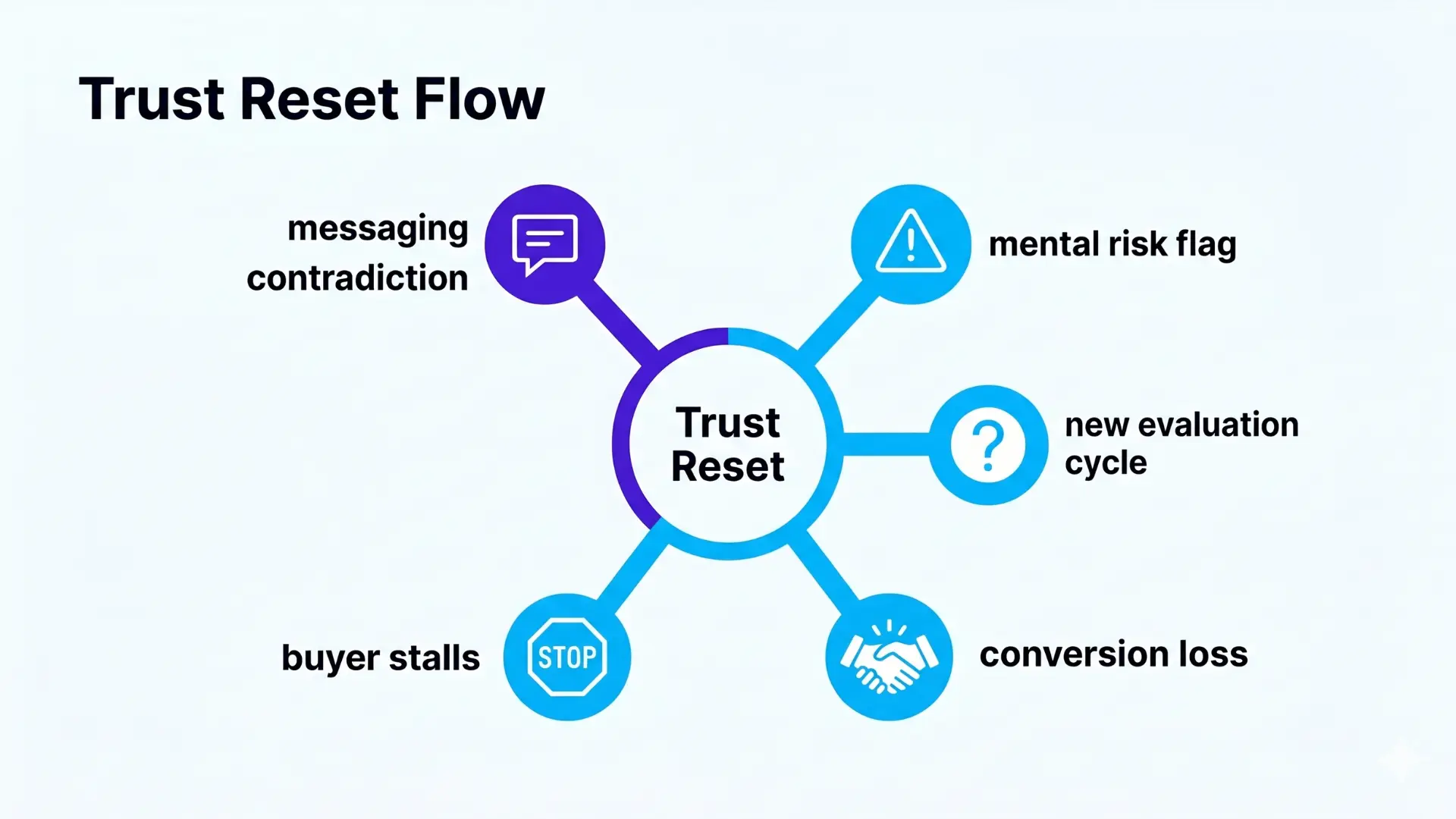
How fragmented meaning interrupts trust building
Think of trust as a savings account: every aligned interaction is a deposit, but one ambiguous withdrawal can empty the balance.
Without a consistent narrative, buyers can’t stack signals over time, so trust can’t accumulate.
We’ve seen clients with multiple landing pages, each “optimizing” for conversions, accidentally splinter core value props.
The result?
Trust compound failure.
Instead of one clear story growing in the buyer’s mind, there’s a jumble – a brand Rorschach.
If meaning shifts, buyers can’t anchor belief.
They become evaluators again, not partners.
Fragmented meaning stops trust from becoming durable.
In practical terms: prospects circle repeatedly, asking the same clarifying questions, stalling decisions, or even ghosting.
Stable meaning is the foundation for trust that stacks – fragment it, and you force buyers to start from scratch every time.
Trust doesn’t drain away gently when positioning slips.
It resets, and every reset increases skepticism and friction.
When you lose coherence, you force your audience into endless re-evaluation – and that’s how deals die before they begin.
A related decision is covered in Why Consistent Positioning Becomes a Trust Signal, which explains the adjacent issue in more detail.

What causes positioning coherence to collapse mid-journey
Most teams think a polished brand guide or strong first impression keeps positioning consistent.
In reality, it’s the mid-journey touchpoints – where your own house starts leaking different stories – that quietly trigger risk perception and interrupt trust.
You might not even see it happening until conversion rates stall or high-intent prospects suddenly flip to indecision.
Why?
Because buyers monitor for meaning stability across every channel, not just the first handshake.
Channel drift: how different narratives create risk perception
Examples of Channel Drift: Conflicting Positioning Across Channels
| Symptom | Description | Effect on Sales Process |
| Repeated Requests for Case Studies or References | Buyers ask multiple times for the same proof points due to lack of trust anchoring | Slows cycle, increases manual effort |
| Extended Sales Cycles | Buyers circle back on basic questions repeatedly | Delays decision-making and deal closure |
| Full Pipeline but Low Conversion Rates | Leads stall or ghost late in funnel despite initial interest | Wastes resources, inflates acquisition costs |
| Prospects Re-evaluate Credibility from Scratch | Every contradictory touchpoint forces buyers to reset trust | Creates friction and reduces momentum |
Imagine visiting three branches of the same bank.
Each uses a different logo, describes their services in conflicting terms, and quotes opposing policies.
You don’t just get confused – you instantly worry about their internal control.
That’s channel drift.
In digital, channel drift is subtler but just as costly.
We’ve watched companies spend months refining a core narrative, only to watch their paid ads, social profiles, and sales decks each deploy watered-down or contradictory claims.
A prospect reads one positioning on LinkedIn (“premium solution, no shortcuts”), but clicks through to a landing page that suddenly emphasizes “affordable and fast”.
Instead of feeling reassured, they wonder: which is it?
If the answer changes by channel, what else changes under stress?
Here’s the myth: that most buyers will average out your messages into something consistent.
They don’t.
They spot contradictions and mentally escalate the risk, treating every unexpected difference as a potential sign of instability.
Channel drift slows the trust accumulation process to a crawl, as buyers hesitate to move forward until the underlying meaning is clear across all touchpoints.
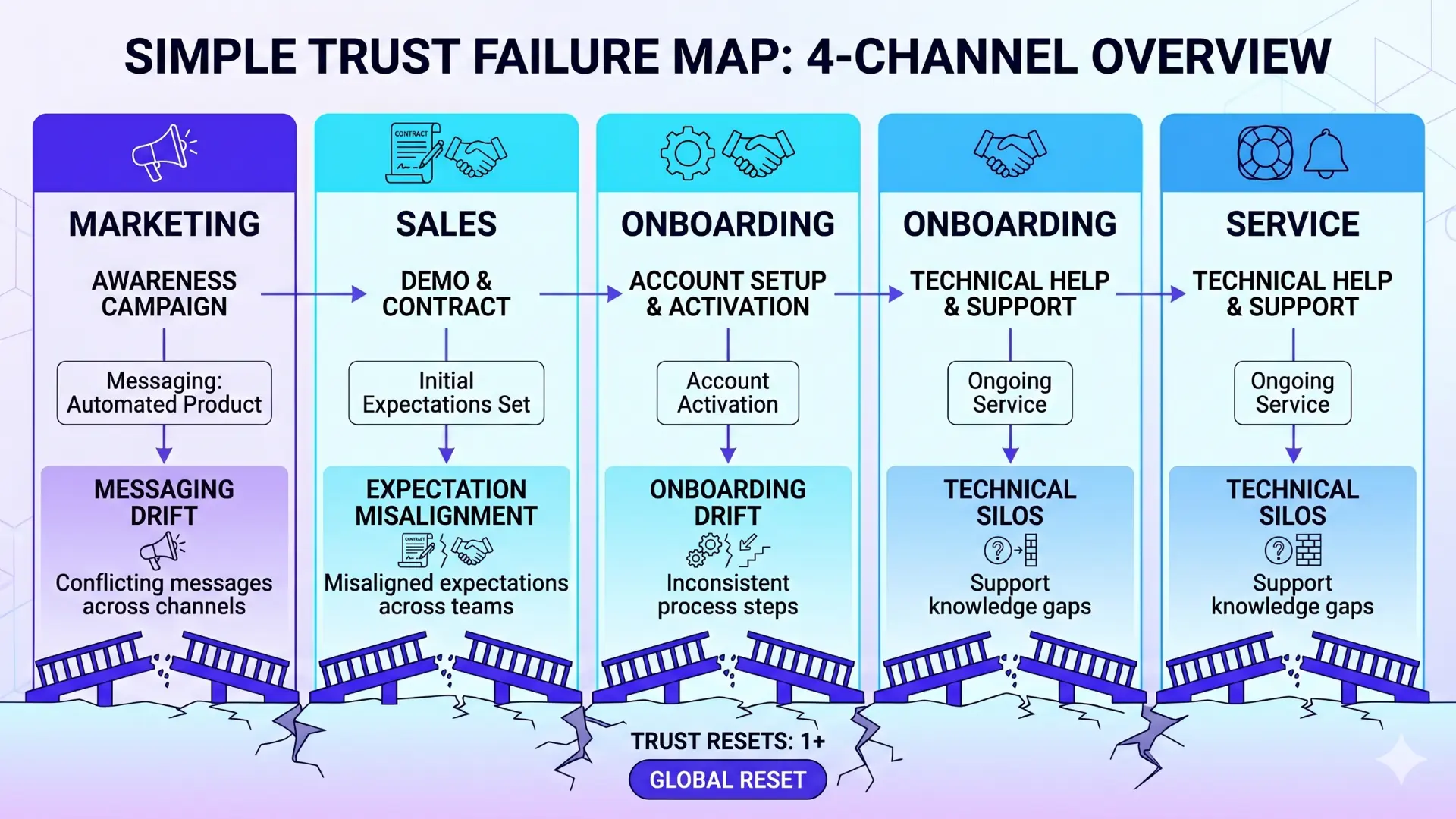
Internal misalignment: when teams dilute positioning consistency
Some positioning failures start with the brand team, but many originate inside the organization.
Think of positioning as a script: once the marketing team steps offstage, the rest of the company needs to keep reading the same lines – or the illusion breaks.
We’ve seen this fracture inside sales calls, onboarding documents, even support tickets.
For one tech client, every department believed they “knew the real USP”, resulting in meetings where two execs explained completely different value props to the same prospect.
This is more than sloppy execution; it’s a trust compound failure.
Every contradictory message forces the buyer to restart their evaluation, draining pipeline momentum and creating an endless series of clarifications.
Why does this internal drift happen?
In high-velocity companies, departmental silos evolve quickly.
Sales rewrites the deck to win tactical objections.
Success teams promise a feature roadmap different from what marketing promoted.
The net effect: even strong external campaigns can’t compensate for fractured internal messaging.
When trust is forced to rebuild at every handoff, your funnel is leaking not just leads, but belief.
Positioning coherence isn’t just a branding matter – it’s structural.
Once drift appears, trust resets aren’t a glitch; they’re a symptom.
The sharper your internal and external alignment, the faster trust can accumulate without interruption.

Why trust can’t compound without stable meaning across touchpoints
Most teams believe adding new proof points or features accelerates trust – but trust doesn’t stack unless buyers see meaning repeated, not reinvented, every time they interact with you.
The risk no one mentions: every novel message triggers doubt, not delight.
Would you trust a pilot who announced a new flight plan with each safety briefing?
That’s how buyers feel when your sales deck, website, and follow-up emails each promise something slightly different.
Trust stacking fails when signals aren’t repeated predictably
The fastest way to break trust accumulation is to change your story with every touch.
Buyers don’t crave variety – they scan for reliable signals to shortcut evaluation risk.
In our work with B2B SaaS clients, deals routinely stalled when product messaging adjusted between campaign, sales, and onboarding touchpoints, even if every piece was well-crafted.
Repetition builds subconscious conviction: if the meaning behind your offer shifts, confidence in your promise evaporates.
Here’s what’s missed: Trust functions less like a savings account and more like a game of Jenga.
Add stable pieces, and you can build real height.
Introduce unpredictability, and the whole stack collapses.
Ask yourself: the last time a prospect ghosted after a strong demo, was your story the same throughout – or did you introduce a new “key differentiator” at the eleventh hour, forcing them back to square one?
Reset cost: friction, comparison, and conversion delays
Every time trust resets, you lose more than just goodwill.
Friction piles up – buyers feel they must start another research cycle because meaning stability has collapsed.
We’ve seen enterprise deals delayed months after a region shared a slightly modified proposal deck, injecting unnecessary doubt and triggering new rounds of comparisons.
Conversion slows; win rates drop as buyers hesitate or, worse, invite new vendors in for a fresh perspective.
Reset costs compound invisibly: your team blames pipeline quality, but the real leak is positioning inconsistency forcing buyers to re-qualify you with each contact.
The bottom line: Trust only compounds when your meaning remains stable across all touchpoints.
Break the pattern, and every deal starts from zero again – regardless of funnel stage.

When every interaction feels like starting over, positioning has broken
Most teams blame lead quality or sales execution when deals slip, but the real signal is subtler: every conversation feels like déjà vu – for buyers and sellers.
Imagine buyers forced to retell their story, restate their goals, or re-justify their interest each time.
That’s not engagement.
It’s friction – evidence of a trust reset in motion.
Symptoms of reset-driven friction across the funnel
Key Symptoms of Trust Reset-Driven Friction in the Sales Funnel
| Channel | Positioning Message | Impact on Buyer Perception |
| LinkedIn Ad | “Premium solution, no shortcuts” | Builds perception of high quality and exclusivity |
| Landing Page | “Affordable and fast” | Confuses buyer about brand promise, raising doubts |
| Sales Deck | “Best-in-class innovation” | Potentially contradicts pricing/offering, adding uncertainty |
| Customer Support | “Flexible and customizable” | May conflict with sales messaging, causing mixed signals |
The myth is that friction means “harder to close deals”.
In reality, it means your prospective buyers are stuck in a loop, re-evaluating your credibility from scratch every time something doesn’t add up.
Watch for these behavioral warning signs:
- Buyers request the same case study or reference multiple times, unable to anchor meaning.
- Sales cycles stretch as buyers keep “circling back” on basics, signaling reset cost is accumulating.
- Pipeline appears full, but conversion rates quietly erode – leads stall, then ghost at the decision point.
We’ve seen clients misdiagnose these symptoms as just being “bad fit” leads.
But the real cause is trust accumulation interruption.
Like trying to climb a staircase where half the steps vanish beneath your feet, each touchpoint contradiction kicks buyers back to zero – resulting in more manual effort, more filtering, and ballooning acquisition costs.
Notice how much internal time is wasted clarifying, not convincing.
That’s your trust compound failure in action.
Why you perceive leads as unqualified when trust keeps resetting
It feels like your funnel is attracting the wrong crowd, but ask yourself: is the problem your traffic, or your message’s coherence?
When trust resets happen repeatedly, qualified buyers start to look and act exactly like bad leads – they hesitate, they ask “obvious” questions, they price-shop aggressively, or they disappear entirely.
Our team has seen well-targeted campaigns fill the pipeline with seemingly off-target prospects, only to discover it wasn’t a traffic quality issue.
The real problem was meaning stability trust: inconsistent positioning forced even perfect-fit buyers to reevaluate, filter themselves out, or postpone until something felt familiar and safe.
Think of it like magnetism – the stronger and steadier your brand signal, the more naturally ideal buyers are pulled forward.
Break the signal, and even the best leads bounce away.
If every sales call, demo, or inbound lead feels like repeating the same elevator pitch from zero, that’s not a resource problem – it’s a foundational positioning problem.
The trust reset loop is the symptom.
Restoring coherence is the cure.

Scientific context and sources
The sources below provide foundational context for how decision-making, attention, and performance dynamics evolve under scaling and constraint conditions.
- Trust Dynamics in Market Exchanges
Trust and Distrust in Organizations: Emerging Perspectives, Enduring Questions – Roderick M. Kramer – Annual Review of Psychology
This seminal review examines how trust forms, erodes, and becomes difficult to rebuild under uncertainty, directly supporting the argument that trust in complex market exchanges is fragile and highly signal-dependent.
https://doi.org/10.1146/annurev.psych.50.1.569 - Effects of Inconsistent Brand Communication
Integrated Marketing Communications: Measuring Its Impact on Brand Performance – Reid, M. – Journal of Advertising Research
This research shows that fragmented or poorly integrated brand communications weaken brand coherence and reduce effectiveness, directly supporting the argument that inconsistency across touchpoints damages long-term brand credibility.
https://www.tandfonline.com/doi/abs/10.1080/00913367.2014.934938 - Cognitive Mechanisms Underlying Trust Reset
The Neurobiology of Trust – Zak, P.J., Kurzban, R., Matzner, W.T. – Annals of the New York Academy of Sciences
This peer-reviewed research explains the biological mechanisms behind trust formation and rapid trust reassessment when signals conflict, supporting the claim that humans quickly re-evaluate trust under inconsistency.
https://doi.org/10.1196/annals.1314.025 - The Consistency Principle in Consumer Psychology
Consumer Response to Negative Publicity: The Moderating Role of Commitment – Ahluwalia, R., Burnkrant, R.E., Unnava, H.R. – Journal of Marketing Research
This research shows that consistency between prior brand beliefs and incoming signals strongly affects trust judgments and consumer decision confidence, supporting the strategic importance of coherent brand narratives.
https://doi.org/10.1509/jmkr.37.2.203.18734 - Organizational Silence and Internal Drift
Organizational Silence: A Barrier to Change and Development in a Pluralistic World – Morrison, E.W., Milliken, F.J. – Academy of Management Review
This foundational research shows how unresolved internal communication failures suppress critical information flow, creating execution breakdowns and strategic drift that can later surface as inconsistent market messaging.
https://doi.org/10.5465/amr.2000.3707697
Questions You Might Ponder
What happens when brand messaging becomes inconsistent across channels?
When brand messaging is inconsistent across channels, buyers quickly detect contradictions and mentally flag risk, causing a hard reset of trust. This triggers re-evaluation of your offering, delays decisions, and often leads to increased skepticism or lost sales – undermining prior relationship-building efforts.
Why is trust reset more damaging than slow trust erosion in B2B sales?
Trust reset is more damaging because it instantly neutralizes months of accumulated rapport, pushing buyers back to their initial hesitation. Unlike gradual loss, a reset causes buyers to question your credibility, prompting comparison shopping or disengagement, which stalls or kills the buying decision.
How does internal misalignment between teams affect customer trust?
Internal misalignment – such as different departments presenting conflicting unique selling points – undermines customer trust by generating doubt and confusion. Prospects encountering mixed messages are forced to restart their evaluation, increasing deal friction and lengthening or derailing the sales cycle.
How can brands prevent trust resets under inconsistent positioning?
Brands can prevent trust resets by establishing stable, repeatable positioning across all touchpoints. This requires cross-departmental alignment, frequent audits for message coherence, and training teams to keep the value narrative consistent, reducing the risk of contradiction and building durable buyer confidence.
What signals indicate a trust reset is happening in the sales funnel?
Signals include buyers repeatedly asking for basic information, requesting case studies again, hesitating or stalling at late stages, and more ghosting at decision points. These behaviors often indicate prospects have lost meaning stability and are re-evaluating your brand from scratch due to inconsistent positioning.