
What You’ll Learn
Default positioning is the unintended market meaning a brand receives when it fails to define a clear, distinctive position for itself.
Instead of seeing the brand’s unique value, buyers use familiar category shortcuts and treat it as “just another option”.
This usually happens when messaging is neutral, vague, contradictory, or too similar to competitors.
Default positioning weakens trust before the sales conversation begins, pushes buyers into price and feature comparisons, attracts lower-intent leads, and slows decisions.
For brands, the risk is that the market defines them by what they failed to say, not by the value they intended to communicate.
Key Takeaways
- Default positioning causes the market to view brands as generic commodities, undermining differentiation and value.
- Silence or neutral messaging leads buyers to use their own mental shortcuts, resulting in low urgency and poor-quality leads.
- Unclear or conflicting positioning erodes trust early, causing lengthy sales cycles and stalled deals regardless of product quality.
- Proactive, distinctive positioning is essential for earning trust, shortening sales cycles, and avoiding price-based competition.
Most companies think remaining neutral keeps options open.
In reality, the market hears your silence as “more of the same” – and promptly files you away as another commodity.
The myth: letting product, service, or team “speak for itself” shows strength.
But the real translation?
You’ve opted out of the meaning game, giving buyers all the permission they need to lump you with the crowd.

Why default positioning forms when you stay silent
We’ve seen this firsthand – brands with solid products, but no explicit point of view, get mistaken for knockoffs or “safe-choice” vendors.
Buyers don’t read blank space as potential; they read it as a lack of difference.
It’s like walking into a showroom where every car is painted the same generic gray, hood-to-trunk, badge to bumper.
Why assume one is special?
Silence becomes positioning: how neutrality is interpreted
Without deliberate framing, the market doesn’t give credit for nuance.
Instead, it assigns unintentional brand positioning: “yet another option” at best, “forgettable” at worst.
What seems like strategic restraint actually signals under-positioning and sameness.
How default assumptions shape entry behaviors and comparisons
What happens when the market doesn’t get a strong signal?
Potential leads default to their own mental shortcuts – usually assuming what you offer is like every other generic provider in your space.
Entry behavior shifts: prospects arrive with low urgency, sketchy clarity, and expectations built on the last pitch they heard, not your true strengths.
And they start filtering you out before you even know you’re up for consideration.
In client audits, we repeatedly diagnose lower initial lead quality for brands with unclear positioning than those with bold, even polarizing, stances.
Default positioning leads to lazy, checkbox-style comparisons: “How are you different than X?” or “What makes you better than Y?” That question is only asked when the answer isn’t already obvious.
There’s a hard truth here – a brand that fails to define itself leaves buyers searching for meaning.
If you aren’t proactively shaping the opening narrative, the market makes up its own story about your value.
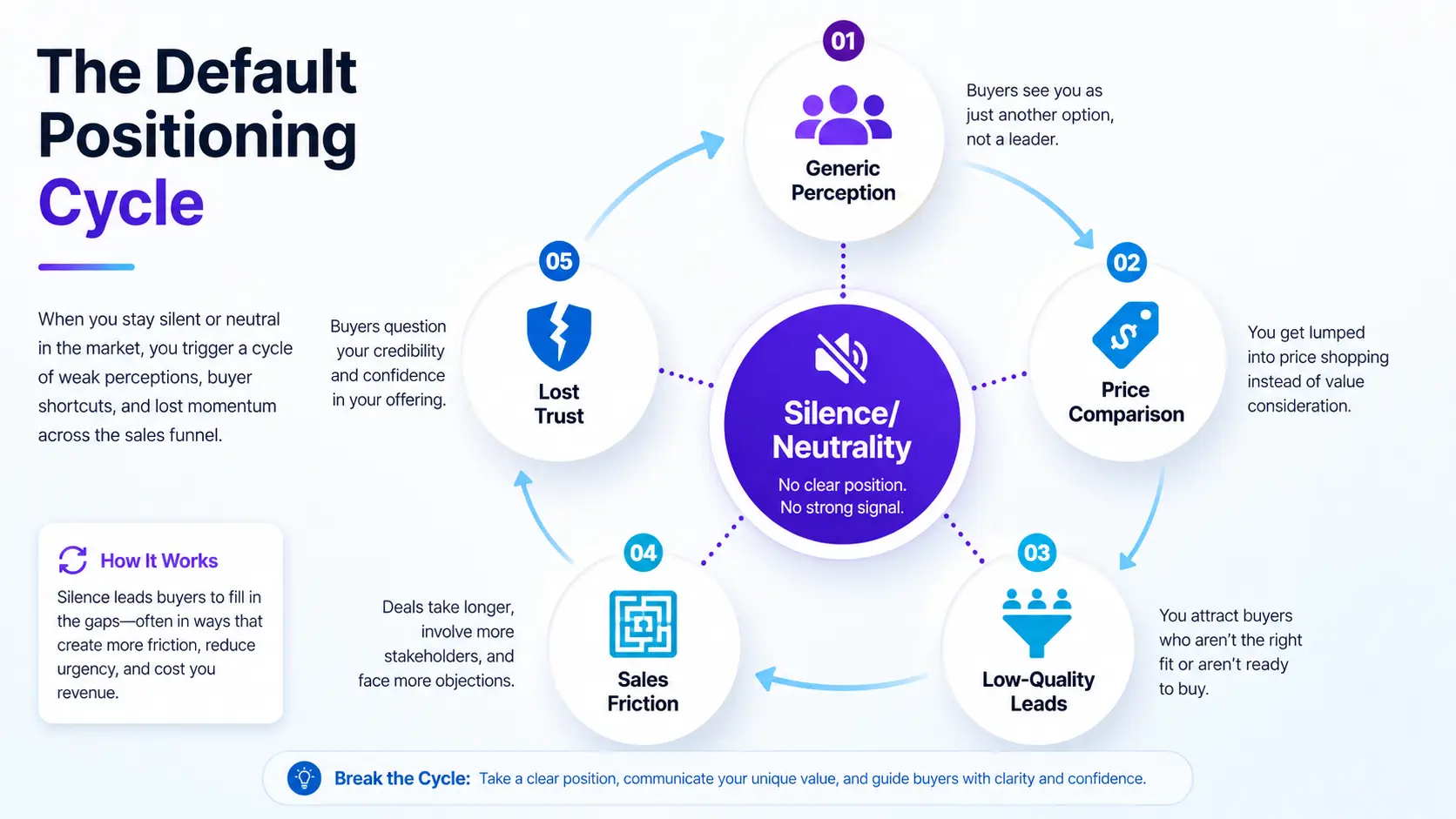
Why default positioning breeds friction downstream
Letting the market define your brand isn’t just a risk at the entry point – it builds drag all the way down the funnel.
When you start from a place of sameness, every interaction becomes a defense: proving you’re not generic, trying to justify pricing, wrestling for attention against interchangeable alternatives.
Teams end up spending sales cycles re-educating, battling misperceptions, and fielding deals that stall or vanish because urgency never materialized.
Inquiry turns to interrogation.
Decision-makers gravitate to safe, minimal-risk choices – or pause entirely.
It’s like running through sand: every step demands more effort, speed slows, and there’s constant slippage.
Friction isn’t just annoyance – it’s lost velocity and lost opportunities shaping tomorrow’s pipeline.
Default positioning isn’t neutral ground.
It’s an open invitation for the market to ignore you or, worse, decide for you.
The companies that win are the ones that shape the story before anyone else can.

Common failure modes within default positioning
Common Failure Modes in Default Positioning
| Aspect | Category Default Positioning | Desired Brand Positioning |
| Market Perception | Seen as just another option; lumped into commodity category | Recognized for unique value and distinctive strengths |
| Competitive Focus | Price becomes primary comparison metric | Value and differentiation drive decision-making |
Most leadership teams don’t see it coming: the default position isn’t just invisible – it’s actively costing you deals.
The silent signal you send isn’t “open for anything” – it’s “not worth choosing”.
And when your market peeks inside, what they find isn’t intriguing variety, but a blur that feels safe to ignore.
Under‑positioning: when nothing sets you apart
There’s a recurring myth that playing it safe – sticking to broad claims or waiting for the product to speak – will at least get you in the running.
It won’t.
Under-positioned brands fade into the competitive wallpaper.
In client diagnostics, we’ve seen sales teams forced to lead with lowest price because prospects genuinely cannot name a single thing that makes the solution distinct.
Vendor shortlists become arbitrary because every pitch sounds interchangeable: “innovative”, “trusted”, “flexible” – meaning none of them are memorable.
Think of under-positioning like entering a crowded room wearing a gray suit, identical to everyone else – you’re forgettable before you even say a word.
When nothing stands out, buyers default to the safety of the known leader or the aggressive discounter.
The catch?
Those left in the middle never control the conversation – or win the urgency battle.
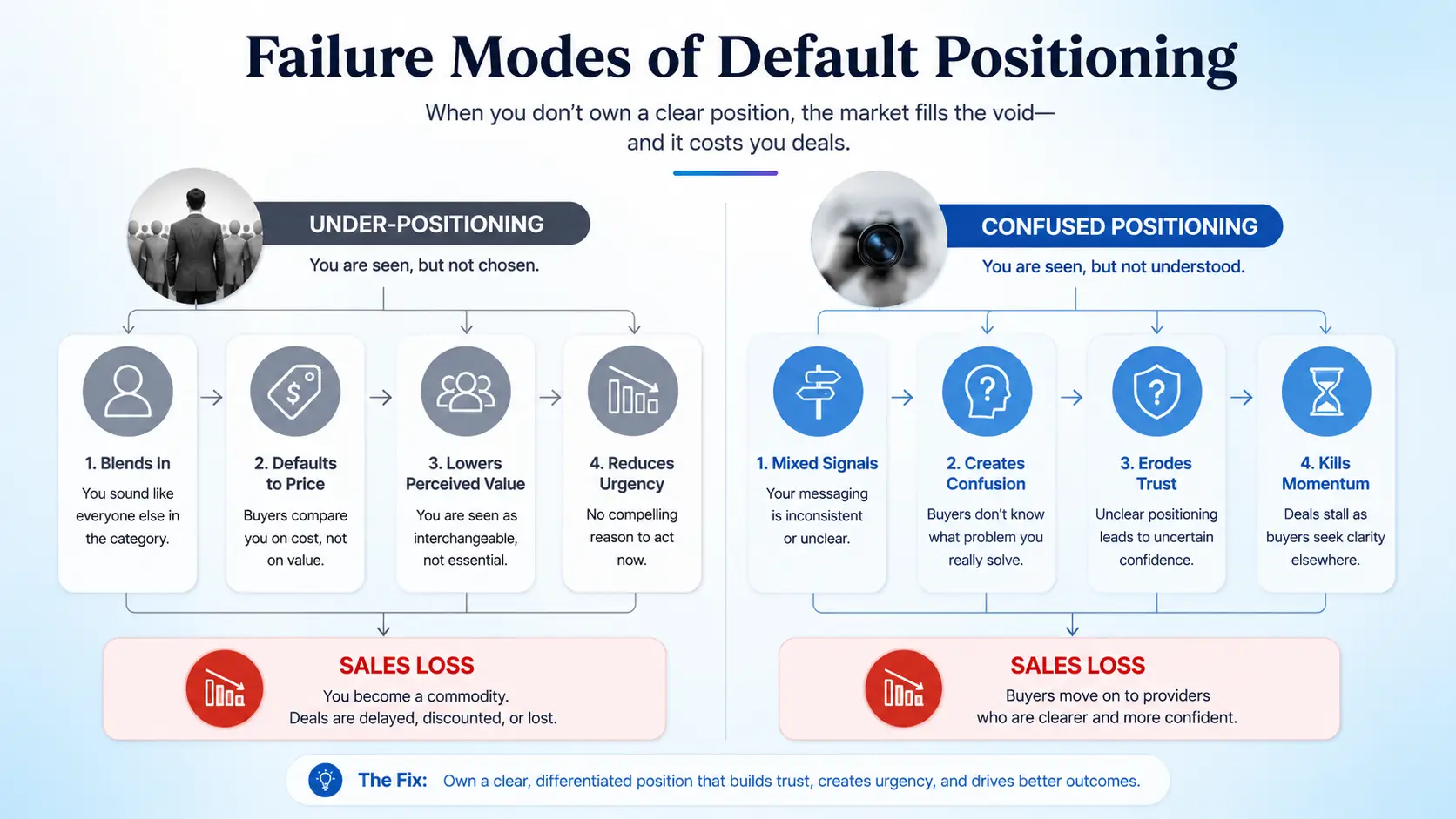
Confused positioning: being too many things to everyone
Trying to be everything is the fastest way to be nothing.
Executives sometimes believe that layering on offerings or flexing brand messages makes them versatile.
In reality, it breeds confusion.
We’ve seen firms market themselves as both premium and budget-friendly, or as a tech innovator and a legacy safe bet.
The result: buyers hesitate.
Internally, teams can’t immediately explain what field they’re playing on.
Externally, prospects struggle to categorize – which delays decisions and lowers trust.
Does your pitch leave prospects saying, “Wait, so what *are* they, exactly?”
Confused positioning acts like a blurry photo: buyers squint, wait, and ultimately move on to the next clear picture.
When clarity drops, so does perceived leadership – and hesitation grows.
If you don’t give the market a clear story to spread, they invent their own, and you won’t like the result.
Every time positioning is vague or contradictory, you lose the power to influence who comes your way and how fast they act.
The real cost isn’t just lost deals – it’s invisibility when you should be chosen.

How default positioning breaks trust before it begins
Most teams believe that if they leave their brand meaning “open”, trust will form naturally over time.
In practice, the opposite happens – unclear positioning quietly erodes trust before you even speak to a prospect.
You can have flawless deliverables, but if the initial perception is muddy, the relationship is strained right out of the gate, whether you notice it or not.
Why trust doesn’t form when meaning is unclear
Imagine being asked to invest in a company, but you can’t figure out what it actually does from the first conversation.
Suspicion – not excitement – takes over.
Buyers don’t grant the benefit of the doubt; they freeze, scan for hidden risks, and build defensive checklists to protect themselves.
This is not a rational delay – it’s reflex.
When positioning is ambiguous, market-assigned meaning (or unintentional brand positioning) fills the void, usually by flattening your identity to a generic category.
“If you’re not claiming a clear specialty, you must be just another option”, they conclude.
We’ve seen leads drop off simply because they sensed a company’s message was slippery.
Even subtle under-positioning, where you use familiar phrases without real definition, acts like static: the signal never resolves, so buyers don’t lean in.
In boardrooms, this costs confidence.
In the funnel, it costs trust long before any objections surface.
Trust cannot compound if the foundation is muddy – clarity and conviction are the ante.
Consequences of delayed trust on evaluation and exit decisions
Delayed trust compounds losses.
Deals that should close quickly turn into endless rounds of clarification and side-by-side comparisons.
Sales cycles stretch.
Hesitation infects every decision: is this vendor safe?
Can I explain this solution to my boss without embarrassment?
Instead of fast-tracking high-fit leads, unintentional sameness invites nitpicking and stalls – even from promising accounts.
Picture default positioning as showing up to a negotiation with a blurred name tag.
Every step after requires costly explanations and over-justification; by the time clarity arrives, your competitor may have already won on trust alone.
Worse, misaligned or weak expectations at the start mean even good delivery later can’t rescue the exit.
Opportunities vaporize mid-deal – not for lack of capability, but because that early feeling of “I know what I’m dealing with” never arrived.
Trust builds fastest when your position reads as obvious and sharp in the first ten seconds.
If the market must guess – or asks you to chase, prove, and explain – you are losing before the real evaluation begins.

When the market defines you: unintended positioning risks
Most teams don’t realize the most dangerous identity is the one stamped on you by default.
You may have built your entire brand on quality, service, or innovation, but if your category frames you as “just another option”, the market cares far less about your intentions than the context it’s given.
Your best effort gets filtered through someone else’s value system – and that filter almost always grinds down your worth.
How category defaults trap you into price comparisons
Category Defaults vs. Desired Brand Positioning
| Failure Mode | Description | Internal Impact |
| Under-positioning | Nothing sets you apart; generic claims or no clear differentiation | Sales teams forced to compete on price; no control of conversation |
| Confused positioning | Trying to be many things to everyone; mixed or contradictory messages | Internal confusion on market position and messaging |
Here’s the risk most leaders underestimate: If your positioning leaves a blank space, buyers automatically slot you into whatever category shorthand feels familiar.
Suddenly, you’re sitting in a six-vendor spreadsheet, where column one is logo, column two is price.
Everything unique collapses into commodity math.
We’ve seen even well-funded startups relegated to the bottom row for nothing but “compliance with specs” – all their innovation erased in a single purchasing cycle.
It’s the silent commercial risk that comes from what we call “positioning by default”.
Category defaults are like gravity.
Unless you define a different vector, the pull drags you straight to lowest price wins.
The assumption that “our value speaks for itself” is the silent myth – category logic doesn’t reward nuance; it rewards speed and safety.
Do you want to compete on cost alone, or do you want your brand to stand for a specific choice?
When competitors have been here longer, they shape the category logic – your silence gets you priced out by whoever is willing to go lower, faster.
Why similarity invites low-intent leads and stalled sales
If your messaging overlaps with default market language, you don’t attract the leads you’ve earned – you inherit the leads everyone else rejects.
We’ve seen growth teams wonder why their pipeline is filled with “tire kickers” or why demo requests convert so poorly, only to trace it back to default framing: the market interpreted their offer as generic, risk-free to inquire but not compelling enough to decide.
Think about it like a line outside a bland new restaurant: curious strangers wander in, but rarely order twice.
When lead quality suffers, sales cycles drag; every evaluation feels endless because similarity never gives buyers permission to move fast or say yes.
Similarity repels discipline – buyers treat you as interchangeable, so urgency and conviction vanish.
Markets simplify by collapsing brands into categories, as outlined in Category Compression.
If you let the market supply your meaning, you lose control of every conversation that matters.
In the end, default positioning isn’t neutral – it’s active permission for the market to define you by what you failed to say.

Scientific context and sources
The sources below provide foundational context for how decision-making, attention, and performance dynamics evolve under scaling and constraint conditions.
- Market Neutrality and Perceived Value
Brand Positioning: Strategies for Competitive Advantage – Subroto Sengupta – Tata McGraw-Hill
This academic book explains why brands that do not actively differentiate themselves are often perceived as generic, with discussion on positioning, competitive perception, and buyer evaluation.
https://books.google.com/books/about/Brand_Positioning.html?id=vyl30AEACAAJ - Buyer Decision Heuristics in Competitive Markets
A Review of Consumer Judgment and Choice – Michael D. Johnson, Christopher P. Puto – Cornell University
This review explains how buyers use simplified judgment and choice processes when comparing options, especially under uncertainty or complexity.
https://ecommons.cornell.edu/server/api/core/bitstreams/690571f1-d3c5-4b77-8dda-b36c8aba063e/content - Trust Formation and Organizational Clarity
The Dynamics of Organizational Identity – Mary Jo Hatch & Majken Schultz – Human Relations
This study explores how organizational identity shapes external interpretation, image, and stakeholder perception when messaging is unclear or inconsistent.
https://journals.sagepub.com/doi/10.1177/0018726702055008181 - Default Decisions and Category Framing
Choice Architecture – Richard H. Thaler, Cass R. Sunstein & John P. Balz – University of Chicago Booth School of Business
This paper explains how defaults, framing, and decision environments shape choices, supporting the idea that weak positioning pushes buyers toward generic categorization.
https://faculty.chicagobooth.edu/-/media/faculty/richard-thaler/assets/files/choice-architecture.pdf - Brand Commoditization and Its Consequences
Commoditization in the U.S. Lodging Industry – Srikanth Beldona, Brian Miller, Tiffany Francis, Hemant V. Kher – Cornell Hospitality Quarterly
Peer-reviewed research showing that commoditization is strongly linked with price sensitivity and perceived similarity between market options.
https://journals.sagepub.com/doi/10.1177/1938965514553465
Questions You Might Ponder
What is default positioning, and why does it matter to businesses?
Default positioning refers to the market’s tendency to assign an undifferentiated, generic role to brands that fail to clearly define their identity. This means if a business stays silent or neutral, buyers often compare it to commodities, making it harder to stand out or command premium pricing.
How does unclear positioning affect lead quality and sales cycles?
When positioning is unclear, potential customers approach with low urgency and weak understanding of your unique value, resulting in lower-quality leads. This lack of clarity makes sales cycles longer and more defensive, since teams must constantly prove their worth to skeptical or indifferent prospects.
Why does letting the market define your brand increase the risk of being commoditized?
If a company does not proactively frame its value, the market applies default category logic – usually price-focused and risk-averse. This leads brands to be viewed as interchangeable options, forced to compete on cost rather than differentiated merits, damaging long-term profitability.
In what ways does default positioning erode trust before conversations begin?
When a brand’s identity isn’t clearly communicated, buyers interpret ambiguity as a potential risk and hesitate to trust. This early uncertainty creates barriers, turns initial interest into skepticism, and often leads to dropped deals before true evaluation begins – even if delivery is strong.
How can companies avoid falling into default positioning traps?
Brands can avoid default positioning by articulating a clear, specific point of view that distinguishes them from competitors. Proactive messaging and strong brand narratives shape customer perception, attract higher-intent leads, and reduce the likelihood of being treated as just another generic option.