
What You’ll Learn
Category compression is the buyer behavior where a brand’s distinct value is mentally collapsed into a generic market category, making it appear interchangeable with competitors before real evaluation begins.
It happens when buyers use cognitive shortcuts to simplify choice, especially when positioning lacks immediate contrast, clear meaning, or structural difference.
Once compressed, the brand is judged by default category criteria such as price, basic features, speed, or availability instead of its unique value.
Category compression weakens trust, lowers intent quality, increases price pressure, and forces sales teams to defend differentiation that should have been clear from the first touchpoint.
Key Takeaways
- Category compression is a buyer behavior where nuanced brands are mentally grouped into generic categories, making them appear interchangeable and undermining differentiation.
- This effect leads buyers to ignore individual brand value, focusing solely on price and basic features, drastically reducing a brand’s leverage in competitive markets.
- Early signals of compression include transactional buyer inquiries, lack of brand-specific questions, and sales cycles dominated by price comparisons instead of strategic evaluation.
- Structural positioning – clear, early framing of unique value and breaking the default comparison script – is essential for escaping category compression and maintaining competitive distinction.
Most executives overestimate how carefully buyers weigh every brand – when in fact, mental shortcut buying dominates from the first second.
If your offering takes more than a glance to explain, buyers will compress it into a mental folder labeled “same as the others” – even when real differences exist.
Think of how you scan unfamiliar SaaS logos: Half get grouped as “generic CRM” or “just another workflow tool” before features or value even cross your mind.
That broader positioning dynamic flows through Brand Positioning.

What category compression is and why it narrows choice
The myth is that great differentiation will shine through on its own.
In reality, the average buyer’s decision model is more like stacking boxes: anything lacking obvious contrast goes into the same pile.
We’ve seen brands with genuine technical edges dismissed by enterprise teams because, visually and verbally, they triggered the memory of other vendors with no unique flag.
Imagine flipping through streaming platforms – unless the thumbnail screams “different”, you just see another row of shows.
Nuance loss buyers default to whatever category is easiest to process.
How buyer cognitive shortcuts turn nuance into sameness
This compression isn’t laziness; it’s survival.
In environments flooded with choice and information, cognitive efficiency becomes a necessity, not a flaw.
One punchy difference: buyers simplify far earlier than most marketers believe – sometimes before a single feature or price is registered.
The cost?
Interchangeable brand perception and a collapsed window for your nuance to land.
When default meaning overrides your intended differentiation
The most expensive positioning failure mode is silence.
If your signal isn’t explicit, your market assigns meaning by default – and not in your favor.
Picture early-stage evaluation bias as a psychological vacuum: the less you fill it with the right cues, the more likely buyers mentally slap your logo onto a category they already understand.
That’s how “innovative data platform” becomes “just another dashboard” in two seconds flat.
Within client workshops, we consistently witness a pattern: brands that let their messaging drift or focus solely on surface-level uniqueness get swept back to the default category.
It’s as if buyers are actively searching for an excuse to simplify, especially when complexity or ambiguity enters.
Is your story razor-sharp, or are buyers forced into evaluation simplification just to make sense of you?
Category collapse isn’t dramatic; it’s quiet.
It looks like your sales team fielding more “how are you different from X?” and fewer nuanced questions about real outcomes.
Invisibility by default is a hidden tax on profit and growth.
Smart positioning fills the vacuum – deliberately.
Letting the market decide your category is leaving your future up to buyers’ shortcuts, not your strategy.

Why category compression derails differentiation before evaluation
Most brands never lose a deal in the room – they lose it before the real conversation even starts.
If your offer feels interchangeable within seconds, the evaluation process turns into a commodity auction, not a strategic choice.
Here’s where the collapse actually begins.
How undifferentiated framing leads to price comparison
What do buyers do when every option feels functionally the same?
They skip your story and jump straight to price.
We’ve seen mid-market SaaS platforms – who invested heavily in feature-rich demos – ignored entirely because prospects filed them under “just another tool”.
Their only response: “Can you beat this quote?”
This is the signature wound of category compression: the moment your nuanced positioning gets reduced to a single question – “Are you cheaper?” Instead of evaluating value, buyers default to the one variable they still control.
An executive once told us, “We thought our integration advantage mattered.
But when we got on the shortlist, the only decision was cost”.
It’s like showing up to a wine tasting and realizing everyone is just looking for whatever’s on sale.
When mental shortcut buying kicks in, you don’t just risk becoming a commodity; you invite direct price competition and lose the chance to signal the right buying criteria.
Worse, these compressed buying frames create a self-fulfilling cycle – drawing buyers who are less interested in value, more likely to churn, and much harder to expand down the line.
Why trust and intent falter when nuance disappears
If buyers can’t tell what makes you distinct, they postpone belief.
We’ve worked with enterprise services firms that outperformed peers in measurable outcomes, yet still saw pipelines full of “just looking” leads.
Why?
The market’s mental map had already collapsed their narrative.
Without immediate nuance, buyers delay trust, hesitate to commit, and treat every touchpoint as disposable.
Here’s a myth: trust is built just through service quality.
In reality, trust closes when a buyer notices something that breaks the mold – something that signals “this isn’t just another solution”.
Compression kills that moment.
It erases the cues that drive intent, reducing every pitch to safe, replaceable language.
“Early-stage evaluation bias” isn’t just a buzzword; it’s the point where your best prospects start withholding buy signals because they see no reason to believe this time will be different.
If you feel like every lead is window shopping, there’s a high chance category compression is smothering your signal.
The fix isn’t louder messaging – it’s structural clarity early enough that buyers can stop defaulting to mental shortcuts.
The core: category compression starts bleeding value before you ever get to sell, reshaping who shows up, how you’re measured, and whether trust arrives on time.
Escape this cycle, and differentiation suddenly works the way it’s supposed to – before you’re forced into a price war.

How to recognize when your brand is being category‑compressed
You can spot category compression long before your win rates plummet – watch how buyers explain your value back to you.
When nuanced questions dry up and conversations turn transactional, you’re facing a classic set of category jail symptoms.
Increased inquiries aren’t always good; sometimes, they’re just evidence that your brand has disappeared into category noise.
Indicators in buyer behavior and lead quality
Key Indicators of Category Compression in Buyer Behavior
| Diagnostic Question | Indicator of Compression |
| Are prospects coming in with a tailored reason for engaging, or canned comparison points? | Canned comparison points indicate compression |
| Do buyers repeat back anything unique to your brand, or only what everyone else claims? | Repeating generic claims indicates compression |
| When buyers describe your offer, is the category the first word out of their mouth or a specific differentiator? | Category first indicates compression |
| How many pipeline opportunities can clearly state why they’d choose you beyond price, speed, or generic features? | Few to none indicates compression |
| Can you swap your name for a competitor’s in buyer conversations without changing the context? | If yes, indicates compression |
Compressed brands see a shift in interaction patterns.
Instead of thoughtful exploration, buyers start sounding transactional: requests for price sheets, rapid-fire RFPs, or surface-level demo bookings.
Detailed questions about your core difference evaporate.
We see this often with B2B tech clients – the pipeline looks full, but most leads are “just comparing options”.
Uncommitted conversations, generic objections, and decision delays feel routine.
A classic symptom: qualified leads who can’t articulate why your offer stands apart, or who reference competitors exclusively by price or availability.
Another tell – buyers default to the generic: “We’re evaluating platforms”, not “We’re exploring how your approach solves X”.
The nuance has dissolved.
That’s when sales cycles stretch, close rates drop, and your team is forced into defending instead of leading.
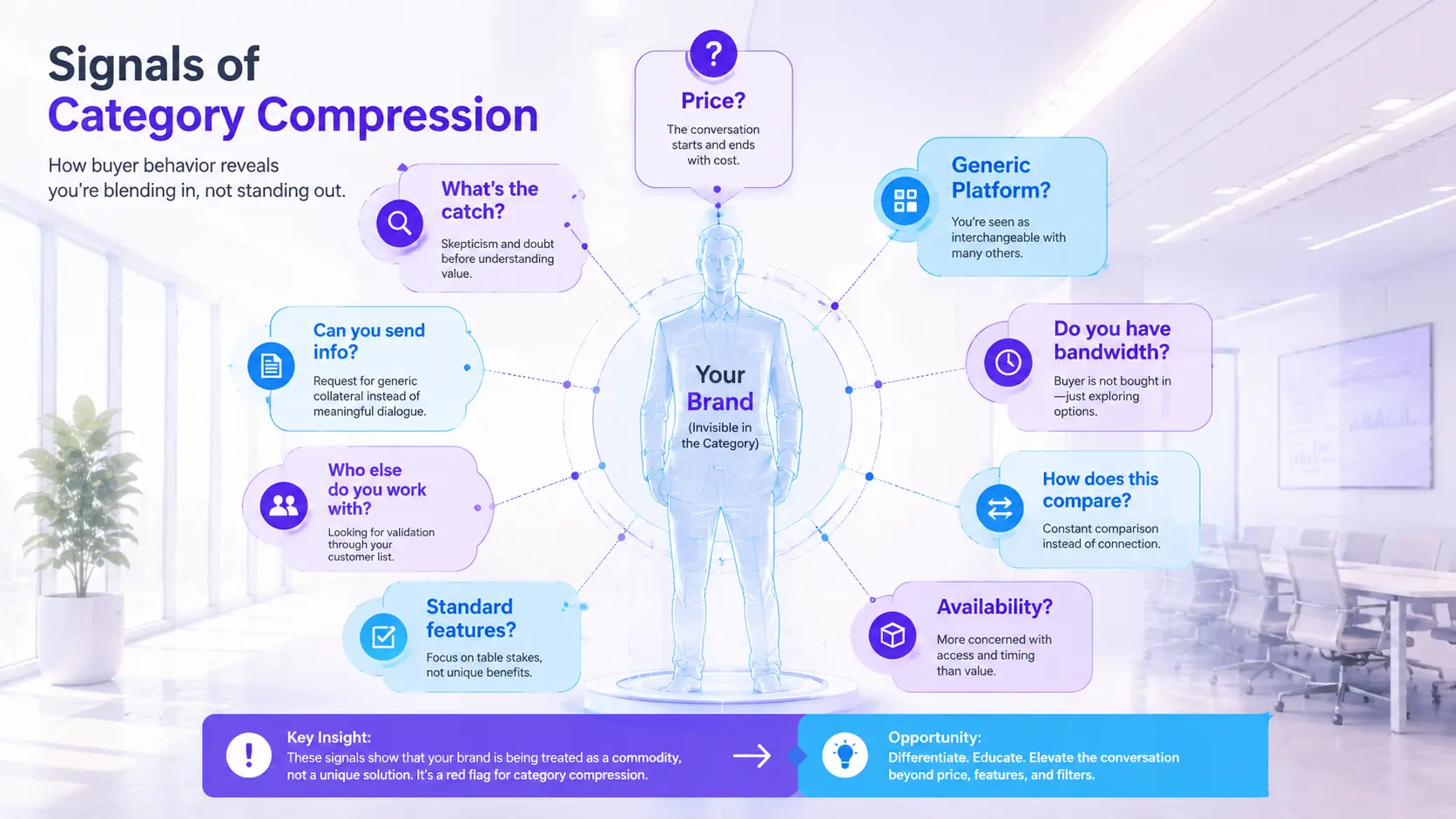
Diagnostic questions to test if nuance is lost
Diagnostic Checklist for Category Compression
| Buyer Behavior | Symptom Description | Impact on Sales Process |
| Requests for price sheets | Focuses on cost comparison over value | Leads to price competition |
| Rapid-fire RFP submissions | Transactional rather than exploratory | Reduces opportunity for nuanced pitching |
| Surface-level demo bookings | Lack of deeper engagement | Signals low buyer intent |
| Generic objections | No focus on unique brand attributes | Prolonged sales cycles |
| Leads unable to articulate differences | Confusion or lack of brand recall | Difficulty closing deals |
Want clarity fast?
Press pause and ask: Are prospects coming in with a tailored reason for engaging, or canned comparison points?
Do they repeat back anything unique to your brand, or only what everyone else claims?
When buyers describe your offer, is the category the first word out of their mouth – or a specific differentiator?
Push further.
How many pipeline opportunities can clearly state why they’d choose you beyond price, speed, or generic features?
If most can’t, you’re facing category compression.
The most telling insight: if you can swap your name for a competitor’s in buyer conversations without changing the context, your positioning isn’t landing.
Smart executives get ahead by treating “category collapse” as a recurring health check, not an afterthought.
The brands with staying power catch the signals early, long before they become headlines in lost deal reviews.
Diagnostic checklist for category compression:
- Buyers refer to you only by category label, not brand specifics
- Most inquiries are price-focused or feature-generic
- Pipeline leads cannot articulate what makes you distinct
- Decision criteria boil down to speed, cost, or availability
- Your brand could be swapped with a competitor’s in buyer conversations without context loss

What changes the outcome: from compression to distinctive clarity
Most brands try to zig their way out of category compression with clever messaging tweaks.
The real escape, however, doesn’t happen after the first impression – it happens before it, by hijacking the buyer’s mental framing at the exact moment they try to lump you in with everyone else.
The biggest difference between brands that become a default and those that force new comparisons?
They engineer meaning into every early interaction, making it nearly impossible to see them as interchangeable.
How front‑loading meaning reshapes comparisons
If buyers default to category shortcuts, why give them time to fill the blanks with assumptions?
When we work with clients wrestling with buyer simplification, one pattern stands out: high-growth brands inject context and consequence into the conversation before the buyer can reach for a price filter.
For example, we saw a SaaS brand reframe their demo intro from “We’re a CRM” to “We eliminate 18% of your deal risk at the first sales call”.
Instantly, the comparison set flipped – from generic CRMs to board-level risk vendors.
Category compression thrives on silence and vagueness.
The longer a brand delays decisive framing, the more buyers retrofit their own (usually flat) meaning.
It’s like a chef who sets the menu instead of letting diners decide what qualifies as dinner – the upfront narrative determines whether the experience commands attention or fades into the noise of interchangeable options.
Which question is your team answering first: why us, or why this category?
If your messaging forces the latter, you’ve already lost.
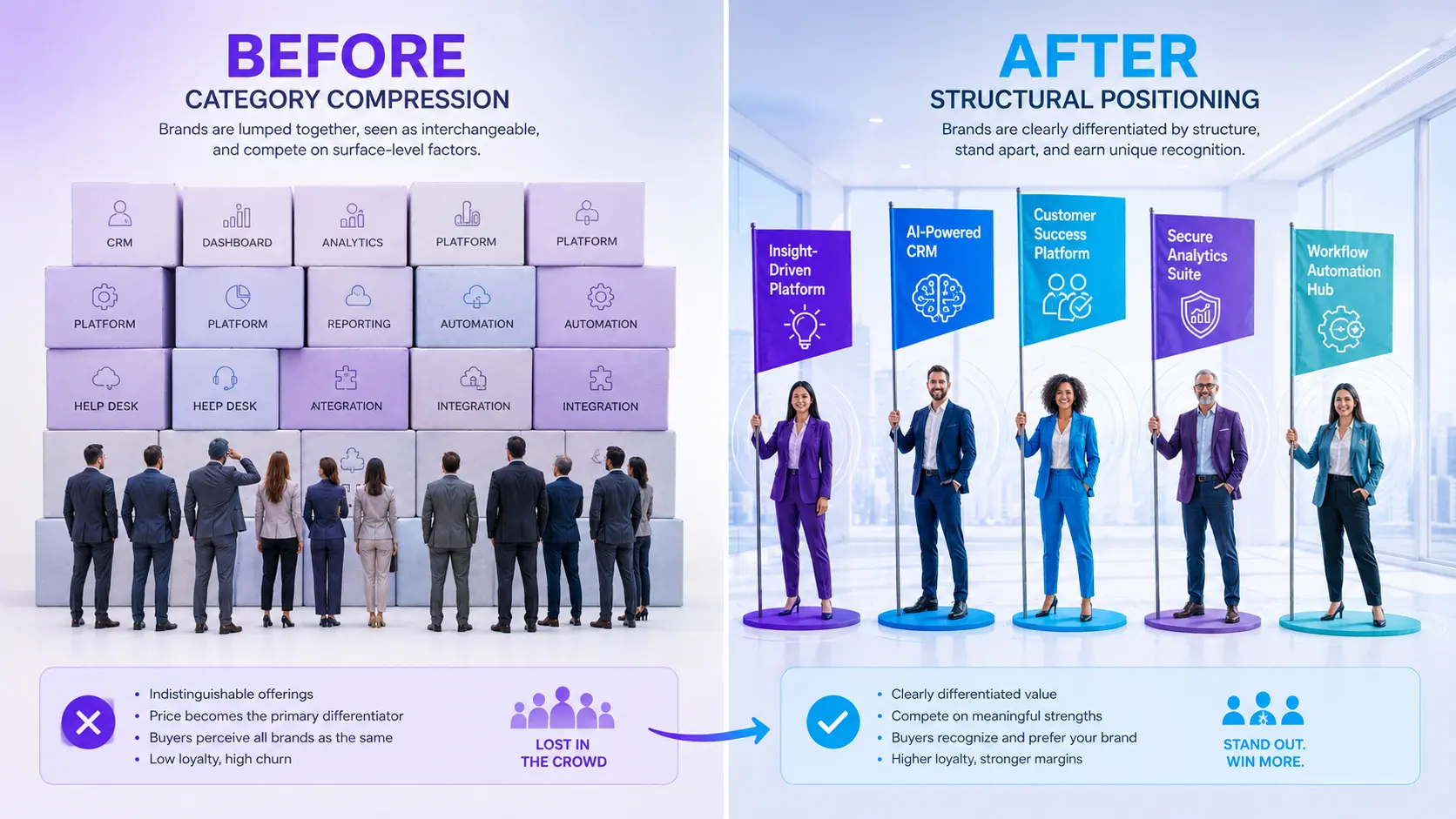
Why structural positioning beats cosmetic differentiation
Messaging doesn’t fix category collapse.
Buyers are hypersensitive to branding veneers; they trust what’s structurally distinct, not what’s painted differently.
Structural positioning means changing the decision model itself: new metrics, new guarantees, new access models – anything that breaks the invisible script of comparison.
We’ve watched an analytics company stop being “yet another dashboard” by charging on insight delivered, not seat count.
Suddenly, the default price-vs-features game no longer applied.
Cosmetic differentiation is like rearranging cutlery on a crowded table – attention snaps back to what diners already expect.
Structural positioning is serving a dish no one recognized but instantly valued.
Is your offering built to survive category simplification, or does it crumble as soon as buyers take the shortcut?
Category compression isn’t just a messaging issue – it’s a structural threat.
Brands that escape don’t just claim difference; they force a new kind of comparison at the door.
Next, it’s about embedding that clarity into every buyer touchpoint – so the collapse never begins.
That wider logic leads directly into Sameness Becomes a Signal.

Scientific context and sources
The sources below provide foundational context for how decision-making, attention, and performance dynamics evolve under scaling and constraint conditions.
- Cognitive Oversimplification in Decision-Making
Judgment Under Uncertainty: Heuristics and Biases – Daniel Kahneman, Paul Slovic, Amos Tversky (Eds.) – Cambridge University Press
Seminal research on how cognitive shortcuts (heuristics) cause people to group nuanced options into mentally manageable categories, underlining the psychological mechanisms underlying category compression.
https://www.cambridge.org/core/books/judgment-under-uncertainty/6F9E814794E08EC43D426E480A4B412C - Market Signals and Default Category Effects
Market Signaling: Informational Transfer in Hiring and Related Screening Processes – Michael Spence – Harvard University Press
This foundational book explains how markets interpret incomplete or ambiguous signals, often defaulting to established categories, which mirrors how brands are reduced when differentiation is unclear.
https://books.google.com/books/about/Market_Signaling_Informational_Transfer.html?id=rkXZAAAAIAAJ - The Impact of Information Overload on Consumer Behavior
Consumer Choice Between Hedonic and Utilitarian Goods – Ravi Dhar, Klaus Wertenbroch – Journal of Marketing Research
This research examines how decision complexity and cognitive simplification affect consumer choice behavior, supporting the broader mechanism that overload increases reliance on simplified comparisons and heuristics.
https://journals.sagepub.com/doi/10.1509/jmkr.37.1.60.18718 - Brand Positioning and Distinctiveness in Memory
How Brands Grow – Byron Sharp – Oxford University Press
Explores empirical laws of marketing showing that distinctiveness and salience, not small differences, drive competitive advantage – reinforcing the risk of blending into category defaults.
https://global.oup.com/academic/product/how-brands-grow-9780195573565 - Evaluation Frameworks in B2B Purchasing
A General Model for Understanding Organizational Buying Behavior – Frederick E. Webster Jr., Yoram Wind – Journal of Marketing
Foundational peer-reviewed research showing that B2B buying decisions rely on structured evaluation frameworks, organizational filters, and category-based decision processes under uncertainty.
https://journals.sagepub.com/doi/10.1177/002224297203600204
Questions You Might Ponder
What is category compression in marketing?
Category compression occurs when buyers mentally group multiple brands into a single generic category, overriding nuanced brand differences. As a result, brands become interchangeable and lose their ability to command premium pricing or loyalty, as unique features and value propositions are overlooked in favor of quick decision-making shortcuts.
How does category compression impact B2B sales cycles?
In B2B sales, category compression causes decision-makers to compare brands primarily by price or availability, not true capabilities or results. This leads to transactional sales conversations, longer sales cycles, and more frequent objections – making it challenging for vendors to communicate and capture real differentiation.
Why do buyers default to category labels instead of brand specifics?
Buyers default to category labels due to cognitive constraints and information overload. To simplify evaluation, they use mental shortcuts, quickly filing unknown brands into familiar categories. This mental compression is a survival mechanism for decision efficiency, not a sign of laziness or lack of interest.
How can brands escape category compression?
Brands can escape category compression by making structural, not just cosmetic, changes to their positioning. This includes clearly front-loading differentiation and reframing the comparison set, ensuring brand-specific value is obvious before buyers default to category assumptions, thus breaking the mental shortcut cycle.
What are early warning signs of category compression in your brand pipeline?
Warning signs of category compression include a rise in generic price inquiries, surface-level demo requests, buyers referring to your offering only by category, and leads unable to articulate why you’re different. These indicators help identify when brand positioning is blurring into the competitive landscape too early.