
What You’ll Learn
Brand sameness signals trust delay when buyers perceive multiple brands as interchangeable because their positioning, value claims, tone, visuals, and promises feel too similar.
Instead of creating confidence, sameness makes buyers pause, compare, or default to price because they cannot identify a clear reason to trust one option over another.
This happens when brands repeat category clichés, rely on generic claims, use template-driven messaging, or avoid a distinct point of view.
The result is decision paralysis, stalled evaluation, lower urgency, commoditization, and weaker buyer confidence.
Trust accelerates only when the brand creates clear, ownable meaning that separates it from alternatives.
Key Takeaways
- Brand sameness signals trust delay by causing buyers to perceive companies as interchangeable, which leads to decision paralysis or price-based selection.
- Internal pressures and reliance on industry norms or automated tools drive organizations to adopt indistinct, risk-averse messaging strategies.
- Consistent but undifferentiated channel messaging accelerates the commoditization of brands and erodes buyer urgency to act.
- Diagnosing and solving system-level sameness is necessary to restore differentiation, accelerate trust, and improve buyer decision outcomes.
Most B2B leaders don’t realize their brand’s biggest competitor isn’t the market – it’s inertia.
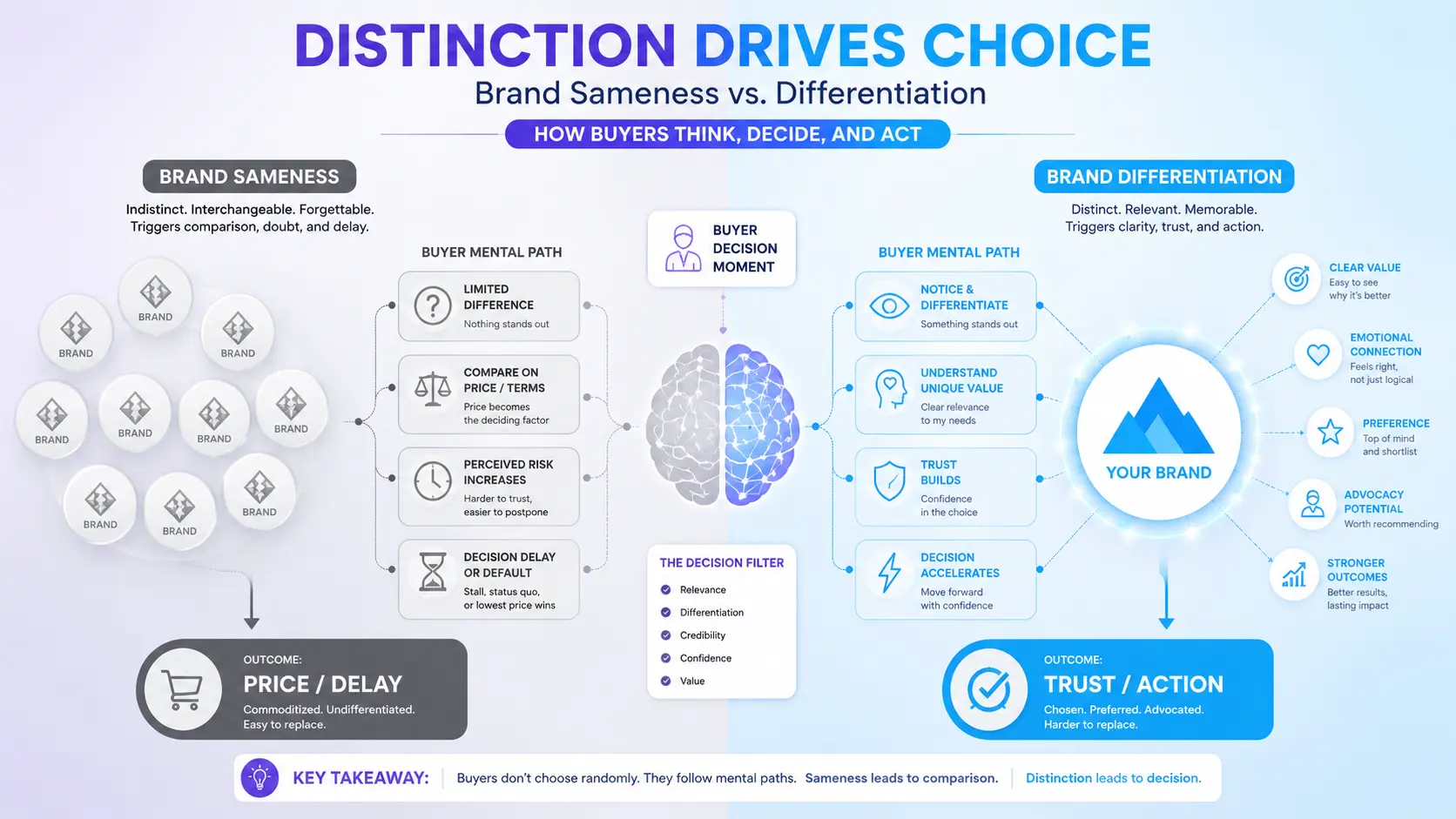
When a buyer sees ten options that all look and sound functionally identical, the brain kicks into shortcut mode: ignore the differences, delay real choice, and – with the first sign of risk – default to the lowest price or the easiest buy.
The catch?
This isn’t just a tactical miss; it’s a signal you’re entirely replaceable before you’ve even entered the real evaluation set.
That broader logic is outlined in Brand Positioning.

Why perceived sameness signals replaceability and stalls trust
When a field of brands bleeds into a wall of interchangeable logos and copy, the human mind immediately hunts for frictionless exit ramps.
We’ve watched procurement reps stare at three “unique” vendor proposals and internally shrug – they all promise results, all use the same metrics, and none articulate a risk worth taking.
“If you can’t tell me why you’re different in two sentences, our budget goes to the lowest quote”.
How sameness triggers mental shortcuts that freeze choice
Comparison of Buyer Responses: Brand Sameness vs. Distinct Brand Positioning
| Symptom | Indication of Sameness | Indication of Differentiation |
| Value Props Repeated Word-for-Word | Yes – same phrases echo across channels | No – messaging adapted and tailored by channel |
| Buyer Perception | Uniform impression of ‘just another option’ | Clear, ownable differences recognized |
| Copy Tone and Style | Consistent but generic and bland | Consistent but vivid, distinctive voice |
| Sales & Marketing Alignment | Replicated deck and collateral content | Unique assets reflecting channel specific strengths |
The myth is that clarity comes from repeating what the competition says.
In reality, this repetition signals risk: If everyone claims reliability, then none stand out, so buyers question if reliability is just the minimum.
One founder described it as “choosing between three shades of gray paint in a rush – you hesitate, stall, or just pick the cheapest”.
Cognitively, similarity acts as mental fog.
The buyer’s brain rationalizes: if these firms are truly equal, then spending more time or money is a waste.
The result?
Decision paralysis – or at best, mechanical buying based entirely on short-term cost.
Your brand becomes wallpaper, invisible except when someone wants a discount.
When lack of distinction becomes assumed equivalence
Buyers don’t have time – or desire – to analyze lines of copy and subtle features.
When positioning differences are indistinct, the mind compresses choices into one bucket: “All options are the same”.
It’s like flipping a coin between lookalike brands.
We’ve seen sales cycles drag on for months, not because the offering was unclear, but because the options were too similar for urgent action.
Questions like, “What’s the real difference between you and your main competitor?” are a sign: the evaluation has shifted from strategic selection to functional equivalence.
Indistinct positioning isn’t neutral – it actively reduces urgency and opens the door to price wars.
When buyers assume equivalence, they default to convenience, cost, or a preexisting relationship.
If you feel decisions slipping away or stalling, sameness, not quality, may be the underlying cause.
In every market, it’s the sharp, distinct signal that earns buyer confidence and action.
Without it, trust is delayed, and your brand remains easy to replace.

What structural dynamics drive brand sameness in decision framing
Most brands don’t copy the competition by accident – they do it because short-term wins look safer than standing out.
Across dozens of growth audits, we see this pattern: leadership teams, under pressure to hit quarterly metrics, default to whatever looks defensible in the boardroom, even if it means mirroring everyone else.
Why risk bold positioning on something unproven, when you can point to industry norms and justify sameness as “best practice”?
Why short‑term pressure favors sameness by design
Imagine a company trying to defend every marketing pitch with charts showing peer adoption and recent benchmarks.
Individual creativity gets crowded out by fear of misstep – a kind of self-induced vanilla filter.
The myth is that playing it safe shields you from loss; in reality, it guarantees that you’ll blend into the noise.
Clients often tell us their messaging feels “solid”, yet bristle at the idea of making it more distinct.
Short-term accountability cycles reward incrementalism and check-the-box alignment, not risk or original strategic leaps.
Board updates get smoother, but the brand grows less memorable overnight.
What happens next?
Defensibility bias kicks in: every new proposal has to “sound like it’s worked somewhere else”.
Companies build slide decks that look and sound interchangeable – because nobody can be blamed for what the whole category already does.
It’s the branding world’s version of camouflaging yourself in a crowd, hoping someone picks you by default.
But buyers don’t reward invisible bets.
How tools and norms accelerate category convergence
Even brands starting out with distinct ambitions get herded into sameness by the tools they use.
Pre-built website themes, template decks, AI-driven copy prompts, and “industry best practice” playbooks all flatten the curve.
You end up with positioning that, for all its polish, carries the indistinguishable flavor of every other SaaS/agency/solution in the space.
One client in SaaS looked up after a rebrand and realized their homepage could swap logos with three major competitors – no one could spot the switch unless they zoomed in.
It’s like everyone’s reassembling the same puzzle, using identical pieces from a shared toolkit.
Is it any surprise decision-makers default to price, size, or inertia when true differentiation is algorithmically erased?
This isn’t just design; it’s mental auto-complete.
The more automation and templates drive execution, the less likely it is that original thinking even reaches the buyer’s mind.
Only the outliers have a fighting chance of being remembered.
Commoditization usually starts inside the organization, not outside.
Once internal pressure and tools shape your positioning, even a big budget can’t hide the sameness effect.
Brands that want to be chosen can’t let their category write their story for them.

Why sameness undermines trust and invites commoditization
Most leadership teams believe that making safe, well-worn messaging choices will at least preserve buyer trust.
The reality is more damaging: the surest way to never be trusted deeply is to sound like everyone else.
The paradox?
Familiarity in messaging – the same claims, the same benefits, the same table-stakes proof – feels reassuring but quietly signals to buyers that your offer is both interchangeable and, ultimately, disposable.
When messaging maskaloids replace meaning
Buyers are trained – often unconsciously – to filter out generic claims.
“Trusted partner”, “results-driven”, “committed to your success”: these maskaloids sound professional but act as white noise at decision time.
One B2B SaaS audit uncovered thirty providers in a single segment sharing 80% of their homepage headlines and value props.
No stakeholder could remember a single difference once the logos were removed.
It’s like shopping for salt: when every container looks, tastes, and promises the same, who cares about the label?
Worse, we’ve seen seasoned buyers use browser tabs as a sorting device, ruthlessly closing those whose phrasing blurs together.
The myth?
That enough repetition of industry buzzwords will eventually trigger confidence.
In truth, each recycled phrase shaves a little more trust off the cognitive balance sheet.
If your messaging feels safe enough to pass legal in record time, it’s probably also safe enough to kill distinctiveness – and with it, any sense of being truly considered.
From familiarity shortcut to trust ceiling
What about brands that have already achieved recognition?
Even visible brands hit a hidden ceiling if buyers can’t access meaning beneath their claims.
Familiarity gets you on the consideration list, but similarity keeps you stuck there.
Here’s why: the brain is wired to shortcut decisions by grouping similar items.
When dozens of brands deploy the same signals – “innovation-focused”, “seamless integration”, “unparalleled service” – buyers lump them together, then default to either the cheapest option or an incumbent.
Familiarity breeds speed, but sameness caps conviction.
One client, despite dominating share of voice, saw pipeline velocity stall because buyers perceived them as a “safer Pepsi” – never the strategic partner.
Ask yourself: where have you seen a trusted relationship built on generic compliments?
Deep trust emerges when there’s a clear, ownable difference – not just visible, but felt.
Otherwise, buyers snap back to price screens and comparison tables.
The risk isn’t just being ignored – it’s teaching buyers to treat your offer as a commodity, no matter how much budget or creative is deployed.
Trust accelerates when meaning is clear and separation is felt.
When those gaps vanish, so does urgency to act.

Next steps when sameness stalls evaluation
You can run a six-figure campaign across every channel – and still blend into static.
The shock comes when buyers can’t recall who you are, even after repeated exposure.
Most leaders expect slow progress from old messaging or incremental tweaks, but the real friction is that buyers see thirty options and experience zero difference.
If every touchpoint echoes the same pitch, your only signal is “replaceable”.
Look for channel‑agnostic sameness patterns
Checklist: Diagnosing Channel-Agnostic Sameness in Brand Messaging
| Aspect | Brand Sameness Impact | Distinct Brand Positioning Impact |
| Perceived Risk | Increases due to lack of differentiation, signals replaceability | Decreases as unique value reduces uncertainty |
| Decision Process | Delayed choice, mental shortcuts favor price/ease | Accelerated choice, clear reasons to buy |
| Buyer Emotion | Frustration, indifference, paralysis | Confidence, trust, urgency |
| Outcome | Price-driven buying, stalled sales cycles | Stronger loyalty, competitive advantage |
Think you have a differentiation problem in email while ads feel strong?
That’s usually wishful thinking.
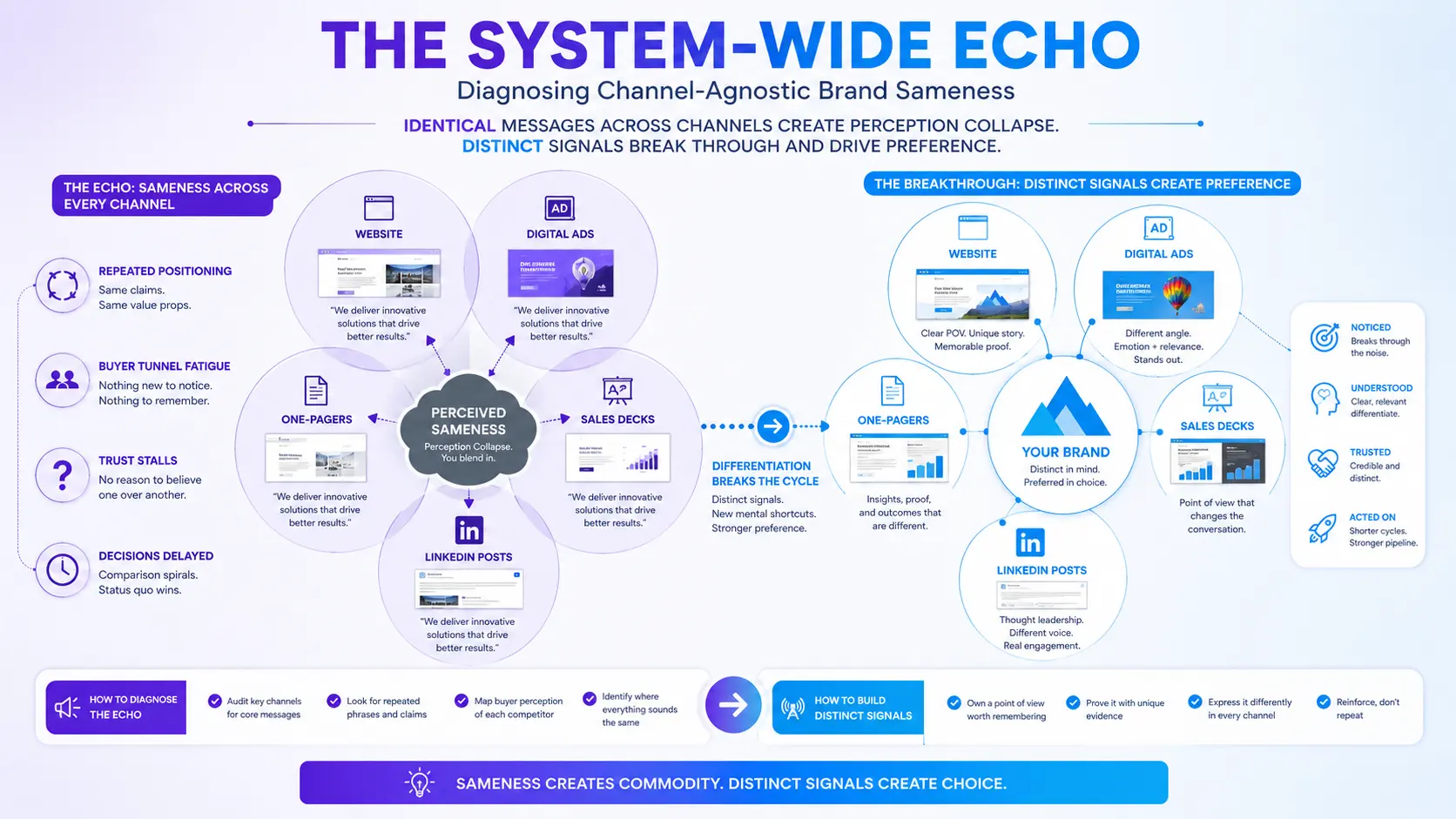
Most brand sameness is not channel-bound – it’s a system-wide signal.
In real audits, we’ve reviewed site copy, one-pagers, LinkedIn banners, and sales decks from the same company, only to find the value props echoed word-for-word.
It’s like walking through different doors into the same empty room.
Buyers notice the uniformity instantly, subconsciously tagging your brand as “just another option”.
Channel-agnostic sameness is sneaky.
It doesn’t matter whether the surface language changes; if the underlying frame always circles back to crowded category claims, perception collapses.
Why trust one widget when every widget promises “streamlined outcomes” and “end-to-end support”?
The mind does not segment by delivery channel.
It compresses perceived value across your ecosystem and, if nothing stands out, defaults to inertia or price comparison.
Is differentiation actually happening, or are touchpoints echoing a safe, indistinct drumbeat?
Scan for failure in value framing that triggers delay
Most teams leap to tweak copy or visuals when deals stall.
Rarely do they test whether their value logic breaks down under buyer scrutiny.
In our client reviews, we see this pattern: the more your framing relies on vague benefits or generic outcomes, the faster prospects vanish from pipeline.
Buyers stall because the brain can’t find a single compelling “why you?” under all the noise.
The true sticking point isn’t aesthetics – it’s value framing that fails to offer clarity or a new decision lens.
Picture a buyer loading five competitor sites: if every headline pushes “innovation” and “customer focus”, their brain treats all choices as functionally equal.
Decision delay sets in because value, not visuals, is the missing signal.
We’ve watched sales teams triple call volume in Q4, only to see pipeline pause as soon as customers realize no new promise is on the table.
Think of it like looking through frosted glass – if you can’t see what’s unique, you don’t move forward.
Indistinct positioning doesn’t just slow deals; it creates mental gridlock.
Fast evaluations depend on distinctive, channel-consistent value framing that is easy to grasp and impossible to ignore.
Repetition across channels is only damaging when it repeats sameness.
The pattern is clear: diagnose the sameness at the system level, then watch how value framing drives – or freezes – real action.
When you see inertia, don’t just ask what’s missing in one area.
Examine what’s echoing everywhere.
Sameness pushes evaluation toward price – which is explored in more depth in Default to Price Logic.

Scientific context and sources
The sources below provide foundational context for how decision-making, attention, and performance dynamics evolve under scaling and constraint conditions.
- Cognitive Shortcut Mechanisms in Decision-Making
“Simple Heuristics That Make Us Smart” – Gerd Gigerenzer, Peter M. Todd, and the ABC Research Group – Oxford University Press
Explains how decision-makers use heuristic shortcuts when overwhelmed by complexity or excessive choice, often relying on simplified mental rules instead of exhaustive analysis.
https://global.oup.com/academic/product/simple-heuristics-that-make-us-smart-9780195143812 - Perceived Category Similarity and Consumer Choice
“Alternative Approaches to Understanding the Determinants of Typicality” – Barbara Loken, James Ward – Journal of Consumer Research
Explores how consumers mentally group similar products and brands, showing how perceived similarity reduces differentiation and makes buyers rely on familiar or simplified decision criteria.
https://academic.oup.com/jcr/article-abstract/17/2/111/1793218 - Organizational Conformity and Strategic Distinctiveness
“The Iron Cage Revisited: Institutional Isomorphism and Collective Rationality in Organizational Fields” – Paul J. DiMaggio, Walter W. Powell – American Sociological Review
Describes how organizations imitate competitors and adopt prevailing industry norms under uncertainty, often reducing strategic distinctiveness and reinforcing sameness in the market.
https://www.jstor.org/stable/2095101 - Trust Formation and Information Overload
“Brand Choice Behavior as a Function of Information Load” – Jacob Jacoby, Joan C. Speller, Carol A. Kohn – Journal of Consumer Research
Demonstrates how excessive information impairs consumer decision-making, increasing confusion and slowing confident purchase decisions when choices become difficult to compare.
https://academic.oup.com/jcr/article-abstract/1/1/63/1818004 - Brand Commoditization and Differentiation Effects
“Conceptualizing, Measuring, and Managing Customer-Based Brand Equity” – Kevin Lane Keller – Journal of Marketing
Analyzes how strong differentiation builds brand equity and trust, while weak differentiation increases substitutability and pushes buyers toward price-based decision-making.
https://journals.sagepub.com/doi/10.1177/002224299305700101
Questions You Might Ponder
How does brand sameness affect trust among B2B buyers?
Brand sameness signals trust delay by making companies appear interchangeable. Buyers, unable to spot meaningful differences, default to low-risk or low-cost choices, stalling trust and reducing the urgency to act. Clear differentiation is essential to accelerate trust and commitment.
Why do organizations tend to copy competitor messaging in saturated markets?
Organizations copy competitor messaging due to short-term performance pressures and defensibility bias. Mirroring industry norms feels safer and aligns with internal accountability, but it ultimately dilutes strategic distinctiveness and slows buyer decision-making.
What role does automation play in brand positioning and sameness?
Automation tools, templates, and AI-driven content often promote category standards, streamlining output at the expense of originality. This accelerates perceived brand sameness signals, causing buyers to view all options as equally replaceable and delaying trust formation.
How does perceived replaceability lead to commoditization in brand evaluation?
When buyers see similar claims and features, they group brands into a single undifferentiated set. This perceived equivalence invites price-based comparisons, erodes loyalty, and makes it difficult for companies to build deep, trust-based relationships with clients.
What system-wide signs indicate your messaging suffers from sameness?
System-wide sameness is evident when your brand’s messaging, visuals, and value claims echo across all channels and materials. If buyers can’t recall a unique value after interacting with multiple touchpoints, inertia or price often becomes the default driver of decisions.