
What You’ll Learn
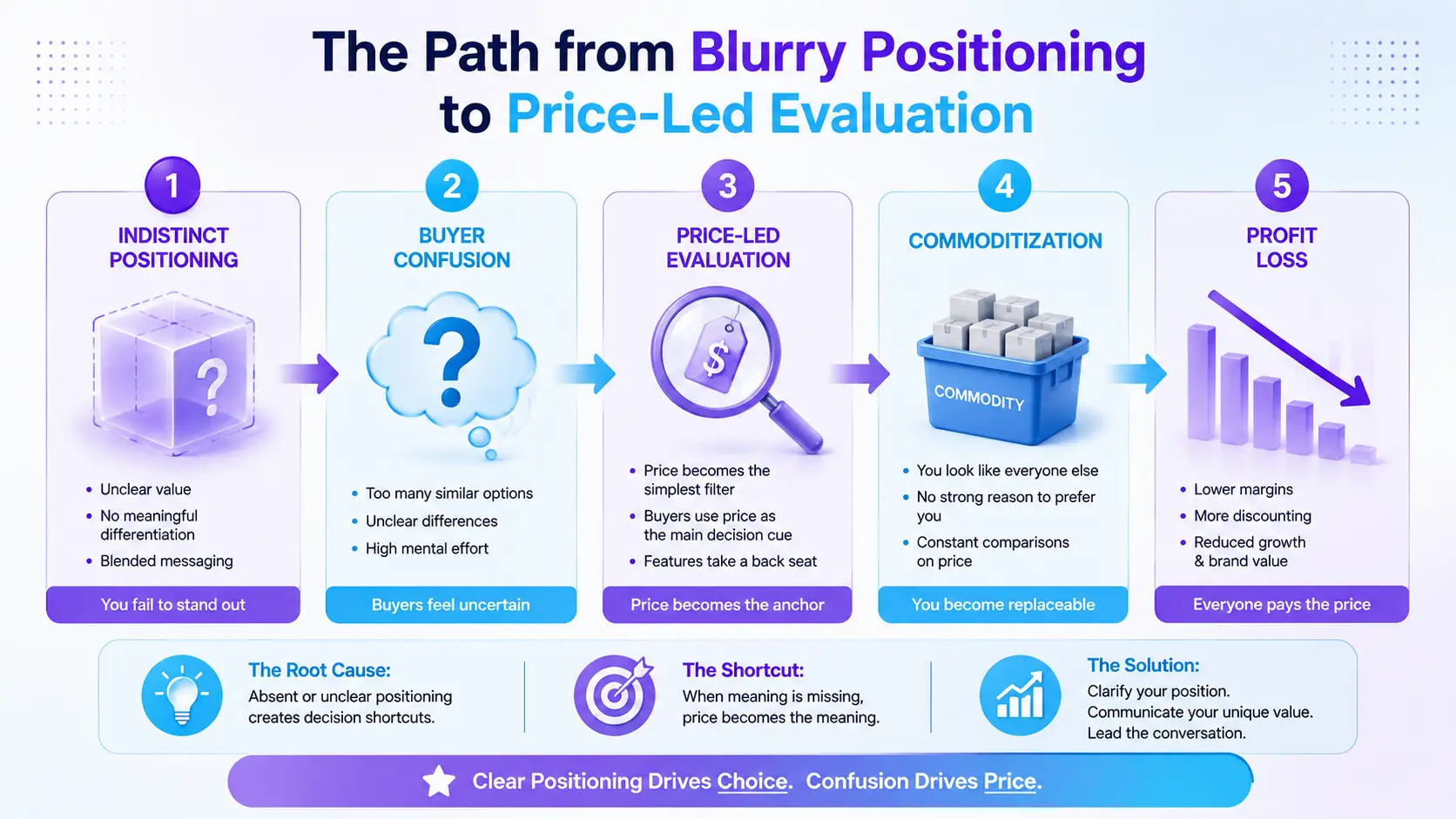
Price-led evaluation is the buyer behavior where cost becomes the main decision filter because a brand’s positioning does not create a clear, credible reason to compare on value instead.
It happens when offers feel interchangeable, differences look cosmetic, or the buyer cannot see a structural reason to pay more, move faster, or choose one provider over another.
In price-led evaluation, sales conversations shift from fit, impact, and risk reduction to discounts, feature checklists, and cheaper alternatives.
Strong positioning prevents this by defining the right comparison set early and making the brand’s distinct value easier to trust than the lowest price.
Key Takeaways
- Buyers default to price-led evaluation when your brand lacks clear structural differentiation, making cost the safest comparison point.
- Ambiguous positioning groups your offer into commodity categories, where the lowest price dictates buying decisions regardless of features or quality.
- Trust deficits and unclear messaging make it nearly impossible to defend premium pricing – prolonging negotiations and eroding margin.
- Establishing strong, unique positioning early is critical to controlling sales cycles, protecting pricing power, and speeding up decisive buying.
Most teams don’t realize their prospects don’t actually want to compare by price – they’re just left with no better option.
If your offer lacks clear, structural meaning, buyers instinctively reach for the decision shortcut that feels safest: price.
This isn’t about market frugality; it’s a signpost that the story you’re telling is leaving blanks.

How market defaults force buyers to evaluate you on price
If your brand’s positioning seems interchangeable, buyers will group you with every lookalike regardless of your actual value.
We’ve seen clients spend months refining features, only to be compared as minor tweaks on a generic template when the deeper reason to choose wasn’t visible.
Here’s the myth: adding “another feature” or “incremental service twist” is enough to stand out.
In reality, without a structural distinction – something that rewires the buyer’s mental category – your offer just joins the mix.
The result?
You get assessed on price, because features with no context feel interchangeable.
How undefined distinctions default you into undifferentiated categories
Feature Additions vs Structural Distinctions in Positioning
| Factor | Cosmetic Differentiation | Meaningful Differentiation |
| Buyer Perception | Features seen as replaceable or superficial | Features perceived as unique and valuable |
| Impact on Price | Leads to discount requests and price wars | Supports premium pricing and urgency |
| Sales Conversation | Defensive, justification-focused | Offensive, decision-advancing |
| Longevity in Market | Collapses under comparison pressure | Sustained and credible differentiation |
This isn’t just theory.
With one tech client, we saw a strong solution neutralized by category-blur: enterprise buyers asked, “Why pay more for this versus X or Y?” – visible proof that the client’s value language had collapsed into the market’s default comparison set.
Think of it like being dropped into a bin labeled “assorted”, where only the cheapest or flashiest gets a second look.
If your brand doesn’t claim a structural distinction, the buyer’s mind will invent one – and nine times out of ten, that means grouping you as a commodity.
Why the reference class shapes what feels expensive or fair
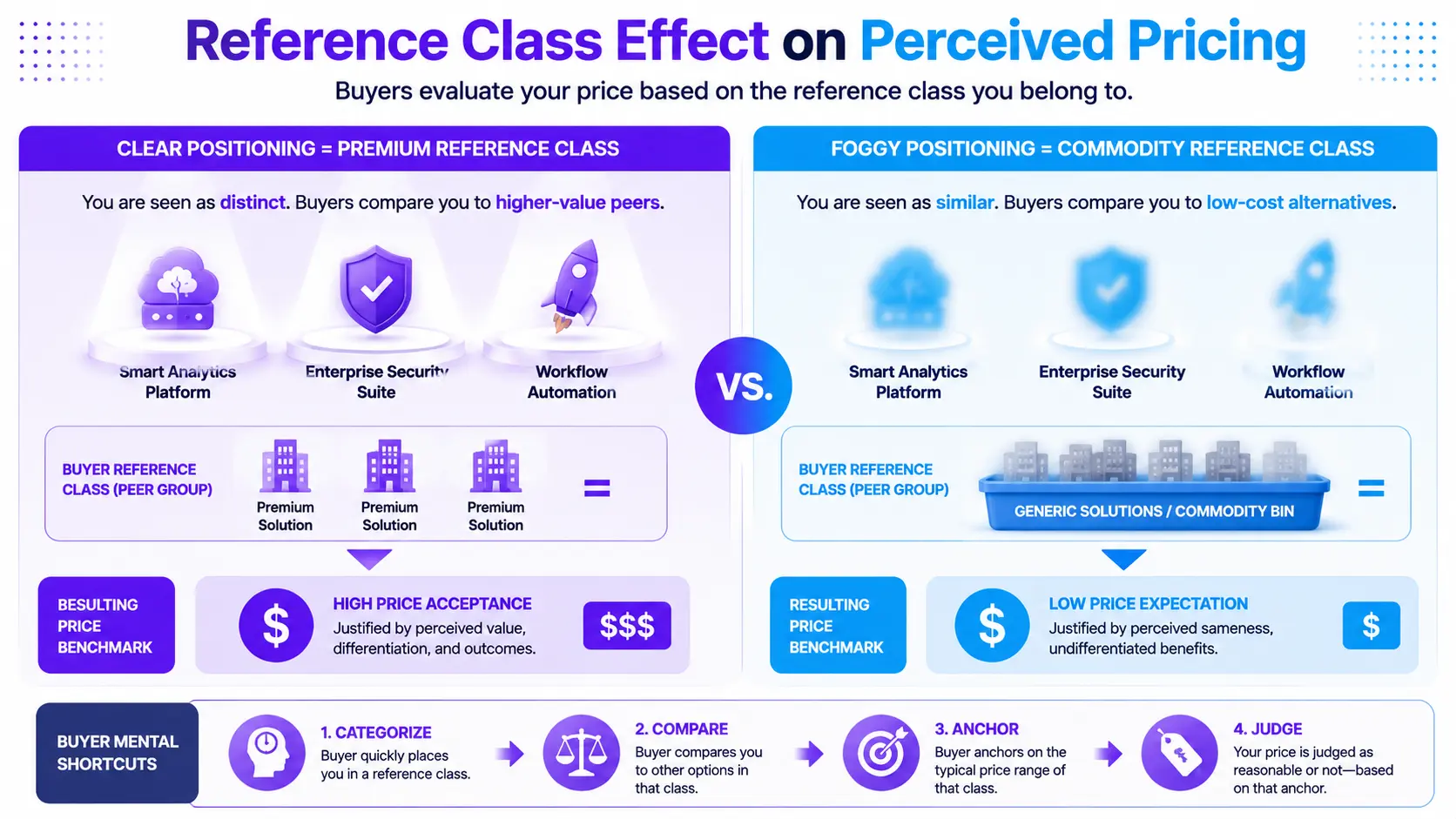
If your positioning is foggy, you’re not just one of many – you’re subject to a “reference class” comparison you never defined.
Buyers unconsciously slot your offer into the peer set that’s easiest or most familiar to them.
Suddenly, your price gets measured against the least expensive player in that crowd, even if your scope, quality, or outcomes differ completely.
We’ve seen this play out with agencies whose work is leaps ahead of freelancers, but whose unclear message parks them in the same mental row.
The result?
Every proposal sparks sticker shock.
The perceived “fair” price is anchored by the cheapest point in the buyer’s chosen class – often a benchmark disconnected from your real value or costs.
Ask yourself: when was the last time you paid extra for what felt like a meaningless version of the same thing?
Buyers rarely do.
Without clarity, the market underprices you by default.
The analogy: it’s like racing in the wrong lane at a track meet – the rules don’t fit your effort or your upside, but that’s how you’ll be judged.
If you want buyers to factor more than price, your positioning must define the peer group you want to be compared against from the first touchpoint.
Letting the market default define your reference class guarantees price-led evaluation.
Position with clarity, or price becomes your only story.

Why weak pricing power signals deeper positioning failure
Most leaders blame price debates on prospect budgets.
The reality?
Weak pricing power is much more often a mirror – reflecting confusion about why your offer matters at all.
If buyers keep defaulting to cost questions, margin isn’t the root issue; it’s a lagging signal that your positioning is leaving a vacuum.
When price sensitivity is a trust deficit in disguise
Every time a decision-maker circles back to price, they’re not just squeezing value – they’re signaling a lack of clarity or trust.
In high-stakes B2B deals, we’ve watched sales teams repeat value stories and differentiation slides, only to face relentless price objections.
Counterintuitively, the more a team tries to justify cost in these moments, the more negotiations spiral into discount territory.
Think of trust as a bridge: when it’s incomplete, prospects revert to the only solid ground they see – price.
We’ve consulted with firms where even genuine feature advantages couldn’t command a premium because buyers simply didn’t believe paying more would guarantee a better outcome.
One leadership team was stunned to discover that ‘price sensitivity’ was code for “I don’t see enough risk reduction or future upside to warrant anything above average”.
Why does this spiral matter?
Because every pricing discussion that starts with skepticism is nearly impossible to reverse.
If the perceived value isn’t locked in early, the conversation turns into a haggling match – an auction, not a decision.
A related decision is covered in Why Feeling Interchangeable Slows Trust and Hides Choice, which explains the adjacent issue in more detail.
How commoditization eats away at perceived uniqueness
As positioning fades, brands lose the ability to sustain unique value.
Even category leaders can see a single cycle reduce them from premium offerings to discount participants when messaging confusion sets in.
Here’s the analogy: commoditization is like air leaking from a tire.
Slow at first, but once pressure drops, no amount of brute-force selling can re-inflate your pricing power.
As features become indistinct in the buyer’s mind, purchase criteria collapse to simple math: who’s cheaper?
A weak positioning structure means even strong innovations lose their sharpness.
In client strategy sessions, we often ask: “If we stripped away your logo, would a buyer know it was you?” In most stalled deals, the honest answer is no.
Pricing power is not just about numbers – it’s the scoreboard for trust, credibility, and unique value.
When it vanishes, the real loss is never profit – it’s control.
That’s what sets up the final drift: endless price negotiations, few quick wins, and a team left defending discount logic instead of advancing decisive action.

What gets lost when price becomes the anchor of comparison
Most teams realize too late that once the conversation centers on price, they’ve already surrendered the strongest levers in the sales process.
It feels logical to fight for every feature, to build value slide by slide, but in a price-led evaluation, these games are played on the buyer’s turf – and the rules guarantee you lose margin, urgency, and sales velocity.
Why does price suddenly matter so much?
Because without a sharp difference embedded in your positioning, buyers can only anchor on what they see: a list, a cost, and a scramble for justification.
How feature debates fail when differentiation is cosmetic
Cosmetic vs Meaningful Differentiation
| Aspect | Incremental Features | Structural Distinction |
| Definition | Minor tweaks or additional features | Fundamental shift that rewires buyer’s mental category |
| Effect on Buyer Perception | Seen as interchangeable with competitors | Creates a unique, non-commoditized category |
| Result in Sales Process | Leads to price comparison | Enables value-based differentiation |
| Market Impact | Joined in a generic template group | Claim own distinct position within the market |
There’s a hard lesson buried inside every feature comparison grid: when differentiation is only surface-deep, nothing actually sticks.
We’ve seen client portfolios where bullet points multiply, demos get longer, and yet, every unique claim crumbles under negotiation.
It’s like dressing up a commodity product and expecting the buyer not to notice the costume.
If new prospects are “just comparing checklists”, that’s not a market-wide laziness – it’s structural meaning missing from your offer.
One CMO we worked with poured resources into product releases, only to watch deals stall because buyers kept asking: “Remind me again, how is this really better?” This is the symptom of value perception collapse – a yellow light blinking that your differentiation is nearly invisible from the outside.
Do superficial edges ever hold in a head-to-head price war?
Almost never.
Buyers strip offers down to base versions and ask for discounts because, at that moment, the brand is reduced to a collection of replaceable features.
Think of it like changing the color of a power tool but leaving the motor identical – no one pays extra for the new paint.
Cosmetic differences can create initial curiosity, but under pressure, they melt away.
If your brand’s uniqueness can’t survive a side-by-side, it can’t command the price or the urgency you need.
Why sales gets stuck defending price instead of advancing decisions
Price-led evaluation doesn’t just slow deals – it blunts every offensive move your sales team can make.
Instead of shaping a prospect’s criteria, sellers are forced into a reactive stance.
The conversation stops being about fit or impact and starts becoming a defensive justification: “Why are you more expensive?” “Can you match their offer?”
What’s really being negotiated here isn’t value – it’s category confusion.
We’ve coached teams into witnessing the same slow death spiral: the more they justify, the more the buyer pushes.
Time expands, conviction shrinks.
With no structural difference to rally around, sales teams fight to protect the price, but end up deepening the notion that the only reason to choose your offer is a lower number.
This is where urgency collapses.
When value perception is weak, buyers never feel they are risking anything by waiting.
The “decision shortcut price” becomes the only logic left, and the deal moves at the speed of procurement’s caution rather than business need.
The cost isn’t only thinner margins; it’s slower cycles, risk-averse buyers, and a pipeline filled with false hope.
In a price-led market, every hour spent defending why you’re not the cheapest is an hour not spent moving the deal forward.
When structure is missing, urgency evaporates, and the sales team becomes professional price explainers instead of decision accelerators.
When price is the anchor, significance gets lost.
Sales stalls, urgency fades, and every interaction becomes a negotiation on the buyer’s terms.
Price-led evaluation is the market’s default mode when your positioning lacks structural differentiation.

Scientific context and sources
The sources below provide foundational context for how decision-making, attention, and performance dynamics evolve under scaling and constraint conditions.
- Reference points and pricing behavior
Judgment under Uncertainty: Heuristics and Biases – Amos Tversky, Daniel Kahneman – Science
Landmark research showing how decision-makers use heuristics such as anchoring, representativeness, and availability when distinctions are unclear, directly underpinning price-led evaluation and reference-point effects.
https://www.science.org/doi/10.1126/science.185.4157.1124 - Effects of categorization on consumer choice
A Study of Classifiers in Consumer Cognition, Judgment, and Choice – Sharon Shavitt, Carlos J. Torelli, others – Journal of Consumer Research
Explores how categorization structures influence perceived similarity, evaluation criteria, and judgment, supporting the idea that weak differentiation pushes buyers toward simpler comparisons.
https://academic.oup.com/jcr/article/25/2/108/1799485 - Trust as a moderator of price sensitivity
TRUST AND DISTRUST IN ORGANIZATIONS: Emerging Perspectives, Enduring Questions – Roderick M. Kramer – Annual Review of Psychology
Explores how trust deficits alter decision behavior, increase defensiveness, and shift attention toward lower-risk evaluative shortcuts, including price-focused comparisons.
https://www.annualreviews.org/doi/10.1146/annurev.psych.50.1.569 - Commoditization and business value erosion
The Innovator’s Dilemma: When New Technologies Cause Great Firms to Fail – Clayton M. Christensen – Harvard Business Review Press
Explains mechanisms by which lack of differentiation and strategic positioning accelerate commoditization and pricing pressure.
https://www.hbs.edu/faculty/Pages/item.aspx?num=46 - Perceived value and decision-making in B2B sales
Value-Based Pricing: Drive Sales and Boost Your Bottom Line by Creating, Communicating, and Capturing Customer Value – Harry Macdivitt, Mike Wilkinson – McGraw-Hill
Examines how clarity in value messaging changes buyer evaluation away from price-only comparisons, reinforcing the relationship between perceived value and pricing power in B2B sales.
https://books.google.com/books/about/Value_Based_Pricing_Drive_Sales_and_Boos.html?id=PdEdkwPdw2kC
Questions You Might Ponder
Why do buyers focus on price instead of value in B2B markets?
Buyers default to price when a brand’s positioning is unclear or indistinct, leaving them without strong comparative criteria. This triggers price-led evaluation, making cost the easiest – yet narrowest – basis for decision, regardless of product value or differentiation.
How does ambiguous positioning lead to commoditization?
Ambiguous positioning causes buyers to group offerings as interchangeable. Without structural differentiation, all competitors appear similar, pushing customers to select based mainly on price – accelerating commoditization and eroding perceived uniqueness.
What is a “reference class” and why does it matter for pricing?
A reference class is the mental peer group buyers compare your offer against. If your positioning is blurry, buyers unconsciously use a low-cost benchmark, making your prices seem high – even if your solution offers superior scope or outcomes.
How does weak positioning undermine sales urgency?
Weak positioning collapses value perception and urgency, forcing sales teams to reactively defend price instead of proactively shaping decisions. This defensive stance stretches sales cycles and undermines confidence in your unique value.
What signals a trust deficit during price negotiations?
Repeated focus on price, skepticism about unique benefits, and buyers resisting premium positioning signal a trust deficit. Without early clarity on risk-reduction and payoff, negotiations default to cost, making value stories harder to establish later.