
What You’ll Learn
Category framing for differentiation is the strategic use of a category context to make a brand’s difference visible, meaningful, and hard to compare on default terms.
It works by changing the buyer’s mental frame – what they notice, what they compare, and what they value – instead of relying on generic claims like “faster”, “easier”, or “better”.
Without a clear category frame, even strong benefits collapse into expected points of parity and become invisible.
Effective category framing creates structural contrast, reframes evaluation criteria, and helps buyers understand why the brand should be judged differently from standard competitors.
Key Takeaways
- Operating within an unchallenged category frame causes even strong product claims to blend in as industry defaults, diluting differentiation.
- Buyers use mental frames as shortcuts, ignoring generic value claims and comparing only on category-assigned points of parity.
- Structural category shifts – redefining what and how buyers compare – not cosmetic tweaks, drive true visibility and pricing power.
- Diagnosing whether you face a frame gap or mnemonic drift is essential for designing effective differentiation and recall strategies.
Most teams believe that piling on more value statements will separate them from the pack.
In reality, when you operate within an unchallenged category frame, the strongest product claims often get absorbed as category table stakes – nothing stands out, and your “difference” becomes invisible before it ever reaches the real decision.
Think of it as shouting louder in a room where everyone’s repeating the same words.
The myth: clarity and repetition alone break through.
The truth?
If your benefits map to what buyers already expect from that category, they blend into white noise.

Why a Category Frame Shapes What Buyers Notice
We’ve seen SaaS leaders roll out campaign after campaign loaded with “faster”, “easier”, “secure”, – all familiar to the point of irrelevance.
Buyers don’t compare your message to some universal ideal; they snap-judge it against default category context, filtering anything generic as “normal”.
How default categories swallow undifferentiated claims
Here’s the analogy: pitching the best umbrella in a storm means nothing if every umbrella promises “keeps you dry”.
Unless you reframe what “dry” actually means – or introduce a new threat no one else covers – your message drowns.
Why does this matter?
When differentiation collapses into points of parity, buyers see little reason to switch, pay more, or even care.
The biggest risk isn’t being misunderstood – it’s being categorized and forgotten.
That broader logic is outlined in Brand Positioning.
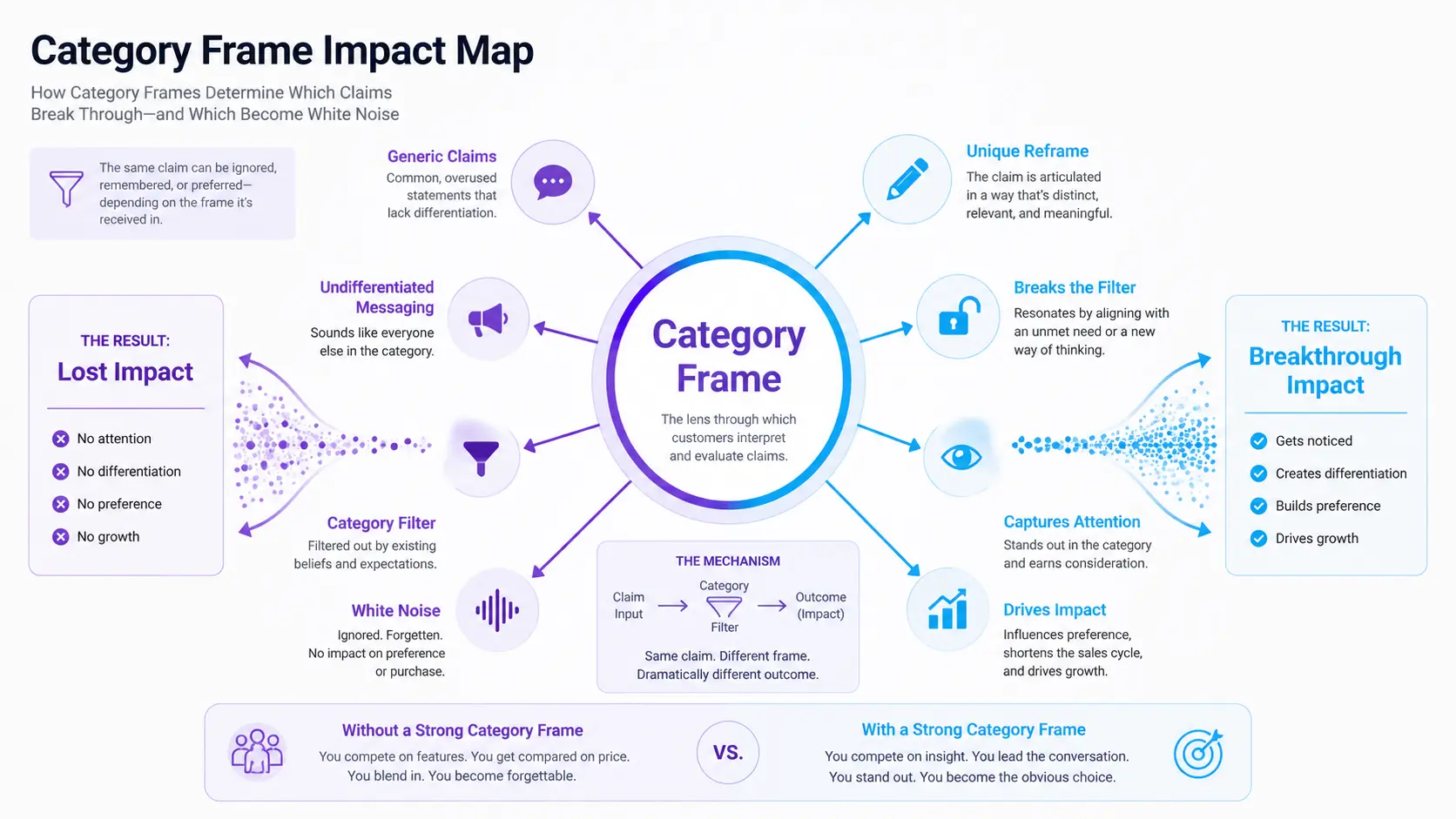
Why a frame is a mental shortcut, not just a label
Category framing isn’t branding fluff – it’s the default wiring for how people process choice.
Decision-makers don’t perform deep research for every purchase; they gut-sort through interpretive frames, assigning trust or skepticism based on category context in seconds.
Frames operate as mental shortcuts, not badges: they shape which claims even get noticed, who you’re compared against, and what deserves a premium.
We’ve watched buyers use category frames to instantly filter pitches – one client’s key upgrade was ignored, simply because it sounded like what every competitor already promised in the “collaboration tool” space.
Only after shifting category context to “revenue performance” did buyer attention – and price elasticity – change.
Ask yourself: are you fighting for shelf space in an aisle buyers barely glance at, or do you own the sign above the shelf?
Category default language dictates trust: if your claim matches the expected “category default”, you’re a commodity.
If your interpretive frame redefines points of difference, you reset comparison itself.
Points of parity lay groundwork, but only a distinct interpretive frame breaks you out of the norm.
In decision moments, buyers rarely choose the “best” in a vacuum – they follow context, mental shortcuts, and cues of structural differentiation.
If your differentiation collapses into category default, your case for change never even gets a hearing.
Category framing for differentiation isn’t optional – it’s the original filter that decides if buyers see you at all.

When Differentiation Collapses Without Context
The most impressive feature stack on the market can still be invisible if buyers don’t know what to measure it against. “Better” is meaningless when the frame defaults to category expectation – the equivalent of shouting in a crowded room where everyone has the same megaphone.
We’ve seen teams come to us with sharp product advantages, only to be lost in translation because buyers slot the pitch right back into the category default language: words like “faster”, “smarter”, “all-in-one”.
The illusion of “better” that still reads generic
Here’s the myth: if you stack enough superior-sounding claims, your product will naturally rise above competitors.
In practice, high-performing teams often watch their differentiation collapse into background noise, because generic benefit language doesn’t disrupt the buyer’s reference points.
Savvy buyers scan for cues that break pattern – the rest gets filtered out.
One SaaS client invested heavily in incremental upgrades, but their “best-in-class” messaging landed as white noise until we reframed what “best” meant in a way no peer could claim.
It’s like offering a slightly sweeter apple at an apple fair – unless you convince people you’re selling a new fruit, they assume it’s just another apple.
If every competitor claims “easier integration” or “robust security”, who actually stands out?
In the absence of a new interpretive frame, “better” becomes a commodity label.
The mental shortcut is simple: if it sounds generic, I assume it is generic.
Points of parity mask difference until the frame shifts
Parity is a trap disguised as progress.
You have to match basic expectations to compete, but parity on features, speed, or service level is table stakes – not differentiation.
Executive buyers expect you to clear that bar.
What catches their attention isn’t similarity; it’s credible, structural difference.
In practical terms: one client outgrew their category but kept selling on points of parity – speed, integrations, cost.
Buyers nodded, saw comparable claims in three proposals, and defaulted to price.
It wasn’t until we shifted the frame (showing a new use case no other vendor could credibly own) that buyers recognized the brand as meaningfully distinct.
Parity is the frame’s silent filter, systematically erasing unique markers until you break the lens itself.
In legacy categories and crowded fields, this is where even strong brands fade into irrelevance – because nobody values what they can’t clearly interpret as “different”.
Superficial claims invite comparison; a category shift invites reconsideration.
The lesson: no matter how strong your list, differentiation will collapse unless context signals structural contrast.
In short: parity maintains relevance, but only structural framing can manufacture true differentiation.
Move beyond “better” – or risk being invisible the moment context disappears.

What Shifts Outcome: Structural, Not Cosmetic, Differentiation
Most rebrands and feature launches die not from lack of effort, but because teams mistake cosmetic tweaks for true category framing.
If a different color palette or an extra feature is all that separates you from rivals, nothing actually changes in the buyer’s mind – they keep filing you under the same mental label as your competition.
That’s the real reason new claims get ignored, no matter how loud the launch.
Why structural frame change resists sameness
Swapping messaging or visual identity is like rearranging furniture in the same old room.
Structural change means knocking down a wall – altering the house’s function, not just its look.
We’ve seen clients spend months iterating on taglines and demo videos only to watch buyers yawn, because the product still mapped cleanly to the old category context.
Buyers rely on category frames as mental shortcuts – they see your offer, consult their internal “what is this?” filter, and move on unless something forces them to pause.
Here’s where myth creeps in: many believe any bold campaign can shift perception.
In reality, actual change demands shifting the interpretive frame.
Example: a B2B SaaS team we worked with stopped being compared to legacy vendors only after they changed the purchasing metric itself – a move that signaled a fundamentally different class of solution.
Surface-level changes never delivered ROI, but category frame deviation turned buyers’ curiosity into sales calls.
If you still look, act, and bill like every competitor, no amount of spin resists the gravitational pull of sameness.
Cosmetic moves invite quick copycats.
Structural shifts create inertia others must struggle to overcome.
How category-level deviation wins when credible
Being different isn’t enough – a credible deviation at the category level does the heavy lifting.
Teams with an established reputation or operating in a maturing category have more permission to break expected patterns.
For example, we’ve watched well-positioned challengers redefine the pricing frame (per outcome, not per seat) and spark a new conversation even before the sales call.
These changes stick, because they alter both the points of parity and the frame of reference.
But the penalty for shallow or unsubstantiated divergence can be severe.
If buyers detect hollow differentiation – or if your shift isn’t supported by actual market strength – the category will snap you back to default language.
Think of it as changing the store layout: only leaders with trust can rearrange the aisles without losing shoppers. Structural, not cosmetic, differentiation rewires the buyer’s decision map.
If you’re tired of running in place while competitors mimic every new feature or tagline, it’s time to challenge the category context itself.

Next Steps When Context Is Missing
Most teams who sense “something isn’t landing” don’t actually have a messaging problem – they have a frame problem or sometimes just a memory leak.
Piling more creative copy on top rarely fixes it, yet that’s where most energy goes.
If ambitious differentiation keeps getting ignored or misattributed to competitors, the question is not “how do we say it better”, but “are we solving the right problem at all?”
Is your problem a frame gap or mnemonic drift?
Frame Gap vs Mnemonic Drift: Diagnostic Comparison
| Condition | Diagnostic Method | Buyer Response |
| Frame Gap | Cold, context-agnostic interviews without prompts | Prospects cannot describe the point of difference |
| Mnemonic Drift | Cold, context-agnostic interviews without prompts | Prospects remember the category but not the brand differentiation |
You can’t optimize what buyers can’t see or recall.
One pattern we see: leadership assumes their offering is fully visible because internally, the category frame feels obvious.
But outside the walls, either the interpretive frame is missing (buyers can’t decode what’s unique), or the right cues fade from memory between first touch and final decision.
Frame gap means your market isn’t clear on which playing field you’re in; mnemonic drift means buyers heard the message but didn’t recognize or recall who owned it.
A frame gap drains energy fast – it’s like shouting into a fog.
We’ve watched leading SaaS brands burn six figures on campaign optimization, all while buyers continued sorting them into the default category, filtering out every claimed difference.
That’s not a messaging alignment issue, it’s a mapping failure.
By contrast, mnemonic drift is sneakier: buyers nod along in research but later default to the category default, unable to anchor a specific point of difference back to your brand.
Analogy: Imagine pouring water into sand versus into a glass.
Frame gap is trying to fill sand – no shape, no retention.
Mnemonic drift is a cracked glass – almost right, but leaking at the most critical moment.
Is your category framing for differentiation missing entirely, or just not sticking?
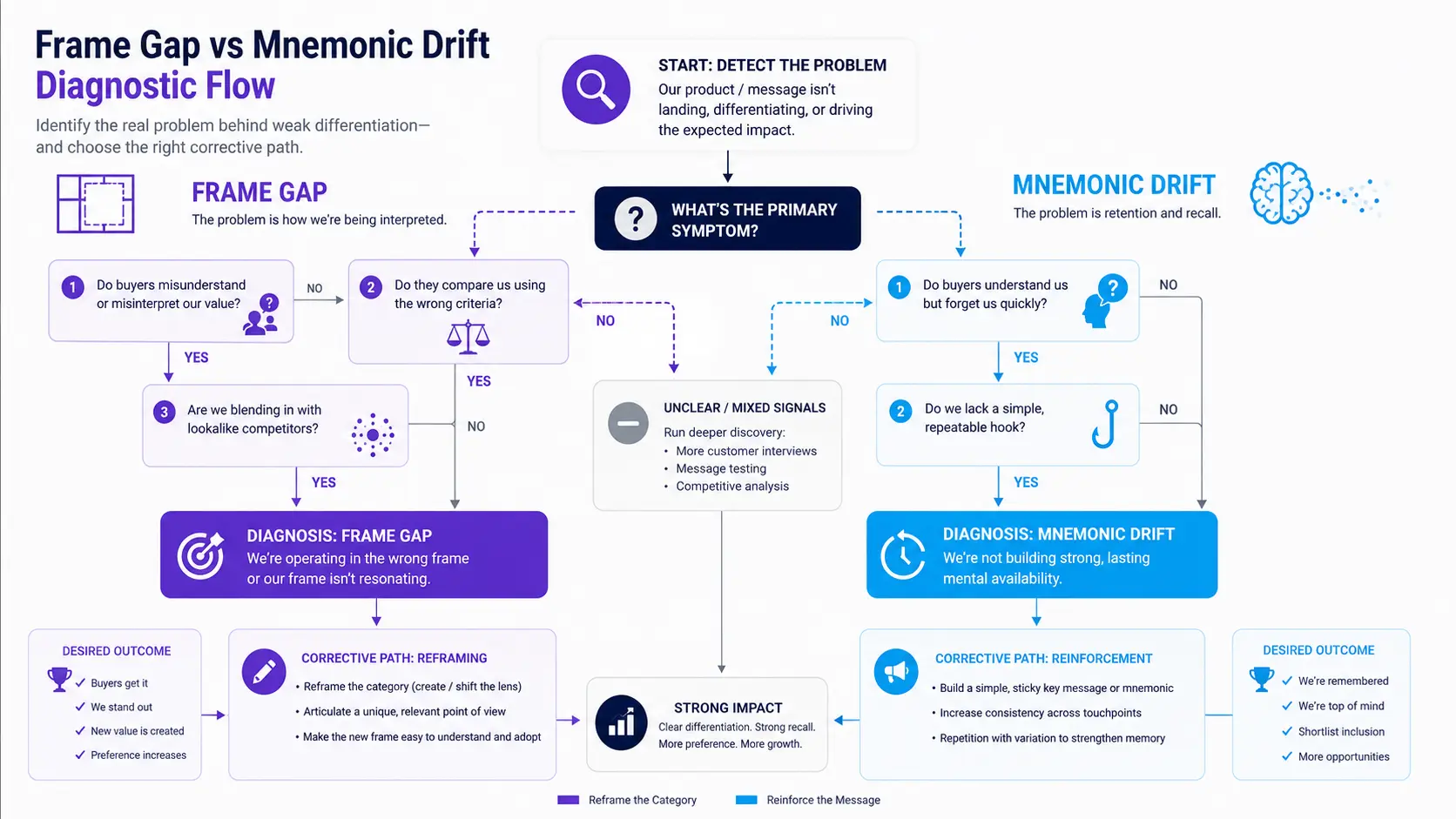
How to decide between reframing versus reinforcing in-channel
Decision Framework: Reframing vs Reinforcing Messaging
| Aspect | Frame Gap | Mnemonic Drift |
| Visibility to buyers | Buyers can’t decode what’s unique; market context unclear | Buyers recall category but not the specific brand or difference |
| Cause | Missing or unclear interpretive frame | Cues fade from memory between touchpoints |
Here’s where decision paths diverge.
If you uncover a frame gap, no amount of refined content, ad spend, or channel optimization will overcome missing context.
The real fix is to reshape the frame of reference: either introduce a new interpretation, or make buyers question the old one.
But if cues are simply eroding (mnemonic drift), the answer is channel reinforcement – discipline in language, repetition of category frame, and ruthless alignment across every touch.
We’ve pushed clients to test this directly: first, strip all creative, then run cold, context-agnostic interviews.
If prospects still can’t describe your point of difference without a prompt, it’s a frame gap.
If they remember the category but not you, it’s mnemonic drift.
The decision is binary: build the right interpretive frame, or reinforce relentlessly until buyers know not just what you do, but why only you do it.
Don’t treat frame and memory failure as creative issues.
Category context comes first.
Diagnose the gap, pick the corrective move, and structural differentiation becomes not only possible – but visible again.
Without a frame, category defaults take over your language.

Scientific context and sources
The sources below provide foundational context for how decision-making, attention, and performance dynamics evolve under scaling and constraint conditions.
- Category Frames and Cognitive Processing
The Role of Explanations and Need for Uniqueness in Consumer Decision Making: Unconventional Choices Based on Reasons – Stephen M. Nowlis, Itamar Simonson – Journal of Consumer Research
Explains how decision-makers rely on justificatory reasoning, comparison frames, and cognitive shortcuts when evaluating alternatives, supporting the idea that generic claims get filtered through existing mental structures.
https://academic.oup.com/jcr/article/27/1/49/1791551 - The Role of Salience in Differentiation
Salience Driven Value Integration Explains Decision Biases and Preference Reversal – Konstantinos Tsetsos, Jörg Rieskamp, Timothy M. Hare – Proceedings of the National Academy of Sciences
Demonstrates how salience determines which attributes dominate decision-making, reinforcing that structural differentiation matters more than superficial variation.
https://www.pnas.org/doi/10.1073/pnas.1119569109 - Mnemonic Anchoring and Reference Points
Memory and Decision Making – Elke U. Weber, Eric J. Johnson – The Blackwell Handbook of Judgment and Decision Making
Describes how memory structures and reference frames shape encoding, retrieval, and evaluation during real-world decisions, directly relevant to recall of value propositions.
https://www.wiley.com/en-us/Blackwell%2BHandbook%2Bof%2BJudgment%2Band%2BDecision%2BMaking-p-9781405157599 - The Pitfalls of Parity and Undifferentiated Positioning
Brand Credibility, Brand Consideration, and Choice – Tülin Erdem, Joffre Swait – Journal of Consumer Research
Analyzes how weak differentiation and parity-based positioning reduce perceived distinction and affect buyer choice behavior.
https://academic.oup.com/jcr/article-abstract/31/1/191/1818147 - Structural Change and Market Reframing
Positioning Rationality and Emotion: Rationality Is Up and Emotion Is Down – Luca Cian, Aradhna Krishna, Norbert Schwarz – Journal of Consumer Research
Explores how framing and structural presentation alter perception and evaluation, showing how changes in presentation architecture can materially shift buyer judgments and preferences.
https://doi.org/10.1093/jcr/ucv046
Questions You Might Ponder
What is category framing for differentiation and why does it matter?
Category framing for differentiation refers to shaping how buyers perceive and compare your product within a defined mental category. It is vital because claims that fit category defaults fade into the background, while unique framing breaks through, boosting recall, attention, and pricing power.
How do undifferentiated claims impact buyer decision-making?
Undifferentiated claims – like “faster, easier, secure” – quickly become table stakes within an established category. Buyers see such claims as generic, making it difficult to stand out or justify a premium, which erodes true competitive advantage.
What’s the difference between points of parity and real differentiation?
Points of parity are features or benefits every credible competitor offers; they’re necessary but not sufficient. Real differentiation requires changing the comparison frame – showing buyers a new, credible, and distinctive value that can’t be easily matched or dismissed.
How can I tell if my brand has a frame gap or mnemonic drift?
A frame gap means buyers don’t recognize what’s uniquely valuable or can’t place your offering in the right context. Mnemonic drift means buyers recall the category but forget your brand’s specific difference. Diagnose by testing market recall without prompting.
What strategies help break out of commodity perception in crowded markets?
The most effective strategy is shifting the category frame – either by introducing a new reference point, redefining how value is calculated, or owning a use case competitors can’t credibly claim. Reinforcing the new frame consistently across touchpoints cements differentiation.