
What You’ll Learn
Category defaults messaging convergence is the process where a brand’s messaging becomes indistinguishable from the standard language of its market category.
It happens when companies rely on familiar claims such as “trusted partner”, “innovative platform”, “seamless integration”, or “end-to-end solutions” instead of using a clear, distinctive point of view.
As more competitors repeat the same value language, buyers stop noticing differences and default to price, feature comparisons, or the safest-known option.
For brands, category defaults messaging convergence weakens trust, reduces memorability, attracts poor-fit leads, and turns positioning into background noise rather than a reason to choose.
Key Takeaways
- Category defaults create a gravitational pull that makes distinct messaging disappear unless brands purposely challenge expected industry language.
- Messaging convergence leads to brand invisibility, price-based competition, and decreased trust, all of which undermine business performance.
- The use of shared value language and competitor-driven framing are major signals that messaging has collapsed into the default.
- Distinctive framing requires contrasting messaging against category norms and testing for clarity and memorability outside standard industry language.
Most teams believe they’re differentiating the moment they type a value proposition.
The real twist?
For your audience, the category’s default script starts running before a single word in your campaign is actually considered.
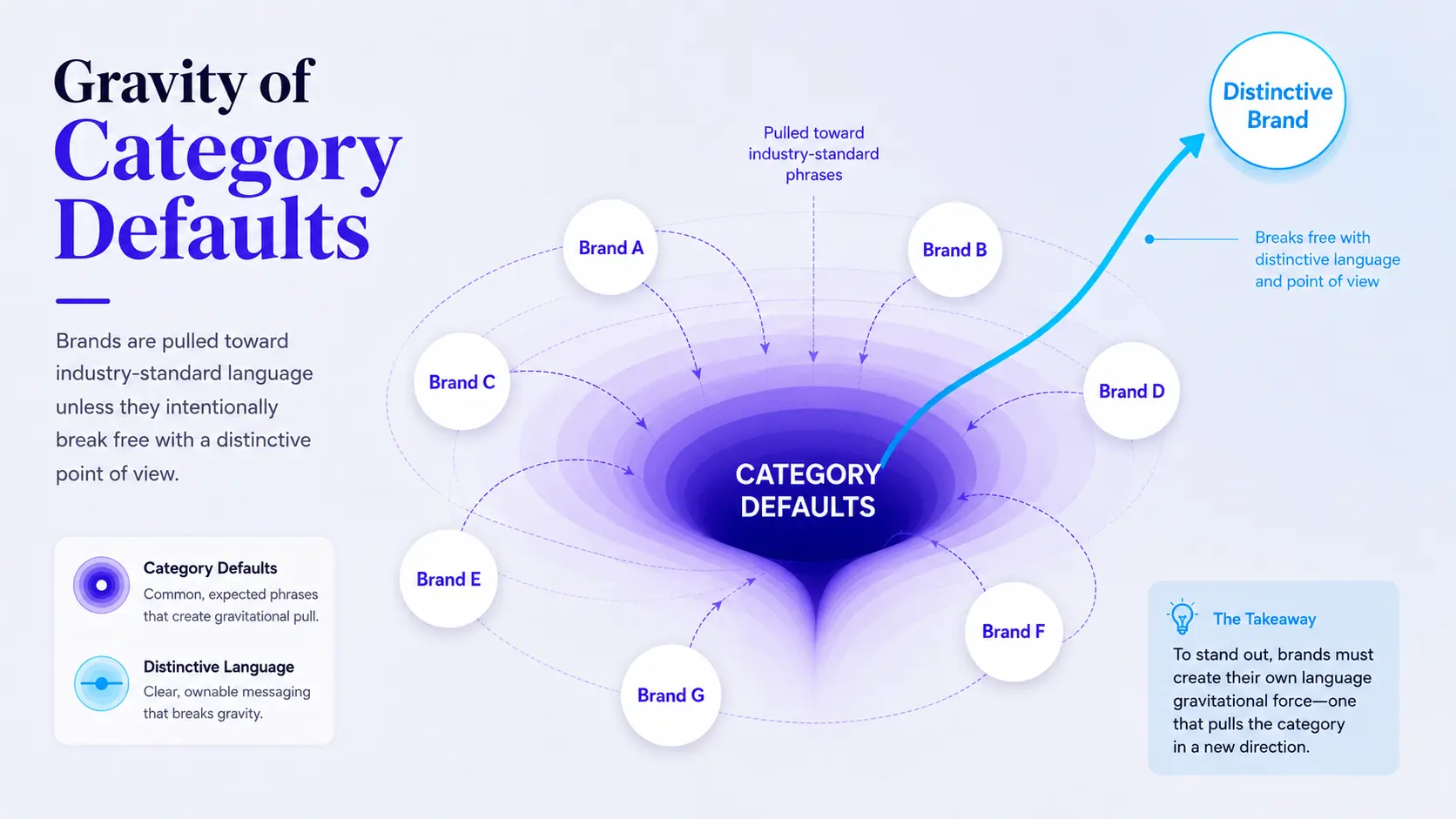
Category gravity isn’t theoretical – it’s a force field that pulls every attempt at distinction back to familiar, safe, invisible territory.
This creates a paradox: the more you mirror industry lingo, the more your messaging vanishes into the background.

Why default category language hijacks your messaging
Imagine approaching a crowded display of lookalike products – the second you recognize the type, your brain primes itself to expect certain features, benefits, and even disappointments.
Buyers do the same with messages in mature categories.
Before your messaging gets any attention, the “category default” has already preloaded expectations, mental shortcuts, and even a bias for how brands like yours should sound.
In workshops with leadership teams, we often see execs shocked at how many assumptions surface when we ask, “What do you expect the next SaaS tool to promise before you read any copy?”
Predictably, the answers echo across companies: reliable, scalable, easy, trusted – the baseline claims of the entire field.
What your audience assumes before they read your words
Here’s the myth: audiences give you a blank slate.
Instead, they judge every sentence through a filter built on years of “default category language”.
If your messaging simply fits that template, it rarely even registers – it’s just background noise.
This explains why even sophisticated messaging audits surface patterns of accidental sameness.
If you’re not actively escaping, you’re converging.
That broader model is outlined in Brand Positioning.
When shared value language becomes invisible sameness
There’s a moment when messaging loses all edge: when every claim could just as easily live on a competitor site.
“Innovation”, “customer success”, “partnership” – these terms blur together, forming what feels like a wall of optimism with zero friction.
As practitioners, we see this during competitive reviews: the biggest brands and scrappiest newcomers alike default to absorption by the category expectations, insisting their shared values are special.
The result?
Prospects simply don’t see you; they see “another X brand”.
It’s like pouring clear water into a glass that’s already full – no one can tell what’s new.
Why do brands sound the same?
It’s not lack of creativity; it’s the invisible pull of the category messaging convergence.
The more you rely on shared value language, the more you blend into the gravity field of the default.
Default category language isn’t neutral – it’s a force that erases your distinctiveness if left unchecked.
If you want real separation, your language can’t just echo shared values.
It must challenge the gravitational pull your audience doesn’t even know they’re feeling.
Otherwise, your story will be over before you think it’s begun.

What signals make your positioning collapse into the default
Most teams don’t spot the signs of messaging convergence until their differentiation has already evaporated.
The danger isn’t sudden or dramatic – it’s incremental: one familiar phrase here, one safe benefit statement there, until your brand becomes just another echo in the category gravity field.
Why do brands sound the same, even when their actual solution is different?
It’s rarely lack of creativity; it’s the silent pull of defaults you barely notice.
Repetition of category clichés masking as benefits
Common Category Clichés Used as False Benefits
| Statement | Source | Uniqueness Check | Typical Phrases |
| Customer-centric next-generation platform driving results | Company A | Hard to identify without branding | Customer-centric, next-generation, drive results |
| Trusted partner offering scalable, reliable services | Company B | Indistinguishable from others | Trusted partner, scalable, reliable |
| Innovative solutions enabling seamless integration | Company C | Blends with industry defaults | Innovative, seamless integration, solutions |
| End-to-end platform for transformational growth | Company D | Generic industry wallpaper | End-to-end, platform, transformational growth |
“Trusted partner”, “end-to-end solutions”, “innovative platform” – these claims feel like value but function as camouflage.
We’ve audited dozens of decks where the key benefit statements could be copy-pasted between competitors with zero friction.
The problem isn’t just that everyone’s saying the same thing; it’s that your target audience’s brain recognizes these as category wallpaper and tunes out almost instantly.
Imagine shouting in a room where everyone uses the same words: any claim loses power the moment it’s confused for a reflex.
One client launched a campaign trumpeting “seamless integration” as its flagship value.
Internally, it felt like differentiation.
Externally?
Three of their top rivals were running identical headlines.
When category defaults become your vocabulary, even your strongest benefits become invisible.
Have you looked at your main messaging lately – would it stand out on a competitor’s site, or would it fit right in?
Constraint by competitor framing and unchallenged assumptions
Most teams build their positioning inside invisible boundaries set by competitors.
You review their public messaging, spot a few recurring claims, and unconsciously adapt to the pattern.
Over time, this constraint acts like gravity: even bold teams drift back toward the center.
It’s subtle, but deadly for meaningful differentiation.
In our client workshops, two signals come up repeatedly: first, messaging that reflexively responds to competitor feature lists instead of making a fresh claim; second, internal debates that default to “what the category says” instead of “what our buyers fear or crave”.
If you start positioning by asking, “How have others framed this?” – you’ve already ceded ground.
The analogy: Trying to escape default category expectations is like attempting to draw a new constellation while anchored to pre-printed dots – every line you add orbits the existing map.
Can you recall the last time a line in your pitch genuinely surprised, challenged, or unsettled your audience’s default mental script?
When your messaging collapses into the default, the cost is real: indifference on first impression, lost deals before the conversation, and the slow bleed of price pressure.
If you catch even the earliest signals of convergence, you have a shot at rewiring audience assumptions – before the category gravity field pulls you back in.

What’s at risk when messages default to category norms
You don’t lose deals to better products.
You lose them to categories that erase any sense you were different – before the buyer even considers a side-by-side.
Most teams miss this: sameness doesn’t just flatten your story, it quietly sets off a chain reaction that chips away at price power, trust, and pipeline quality before your competition even picks up the phone.
Price competition and leaking trust before comparison
When your messaging drifts into the gravitational pull of category defaults, buyers fall back on the most visible tiebreaker – price.
Executives expect differentiation to create margin, but generic messaging puts you on a conveyor belt straight to the discount bin.
In real client reviews, we’ve watched premium SaaS platforms – built with millions – get stack-ranked on price first, even with clear functional leads.
Why?
Because every headline and bullet mirrored the category’s safe promises, letting the default category language run the trust exam for them.
Here’s the thing: trust is built before comparison, but lost when you sound like every other option.
Even if you are objectively ahead, category convergence sends a subconscious message – “if all of you sound the same, how do I know whose claims to believe?” This is why brands that once led on insight find themselves squeezed into RFP spreadsheets, their unique edge lost in translation as buyers filter by lowest cost.
It’s a bit like ordering from a menu where every dish is described the same way: “delicious, satisfying, loved by customers”.
How much are you willing to pay when nothing stands out?
Self‑selection out and wrong – fit leads
Generic positioning doesn’t just attract fewer buyers – it attracts the wrong ones.
One persistent myth is that playing it safe with broad, category language will widen your funnel.
In reality, it opens you to a flood of mismatched, high-churn prospects and causes the top clients – the ones you truly want – to self-select right out.
We’ve seen B2B teams shift from sharp, structural differentiation to “category safe” messaging and instantly watch their qualified leads drop while pipeline noise ramps up.
Ambiguous positioning acts like a signal jammer: the right-fit clients can’t tell you’re for them, while every tangential prospect thinks you might be.
This is more than wasted sales effort.
It’s how conviction evaporates by the first discovery call, with sales teams left guessing who’s actually a fit.
Ask yourself: how many deals have started with excitement only to end with “not exactly what we need” – because your frame was too generic?
If you let category defaults script your story, you invite price wars, leak trust before you’ve had a chance to earn it, and stack your pipeline with drag instead of momentum.
Distinctiveness isn’t a branding nice-to-have – it’s a defense against commoditization, bad-fit leads, and deferred credibility.

How to evaluate whether your framing is default‑driven or structurally different
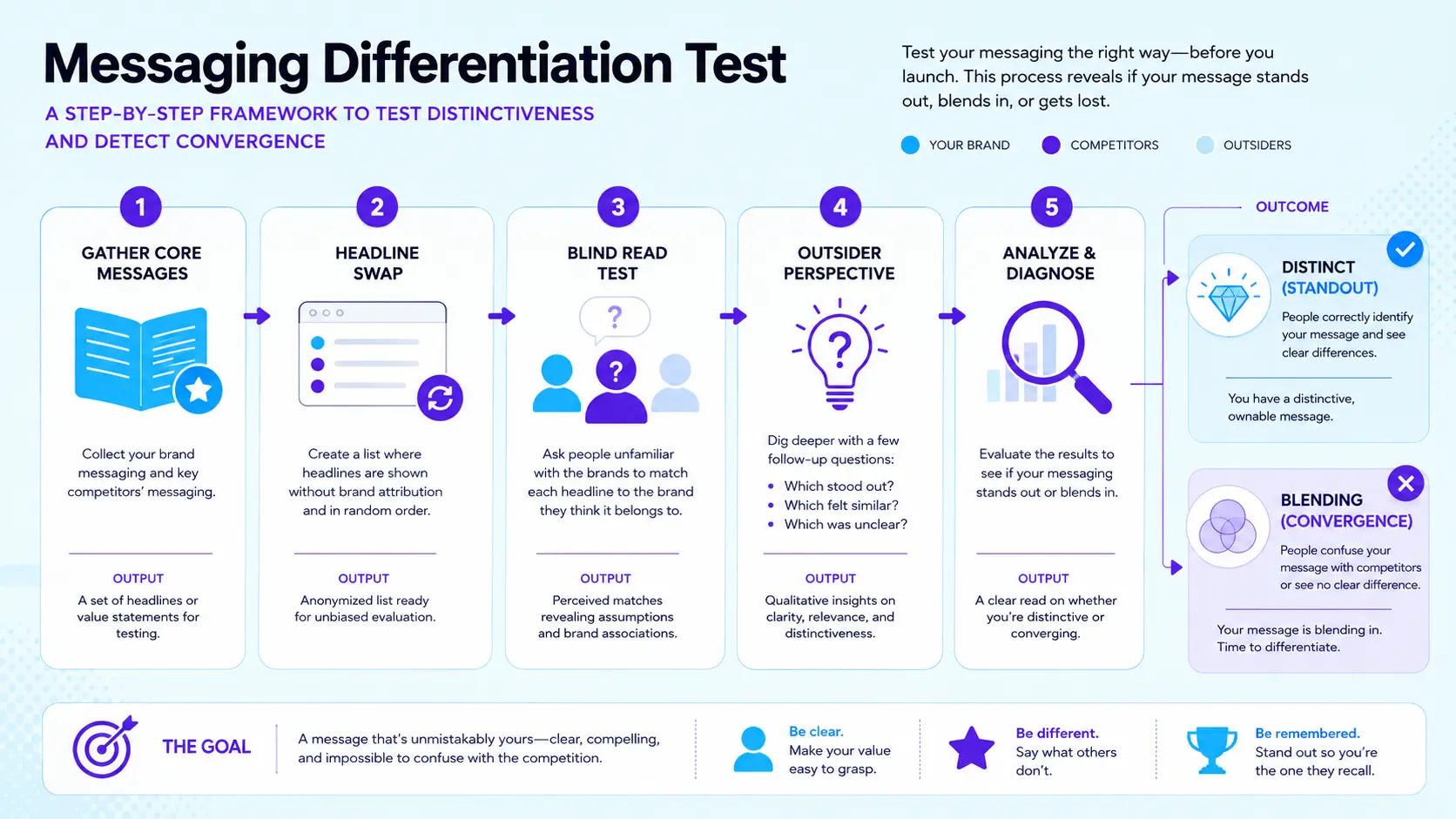
Most executives are convinced their messaging is distinct – until they run a simple, uncomfortable experiment: swap their headline with a direct competitor’s and notice nobody can tell the difference.
The silent trap?
It’s not a flaw in execution but a gravitational pull.
Category defaults create invisible boundaries, turning “differentiation” into costume changes on a standard-issue template.
If your message blends seamlessly into a sea of category language, you’re not escaping gravity – you’re orbiting the same dead planet as everyone else.
Contrast against prototypical category statements
Messaging Contrast Framework: Identifying Category Gravity
| Cliché Phrase | Description | Effect on Messaging | Example Usage |
| Trusted partner | Generic partnership claim | Blends with competitors, loses power | Used as a headline value without uniqueness |
| End-to-end solutions | Vague claim of full coverage | Recognized as category wallpaper | Common phrase in product descriptions |
| Innovative platform | Broad innovation label | Camouflages real benefits | Repeated across many competitor sites |
| Seamless integration | Claim about easy compatibility | Becomes invisible when widespread | Flagship benefit copied by rivals |
Here’s a blunt test: take your company’s core statement and stack it side by side with three leading competitors.
Read them blind.
If you can’t instantly spot your own voice – without logo or color cues – you’ve just witnessed category gravity in real time.
We’ve run this with brands convinced their positioning was unique.
The outcome: six out of seven times, even their own teams couldn’t identify which statement belonged to them.
Why?
Because phrases like “customer-centric”, “next-generation”, or “drive results” now function as industry wallpaper – so familiar, they vaporize identity instead of reinforcing it.
A simple analogy: think of your messaging as a passport.
If border officials (your audience) can’t tell what country you’re from, you’ll get treated like every other tourist.
That’s what happens when differentiation collapses into default.
Ask yourself: Does this language actually pick a fight with the default assumptions in your category, or does it just blend into the expectation?
If your point of view wouldn’t rile the average competitor, it’s likely not bold – or different – enough.
Testing for mental clarity versus generic resonance
The difference between a message that sticks and one that evaporates is clarity – not just of language, but of thought.
Generic resonance is what happens when your words feel broadly agreeable but can’t be repeated by a real prospect five minutes later.
Clarity slices through expectation; generic resonance pampers it.
With clients, we use a test: Say your main claim out loud to someone outside your industry.
If you have to explain what it actually means, or they respond with a vague nod, that’s generic resonance at work.
But if they can recall it and restate it, using your frame – not the category’s default – you’ve achieved distinctive clarity.
Try it: Is your message creating a shortcut in the buyer’s mind, or just adding another brick to the wall of beige?
The goal isn’t to sound “right” for the category – it’s to create a mental flashbulb that makes your position impossible to mistake for a competitor.
If your message passes both tests – clear enough for a stranger, distinctive enough to pick a fight – you’ve broken the gravitational pull.
That’s how structural differentiation signals its arrival.
That wider logic appears in Why “Better” Doesn’t Read as Different.

Scientific context and sources
The sources below provide foundational context for how decision-making, attention, and performance dynamics evolve under scaling and constraint conditions.
- Framing and Category Effects
Choice, Values, and Frames – Daniel Kahneman & Amos Tversky – Cambridge University Press
Establishes how mental framing and category-driven defaults shape perception and influence decisions, explaining why category defaults can dominate market messaging.
https://www.cambridge.org/highereducation/books/choices-values-and-frames/9E500B8A9AB4B7DFE81BFEFDAC55E57E - Cognitive Scripts and Expectancy in Communication
Schemata as Scaffolding for the Representation of Information in Connected Discourse – David E. Rumelhart & Andrew Ortony – Center for the Study of Reading
Explores how people rely on cognitive schemas to interpret new information, leading to familiar category-based perception and “invisible sameness” in communication.
https://users.cs.northwestern.edu/~ortony/Andrew_Ortony_files/1977%20-%20Rumelhart-Ortony.pdf - Information Overload and Market Signaling
Market Signaling: Informational Transfer in Hiring and Related Screening Processes – Michael Spence – Harvard University Press
Examines how visible signals transfer information in uncertain markets, explaining why weak or generic signals reduce differentiation and increase reliance on simpler comparisons.
https://books.google.com/books/about/Market_Signaling_Informational_Transfer.html?id=rkXZAAAAIAAJ - Differentiation, Brand Salience, and Information Processing
How Brands Grow: What Marketers Don’t Know – Byron Sharp – Oxford University Press
Provides data-driven analysis of why distinctive brand assets and mental availability improve recall, recognition, and competitive strength in mature markets.
https://global.oup.com/academic/product/how-brands-grow-9780195573565 - Competitive Convergence and Category Framing
General Evaluability Theory – Christopher K. Hsee & Jiao Zhang – Perspectives on Psychological Science
Explains how people judge value through evaluability and reference context, supporting why category frames can make competing options appear functionally similar.
https://journals.sagepub.com/doi/10.1177/1745691610374586
Questions You Might Ponder
What are category defaults in marketing messaging?
Category defaults refer to common language, claims, or value statements that are used so widely within a market category that they set buyer expectations before any brand’s message is even considered. These defaults make differentiation difficult and cause brand messages to blend into the industry background.
How does messaging convergence impact sales performance?
Messaging convergence reduces a brand’s perceived uniqueness and value, making it harder to command premium pricing or build trust. When all brands sound similar, buyers default to comparing on price or features, leading to commoditization and lost deals even before detailed evaluation begins.
Why do brands unintentionally adopt category default language?
Brands often default to familiar language due to competitor monitoring and a desire to appear credible in the industry. This unconscious mimicry is reinforced by internal alignment and a lack of direct buyer feedback, resulting in messaging that mirrors category norms instead of challenging them.
What risks are associated with relying on industry-standard messaging?
Over-reliance on industry-standard messaging leads to brand invisibility, lost pricing power, and a pipeline filled with poorly qualified leads. These risks are compounded by increased buyer skepticism, as prospects struggle to distinguish between competitors and default to the safest, cheapest, or most familiar choice.
How can companies identify if their messaging has become generic?
Companies can test their messaging by swapping it with competitors’ headlines and seeing if the difference is noticeable. If not, it’s a sign of messaging convergence. Additional tests include asking outsiders to restate brand claims or evaluating if the language challenges category expectations directly and memorably.