
What You’ll Learn
Better vs different brand positioning is the contrast between claiming superiority within an existing category and creating a distinct frame that changes how buyers evaluate value.
“Better” positioning usually triggers direct comparison on price, speed, features, or marginal performance, which can turn the brand into a commodity.
“Different” positioning works when the brand creates meaningful contrast through a new model, sharper specialization, or category-level reframing that makes standard comparisons less relevant.
The goal is not to sound slightly better than competitors, but to make buyers see the brand as the right fit for a specific problem, context, or worldview.
Key Takeaways
- “Better” positioning triggers direct comparisons, erodes trust, and often collapses into price competition.
- True differentiation stems from model-level or category-level contrast, not incremental or cosmetic features.
- Attempting to appeal too broadly or relying on novelty leads to invisible or ineffective positioning.
- Sustainable growth comes from reframing evaluation criteria or specializing deeply, escaping commodity traps and side-by-side buyer scrutiny.
Think “better” signals strength?
In the world of better vs different brand positioning, most buyers see that claim as a shortcut for “compare me”.
When a brand claims superiority, it quietly invites a mental checklist: “Are you cheaper, faster, or just louder?” That’s when the real problem starts.
Superiority claims don’t set you apart – they funnel you directly into a spreadsheet with every other vendor shouting the same thing.

When “better” Turns You Into a Commodity
In client work, we’ve seen executives swear by the power of “best-in-class”, only to watch buyers scroll past in search of a deal.
Why?
Because “better” shifts focus to obvious metrics – price, marginal speed, incremental features – rather than value.
Even a strong case for minor technical improvements quickly dissolves when a competitor offers something nearly identical for less.
Why “better” encourages direct comparisons – and loses trust
Contrary to popular belief, claiming to be better doesn’t create trust; it erodes it.
Buyers become skeptical, assume spin, and default to side-by-side evaluation.
It’s like telling someone you’re the “healthiest” menu option; the next question is always, “Compared to what – and by how much?”
Impacts of ‘Better’ Positioning on Buyer Perception and Trust
| Option | Description | When to Choose |
| Category Context Reframe | Create a new category or mental framework to redefine buyer evaluation criteria | Your offer solves problems not addressed by existing frames |
| Target Shift | Specialize in a narrower, overlooked market segment to avoid broad comparisons | Market is overly crowded; general share battle is unproductive |
What most miss: superiority language tells buyers your product can (and should) be measured against others on standard terms.
That’s a recipe for comparison fatigue – and squeezed margins.
The more you anchor on “better”, the more buyers look for simple proof or cheaper parity.
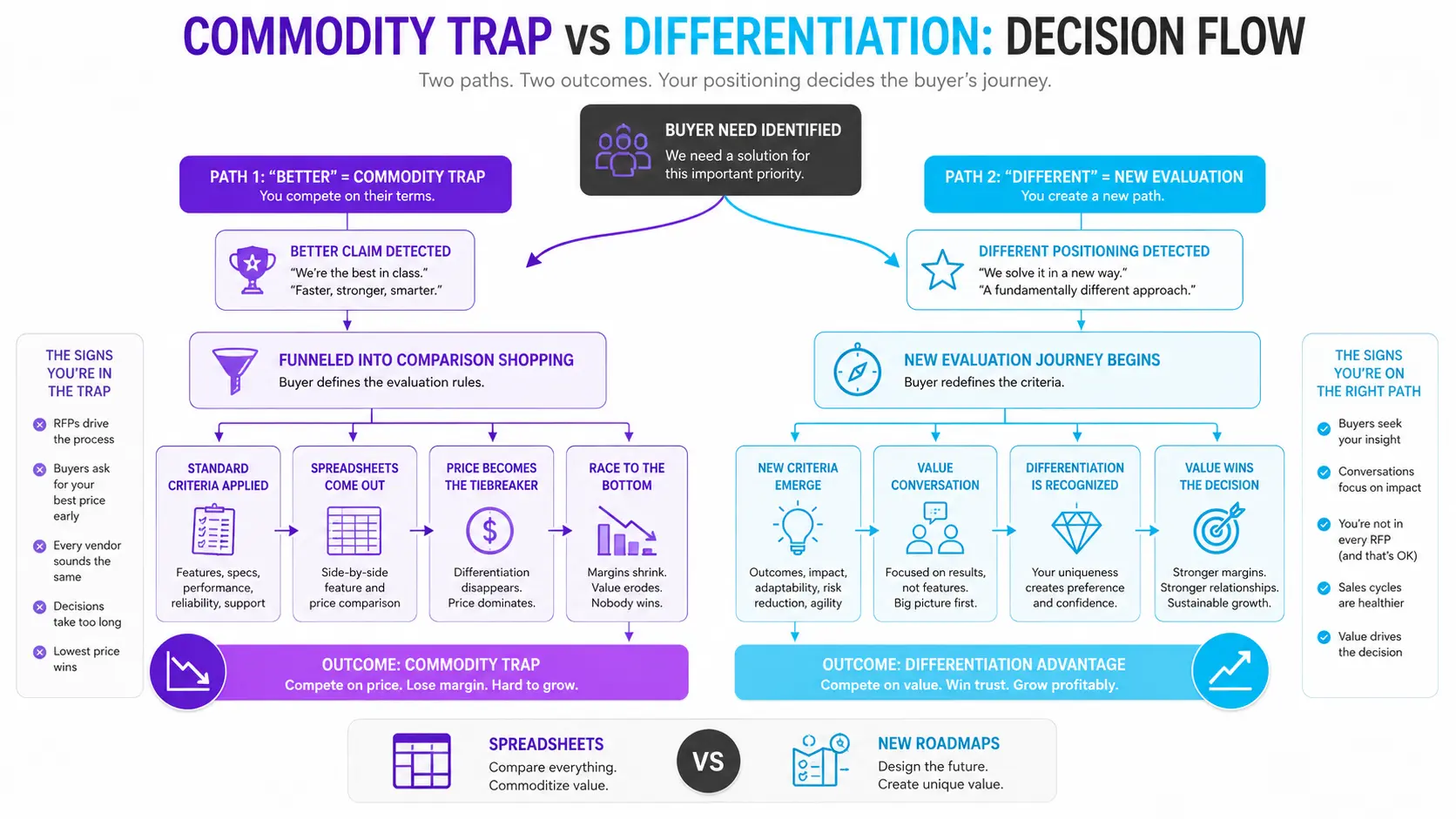
The commodity trap: when small edges vanish in context
Here’s the overlooked reality: the more you try to win buyers with incremental advantages, the less you control the conversation.
Minute improvements – 2% faster, 5% cheaper, slightly more robust – become invisible as soon as one competitor matches or reroutes the promise.
We’ve watched SaaS clients pour resources into micro-feature upgrades, only to enter price wars that left everyone’s margins underwater.
Tiny functional edges don’t survive real-world procurement tables, where buyers ignore differences that aren’t dramatically relevant.
“Better” triggers the commodity trap – the unwinnable game of stacking negligible benefits until they dissolve into noise.
Imagine standing in aisle after aisle of similar coffee brands, each boasting “richer flavor”, “smoother finish”, or “bolder roast”.
The net result?
Everyone looks the same.
Suddenly, price becomes the only variable left to fight over.
Marginal upgrades don’t move decisions – context does.
If your value is mostly “slightly superior”, expect to be asked for discounts or to justify every dollar.
This dynamic is the root of commodity trap differentiation – where any attempt to stand out on incremental ‘better’ claims just deepens the pattern.
When edge after edge gets erased by barrage of alternatives, defending “better” becomes exhausting.
What remains is a race to the lowest denominator – one you can’t win on specs alone.
“Better” claims feel safe, but they silently script you into someone else’s comparison chart.
True differentiation does the opposite – and that’s where most growth breakthroughs begin.

How “Different” Reframes Evaluation – and Resists Collapse
Most brand strategy misses a simple reality: “better” draws out direct comparison.
“Different” flips the game board.
When buyers feel genuine contrast, they stop asking, “Who wins?” and start asking, “Is this even the same race?” That question shifts the spotlight from feature checklists to a redefinition of value itself – no longer about increments, but about category-defining distinction.
Shifting evaluation criteria through model contrast
Think of the difference between comparing apples and oranges – not which is juicier, but why you even want fruit in the first place.
When your positioning stands apart by model – not just margin – what buyers care about transforms.
In real campaigns, we’ve seen companies reframe from “faster analytics” to “a new decision system” and watch evaluation jump from number of features to new ROI levers entirely.
This is the moment where evaluation criteria shift – no longer about small advantages, but about how relevant difference drives decision.
True purpose-built difference creates a new frame, outlasting any race for incremental superiority.
The myth: buyers always stack up vendors side by side, features in rows, pricing in columns.
In our experience, that only happens when every option fits a familiar model.
But introduce a new framework – one that rejects the default – and buyers recalibrate.
Suddenly, they’re not asking which solution is superior, but whether any other provider even belongs in the same discussion.
It’s the difference between being compared on price and being noticed for relevance.
Have you ever found yourself pitching against legacy thinking and sensing the real resistance isn’t your product, but the lens being used to evaluate it?
That’s the leverage point. “Different” lets you sidestep the default mental script.
One B2B client jumped from midpack to first-considered by changing the story buyers told themselves: instead of “a better tool”, it became “a smarter operating model”.
Great model contrast isn’t just a trick – it’s a lens swap.
The fastest way to collapse a commodity trap is to force a new evaluation story to be written from scratch.
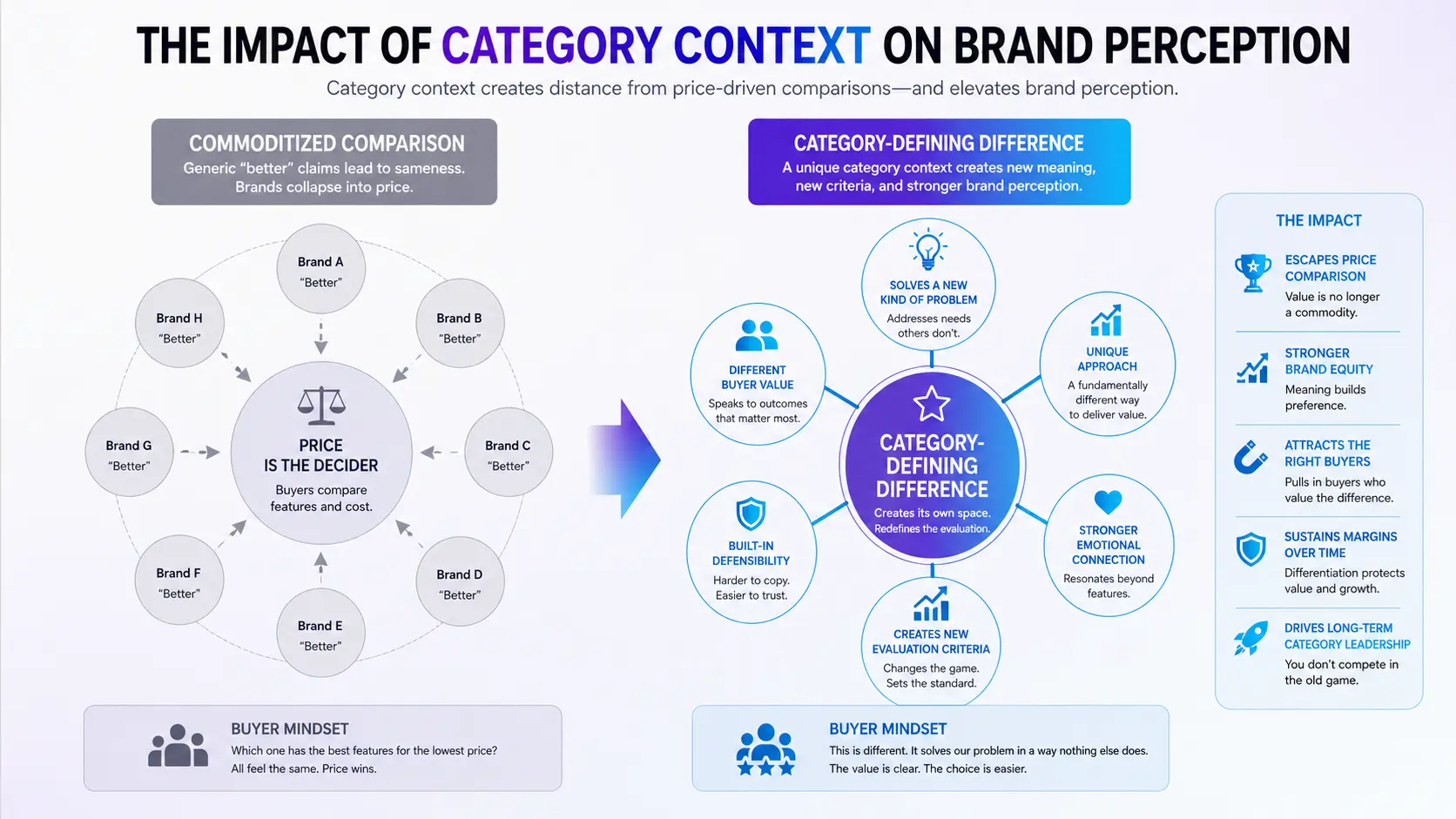
Category context as the backbone of meaningful difference
Ask yourself: would your offer still make sense if buyers forgot what category you’re in?
If not, your “difference” is likely cosmetic.
Category context is the backbone: it gives buyers the framework to see your value as distinct and meaningful, not merely “other”.
We’ve watched brands stall because their “difference” was defined in a vacuum – novel, maybe, but incomprehensible.
The strongest differentiation always roots itself in a new or reframed category.
It’s like shifting from “the next cola” to “the anti-soda” – suddenly the evaluation has new, self-defined criteria.
Buyers no longer compare you on calories or taste alone; they reconsider what they expect from the category itself.
Here’s a simple analogy: imagine two roads leading to the same city versus a road to a city no one’s visited yet.
The first invites a mileage comparison.
The second starts a fresh map.
That’s the power of using category context as your anchor.
Relevant category framing isn’t a brand flourish; it’s the engine that makes difference stick and stops your value from collapsing into commodity status.
No executive wins market share by sounding like everyone else with a twist.
Push the frame, and buyers will shift their criteria – often faster than you imagine.

Common Traps That Make “Different” Still Feel Generic
Most executives celebrate “different” like a trophy – then wonder why buyers still don’t care.
The real trap?
Distinction that’s empty, or so watered-down it’s invisible in the glare of the market.
Nearly every team we’ve worked with has hit these walls and mistaken novelty for substance.
The result: buyers spot the gimmick or can’t find an actual reason to care.
Let’s break down how this happens and the mental shortcuts that quietly push your brand right back into the comparison stack.
When “Different” is just novelty – not relevant difference
A paint brand’s “coconut-scented” finish.
A payroll app with an animated mascot.
These feel quirky.
They might create a momentary blip of attention.
But they don’t change buying decisions because novelty without relevance is invisible the moment the crowd moves on.
Buyers – consciously or not – run your difference through one filter: does it solve my problem or make me rethink my choice?
One client rolled out a new platform feature no competitor had, expecting it to drive conversion.
The spike in demo requests faded after a single campaign cycle.
Why?
The feature was interesting but didn’t shift business outcomes.
It was difference for its own sake – a distraction, not a decision-driver.
Think of it this way: a brightly colored umbrella looks unique until it rains.
Then every buyer reaches for the one that actually keeps them dry.
Does your “onlyness” stand up when the weather turns?
If your difference doesn’t map to a pain point or unlock new value, it becomes a party trick – quickly forgotten, never requested, and deadly to reputation when pressed by competitors who deliver real change.
Diluted framing: trying to appeal broadly erodes contrast
Everyone wants growth – but making “different” safe for everyone strips it of meaning.
The urge to avoid alienating any segment leads teams to sand down edges and broaden the message until nothing memorable remains.
Instead of clear, category-shifting value, you get: “We’re a flexible partner for every company, everywhere”.
In practice, the widest net rarely catches the biggest fish.
We’ve seen SaaS brands jump from “the financial ops platform for e-commerce leaders” to “the business platform for ambitious companies”.
Pipeline quality slid; no one could say exactly what problem they solved or why they were the first call for anyone.
Here’s the test: if your difference feels like it could substitute in any adjacent category, it’s not a real point of contrast – it’s background noise.
Specialization isn’t a risk; it’s the amplifier.
It’s the only way you earn sharper mental shelf space and defensible deals.
Relevance beats novelty, and edge beats generalization.
“Different” only works when it matters – to the right buyer, in the right market, solving the right pain at the right time.
If your difference feels bland, it probably is.
The antidote: sharpen, specialize, and make buyers feel you built it just for them.
Undifferentiated claims become noise.

What to Do Next When You’re Being Compared Anyway
Most brands caught in endless comparison sprints aren’t actually losing the quality race – they’re fielding the wrong test.
The real competitor isn’t another product.
It’s the evaluation criteria silently guiding every buyer’s mental checklist.
If your winning features turn invisible the minute price or technical specs become the focus, you’re not in control of the pitch – someone else is.
Diagnose where evaluation criteria are defaulting to price or features
The catch: even bold claims of difference collapse under pressure if buyers revert to habit.
We’ve seen B2B teams chase costly new features, only to watch prospects skip straight to price columns during final negotiations.
Superiority-fueled language (“we’re the fastest/most secure/most advanced”) actually steers the conversation back to measurable – and easily commoditized – attributes.
Ask: is your pipeline stalling at the stage where buyers compare line-item costs, feature parity, or implementation checklists?
If so, you’re likely stuck in the commodity trap, where every small advantage is shaved down until only price survives.
It’s like trying to differentiate one white paint chip from another under harsh fluorescent light – the nuances fade and buyers just grab the cheapest.
A common myth: adding more “better” claims will tip the scales eventually.
In reality, this arms-race blurs any signal of category leadership, and trains buyers to treat your strengths as bargaining chips rather than deal-makers.
The real diagnostic question is: When do buyers stop caring about your difference and start treating you as a minor variant?
Decide whether to reframe via category context or target shift
Brand Strategy Options to Escape Comparison Traps
| Claim Example | Buyer Reaction | Resulting Consequence |
| ‘Best-in-class’ claim | Skips to deal-seeking; buyer looks for cheaper alternative | Lost trust and comparison fatigue |
| Technical superiority claims | Skepticism about marginal improvements | Judged purely on price or parity features |
Once you’ve spotted the collapse, you face a fork.
One option: reframe the way buyers judge value by making your brand represent an entirely new category context – a move that pulls attention to different benefits, changes the mental shortcut, or demands a new set of must-haves.
The other: shift who you serve, specializing harder so your proposition stops blending into generic market noise.
Category reframing works when your offer solves a problem the old frame can’t address – think of a digital workspace platform that positions itself not as “the fastest”, but as “the only system designed to work across five regulatory regimes without custom code”.
Target shift works when you stop battling for general share and own an overlooked segment (we once watched a SaaS brand grow threefold by abandoning the mid-market melee and owning compliance for fintech startups).
It’s the difference between fighting over lanes in a packed pool, versus draining your lane and holding swim lessons for those who need a new approach entirely.
What to do next: Diagnose whether you’re in a commodity shootout or a feature arms-race.
Then decide – do you invent new decision criteria, or do you put yourself in front of buyers whose needs can’t be met by “better” alone?
Your next move, not your next claim, will decide whether you break the comparison loop or get boxed in by it.
That wider implication is explored in Why Differentiated Claims Fail.

Scientific context and sources
The sources below provide foundational context for how decision-making, attention, and performance dynamics evolve under scaling and constraint conditions.
- Decision framing
Prospect Theory: An Analysis of Decision under Risk – Daniel Kahneman & Amos Tversky – Econometrica
Seminal research on how buyers evaluate choices based not only on absolute value but category/context framing, supporting the risks of comparison-dominated positioning.
https://www.jstor.org/stable/1914185 - Commoditization dynamics
The Innovator’s Dilemma: When New Technologies Cause Great Firms to Fail – Clayton M. Christensen – Harvard Business School Press
Explains why incremental improvements trigger commoditization and how category shifts create sustainable differentiation.
https://www.hbs.edu/faculty/Pages/item.aspx?num=46 - Perceived difference and choice overload
Choice, Values, and Frames – Daniel Kahneman & Amos Tversky (Eds.) – Cambridge University Press
Outlines how buyers mentally sort and group offers, and why category-defining differences rewire evaluation more deeply than better claims.
https://www.cambridge.org/highereducation/books/choices-values-and-frames/9E500B8A9AB4B7DFE81BFEFDAC55E57E - Attention and novel value
The Adaptive Character of Thought – John R. Anderson – Psychology Press
Explores how attention allocation and cognitive processing prioritize salient signals over background information in complex decision environments.
https://www.taylorfrancis.com/books/mono/10.4324/9780203771730/adaptive-character-thought-john-anderson - Category effect in market performance
How New Market Categories Emerge: Temporal Dynamics of Legitimacy, Identity, and Entrepreneurship in Satellite Radio, 1990-2005 – Chad Navis, Mary Ann Glynn – Administrative Science Quarterly
Explores how market categories shape buyer perception, legitimacy, competitive positioning, and market power, directly supporting the argument that category context changes how offerings are evaluated.
https://journals.sagepub.com/doi/10.2189/asqu.2010.55.3.439
Questions You Might Ponder
What is the difference between “better” and “different” in brand positioning?
“Better” invites comparison on features or price, often resulting in commoditization. “Different” shifts buyer evaluation, focusing attention on new value or a unique category, which reduces direct comparisons and increases pricing power.
Why do “better” claims lead to price wars?
Claims of superiority prompt buyers to stack vendors in spreadsheets, making it easy to compare features or costs. This pressure erodes margins as brands compete on minor edges that can easily be matched by competitors, creating a race to the bottom.
How can a brand escape the commodity trap?
Brands should focus on reframing category context or deeply specializing for a target segment. By shifting buyer criteria from “incrementally better” to “meaningfully different”, brands stop competing on minor tech specs and start owning uncontested territory.
What is the risk of novelty-based differentiation?
Superficial differences, like quirky features or aesthetics, do not impact the buyer’s decision if they don’t solve real problems or shift value. Novelty may draw momentary attention but rarely sustains demand or elevates long-term perception.
When should brands consider repositioning their category?
If buyers treat your strengths as bargaining chips or default to price comparisons, it signals your positioning must change. Either reframe buyer expectations through new category context, or further specialize your offer for underserved, high-need segments.