
What You’ll Learn
Claim stacking noise is the loss of clarity and trust that happens when a brand piles too many benefit claims, features, promises, or value statements into its messaging without a clear hierarchy or category context.
Instead of giving buyers more reasons to choose, claim stacking creates cognitive overload, weakens each individual claim, and makes the offer feel generic or hard to believe.
Buyers tune out because they cannot identify what matters most, how the brand is different, or why the claims are credible.
Claim stacking noise often signals a deeper positioning problem: unclear fit, weak contrast, and messaging that tries to compensate for missing strategic focus.
Key Takeaways
- Claim stacking noise undermines trust by overwhelming buyers and diluting each benefit’s credibility.
- Excessive benefit statements trigger cognitive overload and decision fatigue, causing prospect disengagement.
- Strong differentiation and category context are essential for claims to be memorable and persuasive.
- Claim stacking often signals a positioning failure; sharpening segmentation upstream increases message clarity and downstream conversion rates.
Most teams assume more claims mean more reasons to buy.
In reality, it’s the fastest way to strip power from every benefit.
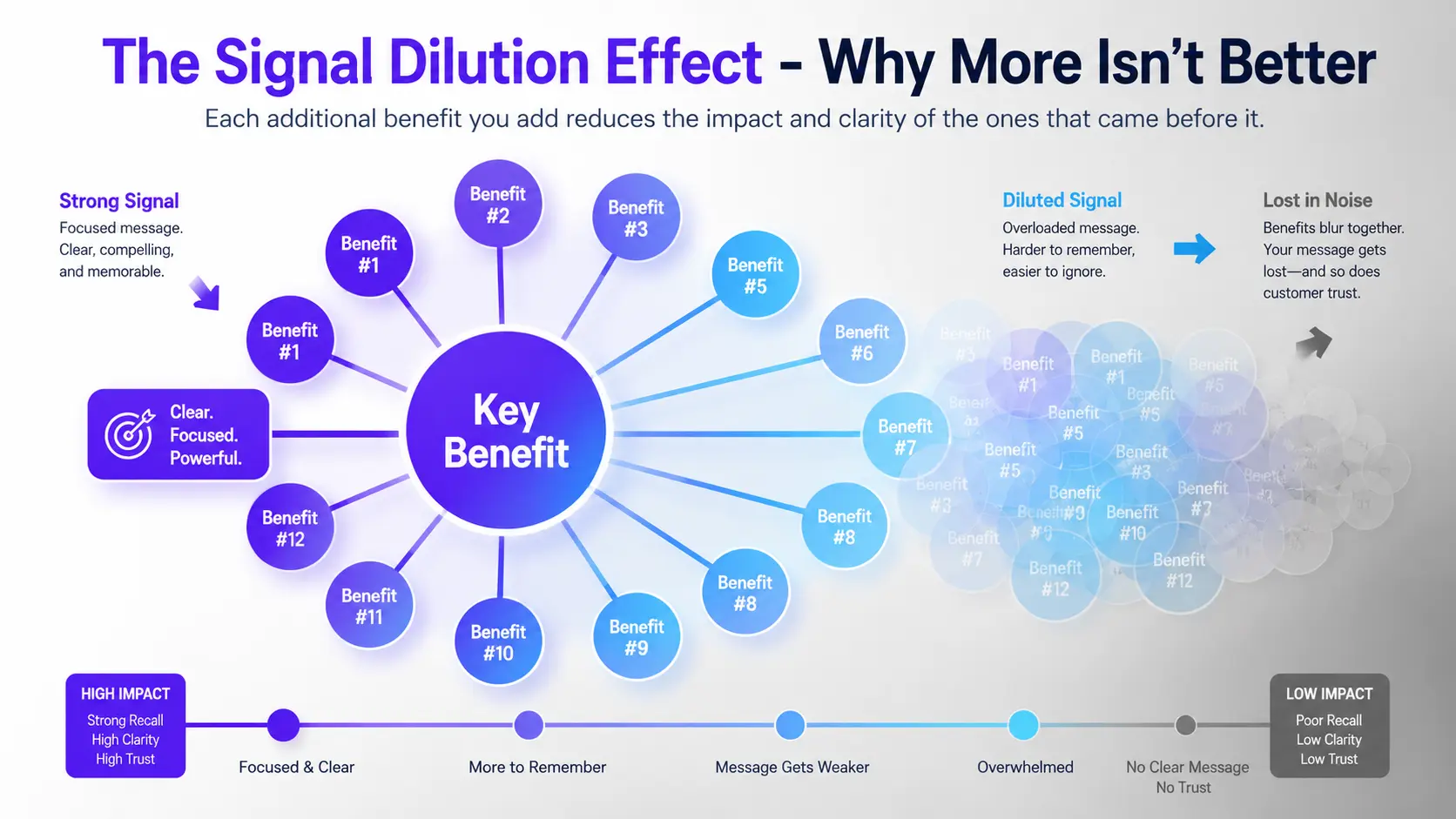
Pile on five, six, seven advantages, and buyers stop absorbing – they start tuning out.
This is a classic case of marketing overload: as each claim lands, the next one drowns it out, until the entire value proposition becomes little more than static.
This whole dynamic is a form of claim stacking noise – a buildup that makes each benefit less believable the more you add.

Why piling on benefit statements undermines trust
One SaaS client once packed their homepage with twelve separate bullet points.
Instead of buyers moving faster, bounce rates quietly climbed.
Each statement tried to outshine the last; none were truly believed.
This is the paradox of “benefit overload” – what’s meant to focus attention actually fragments it.
Without clear prioritization, every message blurs into the next, creating signal dilution instead of differentiation.
When too many claims turn into a blur
Think of claims like colors on a palette.
Too many, too close together, and all you see is gray.
Which benefit should get the spotlight?
If everything is “world-class” or “faster”, nothing really stands out.
Buyers subconsciously protect themselves by ignoring the blur, an instinct gained from years of over-promising marketing.
One simple, sharp claim will be remembered long after a list of ten vague ones fades.
That wider logic is outlined in Brand Positioning.
Impact of Number of Benefit Claims on Buyer Engagement
| Symptom | Description | Consequence | Suggested Action |
| Mental freeze | Buyers freeze after few points | Leads circle back later or disengage | Reduce claims to most distinctive 3-4 |
| Confusion | Difficulty prioritizing benefits | Decision paralysis | Create clear hierarchy of benefits |
| Bounce increase | Higher bounce rates on landing pages | Loss of potential conversions | Limit claims on homepage |
| Choice overload | Too many similar options presented | No decision made | Simplify messaging to avoid paradox of choice |
Why words without contrast sound empty
A benefit only matters in context – and most brand statements leave context out.
Declaring “best customer support” or “seamless integration” without a reference point is like shouting into a crowded room; nobody hears your voice.
This lack of category-based comparison triggers perceived indistinct messaging, which breeds trust erosion.
We’ve seen pitches jammed with positive adjectives but missing any anchor: “fastest onboarding”, “absolute security”, “integrates everywhere”.
None of it tells the buyer, “Unlike other options, here’s why this is different for you”.
Without contrast, every word sounds recycled.
Buyers crave contrast absence differentiation: if you don’t define the category you’re disrupting or what you’re not, your benefit claims become background noise.
A simple analogy: reading a menu where every dish is labeled “delicious”.
At some point, the word becomes meaningless – only a dish with a distinct flavor profile will be remembered.
If claims don’t create separation from rival offerings, trust quietly evaporates.
In positioning, less but sharper language earns more belief than an armful of empty promises.
The more you stack, the less buyers trust.
By stripping away unnecessary noise and restoring real contrast, every benefit statement regains its weight – and the next section reveals exactly why excess claims don’t just stall a buyer, they force them to check out entirely.

What cognitive pressure causes buyers to tune out claims
Most buying teams don’t lose trust because they spot a lie – they lose trust because their brains simply give up sorting the noise.
Imagine your best prospects arriving hungry for a decision, only to find your message looks like an endless row of blinking ads, each one insisting it’s most important.
Cognitive overload in marketing isn’t just an inconvenience; it’s a silent killer of intent.
Their attention collapses long before their skepticism kicks in.
Decision fatigue from benefit overload
Symptoms and Consequences of Decision Fatigue from Benefit Overload
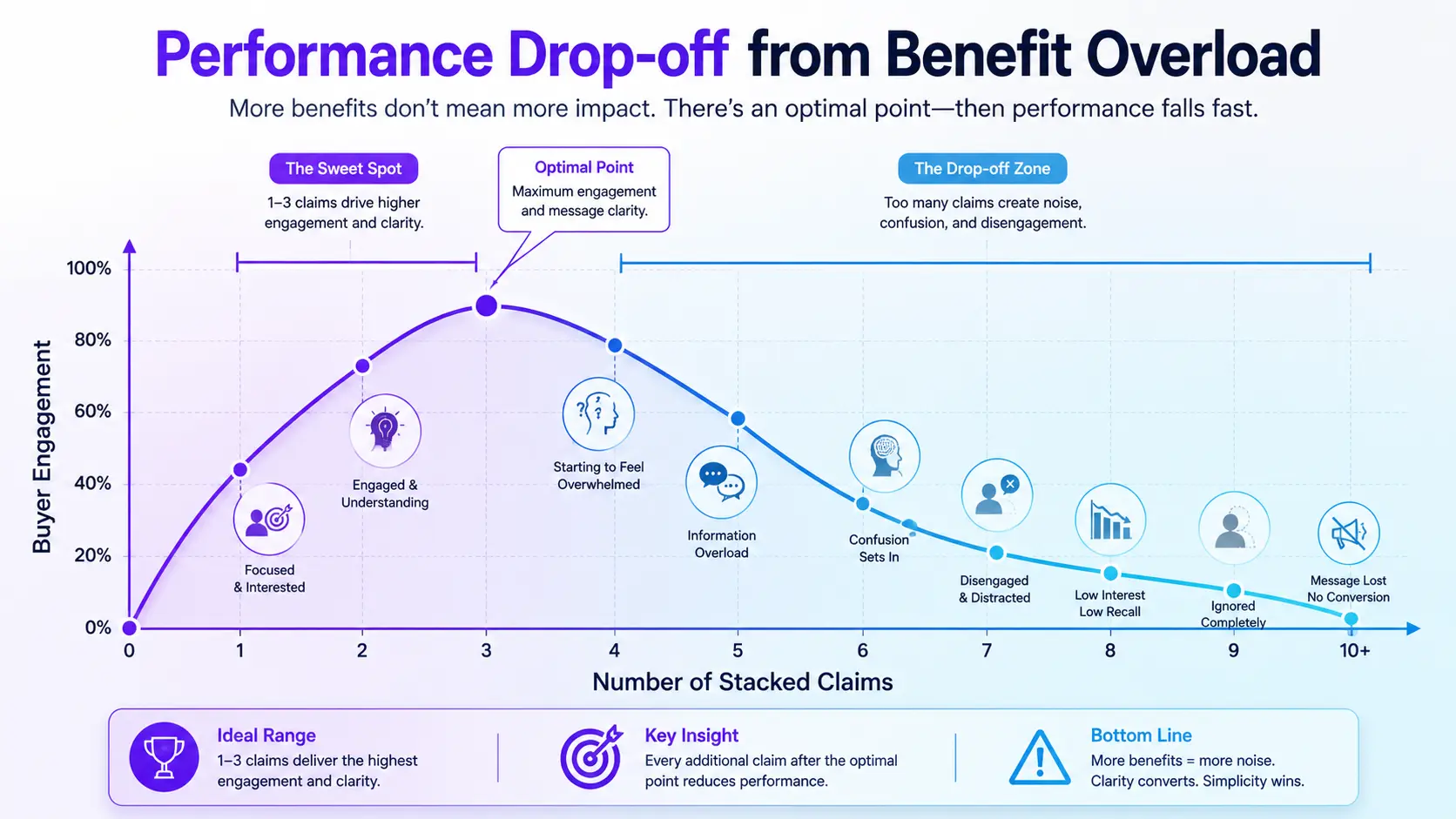
| Number of Claims | Buyer Engagement | Trust Level | Bounce Rate |
| 1-2 | High focus | High trust | Low |
| 3-4 | Moderate focus | Moderate trust | Moderate |
| 5-7 | Low focus | Low trust | Increasing |
| 8-12 | Very low focus | Very low trust | High |
Ever wonder why qualified leads suddenly “circle back later”?
The answer isn’t always hidden objections – it’s usually fatigue from trying to compare a jumbled message.
Layering benefit after benefit without a clear hierarchy forces prospects into mental triage.
In our client reviews, we’ve watched high-intent buyers freeze after just three or four points.
They mentally log out, not because they doubt the value, but because they can’t choose what actually matters.
In one campaign audit, reducing the benefit stack from eight features to the three most distinctive dropped bounce rates by 27%.
It’s like walking into a grocery store with 50 brands of cereal: at some point, you don’t buy anything.
This is classic decision friction – the paradox of choice turned against your own funnel.
Do you resolve confusion, or do you hope the buyer can sort the mess for you?
Trust decay under ambiguous promise conditions
Nobody admits it, but ambiguous claims sap belief faster than skepticism.
Executive buyers have been pitched so many feature lists that “powerful”, “game-changing”, or “end-to-end” hardly register as real categories.
If your promises are unbounded – no clear limits, no relatable stakes – they quietly default to zero trust before analysis even begins.
We’ve watched teams ship landing pages full of bold but indistinct language, with conversion rates dropping as message noise increased.
Trust doesn’t need drama; it needs boundaries.
When prospects can’t sense the limits or proof behind each claim, the entire offering feels indistinct, so they retreat.
This is how trust erosion usually starts – not with a red flag, but with beige sameness.
Today’s buyers don’t just want clarity – they require it to even consider your pitch.
Every additional, unanchored benefit is a silent push toward disengagement.
To earn their energy, you have to win their focus first.

How absence of category context accelerates claim collapse
Most teams think the problem is too many claims – missing the deeper reason those claims never land: buyers have no reference point to judge them.
Imagine telling someone your solution is “faster, smarter, and easier”, but leaving out faster than what?
Smarter compared to who?
The gap isn’t between quantity of benefits and persuasion.
The collapse happens when claim stacking noise takes over – benefits float in a vacuum, unanchored by anything that makes them distinct.
Why statements need frames, not repetition
It’s a myth that repeating benefits makes them stick.
In reality, claims act like colored dots on a whiteboard – they only mean something when seen beside other dots.
With clients, we’ve watched advantage-rich offers falter simply because the pitch lacked a frame.
One SaaS client presented a wall of features, convinced repetition would drive the point home.
But when we reframed just three benefits explicitly against the standard category baseline, their demo close rate jumped within two weeks.
Isolating a benefit outside any frame is like describing water as “wet” – technically true, instantly forgettable.
If buyers can’t compare, they can’t care.
The strongest difference isn’t more claims; it’s clearer boundaries that define what matters.
You need a frame, not an echo.
How default category language absorbs claim impact
Without contrast, your claims dissolve into the general hum of category expectations.
This is cognitive overload marketing at its most subtle: when buyers hear promises using the same unlabeled language as the rest of the market, their brains slot you into “just another”.
We’ve seen entire market segments where every vendor offers “speed”, “efficiency”, and “security”.
No frame, no comparison – it’s all white noise.
In one case, a fintech founder wondered why their “industry-leading” speed stat failed to impress.
The answer?
No competitor was slower, so the boast was invisible – buyers simply tuned out the claim.
That’s signal dilution in action: your best differences drown in an ocean of default language.
Claim stacking noise isn’t just over-communication – it’s unanchored messaging, left to fade in buyers’ minds.
In tough markets, impact only survives when your statements stand out, not float by.

When claim noise signals a positioning failure, not a messaging flaw
Most teams blame message clutter on copywriting errors.
The actual fault sits deeper: overload is often a positioning problem in disguise.
When organizations try to compensate for weak differentiation by issuing a barrage of benefits, buyer trust isn’t just stalled – it’s quietly redirected elsewhere.
The dissonance is subtle but damaging: genuinely strong solutions get lost as prospects sift through what feels like a desperate sales script, not a credible invitation.
Stacked claims as symptom of unclear decision framing
It’s easy to assume that more features or benefits help undecided buyers say yes.
In our direct work with growth-stage SaaS and B2B tech firms, the opposite pattern plays out: claim stacking almost always emerges when leadership hasn’t defined who should walk away.
The real myth?
That clear positioning narrows opportunity.
In truth, teams with a defined decision filter – language that actively signals “this is not for everyone” – see faster self-qualification.
The analogy: stacking claims is like trying to sell a luxury sports car to every driver by listing trunk space and gas mileage – you lose the enthusiast, and still don’t convince the commuter.
If your positioning lacks a sharp boundary, no message will keep the wrong prospects from drifting in – and the best-fit buyers rarely find a hook to grab onto.
How noisy positioning creates downstream friction
When positioning fails to draw a line in the sand, the pain echoes down the funnel.
We’ve seen double the sales cycle time and a sharp spike in low-fit demo requests resulting from broad, indistinct messaging.
The symptoms are predictable: lead quality declines, pipeline meetings fill with prospects looking for something you never promised, and top-of-funnel performance looks strong but conversion lags.
Ask yourself: are buyers spending more time comparing, asking for clarification, or demanding references?
That’s not a messaging issue.
That’s the fallout of signal dilution – too much message noise invites low-fit prospects and stalls progress.
One core insight: sharpening who you filter out is just as powerful as defining what to say.
When you fix positioning upstream, messaging clarifies itself downstream.
Claim stacking is rarely a copywriter’s error.
It’s a warning sign: your positioning system isn’t filtering, so your marketing team tries (and fails) to patch the leaks with volume.
Diagnose the structure first – then fewer, sharper claims will finally break through.

Scientific context and sources
The sources below provide foundational context for how decision-making, attention, and performance dynamics evolve under scaling and constraint conditions.
- Information Overload
The Concept of Information Overload: A Review of Literature from Organization Science, Accounting, Marketing, MIS, and Related Disciplines – Eppler, M.J., Mengis, J. – The Information Society
This review shows that excessive information increases cognitive strain, confusion, and poorer decision quality, directly supporting the argument that stacking too many claims weakens message comprehension.
https://doi.org/10.1080/01972240490507974 - Decision Fatigue and Consumer Behavior
Making Choices Impairs Subsequent Self-Control: A Limited-Resource Account of Decision Making, Self-Regulation, and Active Initiative – Vohs, K.D., Baumeister, R.F., Schmeichel, B.J., Twenge, J.M., Nelson, N.M., Tice, D.M. – Journal of Personality and Social Psychology
This peer-reviewed study found that repeated decision-making depletes cognitive resources, supporting the idea that forcing prospects to evaluate too many claims can reduce engagement and action.
https://doi.org/10.1037/0022-3514.94.5.883 - Trust, Signal Dilution, and Market Communication
No Pain, No Gain: A Critical Review of the Literature on Signaling Unobservable Product Quality – Kirmani, A., Rao, A.R. – Journal of Marketing
This research explains how market signals communicate product quality, supporting the argument that unclear or overloaded messaging weakens credibility and makes trust signals less effective.
https://doi.org/10.1509/jmkg.64.2.66.18000 - Positioning and Category Contrast
How Brands Grow: What Marketers Don’t Know – Byron Sharp – Oxford University Press
This evidence-based marketing book argues that strong brands build around clear mental availability and distinctive associations rather than broad, unfocused promise stacking.
https://global.oup.com/academic/product/how-brands-grow-9780195573565 - Attention and Persuasion Limits
Attention Capture and Transfer in Advertising: Brand, Pictorial, and Text-Size Effects – Pieters, R., Wedel, M. – Journal of Marketing
This empirical study shows that attention in advertising is finite and competing message elements reduce the effectiveness of individual claims, supporting the case against benefit overload.
https://doi.org/10.1509/jmkg.68.2.36.27794
Questions You Might Ponder
What is claim stacking noise and why does it harm trust?
Claim stacking noise refers to the overload created when marketers present too many benefit statements at once. It confuses buyers, dilutes each claim’s credibility, and leads to lower trust because prospects can’t tell which benefits truly matter.
How does decision fatigue impact buying behavior in B2B marketing?
Decision fatigue occurs when buyers are overwhelmed by a long list of claims or options, causing mental exhaustion. As a result, buyers delay decisions, disengage from the message, or exit the funnel, harming conversion rates and trust in the offering.
Why does the absence of category context weaken benefit statements?
Without category context, benefit statements float in a vacuum. Buyers can’t compare claims to competitors, turning all statements into generic noise. This loss of contrast reduces differentiation and makes the entire message less believable and persuasive.
How does poor positioning create downstream sales friction?
When positioning is vague, messaging becomes crowded and unclear, attracting low-fit leads and lengthening sales cycles. Downstream effects include more clarification requests, lower conversion rates, and wasted sales hours on poor-fit opportunities – all due to upstream claim stacking.
What strategies prevent claim stacking noise and restore trust?
To prevent claim stacking noise, marketers should prioritize a few distinctive, well-framed benefits anchored against category norms. Clear positioning that signals who the solution is for (and not for) enhances trust, sharpens differentiation, and reduces downstream sales friction.