
What You’ll Learn
Why attribution models disagree is that each model assigns conversion credit using different assumptions about which touchpoints matter, how time should be weighted, and what counts as influence.
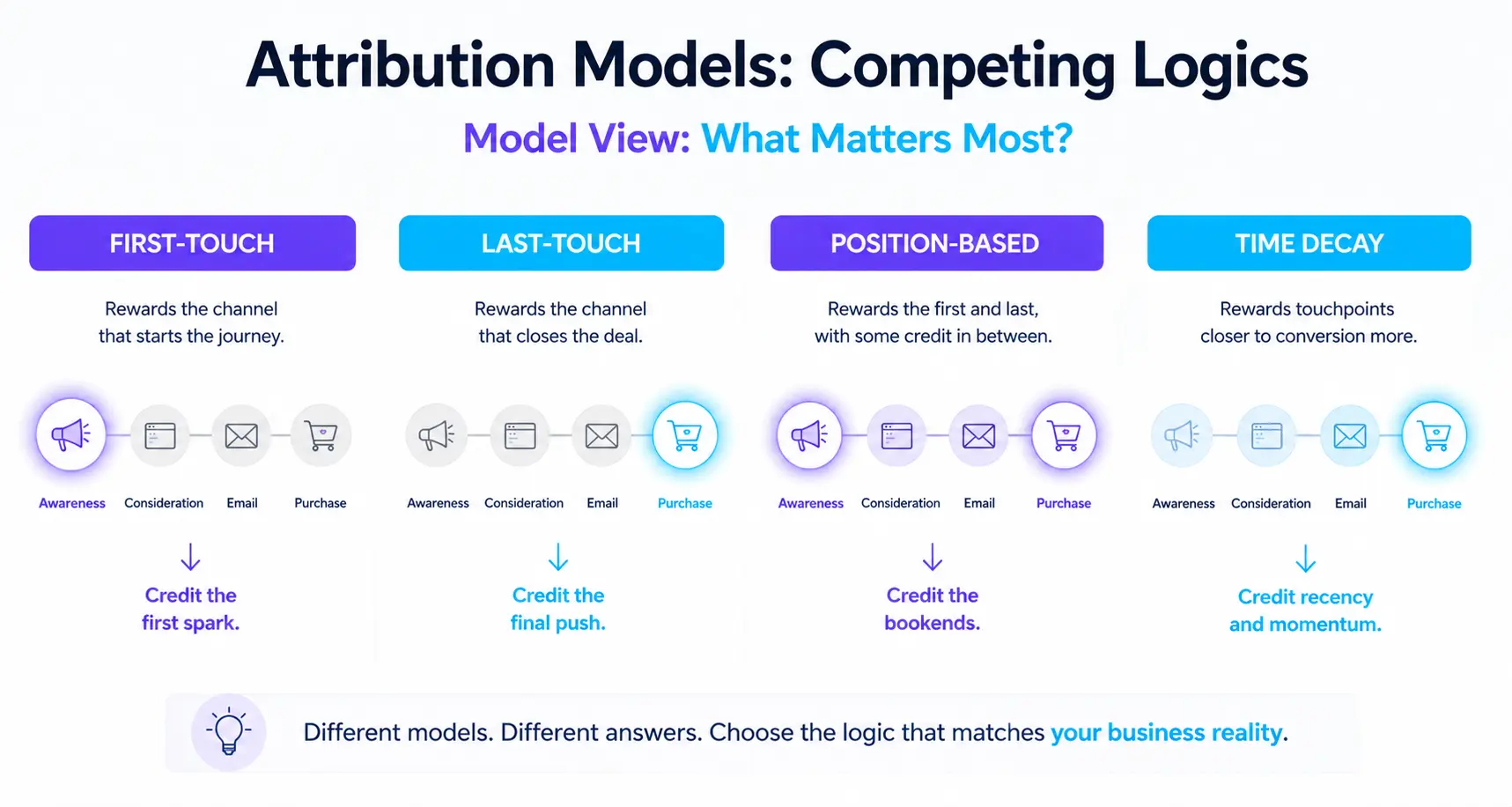
First-touch, last-touch, time-decay, position-based, and multi-touch models can analyze the same journey and produce different winners because they answer different questions, not one universal truth.
Disagreement also comes from fragmented identity, missing touchpoints, inconsistent event definitions, data governance gaps, and the fact that attribution observes correlation but cannot prove causation.
When models conflict, the right response is to audit data lineage, identity stitching, and event logic before using attribution for budget decisions.
Key Takeaways
- Attribution model disagreement stems from embedded philosophical assumptions and perspective bias, not simple technical errors.
- Fragmented user identity and inconsistent data governance undermine every attribution model, making disagreement inevitable if measurement is flawed.
- Attribution outputs reflect correlation, not causality; only experimental designs can reveal true incremental impact.
- Leadership should prioritize measurement system integrity before trusting or acting on model-based strategic recommendations.
Most teams think two attribution models disagree because one is wrong.
The truth: both are “right” – just built on clashing, invisible rules.
Lift the hood, and the disagreement is engineered from the start.
Every attribution model secretly defines its own version of fairness: should the first click matter most, or the last?
Does exposure mean intent, or do only conversions count?
These aren’t technical quibbles – they’re foundational judgments buried as defaults.

Why Different Attribution Models Yield Different Outcomes
One client ran both position-based and time decay models, shocked to see the same campaign swing from hero to scapegoat.
That’s because every model encodes a particular worldview: one rewards early touchpoints, another worships proximity to the sale.
It’s less a battle of math, more a collision of philosophies disguised as metrics.
How model assumptions drive conflicting interpretations
The myth: attribution should converge on a single “true” answer.
The reality?
Each model answers a different question about who deserves credit, filtered through structural assumptions – about the journey, about time, about influence probability.
It’s like running the same photograph through different color filters and expecting identical results.
Comparison of Attribution Model Philosophies
| Model Type | Key Assumption | Who Gets Credit | Impact on Campaign Outcome |
| Position-Based | Fairness balances early and late touchpoints | Both first and last touches share credit | Campaign performance can appear consistent or fluctuates moderately |
| Time Decay | More credit given to touchpoints closer to conversion | Last touches weighted more heavily | Campaign credited more when involving recent interactions |
| First Touch | First exposure drives intent | Only first touchpoint receives credit | Campaigns with strong early contact favored |
| Last Touch | Final touch drives conversion | Only last touchpoint receives credit | Campaigns with final-step strong interactions favored |
What matters for leaders: competing models are not evidence of data failure alone, but of embedded perspective bias – a model’s designer debating the marketer’s intent.
Attribution disagreement is a feature, not a bug, built by a silent negotiation over what “matters”.
Why observational data can’t prove what didn’t occur
Look closer, and another trap emerges: even when data perfectly tracks what happened, it cannot reveal what else might have happened under different circumstances – a distinction executives often miss without realizing the operational risk.
Here’s the core distinction most miss: observing that users who saw ad A are more likely to convert doesn’t prove A caused anything.
In statistics, that’s the difference between P(Y|X) and P(Y|do(X)).
In executive terms: correlation (P(Y|X)) just shows a pattern after the fact, while intervention (P(Y|do(X))) asks what would change if you could directly alter the customer journey.
The former is about correlation – what’s present in the data.
The latter is about intervention – what would actually change if an action or touchpoint were altered.
We’ve watched leadership teams chase changes based on patterns that would evaporate if causality were tested.
It’s like assigning credit to the last person in a relay, ignoring the unseen alternatives where they never received the baton.
Two questions expose the limitation: What about customers who never touched channel X?
What if the sequence was impossible to reconstruct?
Attribution models can only assign credit where tracks exist; they cannot measure the counterfactual – the world that didn’t happen.
That’s why “proving impact” with only observed data is always, at best, partial.
Models compare what’s visible, not what’s possible.
Disagreement between models isn’t a sign of error.
It’s the visible result of hidden assumptions and the limits of observation.
Leaders who grasp this step beyond debate and focus on what models can, and cannot, ever show.
A related decision is covered in Why Attribution Assigns Credit but Can’t Prove Cause, which explains the adjacent issue in more detail.

Where the Measurement System Fails Before the Model Runs
Executives assume attribution disagreements come from differences in models.
The bigger problem often starts upstream, long before the first algorithm assigns credit.
If your data is fractured, every model is forced to answer a distorted question – and any sense of objectivity dissolves.
Fragmented identity and incomplete journey reconstruction
Picture this: a single buyer who appears as five different identities across platforms.
Their journey should tell one cohesive story, but instead it’s scattered – a desktop cookie here, a mobile login there, an email open with no ID tied to either.
Attribution in this environment becomes guesswork wrapped in spreadsheets.
We’ve seen client budgets swing millions after “proving” a channel’s value, only to realize later it was the same customers repeatedly miscounted, never stitched together.
The analogy: it’s like tracking marathon runners when half the bib numbers get swapped at the halfway point – nobody knows which split times belong to whom.
The myth: as long as every touchpoint gets tracked, you see the real journey.
The reality: fragmented identity punctures accuracy, making multi-touch attribution as reliable as a jigsaw puzzle missing key pieces.
Which decision would you trust if customer journeys are routinely chopped into fragments, distorting apparent performance patterns?
Inconsistent data governance and event interpretation
Misunderstanding doesn’t always come from missing touchpoints – it also creeps in from mislabeling, shifting rules, and inconsistent events.
During audits, we’ve found “conversion” defined three distinct ways within the same organization, each revision retroactively reshaping past performance.
If the meaning of a core event drifts over time or across business units, models lose their shared foundation; comparisons become apples and oranges.
When an action’s definition changes silently, your historical attribution data instantly becomes a minefield.
Are your smartest people debating which channels win, or quietly doubting whether database fields mean the same thing this quarter as last?
Measurement failure is almost always structural, not technical.
The deeper you dig, the clearer it gets: no attribution model can rescue decisions from broken measurement plumbing.

When Attribution Disagreement Erodes Trust and Informs Poor Decisions
Most leadership teams trust the biggest number in the attribution report – until results stall and the finger-pointing starts.
The shock?
Disagreement between models isn’t a red flag for the analytics team; it’s a warning that your entire decision pipeline is quietly at risk.
False precision breeds false confidence in strategy
It’s easy to assume that precise numbers mean precise answers.
Leadership often treats decimal-point differences in attribution as real strategic signals – when in reality, they’re often just echoes of model structure.
We’ve seen digital sales forecasts swing millions in either direction, just by changing which model sits at the top of a dashboard.
Behind the scenes, this isn’t a matter of data rigor; it’s a shell game of perspective – one that budgets are forced to play.
Think of it like trying to navigate with two compasses, each pulled by a different magnetic north.
Is it surprising that teams end up plotting in circles?
Executives rarely pause to ask: are those numbers measuring reality, or just measuring the consensus bias of last quarter’s definitions?
Chasing false precision hardwires uncertainty into strategy decks, offering the comfort of numbers but none of the security.
Misaligned incentives lock teams into debates, not outcomes
The bigger the budget at stake, the more attribution models become turf wars.
It starts subtly: sales swears last-touch attribution is gospel; marketing backs first-touch.
Soon, data teams are refereeing philosophy instead of unlocking business value.
One B2B client lost a full quarter in cross-functional debates, tracing attribution credit to decimal points instead of shipping product improvements.
The real cost wasn’t just time – it was the erosion of trust.
Each team built strategy around their favored model, then fought harder to defend its worldview, no matter what outcomes the business actually needed.
Why does this cycle repeat?
Because internal incentives push teams to optimize for attribution credit – not customer or revenue impact.
Attribution debates become rich soil for politics: those who control the narrative gain influence, those who don’t lose budget.
The trick: what looks like a fight about data is really a contest of perspectives, locking organizations into arguing over points when they should be focusing on progress.
Where attribution models disagree, execution trusts fractures.
Restoring clear decision-making requires recognizing these fights for what they are – a marker of system failure, not a sign of analytical sophistication.

What to Do When Models Disagree: Diagnostic Next Steps
Most attribution fights are settled in spreadsheets, but the real decision should start at the evidence table.
What if the smartest response to model disagreement isn’t picking a winner – but questioning if any result should be trusted in the first place?
The solution isn’t in the algorithm; it’s in how much faith you put in the pipeline that feeds it.
Assessing measurement trust: data, identity, interpretation layers
A common trap: executives debate multi-touch versus last-touch attribution, all while their underlying data barely ties user actions together.
If your identity matching is faulty, every credit assignment is built on sand.
We’ve seen clients burn months on model selection only to discover their systems split a single high-value customer into three, scattering the journey like confetti.
Key Questions to Assess Attribution Measurement Trust
- Are all relevant data sources connected and up-to-date in the system?
- Does each user have a unified, unbroken touchpoint history across devices and platforms?
- Do event labels and definitions consistently match marketing intent across all channels?
Even when identity is solid, data inconsistencies creep in – field names and definitions drift, events register at different levels on each platform, and “conversion” can mean anything from a whitepaper download to an enterprise sale.
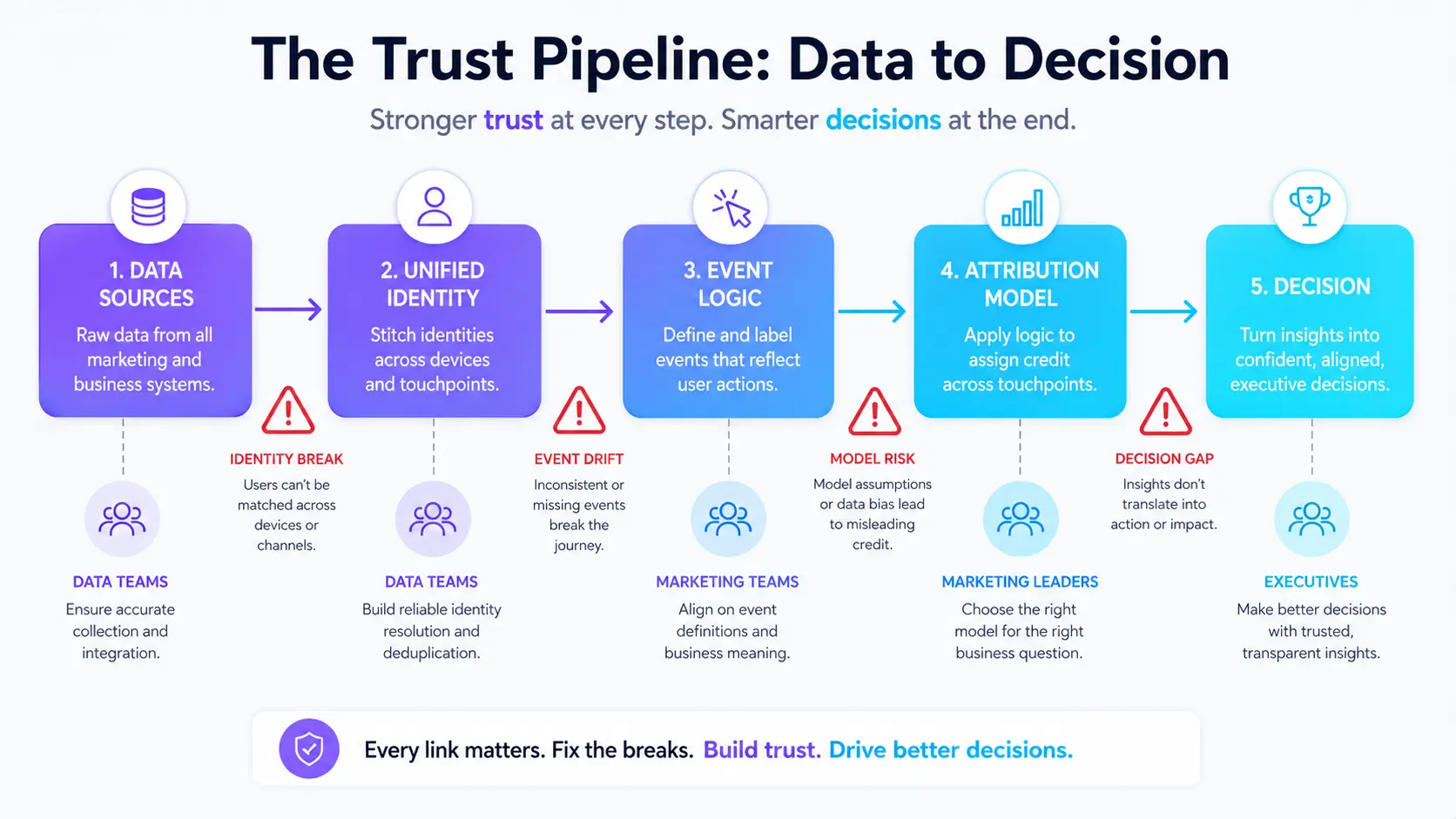
When we audit attribution readiness, the first layer isn’t model math – it’s data lineage, then identity stitching, then event logic.
Miss a step, and the output doesn’t just disagree – it loses all grounding.
Think of attribution like a courtroom ruling: if the chain of evidence is broken anywhere, the verdict is meaningless.
So before running diagnostics or defending a model’s numbers, reality-check three questions:
- Are all data sources connected and current?
- Does each user have a unified, unbroken touchpoint history?
- Do event labels and definitions match intent across platforms?
If you can’t answer yes to all three, attribution disagreement isn’t just likely – it’s guaranteed.
Preparing for causal decision support beyond attribution
Attribution can reveal what happened – but not what would have happened if something changed.
That gap is where true decision support begins.
Repeat this sentence to your team: “Attribution tells a story, not a counterfactual”.
Too many strategies crash because leadership confuses observed correlations for causality.
The next capability step is to separate measurement fidelity from causal inference.
Incrementality testing (think: systematic holdouts or geo-experiments) helps answer what changed because of an action, not just what appeared next in the log.
When a client upgraded from attribution measurement to causal experimentation, they discovered entire budget lines had zero impact – insights no attribution model would have surfaced.
Treat attribution as a starting point – a map, not a territory.
Mature decision-making requires asking, “Did this action move the needle, or did it ride existing momentum?” Data-driven decisions demand more than model comparison; they require structural trust and a path to causal insights.
Every strong attribution system is built twice: first for accuracy, then for consequence.
Trust in outputs rises when you audit the evidence – and when you acknowledge what attribution can’t answer.
The next section belongs not to more models, but to more informed decisions.

Scientific context and sources
The sources below provide foundational context for how decision-making, attention, and performance dynamics evolve under scaling and constraint conditions.
- Attribution theory, bias, and managerial decision-making
Attributing Conversions in a Multichannel Online Marketing Environment: An Empirical Model and a Field Experiment – Hongshuang Alice Li, P.K. Kannan – Journal of Marketing Research
Shows that attribution outputs differ by model and method, and that channel credit can differ strongly from commonly used metrics.
https://journals.sagepub.com/doi/10.1509/jmr.13.0050 - Observational vs. causal inference in business analytics
Causal Inference in Statistics: A Primer – Judea Pearl, Madelyn Glymour, Nicholas P. Jewell – Wiley
Explains why observational data alone does not prove causation and why causal assumptions matter in business analytics.
https://www.wiley.com/en-us/Causal%2BInference%2Bin%2BStatistics%3A%2BA%2BPrimer-p-9781119186861 - Structural limitations in digital measurement
Measuring the Effects of Advertising: The Digital Frontier – Randall Lewis, Justin M. Rao – NBER Working Paper
Explains why digital advertising measurement remains difficult due to noise, selection effects, and the gap between observed metrics and causal impact.
https://www.nber.org/system/files/working_papers/w19520/w19520.pdf - Measurement error and the impact on decision quality
Noise: How to Overcome the High, Hidden Cost of Inconsistent Decision Making – Daniel Kahneman, Andrew M. Rosenfield, Linnea Gandhi, Tom Blaser – Harvard Business Review
Analyzes how inconsistency and measurement-like noise distort professional judgment and organizational decisions.
https://hbr.org/2016/10/noise - Incentive-driven model bias and cross-team conflict
When and Why Incentives Don’t Work to Modify Behavior – Uri Gneezy, Stephan Meier, Pedro Rey-Biel – Journal of Economic Perspectives
Explains how incentives can distort behavior and create counterproductive outcomes, supporting the point about attribution politics and departmental bias.
https://www.aeaweb.org/articles?id=10.1257%2Fjep.25.4.191
Questions You Might Ponder
Why do attribution models often provide conflicting results for the same campaign?
Attribution models produce different outcomes because each encodes unique rules about assigning credit – such as prioritizing first, last, or all touches. These underlying assumptions shape each model’s definition of fairness, leading to structurally different answers even with identical data sets.
How do data fragmentation and identity issues affect attribution model accuracy?
When user identities and touchpoints are fragmented across devices or platforms, models can misattribute or double-count interactions. This results in distorted journey reconstruction and unreliable credit assignment, strongly affecting leadership decisions and optimization strategies.
What is the difference between correlation and causation in attribution analysis?
Correlation means two events are statistically linked, but one doesn’t necessarily cause the other. Attribution models based only on observed data reveal correlation, not causation. True causal impact can only be tested with controlled interventions, like holdout experiments, not typical observational data.
How can inconsistent event labeling undermine trust in attribution results?
If key events (like ‘conversion’) are defined differently over time or between business units, model outputs cannot be reliably compared. This inconsistency breeds mistrust, as strategic decisions may be made on the basis of shifting, ambiguous definitions rather than objective metrics.
What practical steps can organizations take when attribution models disagree?
Start by auditing your data pipeline: Ensure unified identity across platforms, up-to-date connections between data sources, and event definitions that match intent. Only when structural trust is established should you interpret or compare model outcomes to guide business decisions.