
What You’ll Learn
Attribution channel bias is the tendency of attribution systems to over-credit channels that are easiest to observe, track, and connect to conversion, while under-crediting channels that create demand earlier or influence buyers invisibly.
It often favors paid search, retargeting, branded traffic, and last-touch interactions because they appear closest to the sale, even if upstream forces such as brand, PR, content, partnerships, word of mouth, or dark social created the real intent.
Attribution channel bias turns visibility into perceived value, causing budget to shift toward measurable touchpoints instead of causal growth drivers.
Strong analytics treats channel credit as a signal to investigate, not a final verdict.
Key Takeaways
- Attribution channel bias leads to systematic over-crediting of visible, easily tracked channels, distorting strategic marketing decisions.
- Upstream awareness and demand-creation channels often go unrecognized by attribution systems, causing brands to underestimate their true influence.
- Switching between attribution models does not resolve structural bias; instead, it redistributes credit and political conflict within teams.
- Effective growth strategy requires looking beyond what’s easily measured and questioning which influential factors are missing from reports.
Most teams celebrate the channels they can track.
The problem: what’s visible often looks more effective than it is – especially right before a sale.
Observable channel bias sets in early, as attribution systems reward what’s easiest to measure, not what truly drives growth.
This isn’t a data problem; it’s a structural trap, the result of proximity effects in attribution systems baked into the way we observe user journeys.
That broader pattern is clearer in Analytics & Attribution.

Why attribution consistently over‑credits observable channels
Ask any marketer where growth is coming from, and they’ll usually point to channels delivering last-touch conversions – think branded paid search, retargeting, or direct response tactics.
These results seem ironclad because the data looks concrete and granular.
But clarity is an illusion here.
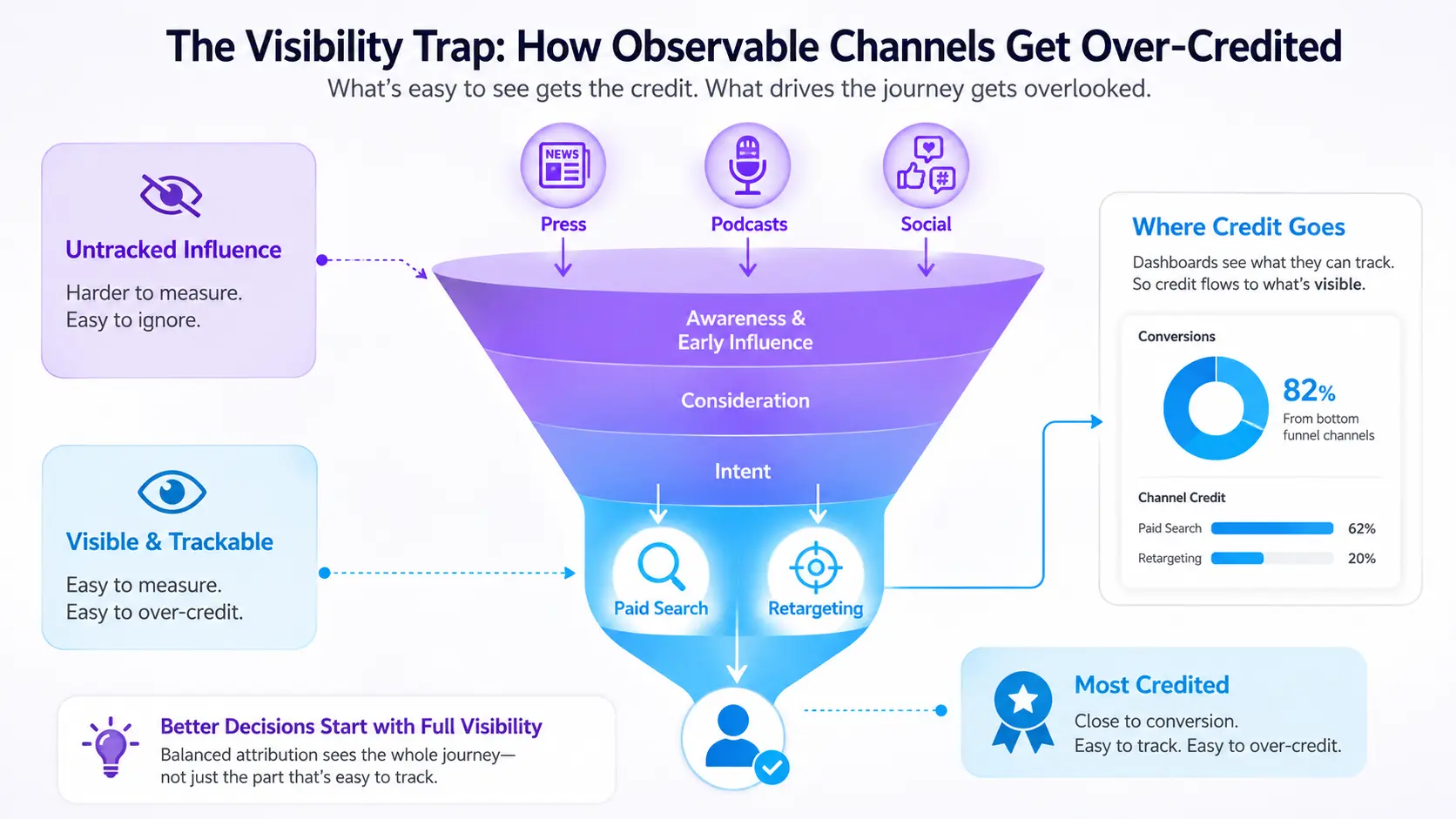
The real bias: observable channels, especially those that interact closest to conversion, receive excessive credit simply for being measurable and “proximate”.
Consider a dashboard where branded search sits at the top of every conversion path.
It didn’t build demand, but the measurement model makes it look irreplaceable.
How observability and last‑touch inflation distort perceived impact
One client cut spend aggressively from these “high-assist” channels.
Conversions barely dipped, proving what looked like cause was often just correlation.
We see this inflation play out almost every time a brand optimizes budget against tracked outcomes: touchpoints with the easiest analytics get the biggest budget – even if they did little heavy lifting.
Signs and Effects of Observable Channel Bias
- Channels closest to conversion get over-credited due to easy measurability
- Budgets shift disproportionately to highly visible channels, even if they didn’t drive real growth
- Upstream demand-building efforts often go unrecognized in attribution
- Attribution rewards correlation, not causation, leading to misleading conclusions
- Brands risk cutting upstream or awareness channels that silently fuel conversions
Relying on last-touch, or even multi-touch models with visibility bias, is like judging the value of rain by only measuring the puddles by your door.
What about the upstream clouds that made the downpour possible?
If your reporting stacks numbers behind the nearest channel, is it because that channel is truly effective – or simply the most visible in your line of sight?
Under the hood, most “hero” channels are just well-lit.
Why upstream influence gets anonymized in conversion credit
The myth: if you can’t track it with precision, it didn’t matter.
In reality, upstream and awareness-driven channels (podcasts, PR, organic content, and non-click social) set the stage for conversion, then quietly exit before the curtain falls.
Their impact is profound but almost always anonymized in attribution models.
Executives often ask: “If top-funnel activities move the needle, why don’t they show up in the reports?” Because these early interactions rarely leave a digital fingerprint tying them directly to a purchase – they’re ghosts in your data.
In one project, brand lift from a 30-second video was invisible in downstream credit, yet retention for exposed cohorts doubled within months.
The analytics system called it an outlier; we called it the campaign.
Think of attribution like spotlighting only the last actor on stage and ignoring the full cast.
The illusion of precision hides the machinery behind the performance.
If your strategic bets vanish in reporting, it may be a symptom of structural channel bias – not actual underperformance.
Sometimes attribution isn’t just misleading; it’s erasing what matters most.
Last-touch credit feels reliable, but it’s frequently the product of observability bias, not effectiveness.
To build a growth engine that lasts, you need to see past the dashboard and start questioning what’s missing.

Why credit doesn’t equal causality – and what decision‑makers miss
Most boardrooms trust attribution numbers as if they’re cause-and-effect – yet, behind every precise-looking pie chart, the majority of “credit” is just a map of what showed up, not what truly drove action.
The structural trap: visibility gets mistaken for influence, and executives start making bets based on who appears at the finish line, not on what moved the runner.
Credit assignment vs actual influence: the structural mistake
The difference between “this channel got credit” and “this channel caused the outcome” is not trivial.
Take paid search – a channel that regularly receives the lion’s share of last-touch credit.
In multiple client audits, we’ve found it often piggybacks on demand generated upstream by content, word-of-mouth, or even dark social channels.
Yet, attribution models crown paid search as hero simply because it’s measurable at conversion.
Why do so many teams turn this convenient output into absolute truth?
Simple: attribution models produce clear winners and losers, fueling an illusion of scientific rigor.
But presence isn’t proof.
Otherwise, the ambulance at the finish line would get credit for every marathon winner.
Assigned credit only reflects what your measurement system can see – not what actually pulls the lever on growth.
One myth that needs immediate disposal: “If a channel receives most conversion credit, it must be the highest performer”.
This belief shapes budget, reporting, even careers.
But, as we’ve seen, it overlooks upstream forces that attribution models sanitize out of the record.
Ever wondered why a branded search conversion spikes right after a trade show or viral press?
The real influencer is invisible to your tracking, but its effect is real and material.
False precision hides real uncertainty in decision outcomes
Decimal points in attribution outputs feel definitive – “Display: 13.6%, Paid Search: 40.1%” – yet they obscure the murkiness underneath.
Executives frequently anchor big budget decisions to marginal shifts in these figures, believing these micro-variations expose advantage.
The reality: attribution’s air of exactness often hides huge blind spots in influence mapping and signal leakage.
In our work, we’ve watched teams move millions from one channel to another based on a 4% change – only to realize months later that real pipeline impact barely budged.
Most models create the illusion of granularity: if the number looks precise, the answer must be right.
But that’s like staring at the dial on a bathroom scale that shifts by tenths of a pound, not noticing the scale is sitting on a high pile carpet.
The uncertainty isn’t visible – but it distorts every reading.
False precision doesn’t just mislead; it gives confidence where skepticism is needed most.
Causality requires real connective tissue between activity and outcome – not just correlation or proximity.
Attribution systems excel at showing who appears in the data, not who truly tipped the result.
Smart organizations resist mistaking visible credit for real impact.
Until you distinguish assigned credit from actual influence, your most confident strategic moves may rest on invisible sand.
Bias becomes dangerous when numbers feel precise.

How structural channel bias fuels political optimization friction
The real friction in marketing ops isn’t about budgets or tactics – it’s about who gets to claim victory.
Attribution channel bias doesn’t just skew metrics; it turns dashboards into battlegrounds, igniting turf wars and distracting teams from actual growth levers.
When every team’s bonus or headcount depends on looking like the rainmaker, attribution models don’t just reflect business reality – they shape politics.
Why teams fight over credit, not contribution
Most leaders assume attribution is a neutral scoreboard.
In reality, it’s the rulebook that defines the game.
As soon as a channel’s visibility – think paid search or retargeting – is amplified by attribution models, teams start optimizing for the scoreboard, not for impact.
We’ve watched marketing teams lobby for their own tracking pixels, launch short-term campaigns designed to be highly visible, or even redefine success metrics mid-quarter.
The question quietly shifts from “what moved revenue?” to “what gets me credit?”
Attribution Models and Their Political Impact
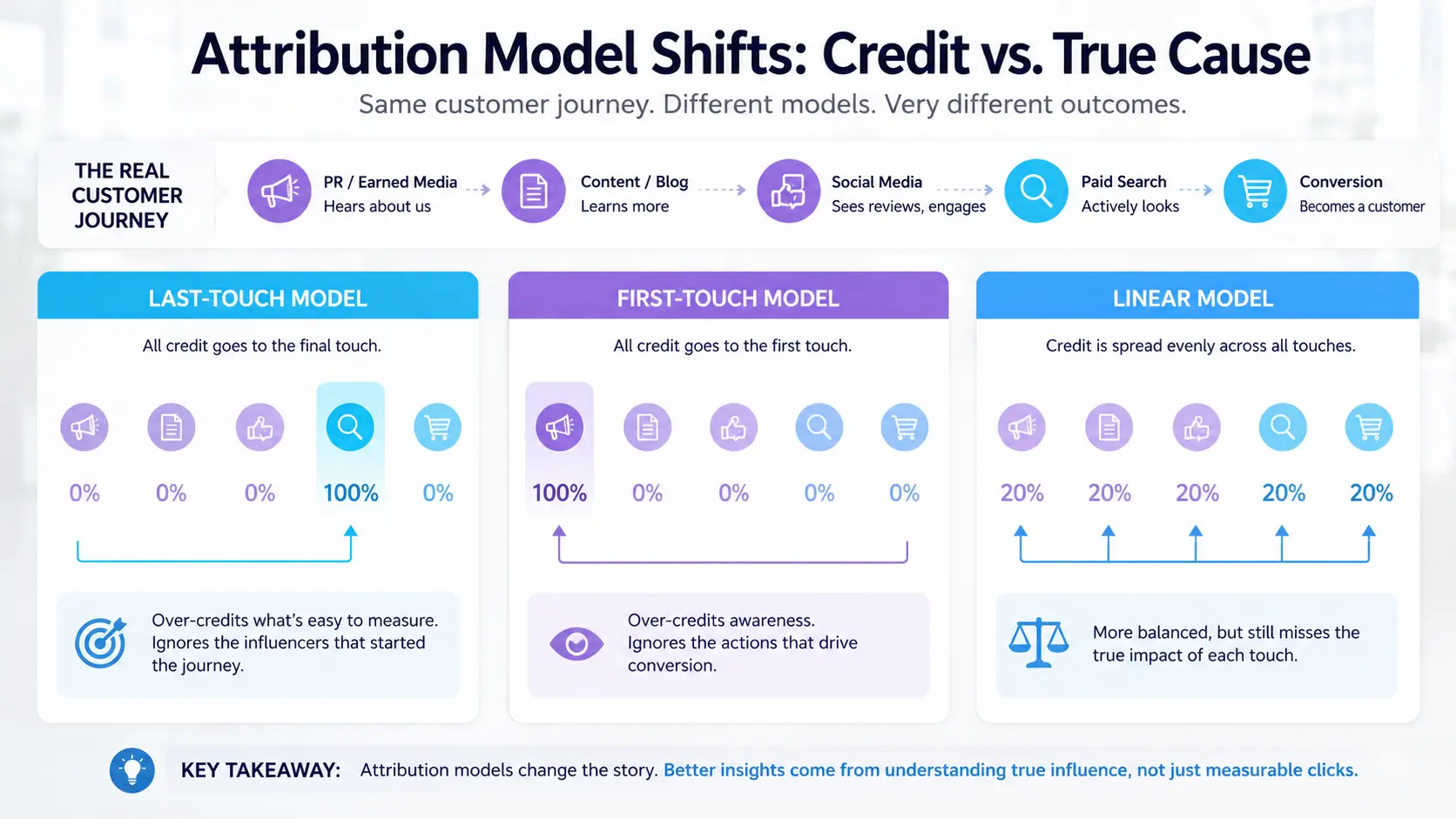
| Attribution Model | Who It Favors | Resulting Team Behavior |
| Last-touch | Closers (e.g., paid search, retargeting) | Teams optimize for last-touch visibility and credit |
| First-touch | Brand strategists (top-funnel channels) | Teams emphasize early funnel channels for recognition |
| Linear | Diplomats (balanced credit) | Teams attempt to share credit evenly, but disputes persist |
The biggest myth: that infighting erupts from unclear goals or lack of buy-in.
In fact, attribution channel bias actively sows division by making some team’s work invisible while inflating others.
The result?
Collaborators become competitors.
Attribution’s proximity effects turn departments into rival claimants, campaigning for their version of the “truth” – not to amplify impact, but to win next quarter’s resources.
It’s like referees awarding points based on visibility, not actual play; everyone scrambles to be seen rather than to drive true progress.
Ask yourself: do your internal reporting debates center more on attribution fairness than business results?
Political optimization blooms wherever attribution bias persists.
Why model‑hopping fails to resolve conflict
Switching attribution models feels strategic, but it’s only moving the goalposts.
Linear favors the diplomats, last-touch crowns the closers, first-touch flatters the brand strategists – and each shift resets internal winners and losers.
Yet, across a decade of client data, we’ve seen the fighting follow the credit – not the truth.
Every model promises objectivity, yet teams quickly adapt campaigns and reporting to fit the new logic, reigniting the same disputes in fresh formats.
The analogy: swapping thermometers doesn’t change the weather.
Attribution model changes never dissolve political friction; they only redistribute it.
When leadership scans a graph and sees decimal changes in channel contribution, they’re often staring at the aftermath of rerouted incentives, not improved performance.
Is your team seeking the high ground or simply a different scoreboard?
The insight: structural channel bias doesn’t just cloud ROI – it manufactures endless debate, keeping decision-makers locked in optimization theater instead of business transformation.
To move forward, leaders must look past the attribution scoreboard and refocus on what actually shifts outcomes.

What to look at next when attribution is misleading
Most teams think attribution shows the whole growth picture – but the real threat lurks in what’s missing, not what’s measured.
The biggest errors aren’t in what gets too much credit, but in the silent gaps and vanished roles no dashboard ever surfaces.
If last quarter’s report left you feeling certain, you’re almost certainly missing a line of influence that’s invisible by design.
Ask: which channel roles are missing from credit analysis?
Here’s the hidden tax: valuable upstream or support channels routinely go uncredited because they’re hard to track, not because they don’t matter.
We’ve seen brands slash content or partner budgets after attribution reports “proved” those channels did nothing – only to watch acquisition grind to a halt.
When the awareness work dries up, so does the pipeline, but the model never flashes red.
Why?
Roles like brand, press mentions, strategic partnerships, and even dark social push prospects into the funnel long before analytics tags ever fire.
Imagine a soccer team cutting its midfielders because they don’t score goals; that’s how observable channel bias silently punishes upstream effort.
Key Channel Roles Often Missing in Attribution Credit
- Brand awareness activities (e.g., press mentions, sponsorships)
- Non-click social and dark social interactions
- Strategic content marketing and educational resources
- Partnerships and influencer engagements
- Channels creating pipeline momentum long before tracked conversions
So before you accept the dashboard’s verdict, ask: whose fingerprints are missing from this crime scene?
Where did influence pass invisibly, never leaving data behind?
Sometimes the best clue is in the empty chair, not the one in the spotlight.
Understand: where credit is a symptom, not a verdict
Attribution numbers often feel deterministic – decimal points make the verdict look scientific.
But credit in complex funnels is more like a fever: it signals something’s happening, but rarely diagnoses the cause.
We’ve worked with B2B firms who optimized hard around top-credited channels, only to see conversion rates slide as softer – but essential – influencers shrank.
In the rush to treat symptoms, teams miss the system error: credit is just a shadow of the customer journey, not its engine.
Are you letting perceived channel returns drive the strategy, or are you using those numbers as signals to probe deeper?
Attribution channel bias means it’s easy to chase what’s most visible, instead of what’s most valuable.
The real leverage comes from treating attribution as a starting point for questioning, not as the final word.
The difference between good and great marketing teams?
Great teams dig past the numbers to diagnose the invisible work fueling growth.
If your next move comes from what’s in the report, pause – your breakthrough might depend on what’s still in the dark.

Scientific context and sources
The sources below provide foundational context for how decision-making, attention, and performance dynamics evolve under scaling and constraint conditions.
- Cognitive Bias in Attribution
The Psychology of Interpersonal Relations – Fritz Heider – Wiley
Foundational attribution theory explaining how people assign cause and credit to observable outcomes, which helps explain why visible channels often receive disproportionate performance credit.
https://psycnet.apa.org/record/2004-21806-000 - Measurement and Decision-making Errors
Noise: A Flaw in Human Judgment – Daniel Kahneman, Olivier Sibony, Cass R. Sunstein – Little, Brown Spark
Explores how inconsistent judgment, noisy signals, and over-reliance on visible data distort decision-making, directly relevant to attribution interpretation errors.
https://www.hachettebookgroup.com/titles/daniel-kahneman/noise/9780316451406/ - Marketing Channel Attribution Limitations
Attributing Conversions in a Multichannel Online Marketing Environment: An Empirical Model and a Field Experiment – Hongshuang Alice Li, P.K. Kannan – Journal of Marketing Research
Academic research explaining the methodological limitations of attribution models, including differing channel credit outcomes depending on model assumptions.
https://journals.sagepub.com/doi/10.1509/jmr.13.0050 - Influence of Unobservable Marketing Activities
Advertising and Brand Equity – David A. Aaker, Alexander L. Biel (Eds.) – Psychology Press
Provides evidence that brand-building communication creates long-term, lagged value often missed by short-term attribution systems focused only on directly observable conversion events.
https://www.taylorfrancis.com/books/edit/10.4324/9781315799537/brand-equity-advertising-alexander-biel-david-aaker
Questions You Might Ponder
What is attribution channel bias in marketing?
Attribution channel bias refers to the systematic over-crediting of marketing channels that are easiest to measure, particularly those closest to conversion. This distorts decision-making by inflating the perceived effectiveness of observable channels while underestimating the impact of less trackable, upstream activities.
How does last-touch attribution inflate the success of certain channels?
Last-touch attribution gives full credit to the final marketing interaction before conversion, often making channels like paid search or retargeting look much more effective than they truly are. This overlooks the role of earlier, less observable touchpoints that drive customer interest.
Why do awareness channels often get ignored in attribution reports?
Awareness channels, such as PR or content marketing, usually influence conversions without leaving clear, digital traces directly tied to purchases. Standard attribution models deprioritize these channels because their impact is harder to track, leading to the false belief that they don’t matter.
Can switching attribution models solve channel bias problems?
Switching attribution models might redistribute credited influence among channels, but it doesn’t eliminate structural bias. Each model – whether last-touch, first-touch, or linear – has limitations, and teams often adapt strategies to exploit new reporting rules, perpetuating political friction and measurement gaps.
What risks do companies face if they ignore attribution channel bias?
Ignoring attribution channel bias can lead to poor budget decisions, neglect of vital upstream efforts, and division among teams. Over time, this undermines growth, as brands may cut essential channels that are invisible in reporting but critical for long-term customer acquisition and retention.