
What You’ll Learn
False precision in attribution is the misleading appearance of certainty created when attribution reports show highly specific numbers, decimals, or percentage splits that exceed the reliability of the underlying data and model.
It happens when dashboards assign exact-looking credit to channels or touchpoints even though results depend on noisy data, incomplete journeys, model assumptions, identity gaps, and correlation rather than proven causation.
False precision makes leaders trust attribution because it looks mathematically rigorous, not because it is decision-safe.
The risk is that small decimal differences drive large budget shifts, mask uncertainty, confuse credit with cause, and weaken analytics trust when precise-looking forecasts fail in the real market.
Key Takeaways
- False precision in attribution leverages decimal formatting to overstate confidence, masking uncertainty and model limitations.
- Precision bias causes leaders to trust metrics based on appearance rather than statistical validity, risking misallocated resources.
- Attributing detailed credit to marketing touchpoints can confuse reporting with real causality, distorting strategic direction.
- Persistent reliance on over-precise analytics erodes organizational trust, undermining long-term data-driven decision-making.
Most attribution dashboards don’t make you trust the data – they make you trust the decimals.
When rows of numbers deepen from one decimal to three, our brains instinctively label the output as “accurate”, even if the underlying reality is far messier.
This exact false precision in attribution is why seasoned executives chase decimal points but end up sidestepping the real risks lurking underneath.
That broader risk logic is outlined in Analytics & Attribution.

When decimal accuracy feels like certainty but hides uncertainty
Teams routinely debate whether a 1.24% or a 1.32% conversion rate justifies shifting six-figure budgets, forgetting that three digits after the decimal rarely reflect reality – and the underlying margin of error usually dwarfs the visible difference.
The myth is that more decimal places equal more truth.
The real risk: precision bias in measurement creates easy overconfidence in analytics numbers, persuading decision-makers to trust attribution figures that only look definitive.
How precision bias inflates credibility of attribution metrics
In real client review sessions, we’ve watched as attribution reports showing “42.68% credit” for a channel spark confidence and lead to aggressive investment changes, even as the actual model is based on data so noisy that the answer could easily be plus or minus ten percentage points.
The numbers sparkle, so the doubts get dulled.
Rhetorically – if you rewrote the number as “about 43% (with 10% swing)”, how fast would the confidence fade?
Key Symptoms of Precision Bias in Attribution Metrics
- Overreliance on decimal places to gauge accuracy.
- Ignoring underlying margin of error or data noise.
- Increased confidence in model outputs despite uncertainty.
- Decisions made on insignificant numerical differences.
- Presentation style overriding analytical scrutiny.
Precision bias is the cognitive shortcut that says: “If it’s that specific, it must be trustworthy”.
But that’s a trick of formatting, not analysis – a bit like believing a house is sturdy just because the paint is crisp.
Smart operators remember: the number of decimals is a stylistic choice, not a guarantee of reliability.
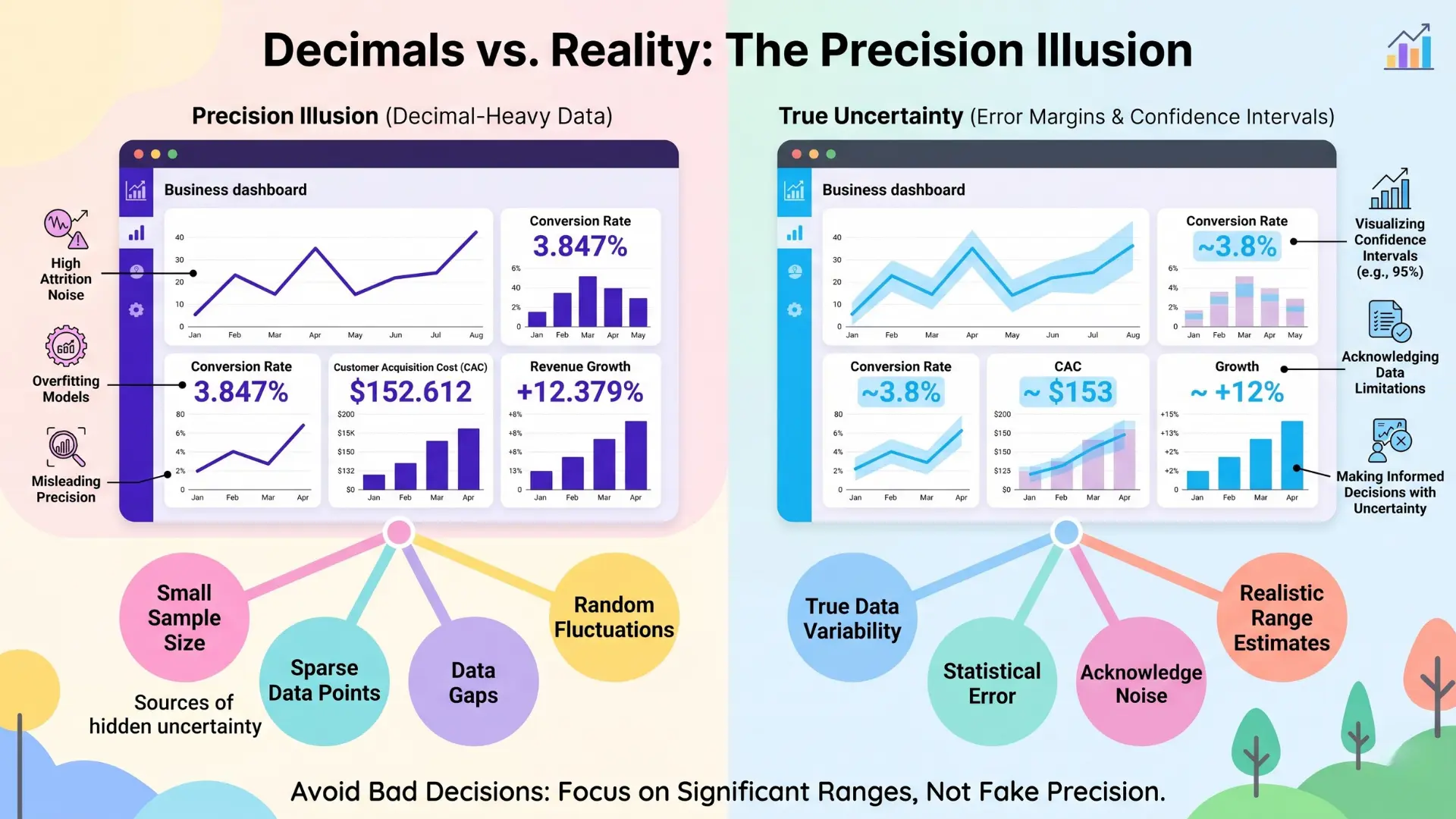
Why decimal illusions trump actual accuracy in reporting
Numbers don’t lie, but the way they’re displayed seduces us into believing in clarity that doesn’t exist.
The “decimal illusion attribution” effect means visual cues – the extra zeros, the spreadsheet elegance – override our healthy skepticism.
Instead of asking, “What is the margin of error?” executives argue about hundredths of a point.
The result: overconfidence in the illusion of accuracy in reports, instead of healthy attention to attribution uncertainty perception.
Colleagues sometimes defend their dashboards by pointing to side-by-side panels: Channel A “contributed 53.27%”, Channel B “contributed 41.11%”.
But without knowing sample sizes, model assumptions, or underlying data volatility, these decimals give a confidence they don’t deserve.
One client’s analytics lead admitted, “If I round to the nearest percent, I get challenged.
If I keep decimals, everyone assumes I did a rigorous job”.
That’s spurious precision in analytics – the presentation trumps substance and the real measurement risks stay hidden.
False precision in attribution produces an optical effect: like looking at a high-res image of a foggy scene.
It’s sharp, but what’s beneath is still unclear.
The strongest move is to ask – what’s the confidence interval, not just the decimal place?
Decision-makers who chase decimals ignore the signal hidden behind the presentation.
Real rigor means probing past the surface of precision, not letting decimal illusions define investment moves.
Don’t let decimals give you comfort – let them trigger the right questions.

How attribution’s false precision distorts budget and trust
Most marketing budgets are set by numbers that look infallible – numbers packed with decimals, forecasts, and color-coded certainty.
But what if that precise-looking number is a mirage?
Companies routinely pour dollars into the “top-performing” touchpoint, only to discover later that confidence came not from data quality but from the comfort of decimal places.
The fallout isn’t just wasted spend – it’s a slow erosion of trust that stains every future analytics claim.
When over‑precise numbers drive misaligned investments
Here’s a myth that quietly drains millions: The more decimal places, the smarter the allocation.
In practice, the opposite is true.
We’ve seen CMOs move budgets mid-quarter because channel A “drove 23.741% more conversions”.
Yet often, that granular split masks statistical noise or model quirks, not true advantage.
It’s like tuning an engine to perfection using a cracked thermometer – the reading looks exact, but every adjustment sends you further off course.
Common Pitfalls of Acting on Over-Precise Attribution Numbers
- Reallocating large budgets for insignificant metric differences.
- Failing to question assumptions behind decimal precision.
- Letting small decimal swings drive major strategic moves.
- Masking statistical noise as real advantage.
- Eroding team skepticism and analytical rigor.
Teams crave certainty, especially under pressure.
But every time a dashboard elevates a .321 from a .312 with scientific flair, decisions lock around the illusion.
“Are we really reallocating six figures because a channel is up nine one-thousandths?”, one client finally asked.
The more exact the digit, the less anyone pauses to question its foundation.
In one cycle after another, small decimal swings redirect real money – while upstream assumptions go unchallenged.
Why repeated misses degrade analytics credibility
If overconfident numbers guaranteed results, finance would never question marketing again.
Instead, those decimal-backed decisions often whiff in-market.
Leadership remembers every initiative that promised a precise ROI uplift and missed by a mile.
Each miss – even by a fraction – doesn’t just impact results.
It chips away at the authority of the analytics team itself.
Confidence rooted in false precision ages badly.
At first, over-precise reports win faith, but after the second or third gap between forecast and outcome, skepticism seeps in.
“If the model was so sure, why are we off again?” The more specific a miss, the deeper the long-term doubt.
This distrust rarely arrives all at once.
It builds – quietly, persistently – until analytics gets sidelined and gut feel takes the wheel.
The biggest risk isn’t a single bad bet; it’s the slow loss of confidence in data-backed decisions, when the illusion of accuracy proves brittle in daylight.
Don’t let decimals dictate direction.
Precision bias can steal budget, but it also poisons trust – a cost much harder to recoup.

How false precision in attribution masks the difference between credit and causality
Most leaders assume attribution numbers – even sliced to the second decimal – reveal what’s truly moving the needle.
They don’t.
The biggest mistake?
Confusing credit with causality.
Seeing “38.72% of conversions” assigned to a single campaign feels like proof of impact, but the number just divides outcomes according to a model’s rules, not observed reality.
Precision bias in measurement makes this sleight-of-hand hard to spot: present a decimal-heavy chart, and the human brain immediately upgrades the output’s authority.
Decimals don’t turn touchpoints into causes
In actual marketing operations, we’ve watched executives fixate on tiny changes between quarterly attribution numbers, debating the merits of a .4% up-tick as if it proves strategic worth.
But the decimal illusion attribution models create is easy to buy into – because few question whether the number reflects genuine cause or just tidy data partitioning.
Imagine giving a gold star to whichever classroom row seems most colorful and believing that row caused the best test scores.
That’s attribution: it scores what’s most visible, not what’s actually responsible.
Greater spurious precision in analytics fuels overconfidence in analytics numbers, but doesn’t make a single touchpoint the reason for the outcome.
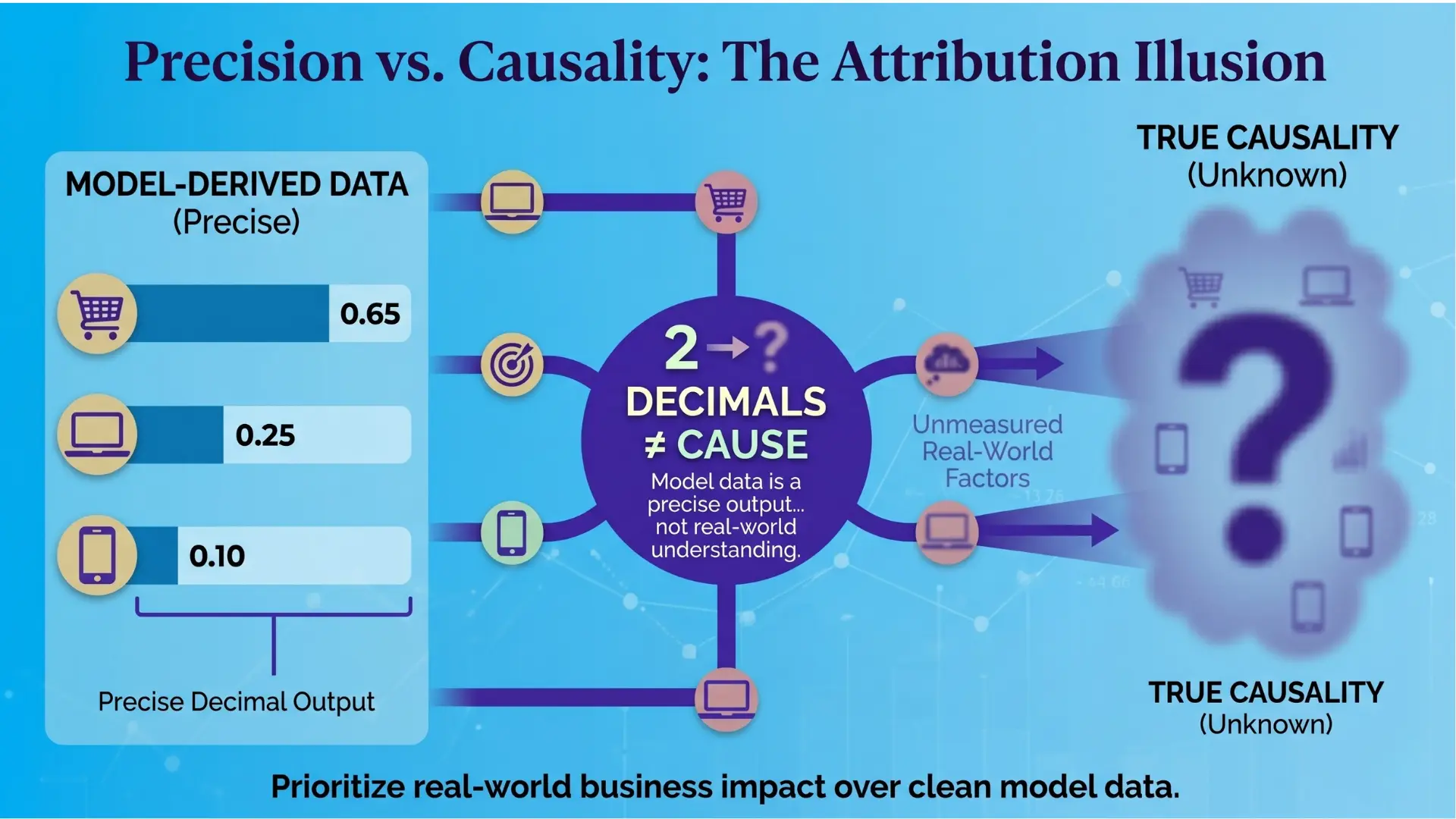
Why model disagreement is expected when precision lacks context
If your marketing attribution reports from two different tools disagree – even at two decimal places – that’s not an error, it’s a warning sign.
Executives often treat model disagreement as a technical bug to fix, when it’s really a reflection of attribution uncertainty perception.
Different models carve up the same set of facts in competing ways: rules-based, data-driven, linear, U-shaped.
The illusion of accuracy in reports encourages the idea that there is one “right” share to assign.
But just as two cartographers might draw borders differently on a map, attribution models split credit based on differing logics, not hidden truths.
Common Attribution Model Types and Their Characteristics
| Model Type | Description | How Credit is Assigned | Effect on Attribution Precision |
| Rules-based | Assigns credit based on predetermined rules. | Fixed weights per touchpoint. | May produce sharp splits but ignores interactions. |
| Data-driven | Uses statistical methods and machine learning. | Derived from observed data patterns. | More flexible, but sensitive to noise. |
| Linear | Distributes credit evenly across touchpoints. | Equal credit per touchpoint. | Simple but may obscure true influence. |
| U-shaped | Credits first and last touchpoints more. | Front and back weighted. | Emphasizes specific touchpoints, increasing bias. |
This matters because oversight teams expect decimal agreement as a sign of system validity.
But we’ve seen firsthand how precision in the absence of context amplifies the illusion of stability.
What looks like scientific consensus is really modeler’s preference coded in software.
If you trust the decimals without asking “what logic fueled these splits?”, you’re leaning on a mirage.
Live by the decimal, die by the decimal.
Real insight starts by asking, “Do these numbers reflect cause, or just model choice?” That’s the difference between measuring the story and mistaking it for the plot.
False precision in attribution doesn’t make credit and causality the same thing – it just makes the gap harder to see.
Next, let’s look at why high decimal precision in analytics should always come with a warning label.

Scientific context and sources
The sources below provide foundational context for how decision-making, attention, and performance dynamics evolve under scaling and constraint conditions.
- Precision, Accuracy, and the Misuse of Data
The American Statistician Special Issue on Statistical Inference – Wasserstein, Schirm, Lazar – The American Statistician
Explores how statistical precision and formal reporting can create false confidence when underlying assumptions are weak or uncertainty is poorly communicated.
https://www.tandfonline.com/toc/utas20/73/sup1 - Cognitive Illusions of Accuracy
On the Psychology of Prediction – Daniel Kahneman, Amos Tversky – Psychological Review
Seminal work on overconfidence, prediction error, and unwarranted certainty in human judgment under uncertainty.
https://psycnet.apa.org/record/1974-02325-001 - Attribution Logic and Model Uncertainty
The Path to Purchase and Attribution Modeling: Introduction to Special Section – P.K. Kannan, Werner Reinartz, Peter C. Verhoef – International Journal of Research in Marketing
Reviews attribution modeling methods and explains how different model assumptions, customer paths, and touchpoint definitions can produce different channel-credit conclusions.
https://www.sciencedirect.com/science/article/abs/pii/S0167811616300817 - Decision-Making Under Uncertainty
Thinking, Fast and Slow – Daniel Kahneman – Farrar, Straus and Giroux
A comprehensive exploration of why precise metrics persuade decision-makers and how cognitive biases distort interpretation in business contexts.
https://us.macmillan.com/books/9780374275631/thinkingfastandslow - Performance Metrics and Measurement Error
Methods of Meta-Analysis: Correcting Error and Bias in Research Findings – John E. Hunter, Frank L. Schmidt – SAGE
Foundational work explaining how measurement error distorts interpretation, evaluation quality, and downstream organizational decisions.
https://methods.sagepub.com/book/mono/methods-of-meta-analysis-3e/front-matter/i234#_
Questions You Might Ponder
How does false precision in attribution impact strategic decision-making?
False precision in attribution creates the illusion of reliability by focusing on detailed decimal points. This can lead executives to trust numbers that aren’t truly accurate, causing overconfidence, risky budget reallocations, and insufficient scrutiny of underlying data quality or methodological flaws.
What is precision bias in marketing analytics?
Precision bias refers to the cognitive tendency to equate detailed numerical outputs, such as multiple decimal places, with accuracy. In marketing analytics, this can cause teams to make high-stakes decisions based on insignificant or noisy metric differences, overlooking critical uncertainties.
Why do decimals in dashboards increase confidence in analytics outputs?
Decimals create an optical effect of scientific rigor, convincing decision-makers that metrics are exact and trustworthy. As a result, teams may focus on minor differences and ignore vital questions about error margins, sample variability, or model assumptions – fostering misplaced trust.
How does false precision affect attribution model credibility over time?
Repeatedly acting on over-precise, but ultimately inaccurate, attribution numbers leads to missed forecasts and lost performance. Over time, leadership loses trust in analytics outputs, shifting away from data-driven decisions and eroding the analytics team’s strategic influence.
What’s the difference between attribution credit and causality in analytics?
Attribution credit allocates outcomes based on rules or models, but does not prove that a touchpoint caused the result. Mistaking detailed attribution credit for causality can distort budgeting and strategy, as true business impact often depends on broader, less precise factors.