
What You’ll Learn
Revenue lag impact analysis is the process of determining why revenue does not appear immediately after optimization improves clicks, leads, conversions, or pipeline activity.
It separates normal delay from real leakage or reporting illusion by tracing how value moves from first conversion through sales, finance, billing, fulfillment, onboarding, and recognized revenue.
Revenue lag happens because conversion events mature over time, systems update on different schedules, and downstream losses such as refunds, failed payments, stalled approvals, churn, or billing errors can erase early gains.
Strong analysis extends reporting windows, reconciles systems, and shows whether optimization impact is delayed, lost, or hidden by measurement timing.
Key Takeaways
- Revenue lag after optimization is normal due to delays across sales, finance, and fulfillment systems, masking immediate gains.
- Counting conversions is not equivalent to recognized revenue; pipeline maturation and downstream leakage can distort short-term metrics.
- Reporting artifacts and system sync delays often create false negatives, leading to premature and damaging optimization shutdowns.
- Setting strategic reporting intervals and calibrating leadership expectations are essential for accurate revenue lag impact analysis and sustained growth.
Most executives expect to see revenue move as soon as the dashboard lights up green, but the real world staggers every win through an invisible gap: outcome distance.
Across dozens of client audits, we’ve seen optimization lift disappear – temporarily – because revenue, operational, and analytics systems rarely speak the same language or move at the same speed.
A marketing funnel might signal a 20% spike in high-intent leads, yet invoice data sits in a different silo, updating weeks later.
That broader logic underpins the entire Analytics & Attribution model.

Why revenue lag is normal and what it hides
One analogy: imagine a relay race where each runner can’t see the next.
Your front-runner (conversion event) hands off momentum, but the anchoring sprinter (revenue) waits for a signal you can’t see.
Decisions made by sales, finance, and fulfillment quietly reroute or dilute the improved flow long after campaign changes register.
If you only check the scoreboard at the finish line, it’s easy to miss progress made miles before.
How outcome distance masks real improvements
A common myth is that real gains always show up instantly in revenue graphs.
In reality, disconnected or delayed data streams – the “outcome distance” – hide improvement.
The result?
Leaders wonder if optimization efforts fizzled out, when in fact the impact is accumulating just out of sight.
Key Insights on Outcome Distance
- Revenue systems and marketing funnels rarely update simultaneously.
- Decisions by sales, finance, and fulfillment impact final revenue post-conversion.
- Real revenue gains often appear after a delay invisible to immediate dashboards.
- Counting conversions is not equivalent to immediate revenue recognition.
- Leaders often misinterpret delayed revenue as failed optimizations.
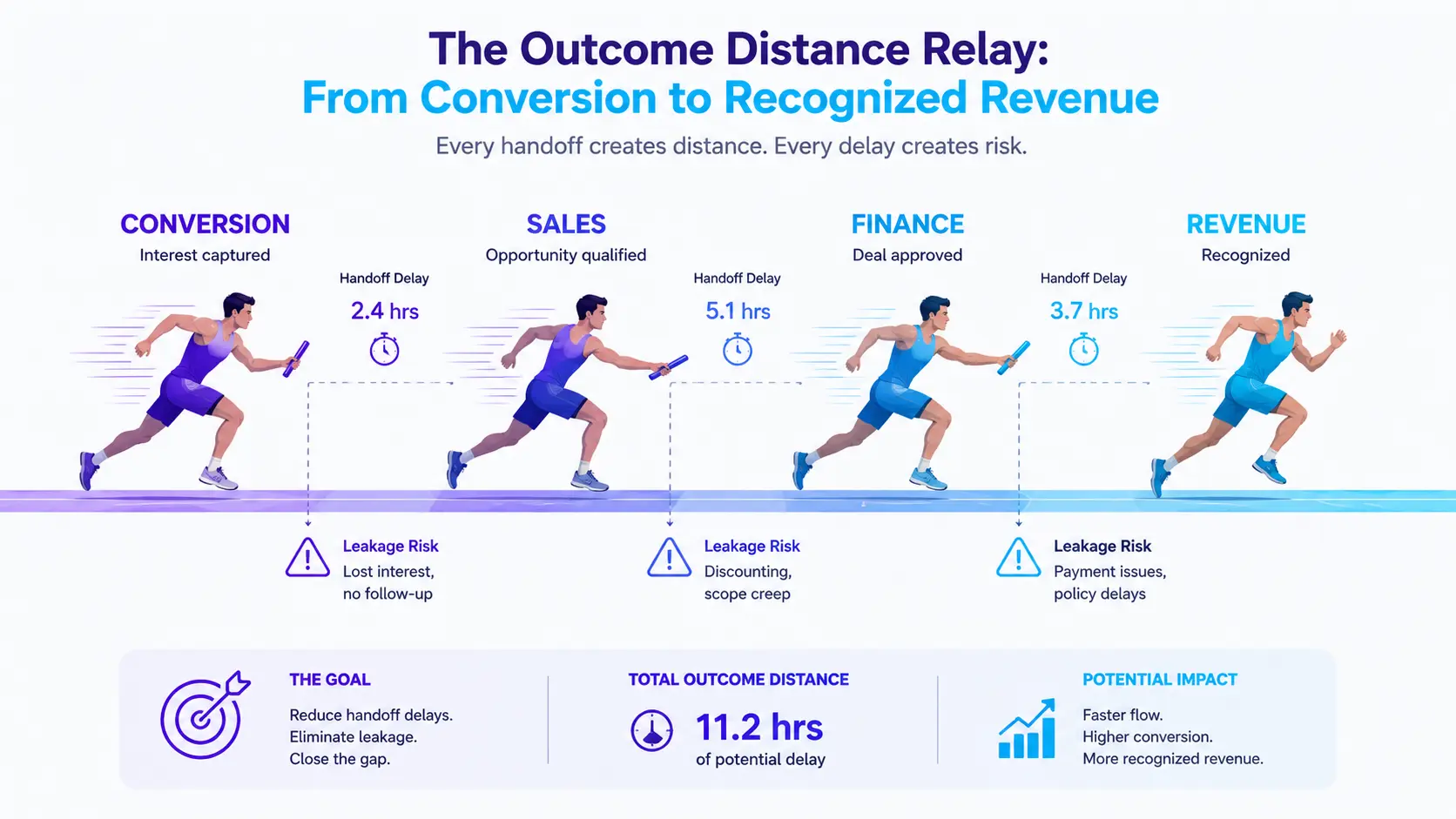
When conversion maturation distorts short‑term gains
The biggest trap: assuming that conversion events translate immediately to income.
They don’t.
High-performing campaigns often fill your pipeline faster than your business can process.
But just as fruit needs time to ripen after harvest, those conversions require nurturing, qualification, and negotiation before cash appears in the ledger.
From experience: a B2B client saw opportunity counts double in Q1, but actual recognized revenue trailed by two full quarters.
The gap?
Conversion maturation delay – a real-world lag as deals worked through decision cycles, compliance, and onboarding.
How many teams have killed winning strategies because the rewards didn’t arrive on their schedule?
Counting conversions is not the same as banking revenue.
Post-conversion value loss and slow outcome realization can stretch weeks or even months.
If your analytics window is too short, every improvement looks like a false start.
Revenue lag doesn’t signal failure – it’s the expected distance between action and outcome.
Recognize the gap, and you’ll stop misreading signal as noise.

Which downstream leakages cancel out optimization gains
Most dashboards celebrate wins at the moment of conversion, but the real erosion begins after the confetti.
The unspoken truth: a significant slice of value vanishes in the murky space between “yes” and “cash collected”.
Common Causes of Post-Conversion Revenue Leakage
| Interval | Description | Purpose |
| Visible Now | Revenue and conversions currently measurable | Establish immediate state of optimization outcomes |
| Conversion Maturation | Revenue expected from nurturing and deal cycles | Account for real-world delays in closing deals |
| Forecasted | Expected revenue beyond typical reporting windows | Set long-term expectations and avoid premature judgments |
Where post-conversion value slips away
One myth stands stubborn – optimizing for more conversions guarantees immediate revenue growth.
Our experience: it’s rarely that linear.
Success at the top of the funnel can mean very little once refunds, failed payments, and multi-party signoff chaos eat into projected gains.
For a SaaS rollout, a double-digit lift in paid signups meant far less when 27% of accounts canceled before the first invoice.
In another case, an ecommerce client saw 12% of large orders abandoned mid-billing due to identity verification breakdowns – a detail buried beneath surface metrics.
Picture this: tracking conversions is like counting freshly poured drinks at a bar, assuming each one is fully consumed and paid for.
In reality, glasses get knocked over, tabs go unpaid, and some never even leave the counter.
Where do these losses hide?
In delayed purchasing approvals, billing system errors, client-side friction, or even internal credit controls quietly killing deals after the supposed finish line.
How many of your best-looking leads are merely ghosts in the system – celebrated by the optimization dashboard but wiped out before settling the bill?
It’s common to discover that a third of pipeline growth disappears downstream, invisible in first-glance analytics.
If the only numbers you see are pre-churn, your real gain might be closer to zero than you think.
Why attribution models often fail to align with recognized revenue
Even the most sophisticated attribution setup can lead you astray if it ignores what happens beyond the click or signup.
Standard models tag success at points that have no guaranteed connection to cash recognized on your GL.
A common trap: claiming victory on primary conversion, only to find that Finance can’t reconcile the supposed increase in revenue months later.
For example, one client’s attribution model showed a surge in “won” deals thanks to a new campaign – except a full 18% never completed onboarding due to vendor delays, causing contracts to lapse.
Another reveals its hand when multi-touch attribution awards a channel for deal creation, but the actual revenue splits between partners, gets clawed back, or stalls with compliance holds.
What looks like a channel triumph is actually an accounting fiction, cut down by downstream variables analytics never touch.
If attribution celebrates the touchdown but the points never hit the scoreboard, what’s the real win?
Leaders accustomed to trusting standard reports must question whether their models are mistaking early movement for realized outcomes.
Optimization isn’t just a story of what moves up front.
It’s a test of how much value survives every hidden gate after your dashboard throws a party.
The real question – what are you not seeing, and what’s quietly lost after the congratulatory email goes out?
A related decision is covered in Why Attribution Revenue Mismatch Erodes Decision Confidence, which explains the adjacent issue in more detail.

How to tell if it’s delay, leakage, or a reporting illusion
Most revenue slowdowns aren’t system failures – they’re diagnostic mirages.
Countless leaders shift strategy too soon because tracking tools whisper problems that don’t exist, while real leaks run undetected deeper in the funnel.
Miss a single signal, and you risk correcting the wrong issue – or worse, breaking what was quietly working.
Distinguishing reporting artifacts from genuine gaps
What if your so-called revenue stall is just measurement lag dressed as loss?
Hidden beneath the surface: attribution windows that cut off too early, syncing delays between platforms, and stale data that slashes confidence in real wins.
For example, a senior exec watches daily dashboards and flags a drop.
But after looking across systems, the real sales arrived days later – correct, but outside the automated report’s timebox.
We see this pattern repeatedly: marketing claims an improvement, finance shakes their head, and both cite numbers that technically disagree.
In reality, the outcome distance – the time between an optimized action and visible revenue – is always moving.
It’s like receiving a package tracked by three couriers who update status on different schedules.
If you only glance at one tracker, the delivery can look lost, late, or duplicated, depending which system you believe.
Here’s the myth: high-velocity metrics equal high-velocity money.
In truth, revenue visibility rides on the slowest part of your data sync.
That means week-to-week charts can bury true gains under apparent dips, simply because signals haven’t lined up yet.
The real test: does the value reappear when you extend your reporting window, or does it evaporate?
If it lags then recovers, you’re seeing a reporting artifact – an illusion, not a leak.
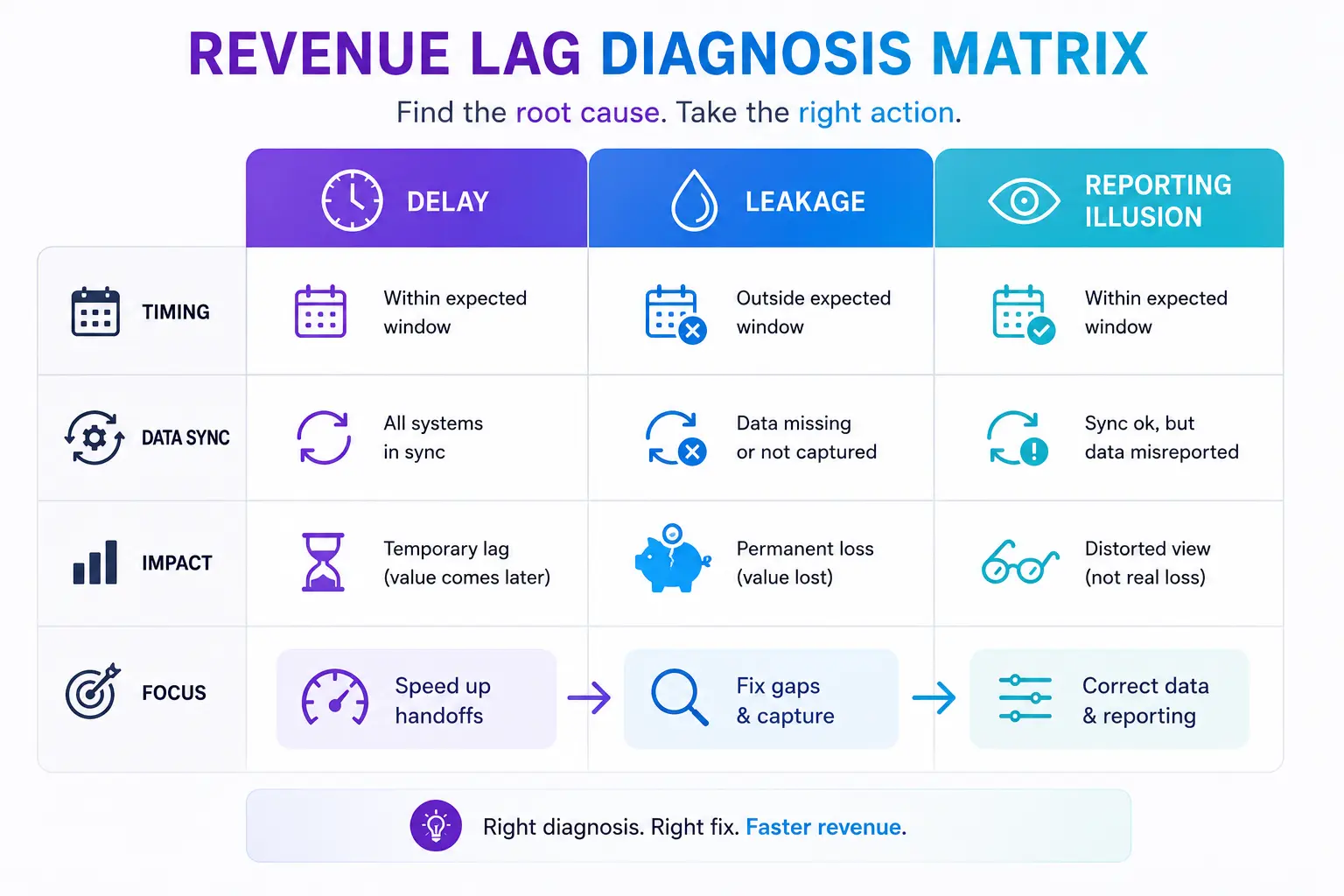
Routing next steps based on what’s really wrong
Before making any move, pause: is the shortfall due to delay, actual leakage, or misaligned reporting?
Two questions clarify fast – does extending your attribution window change the story, and do synced systems ultimately match up in aggregate?
If both answers are no, you’re likely facing genuine loss, not mere reporting fog.
In practice, we help clients triage: extend attribution windows, check for asynchronous data pulls, and manually reconcile periods where revenue goes missing.
Only after pattern-matching across these layers do we pursue root cause – technical, behavioral, or process-driven.
Often, a two-day disconnect between conversion and revenue posting hides real value that a knee-jerk campaign change would have erased.
Think of this as tuning a radio: sometimes the static is the channel, but more often, it’s just interference while the real song is playing.
Diagnosing correctly protects you from fixing the wrong problem or overreacting to illusion.
Even after time passes, impact stays invisible if measurement stops too early.
True progress starts with knowing which mirage you’re really chasing.

When slow revenue response becomes a strategic risk
Executives rarely admit it, but the greatest threat to growth experiments isn’t poor performance – it’s impatience disguised as decisiveness.
Most optimization projects aren’t killed by obvious failure; they’re cut short because revenue refuses to “play along” on schedule.
What if the apparent stall is nothing but a timing mismatch, not an outcome gap?
Recommended Reporting Intervals for Optimization Revenue
| Leakage Cause | Example | Impact on Revenue |
| Refunds & Failed Payments | 27% SaaS accounts canceled before first invoice | Significant reduction from projected revenue |
| Billing Errors | 12% large ecommerce orders abandoned mid-billing | Lost sales despite counted conversions |
| Delayed Purchasing Approvals | Client-side friction delays deal closure | Deals fail to finalize in system |
Risks of prematurely killing optimization experiments
Picture putting a seed in the ground, watering it for a week, and yanking it out when there’s no sprout.
That’s how most companies treat optimization: if revenue doesn’t pop in the reporting window, pull the plug.
This reflex isn’t discipline – it’s value destruction.
In our client work, we’ve watched organizations torpedo high-potential campaigns because initial dashboards showed only static revenue.
Yet, in post-mortem reviews, 60-day and 90-day windows revealed those same experiments would have delivered multi-fold returns – if left alone to mature.
The root issue?
Conflating short-term noise with true signal.
Ask yourself: are missed revenue improvements really failures, or just outcomes waiting to cross the finish line?
Canceling too soon not only wastes sunk effort, but also leaves the real gains for competitors with more patience.
Repeat this: speed kills more real optimizations than bad strategy ever will.
How to set timing expectations with leadership
No C-suite likes hearing, “Just wait”.
Yet, trust collapses the moment optimism and results get out of sync.
The solution isn’t to avoid lag, but to structure the story around it.
Whenever we scope new campaigns, we use outcome distance measurement (how far actions today must travel to become revenue tomorrow) as the expectation baseline, not a risk excuse.
We recommend segmenting reporting into three intervals: what’s visible now, what enters conversion maturation, and what’s forecasted based on optimization-to-revenue delay.
This isn’t arbitrary – conversion cycles, contract sign-offs, or finance reviews extend the window beyond any dashboard’s comfort zone.
Calibrate executive patience to these cycles or risk sabotaging long-tail gains.
Here’s the acid test: could your revenue lag actually be right on track?
If leaders understand “slow” may just be “on schedule”, trust – and eventual wins – hold.
Success in optimization isn’t just about launching smart plays, but building organizational patience as a strategic asset.
That’s how you turn lag from risk into compounding advantage.

Scientific context and sources
The sources below provide foundational context for how decision-making, attention, and performance dynamics evolve under scaling and constraint conditions.
- Revenue Recognition Timing and Information Value
Revenue Recognition Timing and Attributes of Reported Revenue: The Case of Software Industry’s Adoption of SOP 91-1 – Yuan Zhang – Journal of Accounting and Economics
Explores how revenue recognition timing affects the usefulness, timeliness, reliability, and predictability of reported revenue. It directly supports the point that revenue timing can distort how business outcomes are interpreted.
https://doi.org/10.1016/j.jacceco.2005.04.003 - Funnel Conversion Latency in B2B Revenue Analytics
The Impact of Sales Effort on Lead Conversion Cycle Time in a Business-to-Business Opportunity Pipeline – William Bradford, Wesley James Johnston & Danny Bellenger – 6th International Engaged Management Scholarship Conference
Covers B2B lead conversion cycle time and shows how sales effort affects the speed of lead conversion in a B2B opportunity pipeline. This is a real source for funnel latency and pipeline maturation effects.
https://doi.org/10.2139/ssrn.2866954 - Attribution Modeling Challenges
Data-Driven Multi-Touch Attribution Models – Xuhui Shao & Lexin Li – Proceedings of the 17th ACM SIGKDD International Conference on Knowledge Discovery and Data Mining
Examines multi-touch attribution in digital advertising and explains why assigning credit across multiple interactions is more complex than last-touch attribution. Useful for discussing why attribution models can diverge from downstream revenue outcomes.
https://doi.org/10.1145/2020408.2020453 - Time Lags in Organizational Decision-Making
Perils of Managing the Service Profit Chain: The Role of Time Lags and Feedback Loops – Heiner Evanschitzky, Florian v. Wangenheim & Nancy V. Wünderlich – Journal of Retailing
Analyzes how time lags and feedback loops can cause managers to over-focus on short-term results and make suboptimal decisions. This directly supports the point that lagging metrics can mislead optimization and strategic decisions.
https://doi.org/10.1016/j.jretai.2012.01.003
Questions You Might Ponder
Why does revenue lag occur even when conversion rates increase?
Revenue lag happens when there’s a delay between customer acquisition and when revenue is fully recognized. Factors like contract cycles, fulfillment, or financial review slow down the impact of optimizations, masking immediate gains in revenue even while conversions rise.
How does outcome distance affect revenue lag impact analysis?
Outcome distance refers to the time between a marketing or sales event and realized revenue. Short reporting windows often miss improvements because value takes time to flow downstream, making accurate impact analysis dependent on understanding these cycle lengths.
What post-conversion events cause revenue leakage?
Post-conversion revenue loss may stem from failed payments, compliance issues, client-side drop-off, order cancellations, and billing errors. These hidden events mean higher conversion counts don’t always correspond to actual income, skewing revenue impact analysis if not tracked.
Can reporting artifacts mislead revenue lag impact analysis?
Yes, data syncing delays, mismatched attribution windows, and cutoff artifacts can create the illusion of flat or declining revenue. Without aligning system windows, you may mistake technical reporting gaps for genuine underperformance, leading to misguided strategy shifts.
How should leaders adjust revenue expectations after optimization?
Executives should set reporting intervals that reflect the full optimization-to-revenue lag. This involves segmenting what’s immediate, what’s maturing, and what’s forecasted, ensuring judgments aren’t based on incomplete short-term data and protecting long-term program value.