
What You’ll Learn
Measurement cutoff before revenue is the gap that occurs when analytics tracking stops at a digital event, such as a click, form fill, lead, demo request, or micro-conversion, before the business can confirm actual revenue.
It makes campaigns look successful in platform dashboards while sales, CRM, billing, onboarding, or finance systems may show little or no realized value.
This cutoff happens when post-conversion steps are untracked, delayed, disconnected, or lost in manual handoffs. It can hide leakage, inflate performance, mislead optimization, and cause teams to mistake flat revenue for campaign failure.
Reliable measurement connects front-end conversions to backend revenue outcomes.
Key Takeaways
- Conversion tracking often ends long before real revenue is realized, creating hidden measurement cutoffs between form fills and closed deals.
- Optimizing campaigns for micro-conversions can misguide decision-making by maximizing volume without moving actual business outcomes.
- Post-conversion leakage – such as CRM backlog, system disconnects, or timing delays – causes revenue stagnation despite increasing digital conversions.
- True optimization impact is revealed only by connecting tracked events with backend revenue data, exposing and closing the measurement gap.
Most marketing teams celebrate a spike in tracked conversions – until they notice revenue remains stuck.
Here’s the uncomfortable truth: an optimized path to a form fill doesn’t guarantee customer growth, and in many businesses, tracking quietly stops long before the money ever arrives.
That distinction is foundational to how analytics attribution changes executive decision-making.

Why improving conversion metrics can still leave revenue flat
Almost every digital campaign brags about cost per lead or form submissions.
The hidden flaw?
Those “conversions” are usually endpoints of platform tracking, not of real value creation.
The data pipeline ends at the moment someone clicks “Submit” – but your real business impact is decided weeks later, inside your CRM, after multiple sales handoffs, calls, or post-purchase steps.
What conversion tracking captures – and what it doesn’t
We’ve seen high-performing campaigns where paid social and PPC drove a surge in “leads”.
But after mapping the full buyer journey, only a fraction resulted in actual sales.
The platform dashboard didn’t reveal that drop-off.
Conversion metrics function like looking at only the first act of a play and claiming you know how it ends.
Key Differences Between Conversion Tracking and True Revenue
- Conversion tracking usually ends at lead submission or form fill.
- Real business impact happens weeks later in CRM after sales and follow-up.
- High lead volumes may not translate to actual sales.
- Platform dashboards do not show post-conversion drop-offs.
- Optimizing micro-conversions alone can mislead performance evaluation.
Here’s an insight for executives: optimizing to micro-conversions without closing the loop to revenue is like grading a relay race with only the first runner’s split.
Would you celebrate a world-record lead if your team never finished?
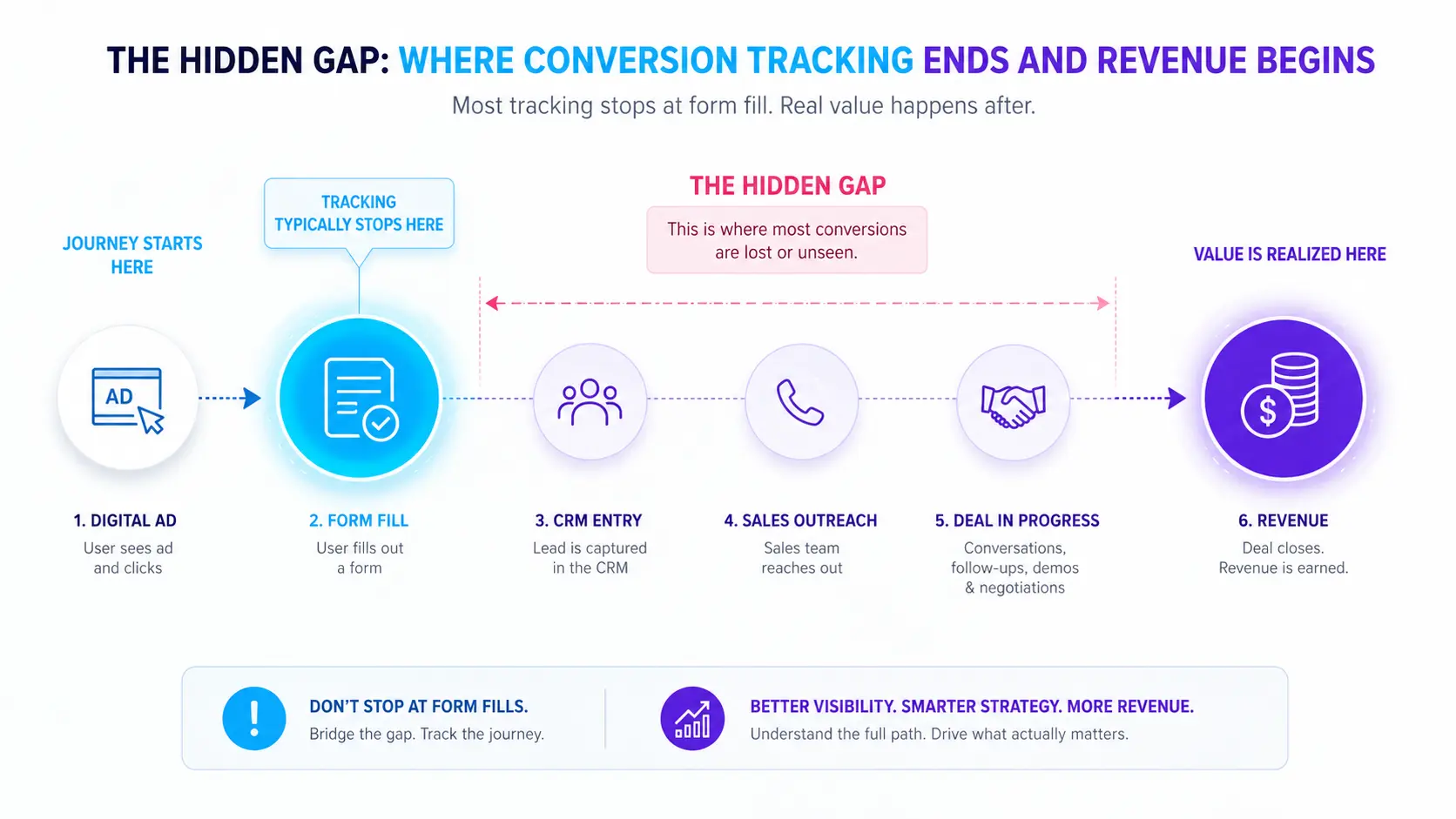
How post-conversion leakage and delays mask optimization gains
What happens to that hard-won lead after the “conversion”?
Too often, it enters a black hole: an unintegrated CRM, a manual handoff to sales, or a slow internal review.
This is where leakage and delay do their hidden work, quietly shaving value off campaign gains.
Common Causes and Effects of Post-Conversion Leakage
- Leads lost in unmonitored CRM queues or backlogs.
- Manual or delayed sales qualification and follow-up processes.
- System mismatches creating data islands between platforms.
- Slow sales cycles causing delayed revenue reporting.
- Analytics dashboards showing conversions but missing downstream losses.
For one business services client, we improved landing page conversions by 30% – but revenue didn’t budge for two quarters.
The culprit?
Most leads sat untouched in a backlog, lost during delayed qualification and follow-up.
The optimization created more “opportunity”, but actual impact vanished downstream.
The myth here is that every tracked win is a revenue win.
The reality: delayed processing, system mismatches, and slow sales cycles introduce lag and loss invisible to most analytics stacks.
Have you ever wondered why revenue lags despite record conversions?
Those missing dollars usually leak out after the “success” event.
Think of your pipeline as a wide, swift river above ground – until it disappears into underground tunnels where sight is lost, and only some water emerges at the end.
Most dashboards glow green while cash flow turns red.
If conversion metrics deliver no revenue movement, the cutoff is probably buried in what you’re not tracking, not because the market stopped caring.
Attacking that gap is where real growth begins.

How noisy signals from micro-conversions distort perceived performance
You might be pouring budget into “high-performing” ad groups that keep winning the wrong race.
Why?
Because platforms will optimize for whatever signal fires most frequently – even if those signals are nothing but digital mirages.
That increase in “conversions”?
It could be the product of an overactive pixel tuned to page views, clicks, or form starts that never correlate with revenue.
When too many weak signals lead to algorithmic misdirection
Most executives assume more tracked events will sharpen campaign performance.
In practice, the opposite often happens: every extra weak event – like button hovers or PDF downloads – acts as another breadcrumb the algorithm can chase.
In our work with mid-market SaaS clients, we’ve watched platforms double down on cheap, volume-driven actions, pulling budget away from true revenue drivers.
When optimization is set to micro-goals, machine learning engines chase the fastest feedback loop, not the most valuable one.
Imagine a guidance system that recalibrates with every tap on the controls instead of adjusting based on the destination.
Every low-value event measured is a steering input – but if those inputs are mostly noise, your campaigns drift farther from genuine business impact.
Why would any growth leader pay for a stream of signals that point everywhere except toward closed revenue?
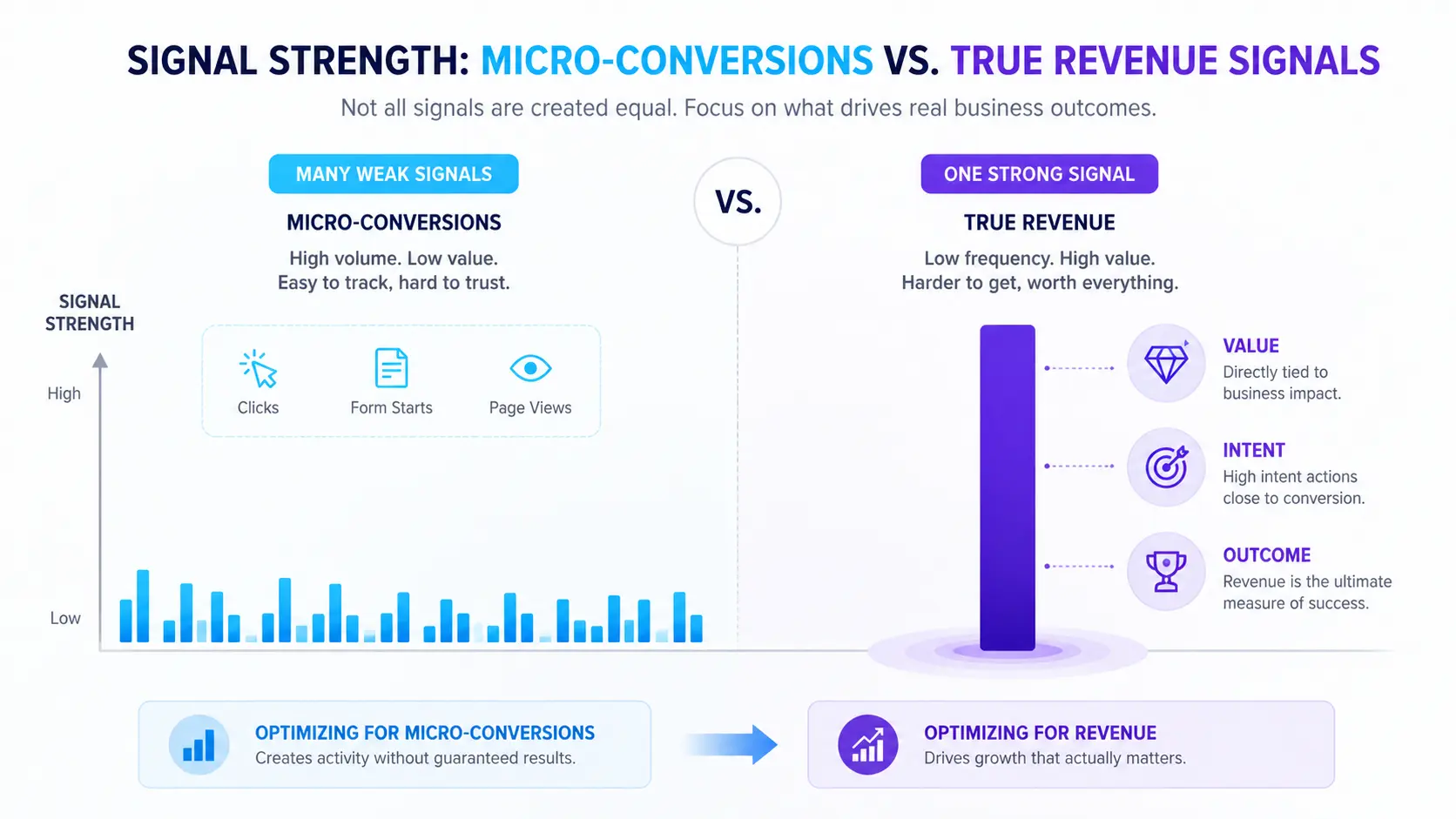
Evaluating signal quality: value, intent, and outcome relevance
So which conversion signals actually guide spend toward real impact?
Three factors separate noise from meaningful direction: value (does the event closely map to revenue?), intent (does the action suggest genuine buying interest?), and outcome relevance (does this signal predict the result you care about?).
For a national insurer we supported, swapping out “Get a Quote” form views as their north star for actual completed applications cut wasted spend by 38% – because the algorithms finally got a signal tethered to business outcomes.
Comparison of Conversion Signal Quality Factors
| Cause | Description | Impact on Measurement |
| Delayed imports | Lead generated in one period but revenue recorded much later | Revenue appears disconnected from conversions |
| Attribution window settings | Conversions ‘won’ despite delayed or lost sales | False positive optimization signals |
| Manual data pulls and batch processing | Revenue data reported weeks after events | Delayed feedback for campaign adjustments |
Not all high-frequency events merit attention.
If your measurement stack rewards clicks and scrolls, you’ll get more of them – just don’t mistake volume for value.
The simple fix: pressure-test every optimization action.
Does increasing this metric move pipeline, or just dashboards?
Sometimes, a single quality signal outpaces a dozen micro-conversions in real-world returns.
If you’re still seeing a gulf between digital “success” and topline growth, inspect your optimization signals – they might be drawing a detailed map to nowhere.

Where measurement typically breaks between ‘form’ and ‘impact’
Most executives assume the data pipeline flows from click to close, but the most expensive measurement failure often happens just after the prospect hits “submit”.
Deals vanish in the space between a tracked form fill and a booked sale – not because prospects disappear, but because your measurement does.
What’s hiding in this blind spot?
Disconnected systems and blind spots after the tracked form
Your analytics platform celebrates a completed form.
Revenue, however, waits for a contract, a payment, or a closed CRM stage hours or weeks later.
We’ve lost count of clients stunned to discover their most prized campaign sends leads straight into a CRM queue no one monitors (or worse – an inbox with 2,000 unread messages).
One B2B provider thought forms equaled deals until we ran a diagnostic: half their “leads” never even entered the CRM due to a broken integration.
This is not rare.
Offline steps – manual verification, in-person calls, or approval processes – often sit outside your martech stack.
It’s like archiving half your customer journey in a locked filing cabinet.
Ask yourself: How many reported conversions are invisible to the sales pipeline?
Do you have a direct link between “conversion” and a living opportunity record?
If that answer isn’t automatic, gap-laden measurement is almost certain.
Myth: All digital touchpoints are synced and unified.
Reality: Systems often drift out of alignment after the form.
The result?
Revenue attribution ends up as guesswork if data islands remain unconnected.
Timing lag: attribution windows and reporting delays
You hit a record week in form-fills – but can’t find the revenue in P&L for months.
Why?
Attribution windows and reporting lags quietly mask when value moves.
Delayed imports mean that a lead generated in March might drive revenue recorded in June, divorcing the impact from the moment you optimized.
Attribution settings, especially on paid platforms, can label a conversion “won” even if the subsequent sale falls out or is delayed indefinitely.
In practice, we’ve seen reporting pipelines set for convenience, not for truth – pushing revenue events outside the attribution window or requiring manual data pulls days or weeks later.
Causes and Effects of Timing Lag in Attribution
| Signal Type | Value (Revenue Link) | Intent (Buying Interest) |
| High-Quality Signal (e.g., completed applications) | High | High |
| Micro-Conversions (e.g., form views, clicks) | Low | Low |
| Weak Signals (e.g., button hovers, PDF downloads) | Very Low | Very Low |
Imagine a relay, but the clock keeps ticking during handoffs no one timed or tracked.
While your dashboards headline last week’s conversion “success”, the revenue outcome is quietly, and often permanently, separated by missed timing.
This lag distorts optimization cycles and clouds true performance.
The measurement cutoff between form fill and impact isn’t a technicality – it’s the difference between influence and ignorance.
To move revenue, bridge the gap where most data stops short.

How to assess whether optimization truly moved value – not just metrics
Quick spikes in digital conversions can feel reassuring – until leaders realize these “gains” vanish once compared to backend revenue.
It’s a shock, and most teams learn it the hard way: celebrating lift on a dashboard while actual bookings don’t budge.
The real signal gets revealed only when front-end and end-state connect, and the gap between them can be wider than anyone expects.
Benchmarking conversions against backend revenue or CRM data
Most marketers still judge campaign value by the number of tracked conversions: shop checkouts, form fills, demo requests.
But true business impact isn’t measured at these micro touchpoints.
If your platform celebrates 500 new leads but your CRM closes only five deals, something’s broken.
We’ve seen enterprise clients double their reported conversion rates through funnel tweaks, only to discover the increase is pure noise – none of it shows up in closed-won revenue.
One practical analogy: trusting surface-level conversion numbers is like weighing yourself on a scale that stops working halfway through a diet.
The appearance of progress means nothing unless it’s measured all the way to the real outcome.
So, what creates clarity?
Merge tracked “conversions” with backend revenue events.
Map each platform-reported win to actual sales, either awaiting in the CRM or booked in your financials.
This lockstep view almost always reveals a gap.
In our experience, the real lesson isn’t in blaming the marketer or the platform – it’s recognizing that most metrics are mere proxies until you verify they match business reality.
If you’ve optimized relentlessly but can’t audit uplift in actual deals, stop grading the effort: start matching event chains to outcomes.
Most importantly, ask: does a rise in tracked conversions create new revenue, or just more noise?
When teams force themselves to answer this with real data, their view of value gets sharper – and sometimes humbling.
Recognizing when flat revenue signals a measurement cutoff, not failure
Here’s the myth: “If revenue is flat while tracked conversions climb, optimization failed”.
In practice, that’s wrong more often than you think.
It’s common to see top-funnel events respond immediately to sharp optimization, while revenue can lag for weeks – or measurement simply ends long before the deal is counted.
A digital paid media client once panicked after conversions doubled in-platform, but invoice revenue lagged behind.
A deep dive exposed the real culprit: campaign tracking ended at the form, and CRM imports happened manually once a month.
By the time true revenue caught up, leadership had already slashed investment based on phantom “failure”.
Imagine tracking athletic progress by only timing the first half of a marathon – you’ll miss the result that actually matters.
Is your team mistaking a reporting gap for an operational problem?
Are you working with half a scoreboard?
Sometimes flat revenue isn’t a verdict on your campaigns – it’s just where measurement stopped.
The fix?
Extend your tracking window, close the loop into backend systems, and choose patience over panic when topline numbers appear frozen.
When teams own this diagnostic mindset, they gain conviction to separate genuine failed impact from mere measurement cutoff.
That’s the difference between chasing phantom problems and driving real revenue growth.
Even when tracking reaches submissions, leakage after conversion can erase value.

Scientific context and sources
The sources below provide foundational context for how decision-making, attention, and performance dynamics evolve under scaling and constraint conditions.
- Attribution and Value Tracking
Attribution Modelling in Marketing: Literature Review and Research Agenda – Jitendra Gaur & Kumkum Bharti – Academy of Marketing Studies Journal
This paper reviews marketing attribution models and methods used for budget allocation and value tracking across marketing channels. It is a better fit than the original source because it directly covers attribution modelling, ROI, multi-channel marketing, and model limitations.
https://www.abacademies.org/articles/attribution-modelling-in-marketing-literature-review-and-research-agenda-9492.html - Decision Lag and Information Flow
Organizations – James G. March & Herbert A. Simon – John Wiley & Sons
A seminal book on bounded rationality, communication, attention, uncertainty absorption, and organizational decision-making. It supports the idea that organizations lose signal through cognitive limits, segmented information flows, and imperfect communication.
https://www.wiley-vch.de/en/areas-interest/finance-economics-law/business-management-13ba/organization-management-theory-13ba2/organizational-behavior-13ba21/organizations-978-0-631-18631-1 - The Pitfalls of Surrogate Metrics
Strategy Selection, Surrogation, and Strategic Performance Measurement Systems – Jongwoon Choi, Gary W. Hecht & William B. Tayler – Journal of Accounting Research
Explains how managers can confuse performance measures with the strategic goals those measures are supposed to represent. This directly supports the danger of surrogate metrics and measurement cutoffs.
https://doi.org/10.1111/j.1475-679X.2012.00465.x - CRM Disconnect and Sales Pipeline Drop-offs
Managing Customer Relationships: A Strategic Framework, 2nd Edition – Don Peppers & Martha Rogers – Wiley
This text covers customer relationship management, customer analytics, and how companies organize around customer strategy. It can support a discussion about CRM structure and customer-strategy integration, but it is broader than “sales pipeline drop-offs.”
https://bcs.wiley.com/he-bcs/Books?action=index&bcsId=6302&itemId=0470423471 - Digital Signal Quality in Algorithmic Optimization
Algorithmic Bias in Machine Learning-Based Marketing Models – Shahriar Akter, Yogesh K. Dwivedi, Shahriar Sajib, Kumar Biswas, Ruwan J. Bandara & Katina Michael – Journal of Business Research
Identifies sources of algorithmic bias in marketing models, including design bias, contextual bias, and application bias. This is a real source for how biased or weak data signals can distort marketing analytics and algorithmic decision-making.
https://doi.org/10.1016/j.jbusres.2022.01.083
Questions You Might Ponder
What is a measurement cutoff before revenue and why does it matter?
A measurement cutoff before revenue occurs when tracking stops at a surface-level event, like a form fill, rather than capturing the full sales cycle. This creates blind spots where real revenue impact is unknown, misleading optimization and business decisions.
How can conversion metrics go up while revenue stays flat?
Conversion metrics often track micro-events, such as lead submissions, but ignore what happens after. If post-conversion stages experience drop-off, delays, or disconnection, revenue won’t increase with reported conversions, revealing a measurement gap.
Why is it risky to optimize for micro-conversions?
Optimizing for micro-conversions, such as clicks or form starts, focuses on events that may have little connection to revenue. This approach can misdirect budget, inflate performance signals, and hide where business value is truly created or lost.
What are common causes of post-conversion revenue leakage?
Typical causes include leads lost in unmonitored CRM queues, manual processing delays, data integration failures, and long sales cycles. These issues break the link between digital activity and real financial results, creating hidden losses after conversion.
How do you know if a measurement cutoff is hiding real marketing results?
Benchmark tracked conversions against closed sales or CRM revenue, inspect integration between systems, look for timing lags, and map each conversion event to an end outcome. If revenue remains flat despite conversion growth, a measurement cutoff is likely present.