
What You’ll Learn
Post conversion revenue leakage is the loss of potential revenue after a lead, signup, form fill, or other conversion has already been captured.
It happens when upstream gains fail to survive downstream steps such as qualification, routing, sales follow-up, handoffs, proposal creation, billing, onboarding, or operational processing.
A dashboard may show more leads or better conversion rates, while closed deals stay flat because value is delayed, misassigned, ignored, unqualified, or blocked after the initial “win”.
Post-conversion revenue leakage reveals that revenue is a system outcome, not a single conversion event, and must be diagnosed by tracing where value disappears after conversion.
Key Takeaways
- Most lead and conversion gains fail to drive new revenue due to unaddressed post-conversion revenue leakage and downstream bottlenecks.
- Dashboards tracking only conversion metrics can mask real profit loss, leading teams to misinterpret surface growth as genuine financial impact.
- Revenue leakage typically hides in handoff ambiguity, lagging qualification, and overlooked operational friction after initial growth wins.
- Sustained revenue growth requires mapping, measuring, and fixing hidden loss points post-conversion – not just optimizing the top of the funnel.
Last quarter, we saw three B2B clients enjoy 30% more leads – and not one saw a jump in closed deals.
Why does the growth story fail like this?
That broader measurement challenge is mapped out in Analytics & Attribution.

Why Upstream Gains Often Fail to Become Revenue
More leads rarely translate to more revenue if the intent behind those leads doesn’t match buying action – think of pouring more water into a leaky bucket.
A recent review of three B2B pipelines showed lead surges of 30% but zero change to closed deals.
Why?
The quality-to-intent ratio fell off a cliff – the volume was up, but the signal was noise.
Why more leads don’t equal more revenue
This illusion is amplified by cognitive bias.
When dashboards fill with new leads, teams feel the urge to celebrate early.
But as deals stall, the celebration turns into confusion or blame.
We’ve seen companies double their top-funnel conversion but miss plan because sales cycles stretched, or handoffs faltered.
Here’s the myth: adding more to the front automagically improves what comes out the end.
What actually happens is that weak-fit, low-intent leads gum up processes, drain bandwidth, and mask the real blockers further downstream.
If you’ve ever asked, “Why didn’t the new campaigns change our bookings?” you’re seeing the lead-to-revenue gap in action.
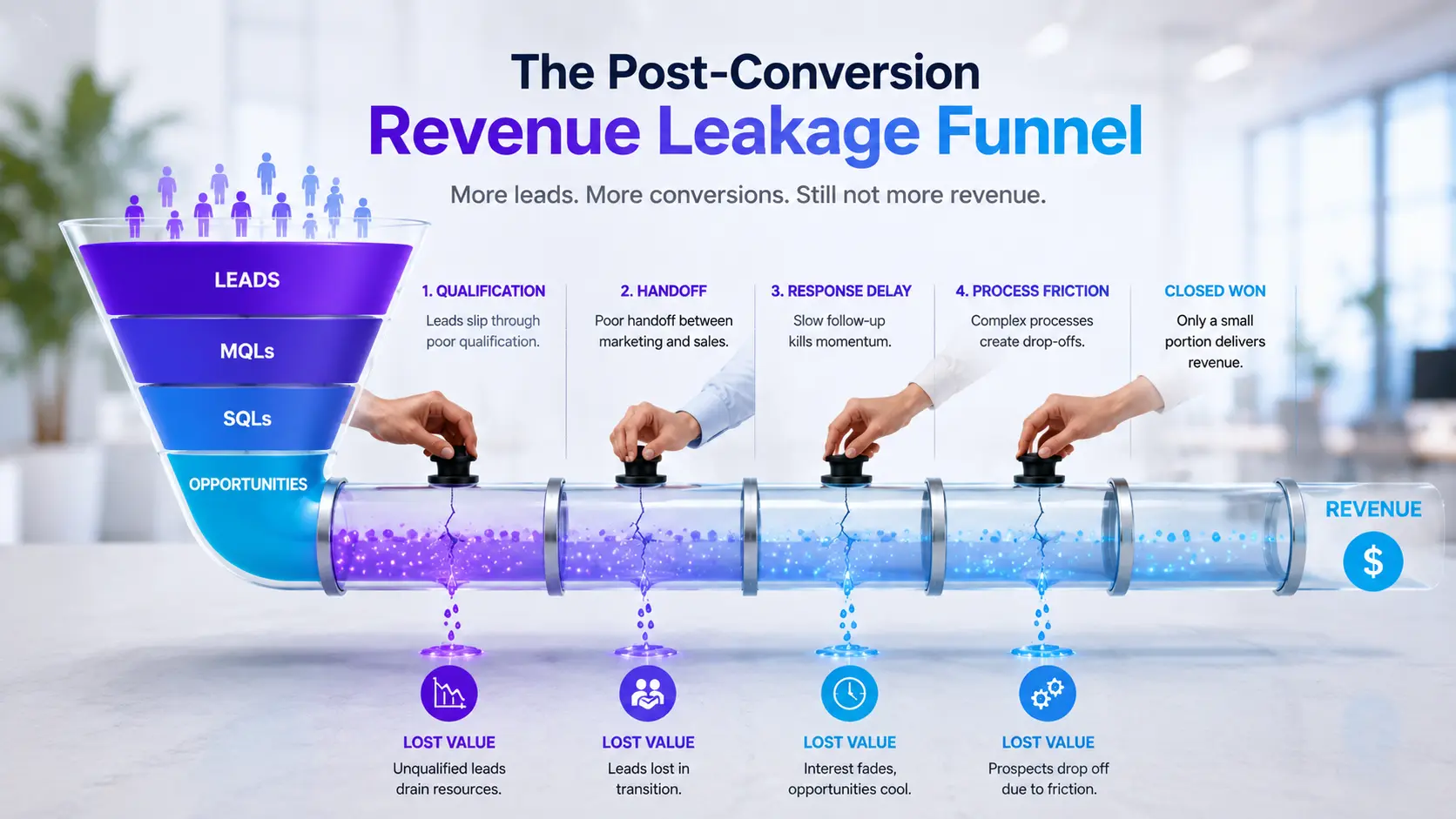
Why conversion gains don’t survive downstream leakage
Pushing conversion rates up looks impressive until you realize how easily those apparent gains slip through the cracks of post-conversion processes.
Pipeline leakage is often a silent killer, hiding in the hidden wait times and clumsy handoffs between teams.
We’ve worked with firms that celebrated higher MQL-to-SQL rates, only to discover that slow lead handling and missed qualification cues wiped out projected revenue lifts.
Imagine upgrading your car’s engine but letting the fuel line rust – speed is irrelevant if flow is blocked where it matters most.
Common Post-Conversion Leakage Points and Their Impact
| Leakage Point | Description | Typical Cause | Impact on Revenue |
| Qualification Bottlenecks | Delays or errors in lead qualification process | Slow lead scoring, misaligned criteria | Leads drop-off, missed sales opportunities |
| Inconsistent Lead Routing | Leads are misassigned or handed off improperly | Lack of ownership clarity, broken processes | Revenue leakage from lost follow-up |
| Operational Clutter | Excess manual tasks or unclear workflows post-conversion | Unoptimized processes, tool overload | Delay in deal progression, pipeline stagnation |
| Slow Lead Handling | Leads not followed up quickly after conversion | Resource constraints, prioritization failures | Extended sales cycles, lost deals |
| Handoff Ambiguity | Unclear responsibilities between teams after conversion | Poor communication, lack of SLAs | Value lost before close, mistrust |
The main culprits?
Qualification bottlenecks, inconsistent lead routing, and operational clutter after the supposed “win”.
Deals that look good on paper fade away – unqualified, delayed, or misassigned.
One B2B SaaS client added two new automation sequences to boost pipeline, but lead scoring lagged behind.
The result: faster movement into the pipeline, and then total drop-off as sales ignored ill-fitting MQLs.
It begs the question: if so many improvements don’t land on the bottom line, where does the value actually disappear?
Revenue is not a point-in-time metric – it’s a system outcome.
If you optimize upstream but bleed value downstream, growth is a mirage, not a result.
Revenue doesn’t materialize just because top-of-funnel metrics look strong.
The real test is what survives the messy journey after conversion.

What Happens When Measurement Stops at Conversion
Most teams trust their dashboards – but the danger is in what those dashboards don’t show.
The most polished funnel metrics can mask a much larger problem: value is leaking out where no one is looking, and executives don’t realize it until revenue misses show up late.
When dashboards lie: tracking vs interpretation gaps
Numbers don’t lie, but they can mislead.
Two executives can look at identical conversion data and draw opposite conclusions about whether a campaign is actually driving profit.
Why?
Because most dashboards only spotlight events up to the point of conversion, not what comes after.
We’ve seen sales and marketing teams high-five over record conversion rates, only to discover later that pipeline leakage swallowed any downstream gain.
One common myth: “If our CRM and analytics match on conversion, we’re fine”.
Not true.
In practice, alignment in tracking means little if the significance of those numbers gets lost or distorted.
For instance, a healthy-looking lead-to-revenue gap might feel like a passing delay, when it’s actually years of faulty routing or slow handoffs eating away at real sales opportunity.
Are your reports surfacing post-conversion loss – or just plotting a line chart of assumptions?
Look at it like a relay race: if you only watch the first runner, you miss the baton drops happening out of view.
Dashboards can show perfect handoffs – but what matters is who actually crosses the finish line with value intact.
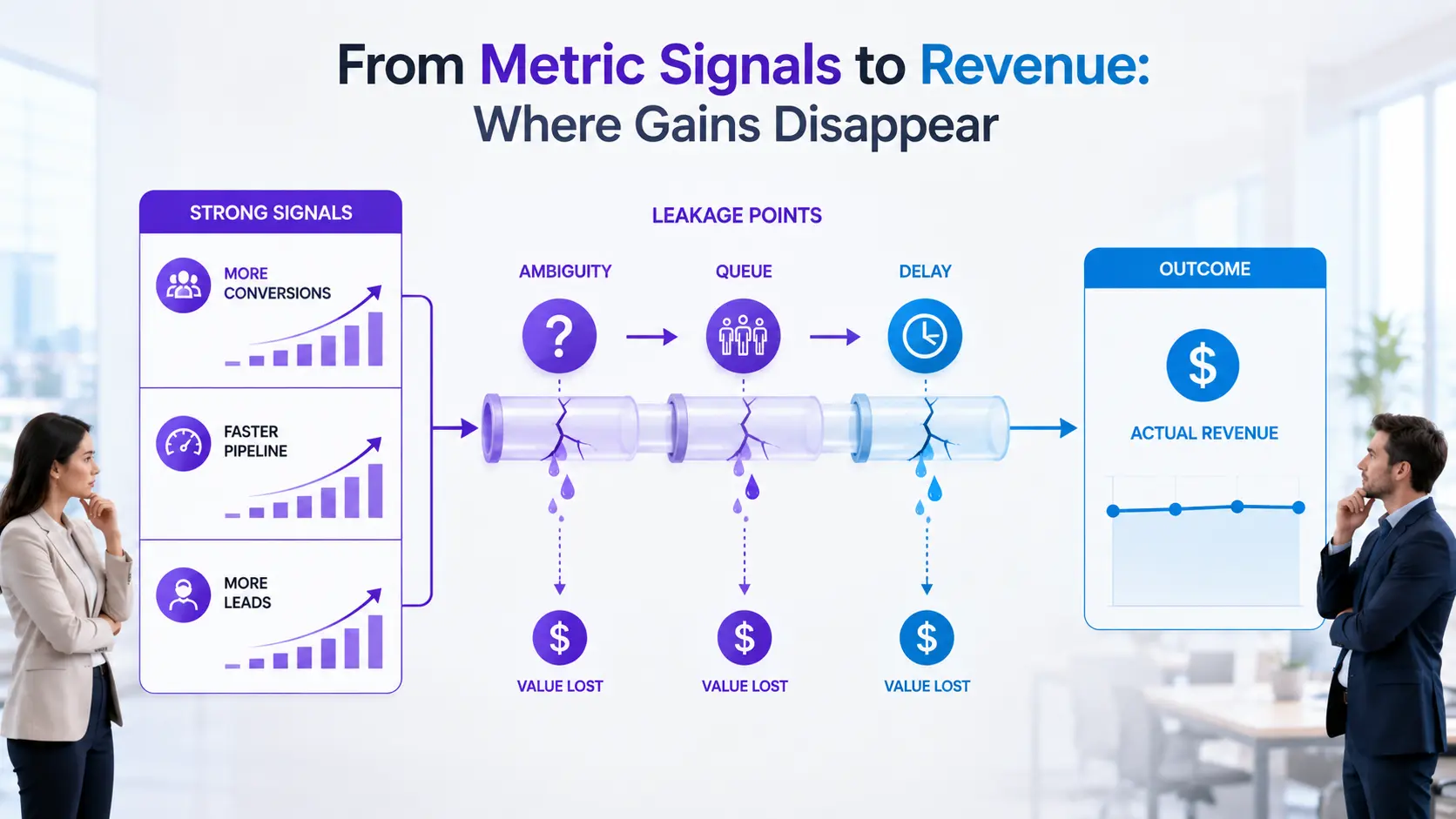
Local metrics vs systemic outcomes: where value vanishes
Marketers often fixate on local KPIs that look healthy – conversion rates, pipeline velocity, campaign output – while missing the larger profit picture.
The mistake?
Thinking these numbers guarantee a lift in final revenue.
More often, spikes in localized metrics hide operational conversion leakage that escapes attention until the quarter is over.
In our work, we’ve traced more than one client’s “optimization not translating to revenue” problem back to silent qualification bottlenecks.
Leads scored and passed met metrics, but weren’t truly ready.
The business saw growth on the dashboard, but revenue stayed flat.
Another client celebrated reduced lead handling time, but didn’t account for downstream loss after conversion when sales didn’t follow up fast enough – revenue left on the table, invisible in the early metrics.
Post-conversion revenue leakage hides in the gap between what looks good locally and what actually drives profit.
If you only measure the first half of the journey, you’ll never see where value vanishes for good.
The further you move from real revenue, the easier it is to celebrate the wrong win.
Teams that stop measurement at conversion end up flying blind – tracking activity, not outcome.

How to Diagnose Where Leakage Happens Without Jumping to Tools
Most teams chase solutions, not causes.
You can pour time into new tech, more automations, or another dashboard – yet still watch post-conversion revenue leakage widen with every quarter.
The invisible drag?
Diagnosis isn’t a tool problem.
It’s a logic problem.
Until you spot systemic loss before shopping for fixes, you risk patching over leaks instead of repairing them at the source.
How to surface delayed and hidden leakage points
Revenue doesn’t evaporate at obvious breakpoints – most of it seeps away after impressive conversion wins.
Spotting downstream loss after conversion means hunting for negative space: areas your current metrics conveniently ignore.
Are deals stalling past qualification in predictable patterns, or do seemingly healthy post-conversion phases quietly delay, defer, or downgrade outcomes?
Key Signs to Identify Post-Conversion Revenue Leakage
- Sudden slowdowns in pipeline velocity after campaign surges
- Increased average time to close deals post-conversion
- Ambiguity over ownership of leads after initial conversion
- Complexity increase in downstream processes and handoffs
- Hidden or buried communications indicating indecision
- Mismatch between lead volume increases and flat revenue
- Unexpected escalation in operational queues or backlogs
One real signal: sudden slowdowns that show up only after campaign surges, not during them.
We’ve seen teams celebrate doubling SQLs, only to miss that their ops queue ballooned and average close time stretched by 40%.
The pipeline looked healthy; the balance sheet didn’t.
Watch for handoff ambiguity (who owns the lead post-conversion?), sudden complexity jumps in downstream processes, or buried email threads that hide indecision.
If this sounds familiar, you’re already seeing the fingerprints of operational conversion leakage – the real killer of optimization translating to revenue.
It’s not just the first point that can leak; breakdowns far downstream quietly shrink the final result before it reaches revenue.
Lead handling leakage and qualification bottlenecks are the typical culprits here, yet are often left invisible in summary reports.
What parts of your pipeline have time lag gaps, sudden slowdowns, or friction you only discover when customers exit – not enter?
Those aren’t flukes; they’re your primary leakage points.
How clear diagnostic paths restore operational trust
Diagnosis starts with ruthless sequencing, not tool selection.
Executives who demand tool demos without mapping one leakage layer at a time trade clarity for complexity – and erode trust between teams.
Begin by isolating each step post-conversion.
What should happen, who owns it, and what constitutes a win?
Only then can you layer measurement – not to find a fix, but to prove or disprove where loss starts.
Example: If leads move from sales-qualified to proposal in two steps, but revenue lags, measure the delta at each junction instead of summarizing the whole process.
Trust is restored when decisions are made visible.
In our experience, showing the precise point where value erodes (without blaming the tech, the market, or the team) creates operational momentum.
It gives leadership a map, not just a metric.
One repeatable move: Diagnose downstream loss by sequence, then trace only to measurement – and stop before new tools clutter the picture.
Only the diagnosis earns the right to fix.
Leakage thrives when hidden in systems nobody dissects.
Sequenced diagnosis is the only route to clarity.

What’s at Risk When Teams Don’t See Post‑Conversion Leakage
Most teams abandon high-potential optimization before it compounds – simply because the revenue needle refuses to move on cue.
Post-conversion revenue leakage isn’t just a technicality; it’s the hidden drain that quietly invalidates hard-won pipeline gains and sabotages future upside.
If you’re only watching lagged revenue, real improvements get missed, misattributed, or flat-out discarded.
Why prematurely ditching optimization wastes upside
The most costly mistakes aren’t always bad ideas – they’re the right moves killed off too soon.
We’ve seen executive teams scrap proven lead-to-revenue enhancements after 8-12 weeks of “invisible” impact, convinced nothing was working.
In reality, qualification bottlenecks or downstream lag were quietly stalling results.
The operational equivalent?
Planting seeds, pulling them up after a month, and blaming the soil.
Common Mistakes Leading to Premature Abandonment of Optimizations
- Expecting immediate revenue lifts without accounting for sales cycle delays
- Ignoring qualification bottlenecks that mask real lag
- Misinterpreting lead-to-revenue gaps as failure rather than delay
- Focusing only on conversion metrics without downstream outcomes
- Cutting optimization efforts after short evaluation periods (8-12 weeks)
- Failing to diagnose operational causes before seeking new tools
- Allowing impatience to override understanding of lagging feedback
One persistent myth: “If revenue lifts don’t show up fast, your new play isn’t working”.
In practice, lagging conversion pipeline leakage, slow lead handling, and hidden process friction mean yesterday’s optimization can bloom months later – if given room.
Ask yourself: how much forecasted value gets erased not by failure, but by impatience with lagging feedback?
Here’s what opens up: Optimization isn’t wasted unless downstream loss goes unaddressed.
The biggest missed wins come from abandoning process changes just shy of their inflection point.
Why operational silence erodes leadership trust
Silence isn’t neutral.
When marketing, sales, or operations can’t pinpoint where the lead-to-revenue gap exists – or worse, go quiet when targets get missed – confidence evaporates across the org.
We’ve watched high-performing marketers become scapegoats for missed revenue when, in fact, post-conversion leakage, slow handoffs, or unresolved operational loss explained the shortfall.
Leadership doesn’t distrust the team; they distrust the signals they receive.
It’s like running a race with fogged goggles – you see motion but can’t tell if you’re winning or drifting off-course.
How often do siloed teams defend local metrics while leadership tries to reconcile the mismatch?
Every time post-conversion revenue leakage is ignored, alignment frays, budget gets reallocated randomly, and the marketing-sales compact breaks down.
Fixing the silence isn’t just about reporting more – it’s building operational transparency so every stakeholder knows where loss occurs, not just that it does.
If you can’t see post-conversion leakage, you’re not just risking missed revenue – you’re gambling with cross-team trust, budget, and your real growth ceiling.
This is why revenue will never match attribution reports exactly.

Scientific context and sources
The sources below provide foundational context for how decision-making, attention, and performance dynamics evolve under scaling and constraint conditions.
- Revenue Attribution and Organizational Dynamics
Business Dynamics: Systems Thinking and Modeling for a Complex World – John D. Sterman – McGraw-Hill
Explains how feedback loops, delays, nonlinear effects, and system structure shape business performance. This is a stronger and real source for systemic leakage and delayed effects in complex organizations.
https://www.mheducation.com/highered/product/business-dynamics-sterman.html - Performance Loss in Multi-Stage Processes
Learning, Communication, and the Bullwhip Effect – Rachel Croson & Karen Donohue – Journal of Operations Management
Shows how delays, poor information flow, and multi-agent coordination problems create inefficiency across stages of a process. Useful for explaining why upstream gains can disappear downstream.
https://onlinelibrary.wiley.com/doi/10.1016/j.jom.2005.08.006 - Metrics, Decision Bias, and Organizational Blind Spots
Competing on Analytics – Thomas H. Davenport – Harvard Business Review
Explains how firms use analytics to improve business processes and compete through better data-driven decisions. It supports the argument that measurement must connect to real business processes, not isolated or incomplete metrics.
https://hbr.org/2006/01/competing-on-analytics - Lead Quality and Pipeline Conversion Science
Marketing-Sales Interface Configurations in B2B Firms – Maja Makovec Brenčič, Frans A. J. van den Bosch & Harry S. J. van der Heijden – Industrial Marketing Management
Examines how B2B firms configure the marketing-sales interface and how that interface affects market orientation and business performance. This is a better real source for handover quality, interface friction, and pipeline conversion risk.
https://doi.org/10.1016/j.indmarman.2008.12.012 - Attribution Gaps in Digital Marketing
Beyond the Last Touch: Attribution in Online Advertising – Ron Berman – Marketing Science
Reviews why last-touch attribution can over-credit late-stage interactions and mislead budget allocation. This directly supports the claim that reported top-of-funnel wins can diverge from true financial outcomes.
https://doi.org/10.1287/mksc.2018.1104
Questions You Might Ponder
Why can increasing lead volume fail to boost revenue in B2B pipelines?
Boosting lead volume may not increase revenue if leads lack buying intent or fit. Irrelevant or low-quality leads clog pipelines, overwhelm teams, and distract focus – leading to more work but no measurable revenue gains. High intent and careful qualification are crucial for conversion success.
How does post-conversion revenue leakage occur in sales and marketing funnels?
Post-conversion revenue leakage happens when qualified leads stall or drop in handoff stages due to slow follow-up, unclear ownership, or missed signals. Value losses accumulate in overlooked pipeline gaps, reducing actual revenue despite apparent top-of-funnel improvements. Even after those leaks are reduced, the commercial effect may take time to surface, which is why Why Revenue Appears Unchanged Despite Optimization Gains examines how delayed outcomes can hide real improvement in the short term.
What is the risk of relying only on conversion metrics for decision-making?
Focusing exclusively on conversion metrics risks missing critical downstream failures. Conversion rates can mask operational leaks beyond the dashboard – such as slow deal progression or dropped proposals – resulting in misleading interpretations and disappointing revenue impact.
What operational cues indicate post-conversion revenue leakage is present?
Watch for rising deal cycle times, ambiguous post-conversion lead ownership, backlogged queues, or disconnect between increased lead flow and stagnant revenue. These signals reveal value is leaking after conversion – often where dashboards and reports don’t provide clear insight.
How can organizations diagnose and fix post-conversion revenue leakage without new tools?
Effective diagnosis starts with sequential mapping: isolate each downstream step, clarify responsibilities, and identify breakdown points. Measurement and accountability – not more software – uncover root causes, enabling teams to target solutions where value genuinely vanishes.