
What You’ll Learn
Attribution revenue mismatch is the gap between revenue credited by attribution reports and revenue actually recognized in financial systems.
It happens because attribution tracks marketing-influenced signals such as impressions, clicks, conversions, leads, or pipeline, while recognized revenue depends on completed transactions, billing, compliance, onboarding, payment, and accounting rules.
The mismatch can come from timing lag, different revenue definitions, post-conversion leakage, duplicate records, identity fragmentation, failed onboarding, churn, or deals that never become cash.
Attribution revenue mismatch is not always a reporting error; it is a diagnostic signal that marketing influence, operational reality, and financial recognition are being measured across different boundaries.
Key Takeaways
- Attribution revenue mismatch is common due to conflicting definitions, timing lags, and measurement boundaries between marketing and finance.
- Attribution models often overemphasize trackable actions while missing unlogged conversion failures, onboarding friction, and post-sale churn.
- Persistent gaps between attributed and recognized revenue signal deeper operational or data integration issues, not just reporting delays.
- Aligning team definitions, processes, and data systems is essential to restore decision confidence and credible revenue diagnostics.
Most executives assume that if an attribution report says marketing delivered $2M last quarter, finance will recognize $2M in the ledger.
That expectation breaks down fast.
The real twist?
Attribution and recognized revenue don’t just disagree – they’re measuring entirely different things, often with barely any overlap.
That broader logic appears in Analytics & Attribution.
How Attribution Reports and Recognized Revenue Tell Different Stories
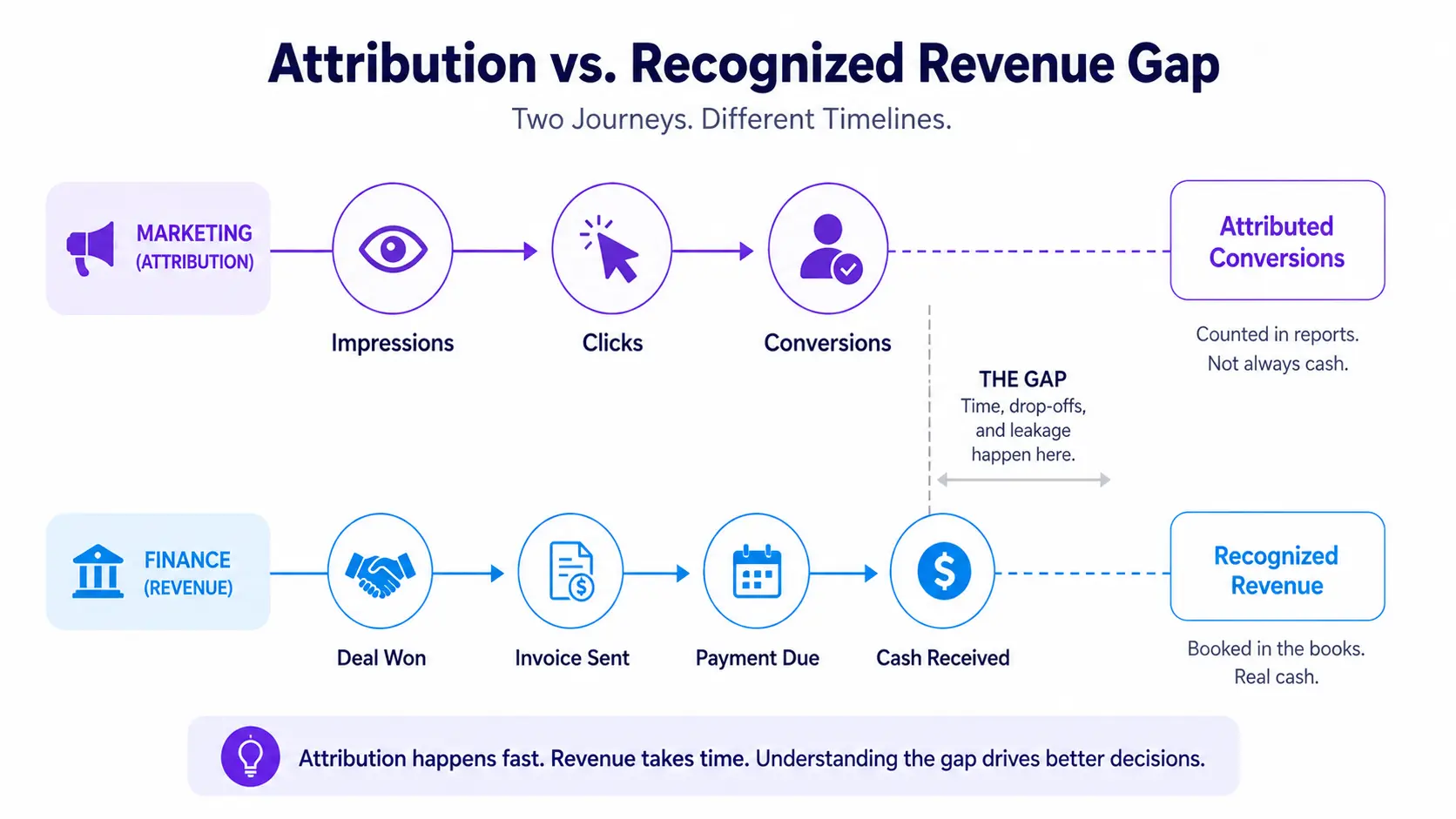
Attribution data tracks signals where marketing ‘influenced’ behavior – impressions, clicks, first touches, last touches, and conversions.
Recognized revenue, meanwhile, is a strict financial event: the moment cash is actually earned and recorded.
One shows intent, the other certifies completed transactions.
It’s a little like reading an airline’s booking app for passenger demand while the accountant only cares who actually flew and paid.
Different measurement boundaries create different truths
A client once discovered that their top-attributed campaigns “generated” 60% of pipeline, yet less than 35% of those deals booked as revenue – thanks to late-stage contract losses, qualification misses, and timing misfires.
Was marketing wrong?
Not exactly.
But the measurement boundary created two partial truths, and neither mapped to the operational reality leaders needed.
What’s worse, this gap plants seeds of doubt in every boardroom discussion.
Comparison of Attribution Data vs Recognized Revenue
| Signal/Threshold | Description | Implication |
| Persistent Revenue Gap > 15% | Attribution and ledger revenue diverge by more than 15% | Indicates potential untracked leakage or misalignment |
| Mismatch Lasting > 1 Reporting Cycle | Gaps remain unresolved beyond one financial close period | Suggests systemic boundary or timing issues |
| Attribution Surges Without Revenue Uptick | Sudden increase in attributed revenue not matched by recognized revenue | Points to post-conversion friction or data blind spots |
| Increasing Delay Windows | Duration between attribution events and revenue recognition lengthens | Signals growing operational or compliance bottlenecks |
| Volume Threshold Widening Gap | More conversions increase mismatch instead of closing gap | Reflects scaling inefficiencies or funnel leakage |
So why do attribution reports often seem to contradict financial reports?
Because they’re not just out of sync by timing – they’re answering entirely different questions.
Model assumptions amplify what isn’t measured
Here’s where the myth deepens: scoring every touchpoint or building complex multi-touch attribution frameworks gives the illusion of accuracy.
In practice, model assumptions quietly distort reality by favoring what’s trackable over what’s meaningful.
Weighted touchpoint models often assign value to every channel in the recorded journey – social, search, display – even when only one or two actually moved the needle.
We’ve seen clients with “successful” attribution models that, upon inspection, wildly overstated the impact of minor interactions simply because those were the easiest to measure.
Meanwhile, unseen influences – like informal referrals, offline conversation, or late-stage pricing – vanish in the data.
It’s like watching a security camera that only points at the door and assuming that’s the full story of what goes on inside.
What’s left out is often more material than what’s counted.
How much of your “attributed” pipeline actually survives to revenue?
What critical actions are missing because the model can’t see them?
One insight we repeat to clients: attribution isn’t causation – every model draws boundaries that decide what’s real and what’s ignored.
If leadership confuses a model’s neat numbers with causal impact, they risk betting the business on half a map.
Revenue leaders don’t just need numbers – they need confidence those numbers reflect reality, not just what’s logged in a dashboard.
Restoring that confidence in the data’s meaning – and its boundaries – turns ambiguity into alignment.

Why Revenue Isn’t Showing Despite Attribution Success
Most teams celebrate a spike in attributed conversions – until the finance report lands and the actual dollars lag behind, stubbornly flat.
Here’s the shock: even flawless attribution can leave you blindsided if you don’t account for timing lag and the silent churn that quietly drains post-conversion value.
Timing delays and revenue realization noise
Winning more conversions doesn’t bring revenue to the ledger on your timetable.
Attribution models count wins the instant a form’s filled or a deal is marked closed, but actual revenue almost always arrives later – sometimes weeks, sometimes months.
One client’s acquisition campaign drove a 30% increase in high-intent form fills, and attribution reports lit up with win signals.
But actual recognized revenue didn’t budge for an entire quarter.
Why?
The signed deals stacked up in CRM, but billing cycles, procurement hangups, and compliance checks scattered real cash collection across several reporting periods.
The myth is that revenue neatly follows attribution: close a lead, get paid.
In reality, operational friction (invoicing, credit checks, onboarding) means finance sees a messy, stuttered flow that never matches marketing’s clean line on the attribution chart.
Imagine trying to measure rainfall by the sound of distant thunder – it tells the right story, just several minutes early, and often with critical details missing.
If your board is impatient for dollar signs, ask: are you setting expectations based on sales signals, or on the unpredictability of financial realization?
There’s always a lag between attributed success and recognized revenue – and the delay itself holds valuable diagnostic clues.
Post‑conversion leakage hides real impact
Conversion isn’t the finish line, and almost every digital funnel springs hidden leaks after the big “win”.
The real surprise?
Attribution platforms rarely track whether converted leads survive onboarding, complete purchase, or even pay their first invoice.
They stop measuring just as the real-world risks ramp up.
Common Post-Conversion Leakage Points
- Onboarding drop-off preventing customers from completing purchase
- Failed verifications or buyer cold feet after conversion
- Churn before second payment or renewal
- Lack of tracking beyond initial conversion event
- Silent erosion of value undetected by attribution platforms
A SaaS client once doubled its paid signups month over month.
Attribution dashboards celebrated.
Yet, when revenue posted, nearly 40% of the new subscribers had churned before making a second payment.
The leakage happened in first-week onboarding – a step no conversion pixel tracks, but with huge financial consequence.
If your CFO keeps asking why celebrated conversions don’t translate to actual profit, probe for drop-off between signup and revenue recognition.
What post-conversion barriers, failed verifications, or buyer cold feet are causing silent erosion after a “successful” campaign?
Here’s a simple analogy: Attribution counts runners who cross the starting line, but revenue depends on how many actually finish the race.
Are you measuring the start – or the true finish?
Momentum looks real in your attribution dashboard, but untracked friction after the click can vaporize expected gains.
The core idea: chasing attributed wins without tracking what happens next is like pocketing IOUs – easy to count, far harder to spend.
Revenue confidence starts with seeing beyond attribution’s spotlight.
The next section surfaces exactly where this trust breaks down across the organization.

Where Attribution Trust Breaks Down in the Organization
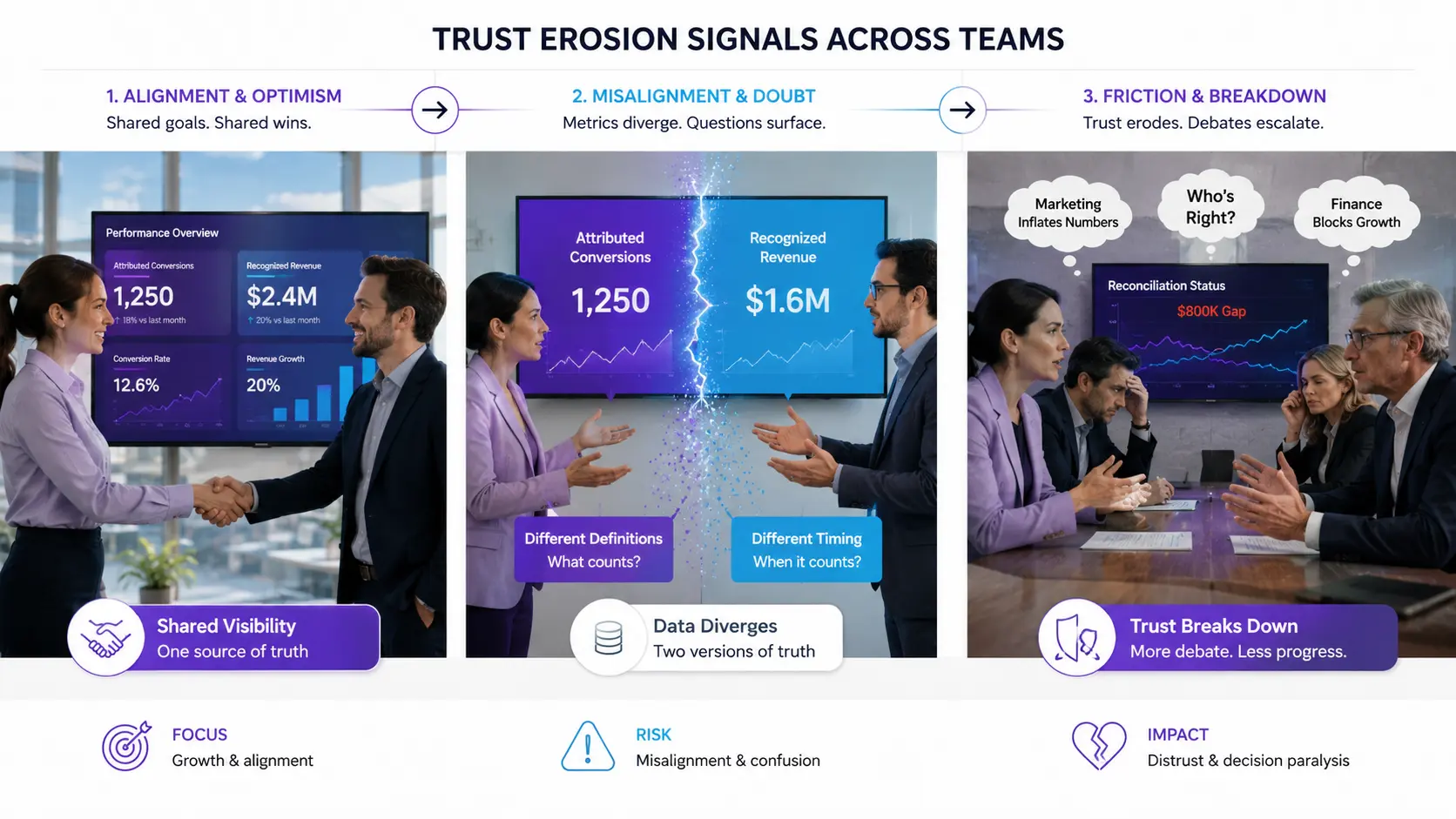
Most attribution failures aren’t technical – they’re cultural.
Picture two teams in the same meeting, staring at the same campaign report.
Marketing claims $1M attributed revenue; finance doesn’t see a dollar in the bank.
Both feel right, but trust quietly erodes.
That’s not a reporting bug, it’s an organizational signal – and it sends shockwaves through every strategic conversation.
Misaligned definitions between marketing and finance
Ask ten companies to define “revenue”, and you’ll get ten subtly different answers.
What counts: closed-won deals, contracts signed, cash received, or something fuzzier like pipeline generated?
This isn’t a debate about semantics.
It drives fundamental mistrust when marketing claims success using attribution reports, while finance rejects it as “unrealized”.
We’ve seen revenue meetings stall out over simple terms – finance refusing to celebrate, marketing defending its numbers.
One client’s CMO pointed to record attributed conversions, while the CFO flagged flat recognized income.
Both blamed the other’s system, but the real gap was their incompatible definitions of success.
It’s like a GPS set for one destination but an odometer measuring another; no matter how fast you drive, agreement never arrives.
When every dashboard tells a different story about the same journey, leaders begin to doubt all of them.
Measurement blind spots and identity fragmentation
Even when definitions align, fractured data sabotages trust.
If attribution logic can’t reliably connect touchpoints, identities, and real buyers across disconnected systems, granularity creates the illusion of accuracy – but leaves glaring blind spots.
In practice, we’ve diagnosed gaps where inbound leads split across multiple records, causing inflated conversion totals and invisible churn.
Identity fragmentation turns otherwise robust models into guesswork.
One enterprise client discovered 17% of “unique” leads were duplicates created by lagging CRM syncs.
The impact: senior teams couldn’t reconcile why campaign-attributed pipeline never matched actual sales bookings.
The analogy here: running a relay race with blindfolded teammates – batons dropped, blame passed, no one sure who finished the race.
When data ownership and technical integration fray, attribution confidence erodes fast.
If the signals don’t match up, the narrative falls apart in the boardroom.
The breakdown isn’t in technology – it’s in alignment and judgment.
When finance and marketing operate from different maps, and when signals fragment across silos, attribution’s credibility vanishes.
Trust cracks first in the numbers, then in teams.

How to Recognize When Attribution Is Describing, Not Diagnosing
Most teams think a soaring dashboard means growth is inevitable – until real revenue stalls and the optimism fades.
Attribution reports might signal progress, but they can just as often conceal the pipeline leaks that quietly undermine last quarter’s projections.
Attribution without action: when the funnel still leaks
Uncomfortable truth: attribution metrics may highlight clean handoffs and strong stage-by-stage influence, but bookings and cash can still fall short.
We’ve seen this pattern in tech firms where weekly funnel reviews declared “record MQLs”, but sales closed fewer deals than the same quarter last year.
The dashboards had no clue about sales enablement gaps or post-demo ghosting.
The leak wasn’t in the traffic or the touchpoints – it was a silent churn point, after handoff and beyond the reach of the attribution model.
The analogy: it’s like a chef obsessively tracking every ingredient sourced, then wondering why the dish still fails – never checking if the stove is even on.
Attribution describes the ingredients; actual conversion depends on what happens after.
Are your best metrics stuck describing activity, while preventable problems in operations or customer experience empty the pipeline?
This is why a healthy scorecard can lull leaders into missing harder-to-spot, systemic friction.
Optimizing touchpoint attribution alone won’t fill a leaking bucket.
When the tool becomes a distraction, not a guide
Many organizations fall for the spectacle of attribution dashboards – the more granular, the better.
But that steady drip of percent gains and pie charts can turn into a distraction fast.
We’ve watched leadership teams debate last-click vs. linear weighting for weeks, even as the sales team flagged major drop-offs after contract signature.
The dashboard wins attention, the system keeps leaking value.
Ask yourself: How many hours are spent tuning attribution models vs. actually listening to what’s breaking after the deal?
When attribution turns from a decision tool to a defensive shield (“but the dashboard says we’re trending up”), problems left off the metrics radar will compound.
The actionable signal: If attribution success stays static or climbs, but revenue, NRR, or customer health slides, it’s time to probe deeper – past the screen and into processes, teams, experience, or churn that attribution simply doesn’t see.
The core idea: Reliable attribution is a starting point, not a verdict.
Detect the warning signs that demand real diagnosis, not just better descriptions.
The difference is the difference between management confidence and management surprise.

What to Look Out For Next – Diagnostic Indicators, Not Fixes
Most teams are primed to celebrate high attribution numbers.
Beneath the surface, those impressive figures can mask a growing disconnect between what teams believe is happening and what actually moves the business.
Gap thresholds and timing flags that demand investigation
There’s an assumption that if attribution says $1M and revenue recognizes $800K, you’re in a normal window.
But we’ve watched that 20% delta balloon into 50% in quarter-end reviews, always with an initial wave of rationalizations: “seasonality”, “billing delays”, “lag from renewals”.
The myth?
That these gaps always self-correct if you just wait.
In reality, persistent or widening mismatches often point to untracked leakage or systemic boundary issues.
Diagnostic Indicators of Attribution-Revenue Mismatch
| Aspect | Attribution Data | Recognized Revenue |
| Definition | Tracks marketing-influenced signals (impressions, clicks, conversions) | Financial event: cash actually earned and recorded |
| Measurement Focus | Marketing influence and intent | Completed transactions and revenue recognition |
| Timing | Counts wins or engagements immediately | Revenue realization often delayed by billing, compliance, etc. |
| Implication | Shows potential/interest, may include unclosed deals | Reflects actual business income and cash flow |
| Limitations | Misses post-conversion losses and hidden leakages | Does not capture marketing activity or intent signals |
A practical signal: if attributed revenue and ledger revenue diverge for more than one reporting cycle – or if the shortfall is more than 15% – stop.
These aren’t just accounting hiccups.
They’re diagnostic indicators that the machine is running with missing or misaligned gears.
One analogy: it’s like your car’s speedometer showing 60 mph while your GPS says you’re crawling in traffic.
Something in the measurement chain is off.
What flags demand urgent investigation? – Attribution surges without a matching uptick in recognized revenue by the next financial close – Delay windows growing longer without explanation (what used to resolve in a month now takes a quarter) – Volume thresholds where every additional “conversion” actually widens the gap, not closes it
How often should you be checking?
If your models are optimized weekly but reconciliation to finance happens monthly or quarterly, incongruencies can pile up and become embedded in strategy decisions.
Why is this so hard to spot?
Because the lag isn’t just a delay – it’s a form of signal loss.
Teams expect the story to eventually line up; often, it never does.
Confidence loss signals in leadership and cross‑team friction
Executive tension becomes clearest in the boardroom, not the spreadsheet.
When meetings turn into debates over whose data to trust, it’s a sign that governance, not just measurement, is under threat.
Signs of Attribution Trust Breakdown in Organizations
- Leadership openly questions ROI and pauses investments
- Escalation of issues between marketing and finance teams
- Cross-functional debates over data accuracy dominating meetings
- Repeated failure to resolve discrepancies over multiple cycles
- Reduced alignment and collaborative diagnostics
These are the signals that commonly precede larger organization risk: – Leadership openly questions reported ROI or pauses investment until discrepancies are resolved – Marketing and finance teams escalate issues instead of collaborating on joint diagnostics – Attribution reports trigger more cross-functional debate than action
Ask yourself: How many cycles does it take before persistent attribution revenue mismatches turn into lost strategic momentum, not just meeting tension?
The analogy: It’s like driving with two steering wheels – each team believes they have control, but the car goes nowhere.
Consistently spotting these signs is more than an audit – it’s the front line of protecting decision confidence and revenue growth.
If friction is rising and explanations no longer satisfy, don’t just adjust the model.
Dig deeper before deciding what comes next.

Scientific context and sources
The sources below provide foundational context for how decision-making, attention, and performance dynamics evolve under scaling and constraint conditions.
- Attribution and Revenue Reconciliation
Understanding the Marketing Department’s Influence Within the Firm – Peter C. Verhoef & Peter S.H. Leeflang – Journal of Marketing
This paper examines marketing accountability and the marketing department’s ability to link marketing actions to financial outcomes. It is a better verified source for the gap between marketing activity metrics and business/financial impact.
https://doi.org/10.1509/jmkg.73.2.14 - Timing Lags in Revenue Realization
Revenue Recognition Timing and Attributes of Reported Revenue: The Case of Software Industry’s Adoption of SOP 91-1 – Yuan Zhang – Journal of Accounting and Economics
This paper examines how revenue-recognition timing affects reported revenue. It finds that earlier recognition can make revenue more timely and relevant, but can reduce reliability and predictability.
https://doi.org/10.1016/j.jacceco.2005.04.003 - Model Limitations and Causality
Conducting Research in Marketing with Quasi-Experiments – Avi Goldfarb, Catherine Tucker & Yanwen Wang – Journal of Marketing
This paper explains how marketing researchers can make causal claims using quasi-experimental designs and why identifying assumptions must be stated clearly. It is a real and stronger source for causality limits in marketing analytics than the original item.
https://doi.org/10.1177/00222429221082977 - Data Fragmentation and Trust
Trusted Decision-Making: Data Governance for Creating Trust in Data Science Decision Outcomes – Paul Brous & Marijn Janssen – Administrative Sciences
This paper explains why organizations often struggle to trust data-science outcomes, especially when data quality, governance, and compliance are unclear. It supports the point that poorly governed data reduces confidence in analytics-based decisions.
https://doi.org/10.3390/admsci10040081 - Organizational Alignment and Information Overload
Information Overload: Causes and Consequences – Susan C. Schneider – Human Systems Management
This article presents a model of information overload, including organizational causes and consequences. It is a better verified source for the claim that too much or poorly structured information can impair workplace decision-making.
https://doi.org/10.3233/HSM-1987-7207
Questions You Might Ponder
What causes attribution revenue mismatch in organizations?
Attribution revenue mismatch arises from differences between marketing’s attribution models and finance’s recognized revenue. Marketers often track early-stage signals like conversions, while finance only counts finalized, paid transactions, leading to misalignment and questioning of reported performance.
Why doesn’t recognized revenue match attribution reports?
Recognized revenue may lag behind attribution data due to operational delays, failed deals, billing issues, or post-conversion customer churn. Attribution highlights intent or engagement, but finance only reports revenue when actual payments are received and obligations fulfilled.
How can attribution models mislead decision-makers?
Attribution models can overvalue easily trackable interactions, leading leaders to believe in inflated marketing impact. Unmeasured influences and post-conversion leakage often remain hidden, so decisions based only on attributed data risk ignoring critical underlying issues.
What are the signs of declining trust in attribution data?
Declining trust shows up when leadership questions reported ROI, cross-team debates over data accuracy increase, and recurring mismatches are unresolved. If meetings focus more on reconciling metrics than addressing strategy, attribution trust is likely eroding.
How can organizations improve confidence in revenue reporting?
Organizations improve confidence by aligning marketing and finance definitions, monitoring both pre- and post-conversion stages, integrating systems to reduce identity fragmentation, and regularly auditing gaps between attributed and recognized revenue to inform proactive diagnostics.