
What You’ll Learn
Local optimization vs system outcomes is the difference between improving an isolated metric and improving the whole business result the system is meant to produce.
Local optimization happens when one team raises its own KPI, such as leads, outreach, ticket speed, or feature output, while system outcomes such as revenue, profit, retention, conversion, or customer value remain flat.
This gap appears because handoffs, bottlenecks, timing delays, and misaligned incentives can erase local gains before they reach the final outcome.
Strong measurement compares local wins against end-to-end flow, so teams can see whether their improvements compound into business progress or simply create visible activity inside one part of the system.
Key Takeaways
- Local metric improvements do not guarantee overall business progress; handoff losses and bottlenecks often offset local wins.
- Siloed optimization and disconnected KPIs create friction and inefficiencies that compound over time, stalling system outcomes.
- Effective diagnostics require monitoring flow across departments, not just isolated checkpoint metrics, to reveal hidden constraints.
- Sustainable improvement comes from aligning incentives and measurement at the system outcome level, ensuring local decisions drive global success.
Most teams think hitting their numbers means the business is healthy.
Not only is that wrong – it’s exactly how companies get stuck while the data looks positive.
The real hazard: local optimization vs system outcomes.
If one metric improves, but profit or growth stalls, you’re likely watching a “local win” hide a silent system failure.

When local wins mask global stagnation
One sales team sets a new lead volume record, while marketing is celebrating record MQLs.
On paper, everyone’s winning.
Yet quarter-end revenue doesn’t budge.
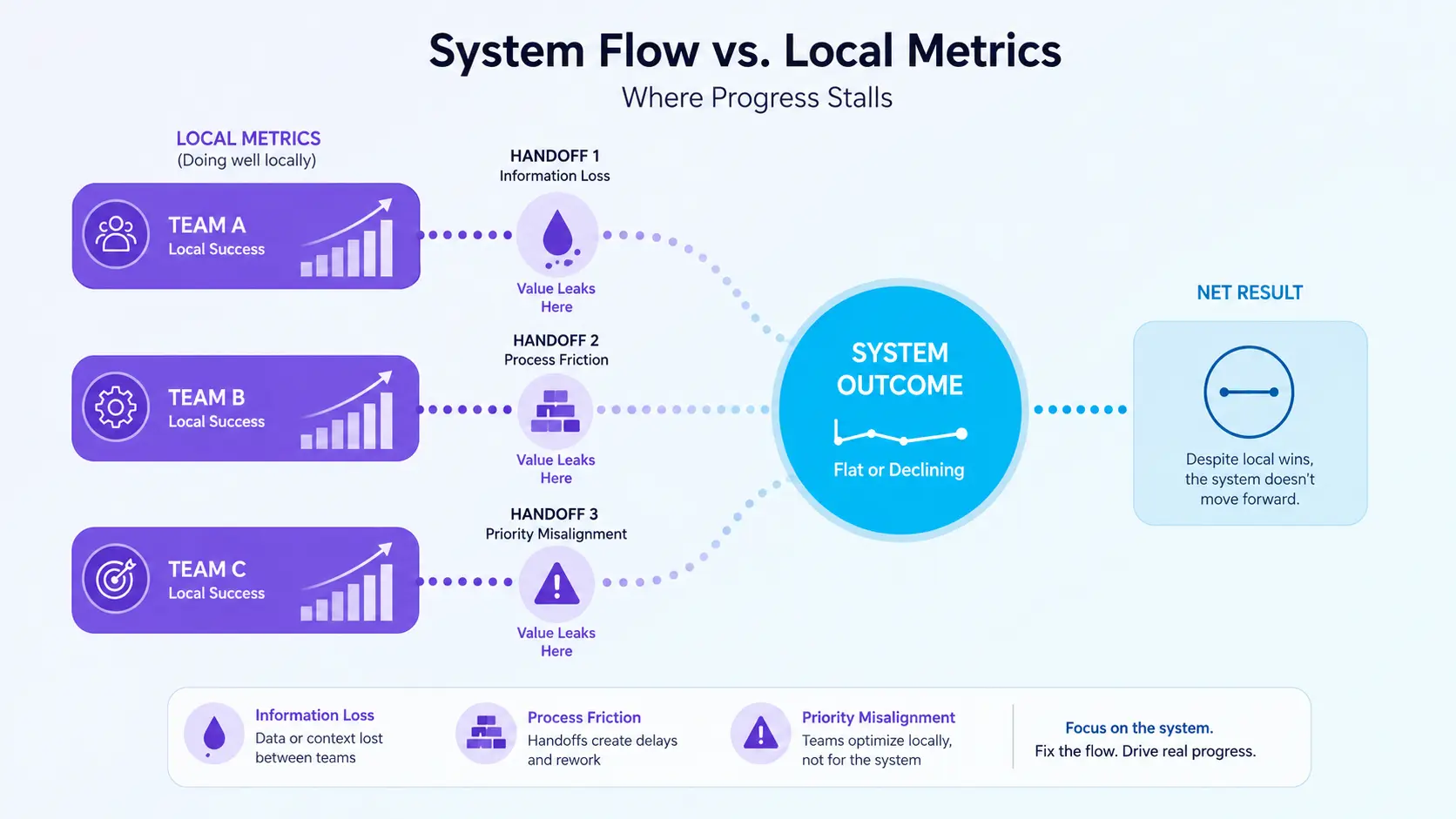
If this sounds familiar, you’ve seen “siloed success” – where each group optimizes their piece in isolation, accidentally locking bigger problems in place.
It’s like runners in a relay caring only about their leg, ignoring whether the baton is dropped during handoff.
How siloed success veils inter-team friction
The myth: improving every part means the whole improves.
Our work with SaaS portfolios showed the opposite.
When every team optimizes locally, friction multiplies at the boundaries.
Teams focus on the metric they own, often creating bottlenecks for others – think Marketing’s lead gen outpacing Sales’ ability to qualify, or Product shipping features that Support dreads.
“Systemic metric blindness” sets in: dashboards glow green, but real progress stalls.
Signs of Siloed Success
- One team achieves record metrics while overall revenue does not increase
- Teams focus only on their own metrics without regard for others
- Bottlenecks form at handoff points between departments
- Dashboards show positive numbers but global outcomes stall
- Local wins mask hidden inter-team frictions
Are your internal KPIs truly moving the business forward – or just keeping departments busy?
Why handoff inefficiencies compound losses
Even if each unit excels, unseen transitions can quietly eat your wins.
Every handoff – lead to sales, trial to paid, support to renewal – is a weak link where losses don’t appear as red flags, but as slow leaks in revenue.
Impact of Losses Across Multiple Handoffs
| Metric Type | Local Metric Change | System-Level Outcome Change |
| Marketing Qualified Leads | Up 30% | Conversions Flat |
| Product Launches | Increased Quantity | Customer Satisfaction Flat |
| Sales Enablement | Higher Outreach | Revenue Growth Flat |
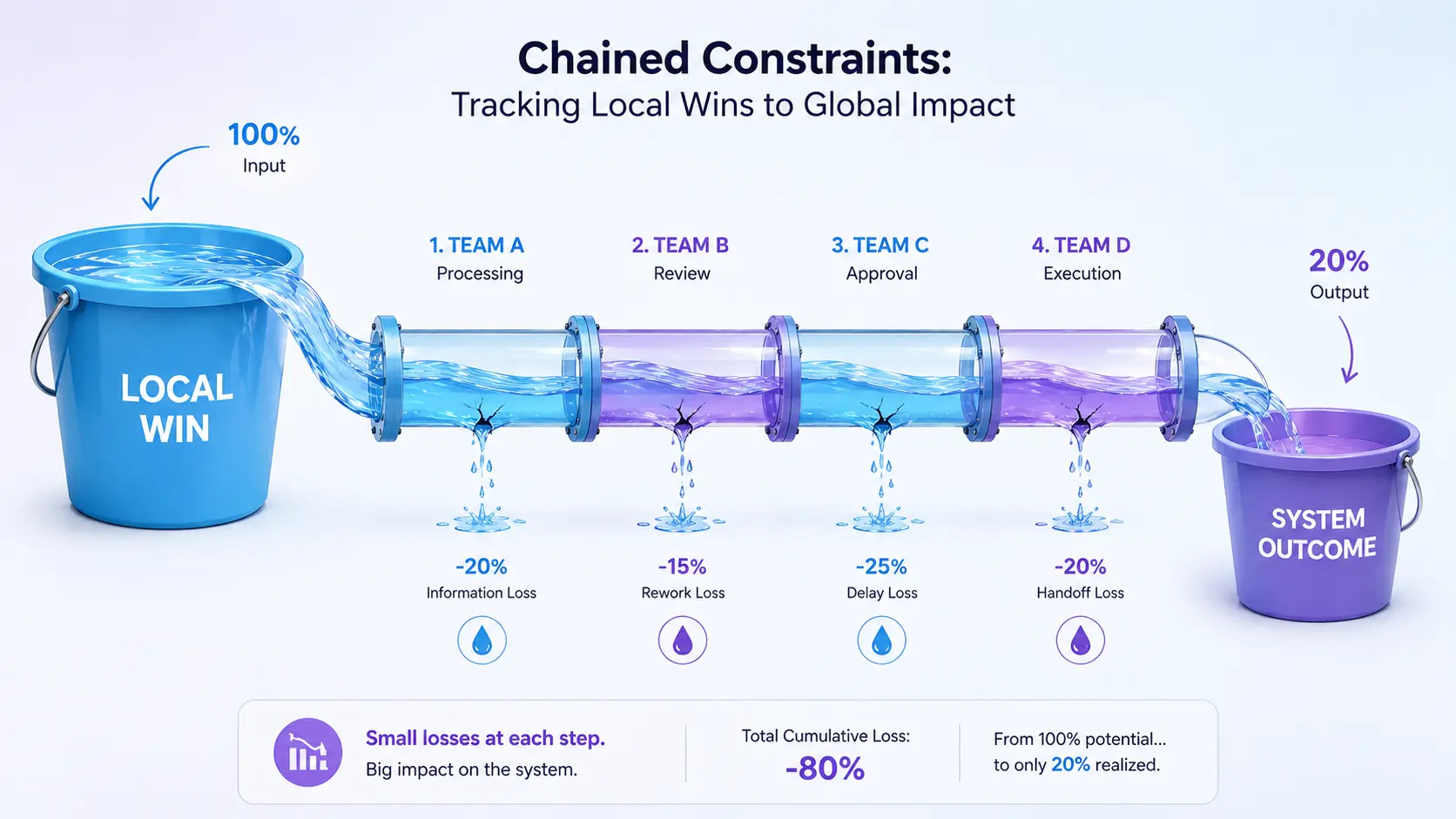
In practice, these cumulative losses behave more like compounding interest – but in reverse.
A 10% drop at each of four handoffs doesn’t just cost 10%.
It can slash outcome by over 30%.
We’ve audited analytics in B2B tech firms that celebrated their “local wins” for months, only to discover that invisible handoff friction eroded net pipeline faster than any upstream win could restore.
Isolated wins can actually degrade global performance when transition costs multiply.
It’s not the visible checkpoints that decide outcomes: it’s the flow across them.
If your dashboards always tell you the parts are healthy, ask which part of the process is quietly breaking the whole.
The real improvement comes when you spot – then fix – where local wins turn into system losses.

What drives sub-optimization in measurement systems
Most so-called improvements are really just prize ribbons for the wrong race.
Companies pour effort into boosting whatever number feels urgent, only to discover global gains are elusive or – worse – imaginary.
The biggest inefficiency in analytics isn’t missing data; it’s optimizing the wrong layer, systematically.
Why?
When metrics reward the part, not the outcome
Picture a relay team where each runner sprints their leg solo, aiming for a personal best – without passing the baton.
That’s the reality in most measurement environments.
We’ve seen marketing focus on MQLs, sales hone in on SQOs, and customer success prize NPS scores, each chasing local wins set by their own dashboards.
But these isolated KPIs create a dangerous illusion: “If every part beats their target, the system will win”.
In practice, incentive misalignment breeds phantom progress.
Teams pad their metrics with no requirement for end-to-end value.
One client’s SDR team hit record outreach numbers, but most conversations never reached qualified status – creating an upward blip in activity but a stagnant results curve.
Ironically, the better each team performs by its local rules, the further the business drifts from real profit or customer impact.
Why does this persist?
Because metrics shape behavior, especially when bonuses or recognition hang on them.
The myth: “Local performance adds up linearly”.
In reality, it often subtracts – one group’s rush for KPIs pushes friction downstream or starves other links in the chain.
If you’re rewarding the sprinter but never watching the finish line, you’re funding motion, not progress.
How sightings without visibility distort decisions
Dashboards offer comfort, not clarity, when they slice up insights by function.
We’ve watched leaders celebrate beautiful numbers in one business unit, blind to the fact that another team is quietly absorbing the fallout.
The problem isn’t awareness – it’s the blindness to how these metric snapshots compound or collide across the system.
One executive client relied on a vast analytic suite, convinced real-time charts meant total visibility.
But as losses mounted, we found that none of those dashboards tracked what happens between the checkpoints – handoffs, timing gaps, friction nobody owned.
The result: big numbers in lots of places, yet cash flow stuck in neutral.
It’s like watching scattered flashlights sweep parts of a warehouse, while the largest leaks flow in the darkness between them.
Systemic metric blindness hides in these gaps.
Sightings on a dashboard look reassuring, but when actual decisions rest on point-in-time data, compounding losses stay invisible.
Here’s the line: what you measure lights up only part of the picture; what you ignore can quietly cost you the year.
What passes for measurement rigor is often just isolated scorekeeping.
Start looking for the incentives and the blind spots – not just the busy charts – and you’ll finally see what’s silently siphoning momentum.

The diagnostic shift from points to flow
Most teams still chase metric snapshots – weekly pipeline counts, this quarter’s open rates, or last month’s MQLs.
But here’s what they miss: systems don’t break at checkpoints; they break in motion.
The very act of chasing points blinds leaders to the quiet erosion happening between them.
Why flow-oriented thinking surfaces silent constraints
Think of measuring progress like checking individual bucket fills along a relay instead of watching the water actually make it to the finish.
Teams celebrate their own full buckets, yet leaks between handoffs keep the system perpetually thirsty.
The hidden culprit is not underfilled buckets, but the tiny spills that go unmeasured – bottlenecks, friction at handovers, process slowdowns.
We’ve seen high-performing departments shocked when flow analysis revealed 30% of their “wins” evaporated before crossing into the next team’s remit.
Funnel metrics looked positive, but real end-to-end conversion told a different story altogether.
Most analytics reward the checkpoints; almost none monitor the actual journey.
And as a result, silent constraints grow unchecked until the whole system stalls.
Here’s the myth to bust: rigorous checkpoints ensure progress.
In reality, they give a false sense of movement while masking the root cause of stagnation.
So, are you measuring the water in the buckets – or how much actually reaches the end?
How outcome-level focus aligns trade-offs across teams
The only numbers that matter are those that connect the start and the finish.
Tracking system-level outcomes – like true customer acquisition cost or profit per cohort – forces every team to see their decisions in the context of the flow, not just the part they control.
Benefits of Outcome-Level Focus
- Connects team decisions to overall business success
- Surfaces trade-offs that local metrics hide
- Encourages collaboration across departments
- Reveals hidden costs like customer churn from local wins
- Transforms local wins into compounded system improvements
A client once obsessed over slashing their support team’s ticket close times, even as unresolved issues quietly increased churn a month later.
The local metric improved, the global business lost.
But as soon as outcome-level measurement was put in place, trade-offs got real: sales knew that passing “problem” prospects made support’s numbers tank; marketing realized that batch leads with low intent were sabotaging lifetime value.
Flow metrics are the X-ray: they surface where speed, quality, or cost gets distorted and let teams calibrate decisions for the actual business – not just their dashboard.
And companies that make this shift find that local wins start to compound, not cancel out.
When you move from snapshots to flow, you finally see the system for what it is.
That’s where real progress begins – by trading easy victories for progress that actually moves the numbers that matter.

Where to look when surface metrics lie
Most companies can tell you which dashboards are green.
Far fewer can show you exactly where those “wins” actually move the needle – or where they vanish the moment the next team takes over.
If your board slides always point to rising metrics but revenue refuses to budge, the real issue might not be performance at all.
It’s where the performance stops.
Trace the chain: map how local gains travel – or stop
Imagine pushing water through a series of pipes.
You fix a slow segment, crank up local pressure, and watch your gauges spike.
But if a hidden leak exists further down, all that new flow never reaches the end.
We’ve seen teams celebrate faster content production, for example, only to discover their distribution channels stalled – so published assets pile up unseen, driving zero business value.
The myth: improvements automatically compound.
In reality, improvements only matter if they make it through every critical link to the outcome.
The most telling question to ask is: Where, exactly, do our local wins start to disappear?
At BiViSee, we map the full journey of a “win” from origin to customer value.
The result is almost always a humbling revelation: handoffs are where progress dies.
Bottlenecks, communication breakdowns, or mismatched metrics quietly waste momentum.
You don’t have to guess – look for where improvement in one area fails to spark measurable movement downstream.
This isn’t just analytics; it’s organizational forensics.
Compare local gains against system-level outcomes over time
The next step is merciless: does what you’re improving actually change the scoreboard?
Strong teams track both their checkpoints and the whole-system outcome – not for a quarter, but across multiple cycles.
Think: marketing qualified leads up 30% last year, but conversions flat. Same for product launches. Same for sales enablement.
Example Comparison: Local Metrics vs System-Level Outcomes
| Handoff Stage | Example Loss % | Cumulative Impact on Outcome |
| Lead to Sales | 10% | 90% of previous stage outcome |
| Trial to Paid | 10% | 81% of original outcome (90% * 90%) |
| Support to Renewal | 10% | 73% of original outcome (81% * 90%) |
If local metrics improve without visible movement in holistic KPIs – profit, revenue growth, churn reduction – you’re staring at systemic metric blindness.
Local wins degrade global performance when the system treats checkpoints as finish lines.
The only way around it: require every team to present the before-and-after effect of their improvement on the true business outcomes, not just their own charts.
Every stuck company we’ve worked with thought their numbers were rock solid – right up until we plotted local trend lines against system-level results.
The resulting gaps always revealed the truth: the map never matched the journey.
When metrics start lying, the answers don’t hide in the dashboards.
They hide in the handoffs, transitions, and in how isolated victories fail to become whole-system progress.
Make your diagnostics show you that chain, or all you’re seeing is a comforting illusion.

Scientific context and sources
The sources below provide foundational context for how decision-making, attention, and performance dynamics evolve under scaling and constraint conditions.
- System vs. Local Optimization
Measuring and Managing Performance in Organizations – Robert D. Austin – Dorset House
Explores the limitations and failure modes of performance measurement systems, especially how measurement can distort behavior when people optimize what is measured instead of what matters to the whole system.
https://www.dorsethouse.com/books/mmpo.html - Organizational Silos and Cross-Functional Dynamics
The Silo Effect: The Peril of Expertise and the Promise of Breaking Down Barriers – Gillian Tett – Simon & Schuster
Illustrates how organizational silos undermine holistic improvement and why cross-team flow matters more than isolated wins, deepening the article’s core message.
https://www.simonandschuster.com/books/The-Silo-Effect/Gillian-Tett/9781451644746 - Holistic KPIs and Compounded Losses
Reinventing Performance Management – Marcus Buckingham & Ashley Goodall – Harvard Business Review
Shows how Deloitte redesigned performance management because its existing evaluation process was out of step with its organizational goals. Useful for discussing the risk of narrow or misaligned performance systems.
https://hbr.org/2015/04/reinventing-performance-management - Measurement-Driven Behavior and System Performance
On the Folly of Rewarding A, While Hoping for B – Steven Kerr – Academy of Management Journal
Classic research showing how incentive misalignment distorts organizational behavior, supporting the point that local metrics can damage global outcomes.
https://www.jstor.org/stable/255378 - Bottlenecks and Management Science
The Goal: A Process of Ongoing Improvement – Eliyahu M. Goldratt & Jeff Cox – North River Press
Seminal text explaining the Theory of Constraints, describing how bottlenecks and handoffs, not local wins, control system outcomes – mirroring the article’s diagnostic shift.
https://mitpressbookstore.mit.edu/book/9780884271956
Questions You Might Ponder
What is local optimization vs system outcomes in business?
Local optimization vs system outcomes compares how focusing on individual team or department metrics (local optimization) often ignores the collective impact on overall business results (system outcomes). Optimizing in silos can create unseen bottlenecks and friction that harm end-to-end performance.
Why do some KPIs improve but not overall growth or profit?
Individual KPIs may improve due to departmental focus, but if teams prioritize their own metrics without aligning with broader business goals, system-level outcomes such as revenue and profit can stagnate or decline due to compounded inefficiencies in handoffs and overlooked bottlenecks.
How do handoff inefficiencies impact business performance?
Handoff inefficiencies are losses that occur when work moves between teams or processes. Each weak transition can silently erode overall gains, meaning that small inefficiencies accumulate and significantly reduce business performance – even when local metrics look strong.
What are the risks of using only dashboard snapshots to measure progress?
Relying only on dashboard snapshots can mask problems between metrics checkpoints, creating a false sense of progress. Important issues like inter-team friction, bottlenecks, and compounding losses are often hidden, resulting in stalled business outcomes despite “green” numbers.
How can organizations diagnose hidden constraints in their processes?
Organizations can diagnose hidden constraints by mapping each local gain through every stage until business value is realized, comparing local improvements to system-level outcomes across time. This approach surfaces where wins are lost in handoffs and highlights where to focus real improvement efforts.