What You’ll Learn
kpi tunnel vision
Key Takeaways
- KPI tunnel vision causes teams to optimize for individual numbers, often at the expense of overall business health and customer outcomes.
- Goodhart’s Law explains why KPIs become distorted when treated as targets, leading to behaviors that game metrics rather than drive value.
- Vanity metrics and average-based dashboards can mask volatility, cross-team friction, and operational weaknesses, creating organizational blind spots.
- True business improvement requires aligning KPIs with system-level outcomes, cross-team collaboration, and ongoing feedback – not just better measurement execution.
Most leadership teams don’t realize their most “successful” metrics may be quietly destroying overall business value.
Hitting all the target numbers can give a warm sense of control – while the system beneath frays with every optimization.
If you’ve ever celebrated a sparkling dashboard and still watched results plateau (or worsen), you’ve seen this firsthand.
Why does a perfectly met KPI so often signal trouble rather than triumph?

Why KPI tunnel vision undermines system-level outcomes
Here’s the simplest way to spot the trap: every time a KPI becomes the goal, it loses power as a measure.
Goodhart’s Law warns that “When a measure becomes a target, it ceases to be a good measure”.
Teams who optimize for the metric itself almost always drift from true intent.
How Goodhart’s Law turns KPIs into distortive proxies
We once worked with a SaaS provider chasing lower support response times.
They celebrated as average reply speed dropped – but client churn quietly rose.
Why?
Agents started prioritizing easy inquiries and deflecting complex issues to hit the timing metric, sacrificing depth for speed.
The KPI that should have signaled health instead drove behavior that degraded it.
This isn’t rare.
Proxy goal distortion creeps in when local teams focus on “winning” their piece of the dashboard, blind to downstream effects.
It’s like smoothing potholes in one lane while debris piles up across the road.
The number improves; the journey worsens.
Examples of KPI Proxy Distortion
| Handoff Point | Typical KPI | Hidden Risk | Example Impact |
| Sales to Support | Conversion Rate | Leaking dissatisfied customers | Churn despite record sales |
| Development to QA | Project Completion | Quality issues missed | Delayed defect discovery |
| Marketing to Sales | Lead Volume | Poor lead quality | High lead count but low bookings |
Does your system measure what matters, or only what’s easiest to track?
The more faith you put in single-score KPIs, the greater the risk of system outcome blindness.
That broader pattern is outlined in Analytics & Attribution.
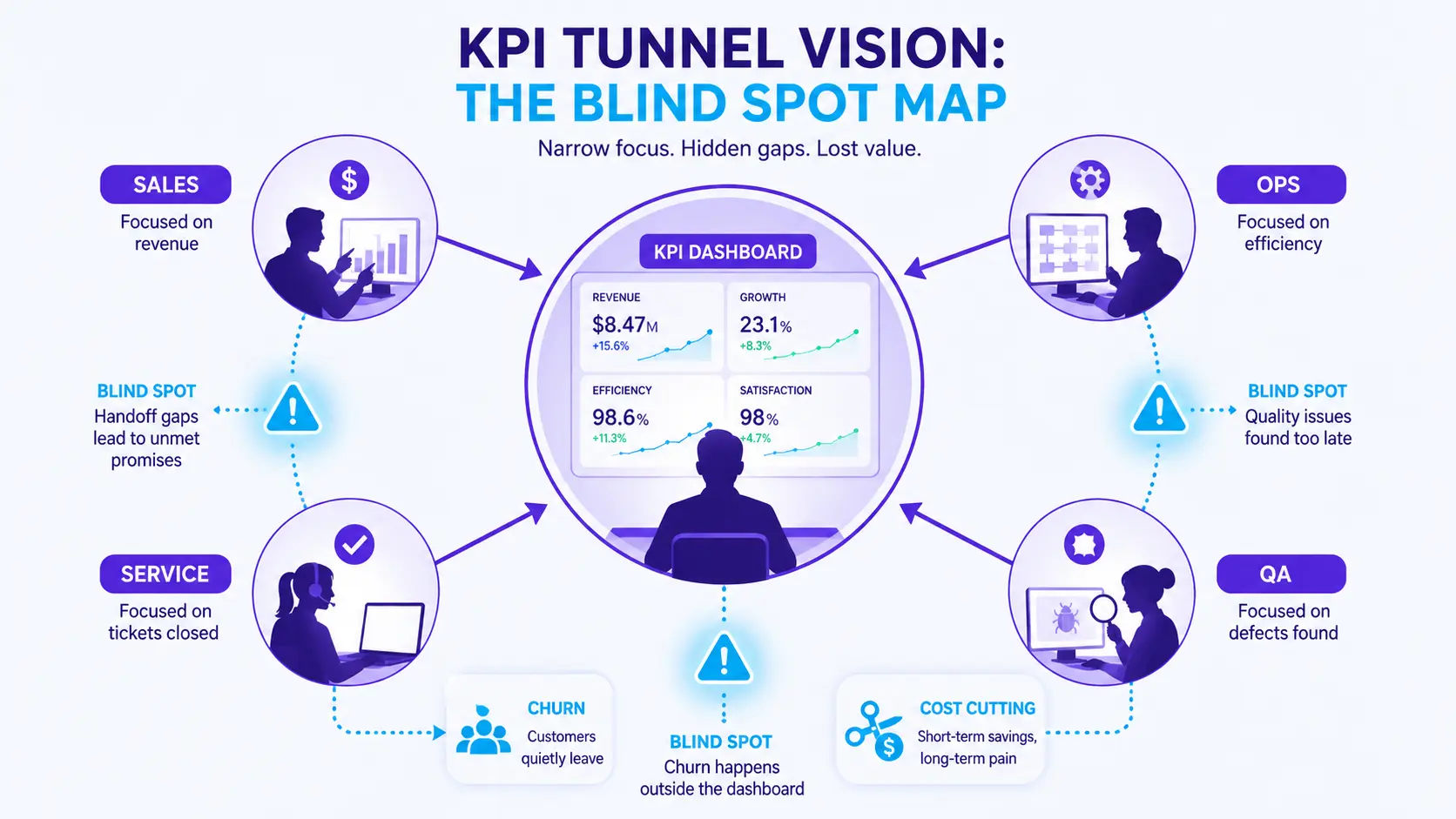
When hitting the number feels good but value erodes
There’s a dirty secret no one puts in board decks: you can hit every departmental metric and still fail the business.
We’ve seen revenue teams celebrate record conversion rates while customer lifetime value drops.
Ops can tout near-perfect on-time deliveries – by escalating costs or cutting quality beneath the surface.
Why does this happen?
The act of “making the number” releases psychological pressure and rewards short-term gain, even as long-term value quietly leaks away.
Teams learn to game rules, maximize visible metrics, and ignore invisible costs.
Metric fixation blindsides leadership not because teams don’t care, but because their effort is funneled through local proxies, not holistic goals.
Warning Signs KPI Success May Be Masking Business Problems
- Record departmental metrics coinciding with declining broader business value
- Teams gaming metrics by focusing on visible wins while neglecting hidden costs
- Short-term gain achieved at the expense of long-term growth or quality
- Increases in KPI numbers paired with declines in customer retention or lifetime value
- Unseen sacrifices made to hit numerical targets but deteriorate overall system health
Ask yourself: if a metric looks great, what has been sacrificed to get there?
What’s not on the dashboard?
Optimization isn’t inherently wrong – but in isolation, it’s like maximizing one instrument while the orchestra falls out of tune.
If your gut says growth feels forced when metrics are flawless, trust that signal.
In complex businesses, “good numbers” without good outcomes are a warning siren, not a victory lap.
KPI tunnel vision doesn’t just warp attention – it slowly disconnects measurement from reality.
When the system’s health depends on the sum of its proxies, it’s time to reexamine what success really means.

How KPI fixation creates behavioral blind spots across teams
Most organizations believe crystal-clear metrics breed accountability.
Here’s what gets missed: your teams may be chasing numbers so aggressively that they’re blind to everything those numbers erase.
The danger of vanity metrics and single-score dashboards
A sales dashboard lights up green – growth up, conversion rising.
But behind the glow, two behaviors usually kick in: teams game the easiest metric, and the rest gets ignored.
We’ve seen revenue surges that mask deep customer churn.
A client once celebrated a “record quarter”, driven almost entirely by discounting, giving the illusion of healthy growth while eroding margin.
This is the trap of metric fixation: oversimplified metrics like “followers gained” or a single composite “success score” compress reality so tightly that hidden risks multiply.
If you treat business health like a single battery percentage, what side effects – lost learning, degraded product quality – have you stopped seeing?
Vanity metrics seduce precisely because they’re simple.
Trouble is, simplicity blinds: a high NPS may mask glaring retention issues; a “total leads” number could rise as actual bookings flatline.
The myth is that more visibility means less risk.
In practice, dashboards become performance theaters – glossy enough for the boardroom, hollow where it counts.
Imagine a hospital tracking only “patients discharged”, never differentiating between full recoveries and quick exits.
That blindness breeds real danger.
Why averaged metrics mask volatility and cross-team friction
Averages smooth data like a fresh coat of paint over structural cracks.
Executive dashboards often beam out a single “average response time” or “mean project completion”.
But when teams are rewarded for keeping these smooth, the outliers – moments of heroics or disaster – vanish completely.
We worked with a service organization whose tickets always closed “on target”.
Invisible: the handful consistently botched handoffs between sales and support, poisoning key accounts.
The dashboard said “no problem”; the client pipeline quietly shrank.
Averaged metrics invite another illusion: that the system is humming, friction-free.
But real performance lives in the seams.
Operational blame games thrive when cross-team breakdowns get hidden in the mean.
Is marketing’s “lead quality” good, or does sales handle the fallout?
Did engineering deliver “on time”, or did QA eat the schedule hit?
When only the surface number survives, root causes slip through the cracks.
Tunnel vision on simple numbers breeds siloed effort.
It’s like navigating traffic by staring only at your odometer.
You’ll hit the speed limit, but miss every warning sign on the road.
Numbers can guide, but distorted measures create blind spots.
The risk is not just missing something – it’s building the wrong thing, faster.
If you sense the dashboard doesn’t tell the whole story, you’re right to pause.
Blind spots multiply in the gaps between tidy metrics and messy reality.
Most losses occur where KPIs stop measuring, as detailed in KPI Handoff Blindness.

What to diagnose before blaming measurement execution
Most measurement failures don’t start with bad execution – they stem from the wrong question.
What if every metric you’re chasing perfectly reflects activity, but not actual performance?
The hardest trap to spot: mistaking precision for truth.
That metric could be accurate, clean, and intensely monitored – yet still have nothing to do with whether the business gets better or worse.
Is the KPI a proxy or real indicator of system health?
Imagine monitoring fuel level on a plane, but never glancing at altitude or engine status.
That’s how teams slip into proxy thinking: obsessing over easily tracked signals, ignoring the real dynamics that matter.
In client reviews, we’ve seen dashboards show “100% tasks complete” while customer outcomes are going backwards.
The myth: every KPI stands in for progress.
Reality: some only measure motion, not movement.
Executives often default to “what’s measurable” instead of “what’s meaningful”.
We’ve encountered product teams that drive daily active users at any cost – without seeing churn or revenue decay until it’s too late.
Is your KPI quantifying an operational step, or is it a warning light for system risks?
If the number can go up while the business gets weaker, that’s not an indicator – it’s a decoy.
Think of KPIs as airport security lines: speed can improve dramatically while overall airport efficiency collapses elsewhere.
What are you missing when you focus there?
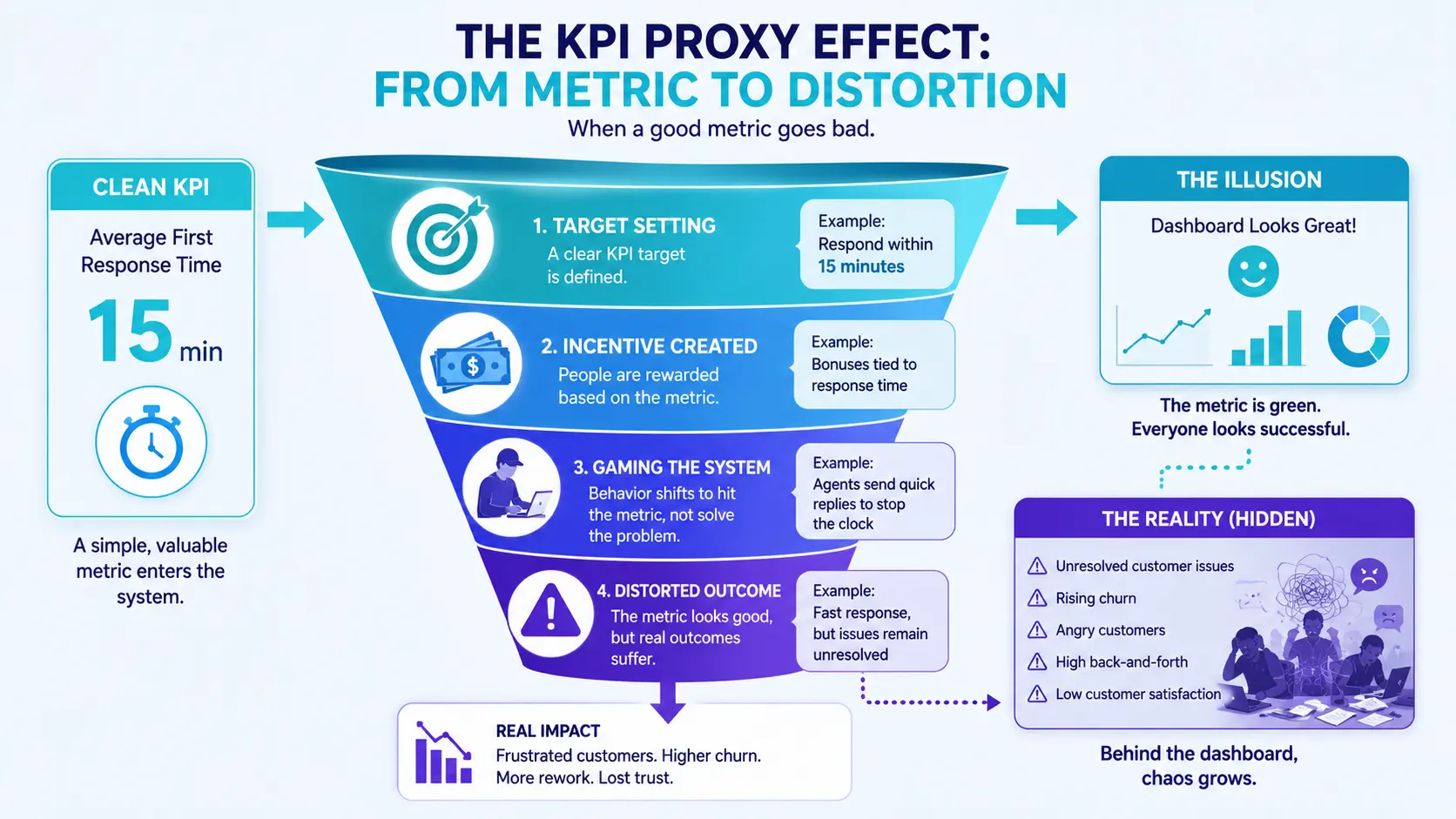
Are incentives reinforcing narrow optimization rather than full flow?
Optimization incentives almost always work – but not how you expect.
When rewards depend on a metric, everything warps around that target.
Teams find workarounds, press for the easiest wins, or redefine success by what’s easy to measure.
We’ve watched support teams shorten response times by escalating tickets, only to push complexity (and customer pain) downstream.
The myth: fine-tuned incentives guarantee alignment.
The effect: fragmented behaviors, each team “winning” individually while the system performance grinds.
Are your bonuses tied to local peaks – conversion, cost, response – while broader outcomes stall?
Single-metric targets act like funhouse mirrors: they distort reality to reward the quickest surface improvements.
If you sense flow stalling between functions, incentives are often the hidden cause.
The repeatable insight: the better the local metric, the greater the risk that someone, somewhere, is quietly gaming the whole.
Review what you’re really measuring versus what you most want to improve.
If numbers move but outcomes don’t, the problem isn’t the dashboard – it’s what you’re asking it to tell you.

Where KPI distortion signals broader decision risk
You can hit every metric, keep the dashboard green, and still steer the whole business into a ditch.
Unlike obvious execution errors, KPI tunnel vision quietly breeds its own kind of risk: the more you trust the dashboard, the more invisible your decision blind spots become.
Most leaders expect manipulation at the margins – but true risk emerges where reporting friction vanishes, not where teams struggle.
What signals are you missing when everything looks smooth?
When dashboards lie, what system handoffs should you examine next?
The most dangerous errors rarely show up as missing numbers – they surface as invisible handoff gaps between systems, teams, or stages.
We’ve seen cases where a flawless conversion number masks a churning customer base – because the sales-to-support handoff is leaking dissatisfied users right after the win.
It’s never the launch metric; it’s what happens after.
If your metrics stay high but complaints persist, look at the seams: where does ownership blur, accountability thin, or follow-up get delayed?
Imagine a relay race where each runner nails their split but keeps dropping the baton between exchanges.
The clock doesn’t show the fumble, but the race is lost all the same.
Which of your handoffs hides that dropped baton?
Common System Handoffs and Hidden Risks
| KPI Metric | Intended Outcome | Observed Behavior | Resulting Issue |
| Support response time | Improve customer service speed | Agents prioritize easy tickets, deflect complex issues | Increased client churn |
| Conversion rate | Increase customer acquisition | Focus on discounting deals heavily | Margin erosion |
| Tasks completed (%) | Track project delivery | Completion percentage up but quality slipping | Decline in customer outcomes |
A pattern: dashboard illusions grow in direct proportion to organizational silos.
The harder it is to trace flow end-to-end, the simpler the KPI becomes – and the more risk it buries.
Real outcomes live in the transfer, not the input or the output.
When good data fails trust, how do you realign measurement and insight?
If your team debates the truth of what the dashboard says, you don’t have a measurement problem – you have a judgment problem.
We’ve watched high-performing teams lose confidence not because numbers were wrong, but because numbers stopped reflecting what mattered.
Numbers became armor: a way to defend, not to understand.
The myth is that more data always means better decisions.
In reality, the more tightly you hold a proxy, the faster it can blind you to system health.
Steps to Realign Measurement and Insight
- Pair quantitative KPIs with qualitative feedback and cross-team narratives
- Regularly review which KPIs have predicted risks and triggered corrective actions
- Identify vanity metrics and replace/augment them with system-focused measures
- Encourage judgment-based discussions rather than blind reliance on dashboard numbers
- Promote transparency about KPI limitations and encourage exploration beyond surface metrics
What closes the gap?
Judgment-based alignment: pairing numbers with fast feedback, cross-team narrative, and context-rich story.
Ask: when did this KPI last predict a future risk?
When did it fail to trigger adaptation?
If you can’t name the last corrective action, the measure is dead data.
Decision-quality metrics are those the whole team trusts to ask better questions.
Vanity metrics trigger dashboard illusions; system metrics breed realignment – if you let the numbers inform, not dictate.
The bottom line: when KPI distortion creeps in, it’s not the metric’s fault – it’s how quickly leaders are willing to see past green scores and go hunting for reality inside the seams.
The next step isn’t to chase new numbers.
It’s to reconnect measurement and insight so decisions escape the dashboard’s trap.

Scientific context and sources
The sources below provide foundational context for how decision-making, attention, and performance dynamics evolve under scaling and constraint conditions.
- Attention and Organizations
Towards an Attention-Based View of the Firm – William Ocasio – Strategic Management Journal
Explores how firms channel and distribute the attention of decision-makers, and how that shapes which issues, answers, and priorities receive organizational focus – directly supporting the KPI tunnel vision dynamic.
https://doi.org/10.1002/(SICI)1097-0266(199707)18:1%2B%3C187::AID-SMJ936%3E3.0.CO;2-K - Metrics and Gaming Effects
What’s Measured Is What Matters: Targets and Gaming in the English Public Health Care System – Gwyn Bevan & Christopher Hood – Public Administration
Analyzes how target-based performance systems create measurement problems and gaming, giving direct support for Goodhart’s Law-style proxy optimization.
https://doi.org/10.1111/j.1467-9299.2006.00600.x - System Thinking
Thinking in Systems: A Primer – Donella H. Meadows – Chelsea Green Publishing
A foundational book on system-level outcomes, feedback loops, and why local optimization often undermines broader system health.
https://www.chelseagreen.com/product/thinking-in-systems/ - Decision Risks and Organizational Performance
Challenger: Fine-Tuning the Odds Until Something Breaks – William H. Starbuck & Frances J. Milliken – Journal of Management Studies
Examines how repeated success, imperfect learning, and conflicting organizational goals distort risk perception and decision-making, directly relating to KPI distortion and organizational blind spots.
https://doi.org/10.1111/j.1467-6486.1988.tb00040.x - The Psychology of Incentives
Pay Enough or Don’t Pay at All – Uri Gneezy & Aldo Rustichini – Quarterly Journal of Economics
Reveals behavioral science findings about how incentives can distort motivation and lead to suboptimal or paradoxical outcomes.
https://doi.org/10.1162/003355300554917
Questions You Might Ponder
What is KPI tunnel vision and how can it harm business results?
KPI tunnel vision is when organizations over-focus on hitting specific metrics while ignoring broader business health. This can lead to optimized numbers but weakened outcomes, as teams solve for the metric itself – not what truly drives value or growth.
How does Goodhart’s Law relate to business KPIs?
Goodhart’s Law states that once a measure becomes a target, it ceases to be a good measure. In business, KPIs can become distorted proxies, driving teams to “win the number” while undermining real progress or customer satisfaction.
What are the warning signs that KPIs are misaligned with business value?
Warning signs include record KPI performance alongside declining customer retention, quality, or profit. If teams game metrics, celebrate local wins, or hide trade-offs, it’s likely metrics are masking system health problems.
Why do single-score dashboards create blind spots in organizations?
Single-score dashboards oversimplify business performance and hide volatility or root issues. They make it easy to miss cross-team problems or hidden costs, leading leaders to trust “green” metrics while deeper problems persist.
How can businesses prevent KPI fixation from eroding long-term value?
Organizations should balance quantitative KPIs with qualitative feedback, review cross-team outcomes, and ensure incentives support system goals. Regularly revisiting dashboards for hidden blind spots and aligning measures to real performance can prevent metric fixation.