
What You’ll Learn
Handoff blindness in measurement systems is the failure to measure what happens when work, data, accountability, or customer context passes from one team to another.
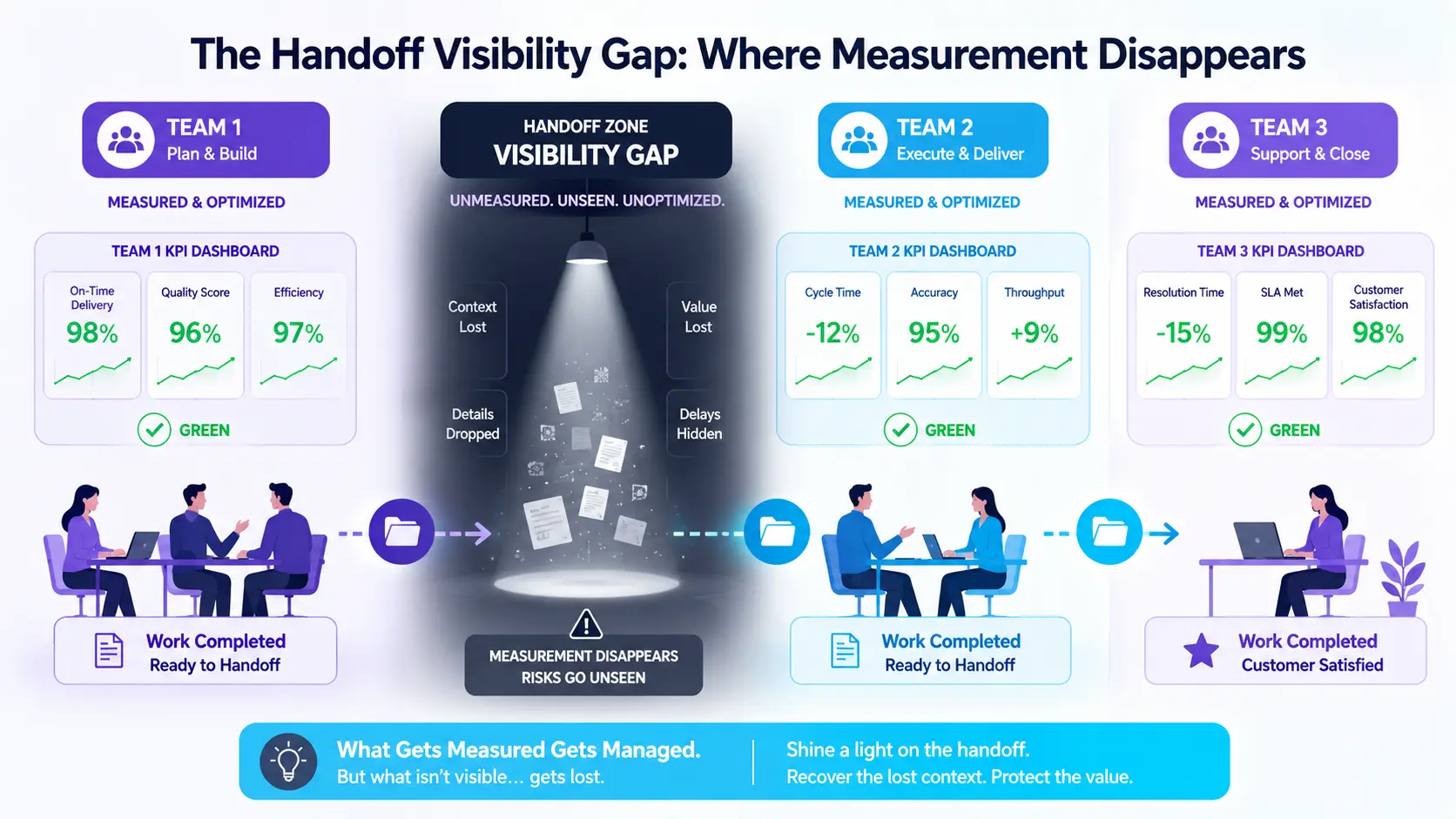
It occurs when each team’s dashboard looks healthy, but losses appear at transition points such as marketing to sales, sales to operations, product to support, or digital to physical fulfillment.
Handoff blindness is caused by unclear ownership, undefined boundaries, inconsistent metric definitions, and context loss between teams.
It makes local KPIs look successful while system outcomes such as revenue, retention, customer experience, or delivery quality decline.
Strong measurement tracks continuity, ownership, and value flow across handoffs, not just performance inside teams.
Key Takeaways
- Measurement systems routinely fail at team handoffs due to ambiguous ownership and shifting definitions, hiding major system losses.
- “Green” dashboards inside teams often mask invisible drop-offs in value at transition points, creating gaps in overall performance.
- Leadership confidence in analytics erodes when attribution breaks down at handoffs, as this prevents accurate decision-making and accountability.
- The highest analytics ROI comes from directly measuring and clarifying ownership at team boundaries, exposing previously invisible value leakage.
A “green” metric inside one team can signal calm – even as chaos brews just outside its walls.
Most organizations assume that if each team reports strong performance, the whole system must be humming.
In practice, this assumption leads directly to handoff blindness in measurement systems: teams optimize for their own KPIs, celebrate local wins, and move work downstream without seeing what’s lost in the shuffle.

Why metrics look solid inside teams but fail at handoffs
One client shipped leads from marketing to sales with near-perfect conversion metrics on their dashboard – yet revenue lagged.
The silent handoff between teams became an invisible leak, where context got stripped and what looked like handoff success for marketing quietly created failure for sales.
The lesson: team-perfect doesn’t equal system-perfect.
It’s like passing a relay baton – the handover point, not the runner’s speed, determines if you finish at all.
How team‑specific success hides between‑team losses
The most common myth?
That excelling at local KPIs ensures company progress.
We’ve seen “handoff visibility gap” rear its head in organizations running weekly OKR standups: every department hits targets, but the handoffs between them bleed value no one is measuring.
The point of greatest measurement loss is usually where everyone claims success and no one owns what happens next.
That broader pattern of hidden measurement loss is mapped in Analytics & Attribution.
Why dashboards stay green even when system outcomes drop
Dashboards love averages and totals – they comfort leaders with clean, positive visuals.
This is how handoff leakage points vanish: when dashboards only pull data from individual teams, cross‑team measurement leakage gets buried below the surface.
System outcome drop‑off hides behind a sea of “all green” tiles, creating false confidence.
In practice, we’ve watched teams win awards for operational excellence while customer renewal rates flatline – because the dashboard showed each group’s slice, not the post-handoff reality.
What’s the actual value of a metric if it resets at artificial team borders?
If you only average local numbers, what gets masked is cumulative loss.
Ask yourself: when your dashboards look healthy, do you check transition points – or do you trust the color coding?
If those numbers fail to track work as it passes between teams, measurement handoff failures can persist undetected for quarters.
Most dashboards measure activity, not continuity – much less value flow.
The harsh truth: the handoffs are where most system value drops off, yet they’re rarely measured directly.
Teams rarely suspect the real culprit isn’t their own work – it’s what happens after their portion is “done”.
That’s where measurement vanishes, and system performance pays the price.

What causes measurement breakdowns when work passes between teams
Most measurement failures aren’t technical – they’re human.
The handoff between teams is where discipline slips, accountability fades, and metrics start to blind rather than reveal.
When work crosses a boundary, the tracking often does not follow.
Imagine an Olympic relay with no clear mark for the baton pass: the fastest sprinters are useless if nobody knows who’s holding the baton – or whether it’s been dropped.
Common Causes of Measurement Breakdowns at Team Handoffs
| Cause | Description | Example |
| Ambiguous Ownership | No clear owner for handoff metrics leads to data loss or lack of accountability. | Both marketing and sales assume the other monitors lead quality, so no one does. |
| Undefined Handoff Boundaries | Teams have unclear or overlapping responsibilities at handoff points. | Measurement continuity collapses because responsibility is shared but undefined. |
| Context Loss | Data crosses teams but meaning or definitions change, corrupting insight. | Three teams using incompatible definitions of ‘opportunity stage’. |
| Inconsistent Definitions | Different teams define key metrics or terms differently, causing disconnects. | Variations in terms like ‘qualified lead’ or ‘conversion’ across departments. |
Ambiguous ownership and undefined handoff boundaries
The real leak often happens where everyone hopes someone else is watching.
Teams excel on their own targets, but handoff points rarely have owners.
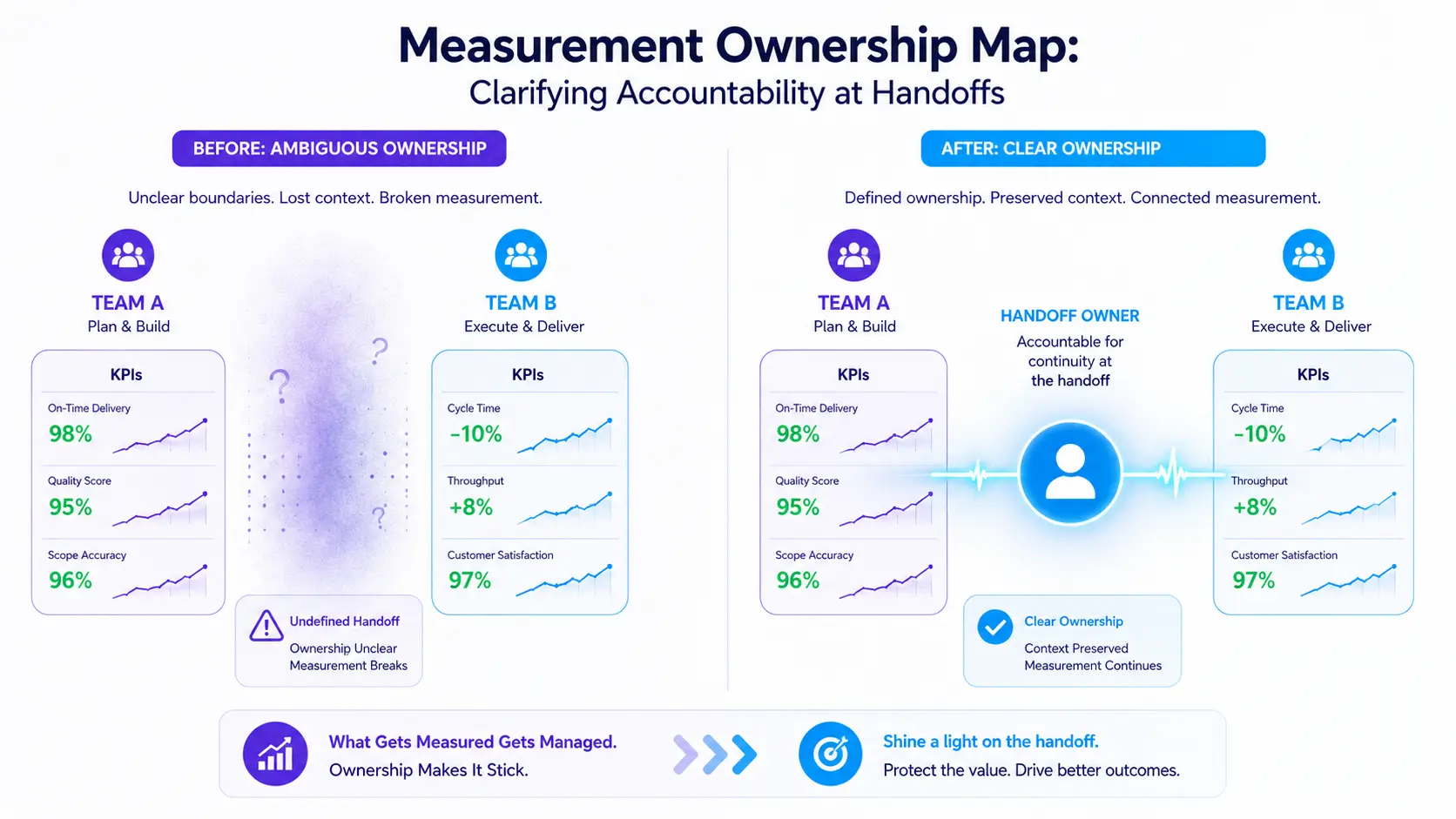
In client projects, ambiguous boundaries are the silent killers – we’ve witnessed situations where both marketing and sales teams assume the other is monitoring lead quality at the transition, and in truth, no one is.
This creates silent handoffs in metrics: the data disappears right where it matters most due to persistent ownership ambiguity.
The myth is that collaboration naturally fills the gaps.
In reality, shared responsibility often translates into no responsibility.
One leader recently confessed, “No one ever brings up measurement holes at our pipeline handover – it’s treated as a black box”.
If ownership isn’t named, measurement continuity collapses and cross‑team measurement leakage becomes inevitable.
Context loss and inconsistent definitions across teams
Even when data crosses the handoff intact, its meaning rarely does.
Each team’s definition of “qualified”, “conversion”, or even “customer” mutates subtly as the work shifts hands.
This context loss is like a translation gone wrong: the number might carry over, but the intent does not.
One executive was stunned to discover her teams used three incompatible definitions of “opportunity stage” – making system outcome drop‑off invisible in dashboards.
The result is handoff loss in analytics, not because data is missing, but because signal becomes noise.
How can organizations make confident decisions when what’s measured in team A no longer matches what’s prioritized in team B?
If you want to find where your system breaks down, don’t just follow the data – follow the definitions.
The most dangerous measurement handoff failures are usually invisible, disguised as smooth transitions but powered by assumption and disconnect.
It’s these invisible seams that quietly erode trust and decision-making across the business.

How invisible failures at handoffs undermine decision confidence
Most leadership teams want one thing from their analytics: clarity.
But the bigger the organization, the harder it gets to see anything but noise at handoff points.
The hardest truth?
Decisive moves stall not when data is missing, but when it’s quietly corrupted by handoff blindness in measurement systems.
You can invest in the flashiest dashboards and still feel paralyzed by gaps you cannot prove – or even see.
Why leaders distrust data when attribution always disappoints
Leaders get frustrated when attribution never seems to deliver clarity at the handoff stage.
Despite increasingly complex tools, accountability still gets lost between teams, and ownership ambiguity keeps measurement blind spots wide open.
Instead, attribution keeps breaking at handoff leakage points: when Marketing hands to Sales, Product to Support, or Digital to Physical, outcome trails evaporate.
With clients, we’ve watched blame pinball between teams while hidden measurement breakdowns go undiagnosed.
In one SaaS org, Sales rejected leads for quality, while Marketing showed top-funnel conversions – but no one could map drop-off with confidence.
Over time, leadership began to discount all data, treating numbers as politics rather than truth.
Here’s the analogy: trusting analytics built on leaky handoff logic is like judging a relay race by only the time each runner clocks on their own watch – never noticing dropped batons.
The handoff visibility gap does more than frustrate attribution; it erodes overall belief in analytics as a basis for action.
How local optimization accidentally undercuts system goals
When teams chase local KPIs, hidden damage tends to pile up between them.
Imagine each department as expert rowers in their own lanes – rowing hard, tracking their speed, while the boat slowly spins off course.
One financial services client spent a year refining onboarding friction scores for new customers, only to discover later that their speed boosts created bottlenecks for Compliance further downstream – nobody measured the system outcome drop-off until customer churn soared.
Local wins can blind teams to where the real loss is: in-between.
The silent handoff in metrics – where one team’s success story hides the next team’s struggle – lets systemic value leakage go unchecked.
How many green dashboards mask the very drop-offs that kill growth?
The cost isn’t just missed opportunity, but spiraling skepticism from leadership.
When decision-makers sense that every team is winning but company results stall, they stop believing any narrative.
The core idea: trust collapses when measurement doesn’t cross team boundaries with the work.
The best-run organizations know confidence comes from seeing not just the finish lines, but what happens in between.
Forward momentum comes when you see the cracks before they become chasms.

What to evaluate next when handoff blindness is suspected
Silence at the boundaries is never accidental.
The deadliest losses in analytics don’t happen where everyone’s watching – they happen where the spotlight never lands.
If your metrics tell a smooth story team by team, but cracks appear in revenue, customer experience, or product delivery, you are likely staring at a classic case of handoff blindness in measurement systems.
Which handoff points to probe for invisible drop‑off
Invisible failures cluster at the boundaries where teams celebrate hand-offs – but measurement often halts there first.
The myth that “problems show up in the numbers” breaks down precisely when responsibility – and measurement – passes from one group to the next.
In practice, we’ve found that most organizations suffer measurement loss at three predictable seams: where sales passes leads to ops, when product hands features to support, and anywhere work transitions from development to QA or deployment.
Most teams trust upstream data and report downstream performance, but rarely scrutinize the no-man’s land in between.
If an initiative looks healthy in both marketing and sales dashboards but leaks revenue, the real break likely lurks in the handoff definition, not the teams’ execution.
Think of it like passing a baton in a relay: if you only review the runners, you’ll miss that the baton hit the track two steps back.
Which handoffs does nobody own start-to-finish?
Which transitions go unmeasured or lack a single accountable outcome?
Where no team can describe exactly how an outcome moves from “done” in one group to “started” in the next, that’s where measurement disappears.
Key signals that indicate handoff‑level measurement failure
How do you know if cross‑team measurement leakage is driving system outcome drop‑off?
Start by hunting for “silent handoffs in metrics” – those points where inputs and outputs appear, but the transformation phase is opaque.
Key Signals Indicating Handoff-Level Measurement Failures
- Recurring gaps between forecast and actual results that can’t be traced to any specific phase.
- Endless debates about win/loss attribution without clear resolution.
- Sudden drops in customer experience metrics that do not align with any one team’s responsibilities.
- Green dashboards despite rising downstream complaints, delays, or customer churn.
- Root cause questions bouncing repeatedly between teams with no final answers.
- Stable KPI graphs contrasted by deteriorating qualitative feedback or business results.
- Situations where every team claims success but overall system results fail.
Red flags include: recurring gaps between forecast and actuals that can’t be traced to a specific phase; endless debates about attribution for wins and losses; sudden customer experience cliffs that don’t line up with any one team’s responsibilities.
If dashboards stay green even as downstream complaints, delays, or customer churn spike, the handoff is likely invisible to your analytics lens.
Ask: where do questions about root cause routinely bounce between teams without resolution?
When KPI graphs remain stable, but qualitative feedback or business results deteriorate, look to handoff leakage points – these are the real weak links.
Symptoms usually surface as “everyone is right, but the system fails”.
In short: every oversight at a handoff is a multiplier for measurement handoff failures elsewhere.
If handoff visibility gap sounds familiar, it’s time to examine the seams, not the surface.
The highest returns in analytics come from shining a light exactly where nobody thinks to look.
Handoffs create metric conflicts, not just gaps.

Scientific context and sources
The sources below provide foundational context for how decision-making, attention, and performance dynamics evolve under scaling and constraint conditions.
- Measurement and Coordination in Organizations
Determinants of Coordination Modes within Organizations – Andrew H. Van de Ven, Andre L. Delbecq & Richard Koenig Jr. – American Sociological Review
Analyzes how coordination mechanisms vary with task uncertainty, interdependence, and unit size. Useful for explaining how information flow and accountability can break down across work-unit boundaries.
https://doi.org/10.2307/2094477 - Attribution and Performance Gaps
Organizational Structure and the Limits of Knowledge Sharing: Incentive Conflict and Agency in Car Leasing – Lamar Pierce – Management Science
Shows how organizational structure and incentive conflict can limit knowledge sharing and reduce performance, especially when information must move across roles or units.
https://doi.org/10.1287/mnsc.1110.1472 - Silo Effects and Context Loss
The Silo Effect: The Peril of Expertise and the Promise of Breaking Down Barriers – Gillian Tett – Simon & Schuster
Explores how organizational silos cause teams and institutions to miss risks, lose context, and fail to communicate across boundaries.
https://www.simonandschuster.com/books/The-Silo-Effect/Gillian-Tett/9781451644746 - Accountability, Ownership, and Decision Confidence
Accounting for the Effects of Accountability – Jennifer S. Lerner & Philip E. Tetlock – Psychological Bulletin
Reviews how accountability changes judgment and choice. It explains when accountability improves decisions, when it has no effect, and when it can make bias worse.
https://doi.org/10.1037/0033-2909.125.2.255 - Systemic Risk Created by Local Optimization
Systemic Risk: The Dynamics of Modern Financial Systems – Prasanna Gai – Oxford University Press
Explains systemic risk through network effects, funding liquidity risk, contagion, and financial-system interdependence. It supports the broader idea that local actions can create hidden system-wide losses.
https://doi.org/10.1093/acprof:oso/9780199544493.001.0001
Questions You Might Ponder
What causes handoff blindness in measurement systems between teams?
Handoff blindness in measurement systems is caused by ambiguous ownership, inconsistent definitions, and dashboards focused only on local KPIs. This prevents seamless tracking of outcomes as work moves between teams, leading to invisible performance losses at transition points and undermining decision-making.
How do local KPIs contribute to hidden system-level failures?
When teams focus narrowly on their KPIs, they can unintentionally create bottlenecks or lose context during handoffs to other teams. This local optimization masks broader system inefficiencies, enabling “green” dashboards while overall performance or customer experience declines.
What are the most common symptoms of cross‑team measurement gaps?
Typical signs include repeated gaps between forecasts and results, recurring root cause debates, stable team dashboards despite downstream complaints, and a lack of clear attribution for wins or losses. These symptoms indicate measurement failure at team boundaries, not within individual teams.
Why do organizations struggle to sustain measurement across handoffs?
Measurement often breaks down at handoffs due to lack of clearly assigned responsibility and inconsistent logic for metrics across teams. Without agreed transition criteria and ongoing tracking, key data and context get lost as work shifts between organizational silos.
How can companies close the handoff visibility gap in their analytics?
To close the handoff visibility gap, organizations must assign explicit ownership at every transition, standardize definitions for key metrics, and track system performance across – not just within – team boundaries. This approach surfaces hidden losses and restores trust in analytics-driven decision-making.