
What You’ll Learn
Metric conflict is the breakdown that happens when two or more teams optimize different KPIs that appear valid locally but push the wider system in opposing directions.
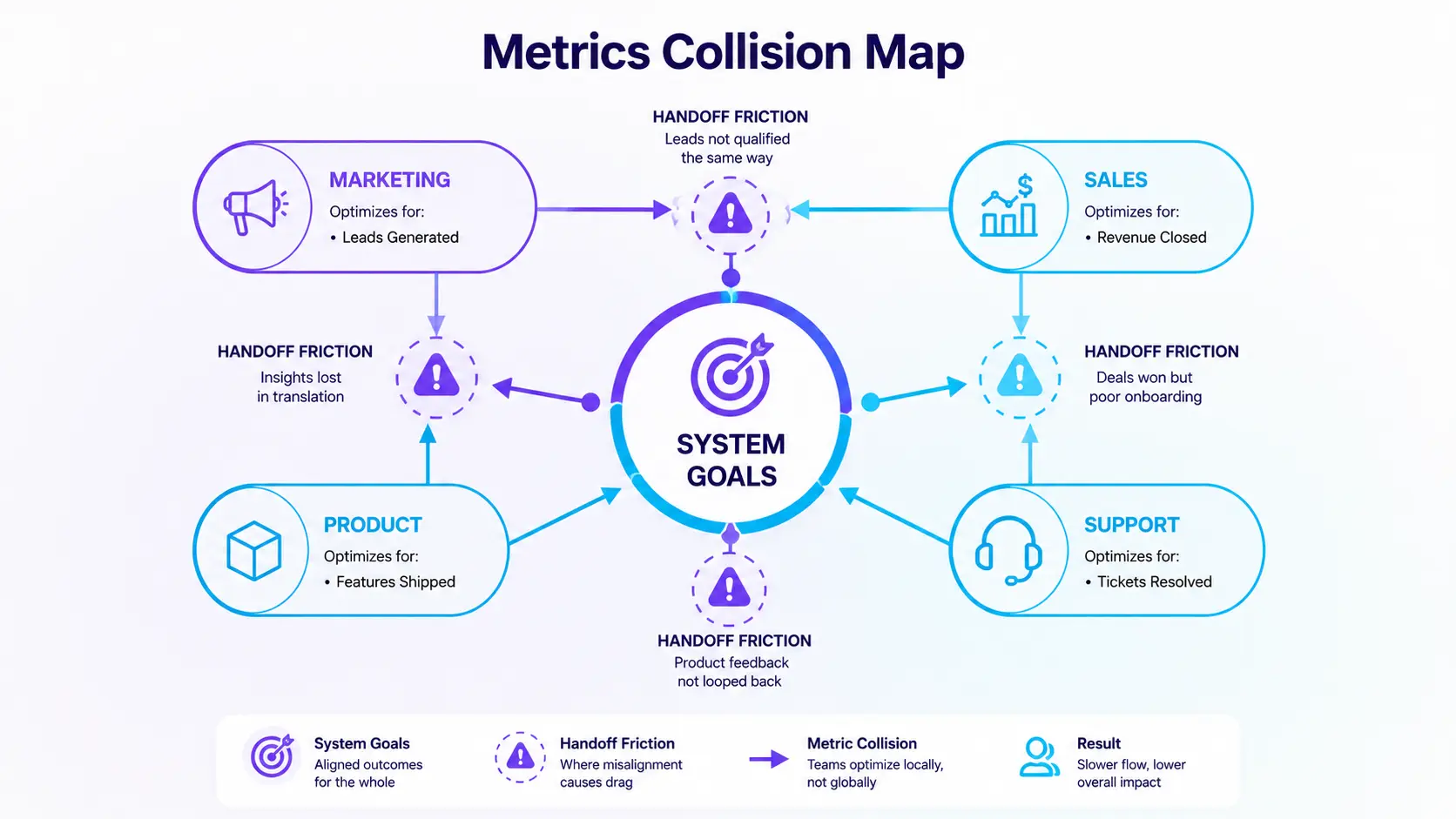
It often occurs at handoff points, such as marketing to sales, product to support, or digital to sales, where one team’s success creates downstream friction for another.
Metric conflict can make dashboards look healthy while revenue, retention, profit, customer experience, or system performance stalls.
It is usually caused by misaligned incentives, unclear ownership, drifting definitions, disconnected tools, and lack of decision authority.
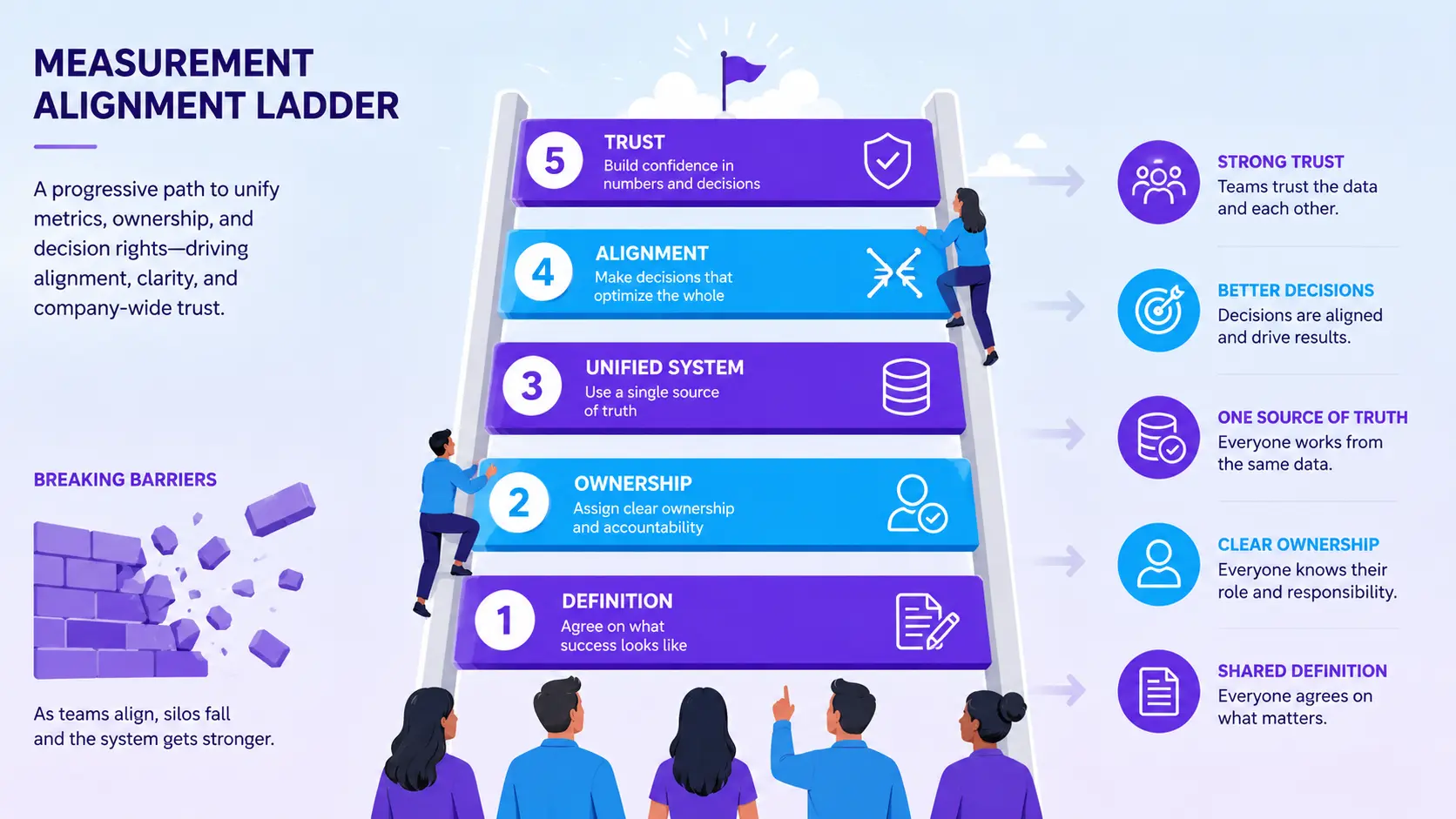
Resolving metric conflict requires unified definitions, named metric owners, and system-level outcomes that override isolated scorecards.
Key Takeaways
- Metric conflict arises when teams optimize local KPIs that are misaligned with overall system performance.
- Most breakdowns and value loss occur at team handoff points, where accountability becomes fragmented.
- Dashboard “green lights” can mask underlying business stagnation, making metric alignment critical.
- Restoring trust requires clear metric ownership, unified definitions, and decision authority at conflict points.
You can rack up record conversion rates in a single team while system-wide results stall – or even decline.
Most organizations think local wins automatically add up.
The surprise?
Optimizing for the wrong local metric often sabotages the bigger picture.
What looks like progress can mask blind spots that make the system less effective with every “win”.

Why local metrics can undermine overall system performance
Failures rarely happen inside well-run silos.
Most breakdowns strike at the borders – where teams pass responsibility but not accountability.
We’ve seen product teams gunning for feature velocity hand off buggy releases to support, creating a downstream mess that bloats ticket queues.
Each team hits their number, but the value chain bends or breaks at the joints.
Key Ways Local Metrics Undermine System Performance
- Teams optimize local KPIs that do not align with overall system goals
- Metric collisions arise at handoff points where accountability is low
- Healthy local metrics can mask wider system breakdowns
- Positive dashboard signals may hide declining real business outcomes
- Misaligned incentives increase friction and reduce overall effectiveness
How conflicting objectives at handoff points create metric collisions
The myth: aligning everyone to “clear KPIs” means harmony.
In practice, performance at the team level becomes a tug-of-war.
One B2B client’s marketing group chased lead volume while sales cared only for qualified pipeline.
At the handoff, marketing’s numbers spiked, but sales velocity tanked, with conversion dropping by a third.
As soon as local incentives diverge, handoffs become friction points – small misalignments compounding into major system loss.
Examples of Metric Collisions at Team Handoffs
| Cause | Description | Effect on Teams | Resulting Impact |
| No Single Owner | Metric definitions lack a steady custodian | Teams redefine metrics independently | Disagreements, stalled initiatives |
| Subtle Rewrites Over Time | Teams tweak definitions to fit workflow pressure | Definitions diverge unintentionally | Confusion, lost alignment |
| Different Interpretations | Same metric means different things (e.g., ‘qualified lead’) | Healthy debates escalate into conflicts | Breakdown in cross-team cooperation |
Think of a relay race where each runner optimizes only their segment, disregarding baton-passing technique.
The baton still drops, even if every split time is impressive on paper.
Where do most metric collisions actually hurt?
Almost always at team handovers, when nobody owns the cost of context lost.
Why dashboards may show healthy signals when real outcomes stall
The most dangerous signal isn’t a red number – it’s a green one masking deeper damage.
Teams celebrate when their dashboard KPIs tell a good story.
But as practitioners, we’ve watched companies trust “improving” metrics while their NPS, retention, or revenue flatlines.
Siloed dashboards can create the illusion of progress, encouraging teams to double down on what’s easy to measure rather than what actually moves the system.
That broader visibility issue is core to Analytics & Attribution.
One growth client poured resources into click-through rates and campaign ROAS, only to see customer lifetime value quietly erode.
Every dashboard glowed green, but month-over-month profit stagnated.
The analogy: monitoring ten dials on a cockpit and missing the low fuel light.
If your system reports all silos as “healthy”, ask: where is the cumulative friction hiding?
What’s missing between local metrics and business reality?
Until you answer that, positive dashboards can become a trap.
Silo wins can drain the wider system when incentive structures clash and transitions break down.
To see – and fix – the real bottlenecks, track where objectives cross at handoffs and whether your green lights map to actual outcomes.

What causes trust in measurement to collapse between teams
Metric conflict doesn’t start with bad intentions – it ignites when two teams each swear by their scorecards, yet no one can guarantee they’re measuring the same game.
Most executives assume that well-defined dashboards keep everyone on the same page.
In reality, that belief often evaporates the moment numbers cross a team boundary, exposing just how fragile measurement trust can be.
Undefined ownership and drifting definitions
Here’s a quiet risk: metrics become orphans.
No single owner keeps the definition steady, so subtle rewrites accumulate.
Over months, the same “qualified lead” means one thing to sales, another to marketing, and something else entirely to product.
We’ve watched healthy debates between teams unravel into arguments over which definition is “correct” – and stall cross-team initiatives for weeks.
The worst friction isn’t visible in the data; it’s buried in conversations no dashboard tracks.
Causes and Effects of Metric Ownership and Definition Drift
| Team A Metric Focus | Team B Metric Focus | Conflict Description | System-Wide Impact |
| Product – Feature Velocity | Support – Ticket Queue Management | Product hands off buggy releases to Support | Increased ticket queues and downstream mess |
| Marketing – Lead Volume | Sales – Qualified Pipeline | Marketing drives lead volume but Sales sees lower quality leads | Conversion rate drops by one third |
| Digital – Time on Site | Sales – Conversion Speed | Digital optimizes time on site; Sales wants faster conversion | Deadlock in prioritization, stalled action |
A simple analogy: Imagine both pilots in a cockpit reading instruments that look identical – but one reads speed as knots, the other in miles per hour.
Alignment becomes impossible.
Without defined, enforced metric ownership, drift is inevitable and so are disputes that drag down momentum.
Why does this myth persist – that having a metric on a dashboard means everyone is measuring the same thing?
Because each team quietly tweaks the rules based on their workflow pressure, then assumes their peers did the same.
Where ownership is fuzzy, disagreement is a certainty, not a surprise.
Disconnected metric structures across tools and functions
The average organization believes plugging metrics into multiple dashboards increases visibility.
In practice, it multiplies blind spots.
When sales pulls lead numbers from CRM, marketing from automation, and finance from spreadsheets, the same metric can disagree by double digits – and nobody can explain why.
Fragmented measurement tools become a hall of mirrors.
Context gets lost, and each tool’s calculation logic mutates on its own timeline.
This isn’t just an integration headache; it erodes confidence in every metric, setting off endless reconciliation cycles.
Consider this: How many meetings orbit around the question, “Which version of this number do we trust?” What if every team has defensible data, but no shared context?
That’s the measurement trust breakdown – when every tool is “right” for its silo, but together they generate more decision friction than answers.
The emotional result for leaders is a blend of skepticism and frustration every time metrics surface in cross-team discussions.
If trust in measurement collapses, every decision slows to a crawl.
Consistent metric definitions and unified systems don’t just surface cleaner numbers – they let teams move faster and argue less.
That’s the promise: clarity, instead of confusion, becomes the operating standard.

How conflicting metrics paralyze cross‑functional decision making
Most teams believe clarity is just one more report away.
In reality, every new dashboard can multiply disagreement.
The kicker: Each metric makes perfect sense – until you try to act on it as a group.
Symptoms and Consequences of Conflicting Metrics on Decision Making
- Meetings where all teams present strong but conflicting metrics
- Decisions stall due to unwillingness to prioritize one metric over another
- Metrics become ‘armor’ protecting team turf instead of fostering alignment
- Delegation without resolution authority leads to circular debates
- Long delays and lost initiatives caused by unclear decision ownership
When every metric is defensible but nothing is actionable
Picture a meeting where sales, marketing, and product leads each present graphs trending up.
No one’s lying.
Yet the project sits stalled, and no one can say why.
The secret: When every function has its own scoreboard, cross-team alignment becomes a negotiation exercise rather than a growth strategy.
One client’s marketing team would proudly tout cost-per-click reductions, while sales saw lead quality quietly erode.
Everyone had data to prove their case.
But instead of resolving the mismatch, meetings became endless debates about whose numbers should set the priority.
“We’re all doing our job” became code for “no one is accountable for the big picture”.
The myth: More measurement equals more progress.
In practice, it means more time debating whose definition deserves airtime.
Metrics turn into armor, not alignment.
If you notice decisions getting delayed for another round of ‘clarification,’ you’re in the danger zone.
When metrics become weapons in a turf war, initiative slows to a crawl.
The system grinds – not from lack of insight, but from an overload of defensible, isolated truths.
Why delegation fails when no one owns resolution authority
Here’s the twist – they’d escalate the deadlock up the chain, convinced a senior leader would break the tie.
But in rooms where no one owns trade-off decisions, debate recirculates like stale air.
Ownership ambiguity turns conflict into a circular relay: everyone can say “not my call”, but no one can say “we’re going this way”.
In one B2B firm, the digital team optimized for time on site, while sales needed conversion speed.
Disagreement brewed, so the CEO delegated “alignment” to a task force – who returned three months later with a report and zero movement.
The gap wasn’t lack of effort; it was a vacuum of authority to enforce a single direction.
Like a ship with several captains, each tugging at a different rudder, nothing gained true forward motion.
Left unchecked, this produces a special flavor of friction: decision loops disguised as risk management.
Every disagreement is punted, and months of opportunity evaporate in polite standstill.
So ask yourself – when did your last big decision actually land, and who had the final word?
When metric conflict turns teams inward, action dies by a thousand tiny negotiations.
For leaders, clarity means clearing a path through defensible numbers – so the organization moves forward, not sideways.

What questions leaders should ask when metrics diverge
Leaders don’t lose control of metrics because teams stop measuring – they lose it because the questions quietly change while the numbers stay the same.
Most executives don’t notice the danger early: the same chart can support two fundamentally different decisions depending on which meaning you assign to each metric.
The risk isn’t in disagreement but in silent assumption – numbers that don’t just diverge, but actively drive teams in opposite directions.
Which metric meaning drives the decision – and is it the right one?
Here’s the hidden trap: teams report “pipeline velocity” or “customer retention”, but no one asks – the exact same term, or two near-identical ones, can mask wildly different calculations.
In our work, we’ve encountered CMOs and COOs each reporting conversion rates, only to discover one includes low-quality prospects and the other doesn’t.
The moment a boardroom decision leans on those differing conversion rates, strategy fragments.
It’s not the dashboard you trust – it’s the underlying logic.
So, ask: does the metric reflect what you need to manage or just what’s easiest to count?
Picture two executives reading the same weather report; one plans for rain, the other prepares for drought.
Which interpretation are people rallying around – and have you audited what version is actually driving the next decision?
If you can’t answer, you’re already flying blind.
Where does optimization collide – at process handoffs or endpoints?
Metric conflict leaves its fingerprints at the handoffs – but leaders rarely look there first.
We’ve watched marketing teams chase lead volume while sales battles for lead quality, both sides claiming victory as missed quotas quietly pile up downstream.
More often than not, the real damage accumulates in the grey zone between teams, where objectives collide and no one claims full ownership.
The point of maximum friction isn’t where metrics peak; it’s where responsibilities overlap and priorities clash.
So the question isn’t just “Are we hitting the number?” – it’s “Where along the value chain do our optimizations grind against each other?” In our experience, cross-functional issues rarely emerge at endpoints; they hide at the seams, sheltered by plausible metrics until results stall.
Clear answers to these two questions give decision-makers x-ray vision: revealing not just metric conflict, but its systemic roots.
If left unchecked, those gaps grow from confusion to real financial risk.

Scientific context and sources
The sources below provide foundational context for how decision-making, attention, and performance dynamics evolve under scaling and constraint conditions.
- Organizational Performance and Measurement Alignment
The Balanced Scorecard: Translating Strategy into Action – Robert S. Kaplan & David P. Norton – Harvard Business Review Press
This book introduces the Balanced Scorecard and shows how to translate strategy into a coherent set of financial, customer, internal-process, and learning metrics. It is a strong source for metric alignment across units.
https://store.hbr.org/product/the-balanced-scorecard-translating-strategy-into-action/6513
Coordination Across Organizational Units
Determinants of Coordination Modes within Organizations – Andrew H. Van de Ven, Andre L. Delbecq & Richard Koenig Jr. – American Sociological Review
Analyzes how task uncertainty, interdependence, and unit size shape coordination mechanisms inside organizations. It fits the issue of coordination failure across team and unit boundaries.
https://doi.org/10.2307/2094477 - Trust and Measurement in Cross-Functional Teams
The Audit Society: Rituals of Verification – Michael Power – Oxford University Press
Explains how audit, accountability, performance measurement, and verification systems can expand beyond their operational value and reshape trust, control, and organizational behavior.
https://doi.org/10.1093/acprof:oso/9780198296034.001.0001 - Incentive Structures and Systemic Friction
The Firm as an Incentive System – Bengt Holmstrom & Paul Milgrom – American Economic Review
A foundational paper on how incentive systems work as bundles of complementary mechanisms. It supports the point that local incentive design can create wider system effects.
https://www.jstor.org/stable/2118041 - Organizational Learning and Measurement Fragmentation
Information in Organizations as Signal and Symbol – Martha S. Feldman & James G. March – Administrative Science Quarterly
Analyzes how organizations collect and use information not only for decisions, but also as signals and symbols. It supports the argument that measurement can shape attention, learning, and organizational behavior in ways that are not purely rational.
https://doi.org/10.2307/2392467
Questions You Might Ponder
What is metric conflict and how does it affect business performance?
Metric conflict occurs when teams optimize their own metrics at the expense of overall company goals. This can lead to internal friction, stalled decision-making, and system-wide inefficiency, even as local team dashboards show positive trends. That is the core diagnostic behind Why Improving One Metric Doesn’t Improve the Whole, which shows how a locally improved KPI can still weaken revenue quality or total system efficiency.
Why do local KPIs sometimes hurt overall system results?
Local KPIs often misalign with broader business objectives. When teams prioritize their metrics without considering cross-functional impacts, they may create bottlenecks or unintended negative outcomes that reduce overall organizational performance.
How can organizations identify hidden metric conflicts at team handoffs?
Hidden metric conflicts typically surface where responsibility shifts between teams. Regularly analyzing process handoffs, tracking misaligned incentives, and monitoring where dashboard ‘green lights’ diverge from true business outcomes can reveal these friction points.
A related decision is covered in Where and Why Measurement Vanishes at Team Handoffs, which explains the adjacent issue in more detail.
What strategies restore trust in performance measurement across departments?
Restoring trust requires unified metric definitions, documented ownership, and centralized data systems. Ensuring all teams agree on what each metric means and how it’s calculated reduces disputes and helps align local performance with the business’s true north.
How do conflicting metrics paralyze leadership decisions?
Conflicting metrics turn cross-functional meetings into debates about whose numbers matter most. When no one owns resolution authority, decisions get delayed or deferred indefinitely, slowing growth and allowing operational risks to compound.