
What You’ll Learn
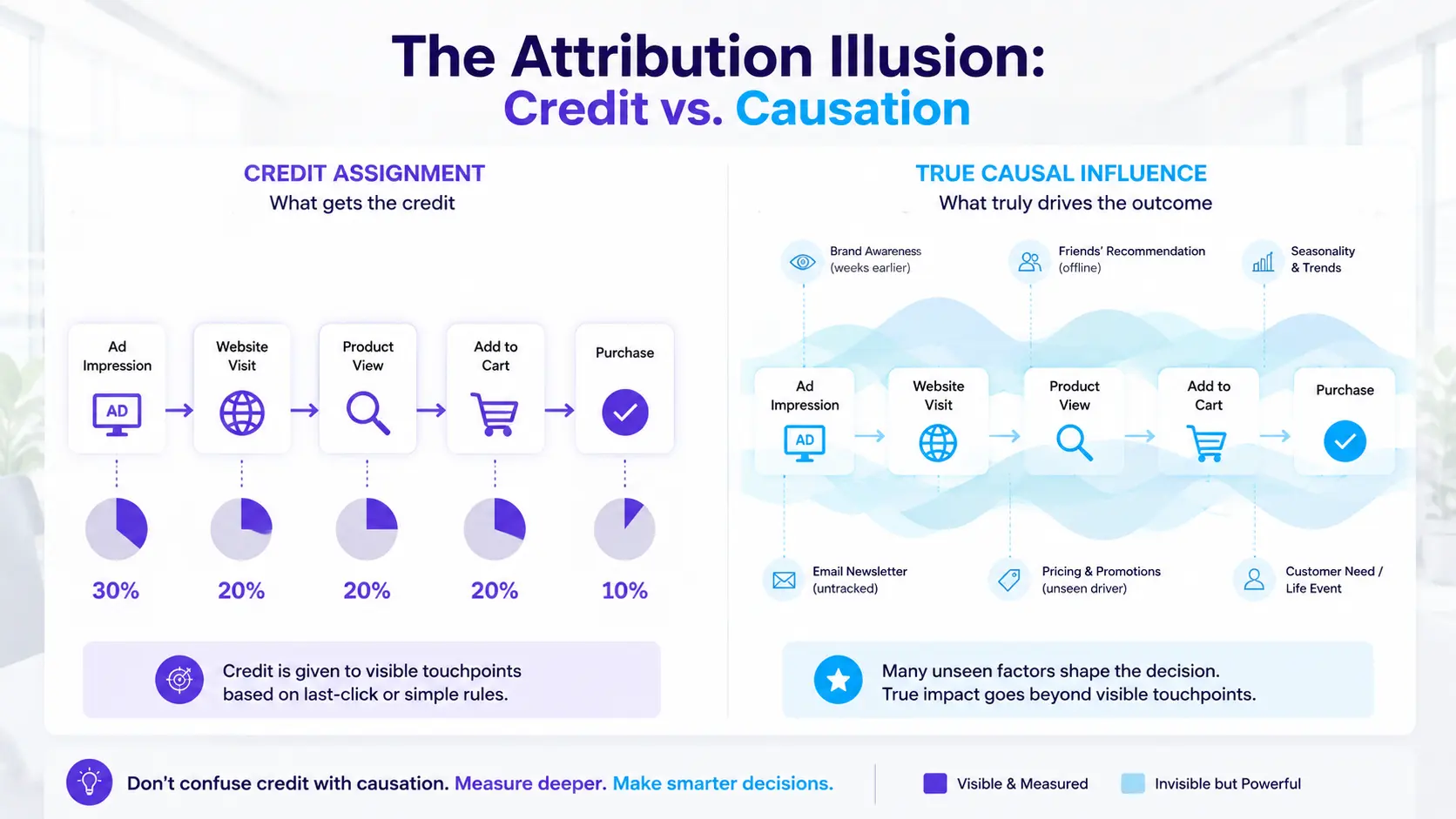
Attribution assigns credit, not causation means attribution models show which observed marketing touchpoints receive credit for a conversion, but they do not prove which touchpoint actually caused the buyer to act.
Attribution can identify visible paths, channel presence, timing, and assigned contribution, but it cannot fully account for hidden influences such as brand memory, referrals, competitor activity, offline conversations, seasonality, identity gaps, or buyers who would have converted anyway.
Treating attribution as proof can misdirect budget toward measurable touchpoints instead of true growth drivers.
Strong analytics uses attribution as a signal for questions, experiments, holdout tests, and counterfactual analysis, not as a final verdict.
Key Takeaways
- Attribution models assign credit based on observed touchpoints but do not establish real causation, which can mislead business investments.
- Data fragmentation and identity issues significantly erode the reliability of attribution results and foster a false sense of precision.
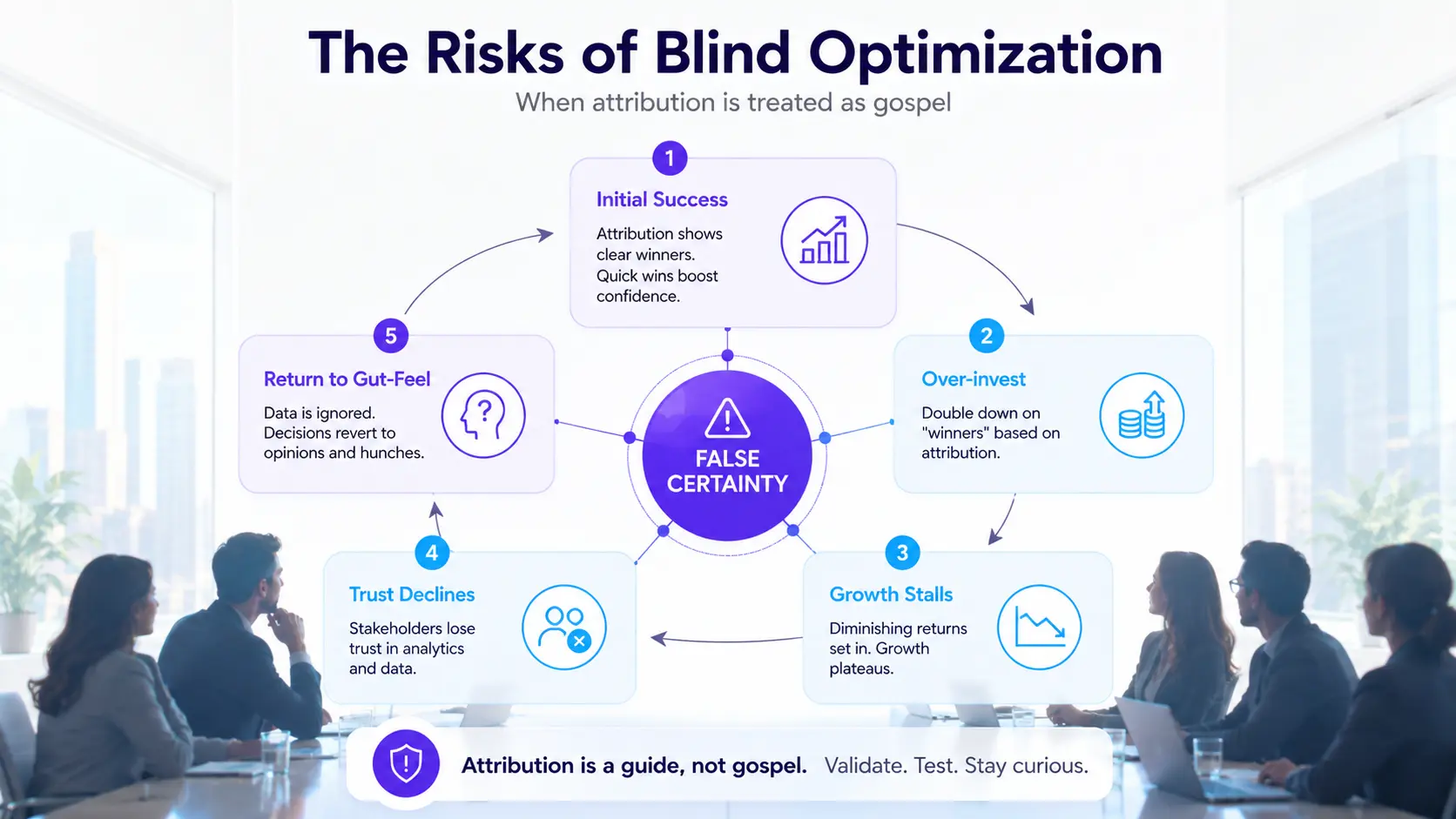
- Over-reliance on attribution as decision proof can cause resource misallocation, plateauing performance, and declining trust in analytics.
- Effective strategies use attribution as a signal to guide further hypothesis testing and real-world experimentation to reveal true performance drivers.
Most executives trust attribution dashboards because numbers appear exact – right down to decimals of “credit” per channel.
But attribution assigns credit, not causation.
The difference?
Credit shows where the dots were connected; causation reveals what actually moved the needle.
If you treat them as the same, you could be spending millions to double down on noise over signal.
That broader pattern is clearer in Analytics & Attribution.

Why attribution models feel precise but often mislead
Here’s the myth: if your model says “paid search gets 37% credit”, that means search drove 37% of your revenue.
In actual client reviews, we’ve seen channels earn the lion’s share of credit just by showing up last, not because they were essential.
Assigning credit is like handing Olympic medals to anyone who crossed the finish line, whether or not they ran the whole race.
How assigning credit differs from understanding influence
Key Differences Between Credit and Influence
- Credit indicates where touchpoints appeared in the journey
- Influence shows what actually caused the outcome
- Allocation of credit can be misleading if based on presence alone
- True influence requires causal analysis beyond correlation
- Treating credit as influence risks optimizing on noise, not signal
That gap is invisible when you look at the surface.
One global client’s retargeting received 50% of conversions in the report – until we isolated users who’d have bought anyway.
The apparent influence collapsed.
Ask yourself: if a touchpoint gets credit for being present, does that mean it caused the outcome, or was it just standing nearby when the sale happened?
If you want a mental shortcut: attribution describes footprints, not the force behind each footstep.
Correlation is not cause – a point that analytics teams love to repeat until everyone nods and promptly ignores it.
The real cost of ignoring this distinction?
You build strategies on stories that feel logical but don’t survive direct scrutiny.
Why correlation-based results fail in decision-making
Correlation-based attribution turns out tidy charts, but tidy charts don’t reveal levers – they just announce guests at the party.
In practice, observational data can’t distinguish between “was present” and “was decisive”.
We’ve encountered scenarios where branded search looks dominant purely because lower-funnel touchpoints are easier to track – not because they created demand.
One retail client shifted half their budget to the “highest-converting” channel, only to see growth stall.
Why?
The model rewarded what was observable, not what was causal.
Here’s the analogy: optimizing based on correlation is like trying to predict tomorrow’s weather by counting umbrellas – convenient but misleading.
What’s missing from the report are the silent factors: competitor promotions, seasonality, economic news.
Ask: how often are you making strategic bets based on what you can see, instead of what actually shifts outcomes?
If there’s one insight: Attribution models give a seat assignment, not a driver’s license.
Treating them as proof means decisions rest on a fragile foundation.
If confidence in attribution feels off the charts, that’s the signal something important is being missed.
The seductive precision of attribution is a mirage – what matters for leaders is moving from pretty charts to the real drivers behind revenue.
In the next section, we’ll look at exactly where attribution falls apart in practice.

Where attribution systematically breaks down in practice
Most dashboards promise precision, but the reality is more like staring through a dirty window – you’re seeing shapes, not certainties.
The appeal of exact “credit” numbers vanishes the moment you ask: where does that number actually come from, and what did we really capture?
Let’s crack open why attribution fails long before strategy – at its foundations.
Common Breakdown Points in Attribution
| Risk | Description | Consequence |
| Misaligned optimization | Shifts budget to channels credited by model rather than truly effective ones | Wasted spend and plateaued conversion growth |
| Eroding trust | Leaders lose faith in analytics when outcomes don’t match attribution claims | Skepticism, political use of data, and return to gut feel decisions |
| Fragile decision foundation | Confusing correlation for causation | Strategy rests on misleading analysis and false confidence |
Data and identity fragmentation undermines accuracy
It’s easy to underestimate how much a single broken link in user data distorts your entire story.
One executive client was convinced their retargeting efforts dominated pipeline impact, only to discover half of conversions were disjointed from actual ad exposure due to identity mismatches.
The myth that data gaps are just minor noise erodes the signal far more than most leaders want to admit.
Fragmented data isn’t a bug, it’s built in: imagine assigning credit for a football goal when half the players are wearing masks or have swapped jerseys at halftime.
Even “resolved” IDs collapse across devices, channels, or consent changes.
How can you be sure which touchpoints were seen, let alone influenced a decision, when your source records are stitched together by inference and luck?
Are those missing journey steps a rounding error – or the invisible force behind your best results?
The more data fragmentation multiplies, the less confident you can be in any downstream performance claim.
The real pitfall isn’t just incomplete numbers.
It’s the false confidence they create.
Complex journeys and hidden external drivers
Attribution models crave straight lines.
Real buyers live chaos.
One B2B project traced twenty-four touchpoints – but the deal was clinched at an offsite after a key decision-maker saw a press story nobody was tracking.
We’ve watched teams optimize for “proven” ad paths while never seeing the external trigger that truly tipped the scale.
Attribution assumes that what’s observable is all that matters, but entire motivations run outside of click trails.
How many of your results hinge on a competitor’s pricing change, a supply chain hiccup, or a rogue social post no model can see?
Causal inference gaps aren’t exceptions – they’re the structural flaw.
Treating attribution results as strategic directives is like only looking at what’s under a streetlamp and ignoring the rest of the map.
When paths twist, loop, or cross invisible bridges, credit assignments lose meaning fast.
True clarity emerges only when leaders accept the severe limits baked into both the data and the journey.
Attribution’s main failure isn’t the number – it’s pretending that number could ever reveal the full picture.

What risk do you run by treating attribution as truth?
Most companies aren’t overspending on bad channels – they’re optimizing the wrong ones with absolute confidence.
The real trap isn’t waste.
It’s certainty built on shaky ground.
Attribution feels like X-ray vision, but it’s closer to a funhouse mirror: what looks sharp often distorts what matters most.
That illusion drives costly mistakes that compound over time.
Risks of Treating Attribution as Truth
| Issue | Description | Impact |
| Data and identity fragmentation | User data gaps cause misattribution due to fragmented or mismatched identity signals | False confidence and distorted credit assignment |
| Complex customer journeys | Many touchpoints and external unseen factors can’t be tracked or attributed | Credit given to observable but not causal events |
| Hidden external drivers | Factors like competitor actions or economic changes are not visible in data | Misleading attribution focusing on measurable but irrelevant factors |
Misaligned optimization and wasted investment
Shift the budget toward whatever the dashboard credits this quarter.
That’s the pattern we see too often: last-click reports show retargeting “winning”, so spend accelerates, but total conversions plateau.
The result?
Critical early-stage and mid-funnel activities get starved.
Paid search jumps in spend while high-value, awareness-driving work gets left behind – simply because the model can’t see long-term influence.
We’ve watched a client triple social spend based on an attribution spike, only to have acquisition costs quietly creep higher every month.
Here’s the myth executives buy: attribution assigns credit, so reallocating dollars will scale results.
Reality?
The model only recognizes what’s visible at the finish line.
What if the unseen drivers – like a critical product review, a referral, or a competitor promotion – aren’t even in the data?
Relying solely on attribution can turn portfolio management into a guessing game dressed as science.
If you treat attribution numbers as gospel, it’s like planting your flag in the sand at low tide.
Resources flow toward what seems measurable, not what truly moves the market.
How do you know you’re not quantifying shadows?
Eroding trust in analytics and decision systems
False precision isn’t harmless – it stains credibility.
We’ve seen leadership teams cheer “data-driven” pivots, only to discover next quarter that lift was an illusion.
The impact?
Not just wasted budget, but growing skepticism toward analytics and anyone who advocates “following the numbers”.
When attribution repeatedly fails to deliver on its promises, a more dangerous drift sets in: decision makers stop trusting their analytics teams altogether.
Every subsequent report is viewed through a lens of suspicion.
Analysts learn to soften findings or omit inconvenient uncertainties.
Culture shifts from using analytics to sharpen thinking to seeing it as a political tool – or worse, performative theater.
Attribution’s false confidence doesn’t just burn capital.
It burns the trust that makes any system work.
Inconsistent results erode buy-in, breed cynicism, and push organizations toward gut feel – undoing years of investment in measurement.
It’s like having a compass that occasionally points south and hoping no one notices.
Treating attribution as fact is a seductive shortcut.
But the price is a cycle of wasted spend and eroding belief.
The next section explains how to break that loop – by reframing attribution as a signal, not a verdict.

How to reframe attribution as one input, not a verdict
Most strategy meetings stall for one frustrating reason: leaders stare at attribution charts, confident that the percentages on screen are the whole truth.
The hidden risk?
Using attribution like a verdict – when, at best, it’s a signal flare.
Once you treat correlation as causation, the room stops asking “what really drove this?” and starts following the numbers blindly.
That never ends well, especially when real influence stays just offstage.
Combine attribution with counterfactual thinking and experimentation
The habits that separate high-impact teams from industry average aren’t about better pie charts – they’re about asking the next uncomfortable question.
If your report says “display drove 23% of conversions”, consider what didn’t happen: what if you’d shut off display entirely, or doubled its budget?
Real causality comes from a collision of attribution data and counterfactual tests – not from trusting neat slices of credit.
Best Practices for Using Attribution Effectively
- Treat attribution as a signal, not proof of cause
- Use counterfactual questions to test “what if” scenarios
- Run experiments to validate or invalidate attribution insights
- Avoid snap decisions based solely on attribution percentages
- Integrate attribution with structured testing for informed strategy
We’ve watched clients run simple experiments that instantly shattered their attribution model’s story.
In one case, pausing a ‘top performer’ channel – one credited with a third of sales – barely moved the bottom line.
The lesson: observational data points, not proof.
Without structured experimentation, you end up confusing footprints for intent.
Attribution feels satisfying because it divides the loot.
But discovery demands friction.
Counterfactuals (“what if we did X instead?”) and direct tests add the real weight to strategy decisions – the numbers by themselves are like reading a weather forecast and betting your quarter on clear skies.
Would you stake your P&L on that?
Use attribution to inform hypotheses, not drive decisions
Attribution assigns credit, not causation.
That’s more than semantics – it’s the air gap between diagnostic intelligence and operational certainty.
In the real world, acting on attribution as the final answer means you’re defining reality by spreadsheet, while the market keeps changing its script.
Instead, treat each assignment of credit as a prompt – a place to probe, test, and learn.
We see the best results when leaders use attribution to sharpen which questions to ask, not to justify snap reallocations or budget cuts.
One analogy sticks: attribution is a magnifying glass for curiosity, not a set of marching orders.
What question could you ask next, if attribution wasn’t the finish line but the starting gun?
That’s how you replace false confidence with clear-eyed direction.
The heart of actionable strategy: use attribution to surface what to investigate, then lean on experimentation and counterfactual logic to uncover what really drives profitable outcomes.
Different models answer different questions, as explored further in Why Attribution Models Disagree.

Scientific context and sources
The sources below provide foundational context for how decision-making, attention, and performance dynamics evolve under scaling and constraint conditions.
- Attribution vs. Causation in Marketing Analytics
Marketing Analytics: Strategic Models and Metrics – Stephan Sorger – Pearson
Highlights the limitations of attribution models in distinguishing correlation from causation in real-world marketing and business data, reinforcing the caution against over-interpreting attribution outputs.
https://www.stephansorger.com/madrid.html - Observational Data and Causal Inference
Observation and Experiment: An Introduction to Causal Inference – Paul R. Rosenbaum – Harvard University Press
Explores the difference between correlational data and actual causal relationships, emphasizing why observational methods can produce misleading conclusions without careful causal design.
https://www.hup.harvard.edu/books/9780674241633 - The Problem of False Precision in Analytics
The Tyranny of Metrics – Jerry Z. Muller – Princeton University Press
Investigates the risks of over-trusting quantitative dashboard outputs and explains how false confidence in metrics can damage real decision quality and organizational performance.
https://press.princeton.edu/books/hardcover/9780691174952/the-tyranny-of-metrics - Biases in Decision-Making Under Uncertainty
Judgment Under Uncertainty: Heuristics and Biases – Daniel Kahneman, Paul Slovic, Amos Tversky (eds.) – Cambridge University Press
Foundational work on cognitive traps and the limits of surface-level data for complex decisions, supporting the distinction between apparent attribution and actual influence.
https://www.cambridge.org/core/books/judgment-under-uncertainty/6F9E814794E08EC43D426E480A4B412C - Identity Resolution and Data Fragmentation
Customer Data Platforms: Use People Data to Transform the Future of Marketing Engagement – Martin Kihn, Christopher O’Hara – Wiley
Explores fragmented identity data, cross-channel customer resolution challenges, and why attribution models break down when identity stitching is incomplete.
https://books.google.pl/books/about/Customer_Data_Platforms.html?id=odUGEAAAQBAJ&redir_esc=y
Questions You Might Ponder
Why does attribution assign credit but not prove causation?
Attribution models show where marketing touchpoints occurred in a customer journey but only reflect correlation, not true causality. This distinction is important because allocating credit based solely on presence can mislead strategies and direct investment away from what genuinely drives business outcomes.
How can relying on attribution models impact business decisions?
Businesses relying strictly on attribution models risk optimizing based on visible but potentially non-essential channels. This can cause misaligned budget allocations and stagnate growth, as real market drivers may remain unseen in the data, reducing the effectiveness of every dollar spent. That limitation becomes more important when the underlying data is incomplete: Why Analytics Loses Clarity When Visibility Is Constrained explains how privacy limits, tracking gaps, and platform restrictions narrow what attribution can reliably tell you.
What are common data issues that undermine attribution accuracy?
Data fragmentation and identity mismatches occur across devices or platforms, breaking the continuity of customer journeys. As a result, attribution claims become unreliable – numbers often rest on incomplete or poorly linked records, making business strategies vulnerable to false precision.
How should organizations use attribution in decision-making?
Companies should use attribution as an input to generate hypotheses, not as definitive proof for budget or strategy shifts. Combining attribution results with counterfactual thinking and structured experimentation allows organizations to discover actual causal drivers and invest more intelligently.
What risks arise from treating attribution reports as “truth”?
Treating attribution outputs as fact carries significant risks – organizations may shift investment to channels that appear successful but aren’t genuinely influential, eroding trust in analytics. This can foster internal skepticism, reduce data-driven culture, and lead to repeated resource misallocation.